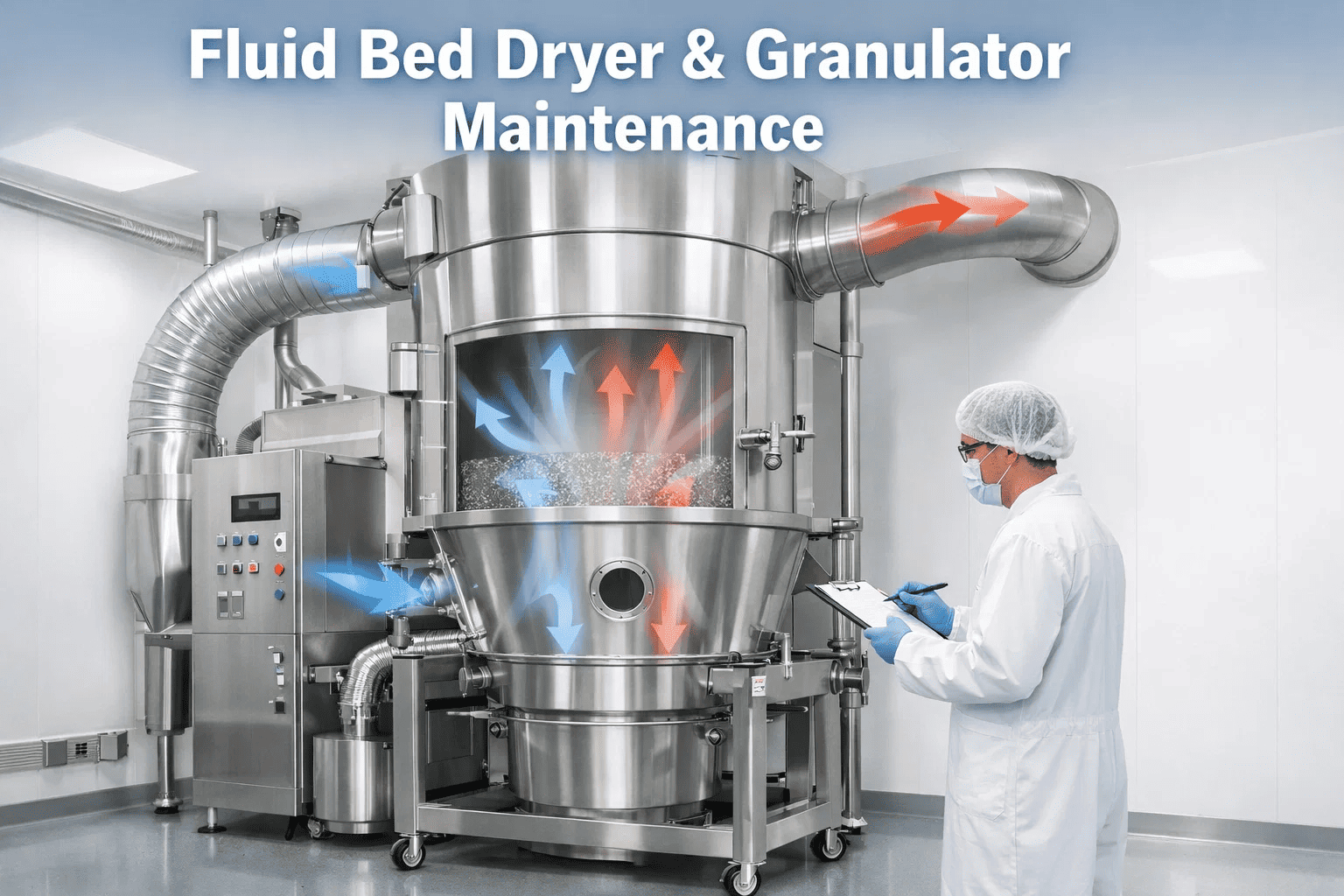
A clogged spray nozzle in a fluid bed granulator does not stop the batch immediately — it just starts producing uneven granules, excess fines, or wet clumping while the process looks normal on the control screen. Granulator nozzle maintenance tracking connects spray rate, nozzle inspection history, and filter bag condition to one equipment record, so drift in granule quality points straight back to the part that caused it instead of triggering a guessing game. Most granulation downtime traces back to a short list of mechanical causes that are fully preventable with routine checks. Here is what actually clogs a nozzle and how a connected CMMS keeps the spray pattern consistent.
Granule Quality Problems Usually Start at the Nozzle
Spray rate, nozzle diameter, and filter condition control granule growth and surface coating directly. A small clog or wear pattern shifts the whole batch before anyone notices on the readout.
How a Clog Develops Into a Batch Problem
Each stage below leaves a different signature in your process data.
Partial Nozzle Restriction
Binder residue or particulate buildup narrows the spray path, shifting droplet size without stopping flow entirely.
Uneven Spray Distribution
The spray no longer spreads evenly across the fluidized bed, creating localized over-wetting and under-wetting zones.
Granule Size Variation
Uneven liquid bridging produces a wider particle size distribution, increasing the fraction of out-of-spec fines or oversized granules.
Downstream Defects
Poor granule flow and compressibility surface later as tableting or capsule filling problems, far from the original cause.
See Nozzle and Spray Rate Tracking on a Live Granulator
Walk through how OxMaint logs nozzle cleaning intervals, spray rate settings, and filter bag condition tied to each granulation run.
The Parameters Worth Watching
Spray rate and nozzle position are the two settings that drift most often and matter most for granule consistency.
| Parameter | Typical Range | Risk If Out of Tolerance |
|---|---|---|
| Spray rate | 5-20 g per minute per kg of product | Sticking, defluidization, or excess fines |
| Nozzle diameter | Sized to binder viscosity and flow rate | Clogging or uneven binder distribution |
| Nozzle position | Set above bed height per process spec | Wall spray buildup, reduced fines collection |
| Atomization pressure | Set per droplet size target | Wide droplet distribution, irregular growth |
Maintenance Checks That Prevent Clogging
A short, repeatable inspection routine keeps spray performance inside spec.
Inspect and clean nozzle tip between batches to remove residue buildup
Verify nozzle position relative to bed height before every run
Check filter bags for blinding, thermal shrinkage, or discoloration
Confirm spray rate and atomization pressure against the validated setpoint
Choosing the right nozzle diameter is essential for granulation efficiency. A diameter that is too small clogs easily, while spray that does not spread evenly across the fluidized bed creates the exact inconsistency teams later misdiagnose as a formulation or binder issue.
Frequently Asked Questions
Stop Guessing Why Granule Quality Drifted
Track nozzle condition, spray rate, and filter health against every run so the next quality deviation points straight to its cause.