A fluid bed dryer running without a structured maintenance program is not a GMP risk waiting to happen — it is a GMP deviation already in progress. Clogged filter bags reduce airflow uniformity and cause moisture gradients that fail Loss on Drying specifications. A worn pneumatic shaking cylinder means filter bags accumulate powder between batches, creating cross-contamination events that trigger FDA 483 observations. A nozzle partially blocked by dried binder residue alters spray angle, changes granule particle size distribution, and invalidates the batch record. Every one of these failures is preventable. Start a free trial and connect your FBD and granulator fleet to a CMMS built for pharmaceutical process equipment, or book a demo to walk through a live GMP maintenance workflow with our pharma operations team.
Fluid Bed Dryer & Granulator Maintenance: The GMP Engineer's Complete Framework
From filter bag integrity to airflow calibration, nozzle condition to distributor plate inspection — structured FBD and granulator maintenance is the difference between a validated batch and a deviation report. Oxmaint keeps every PM on schedule, every inspection documented, and every work order audit-ready.
Connect Your FBD Fleet to a CMMS Built for GMP Process Equipment
No implementation fees. No minimum contract. Load your FBD asset records, configure PM intervals, and start generating GMP-ready maintenance documentation in under a week. Your QA team will thank you at the next audit. Take the first step — start a free trial or book a demo and walk through a live PM schedule with our team.
What a Fluid Bed Dryer Actually Does — and Why Every Component Is a Maintenance Priority
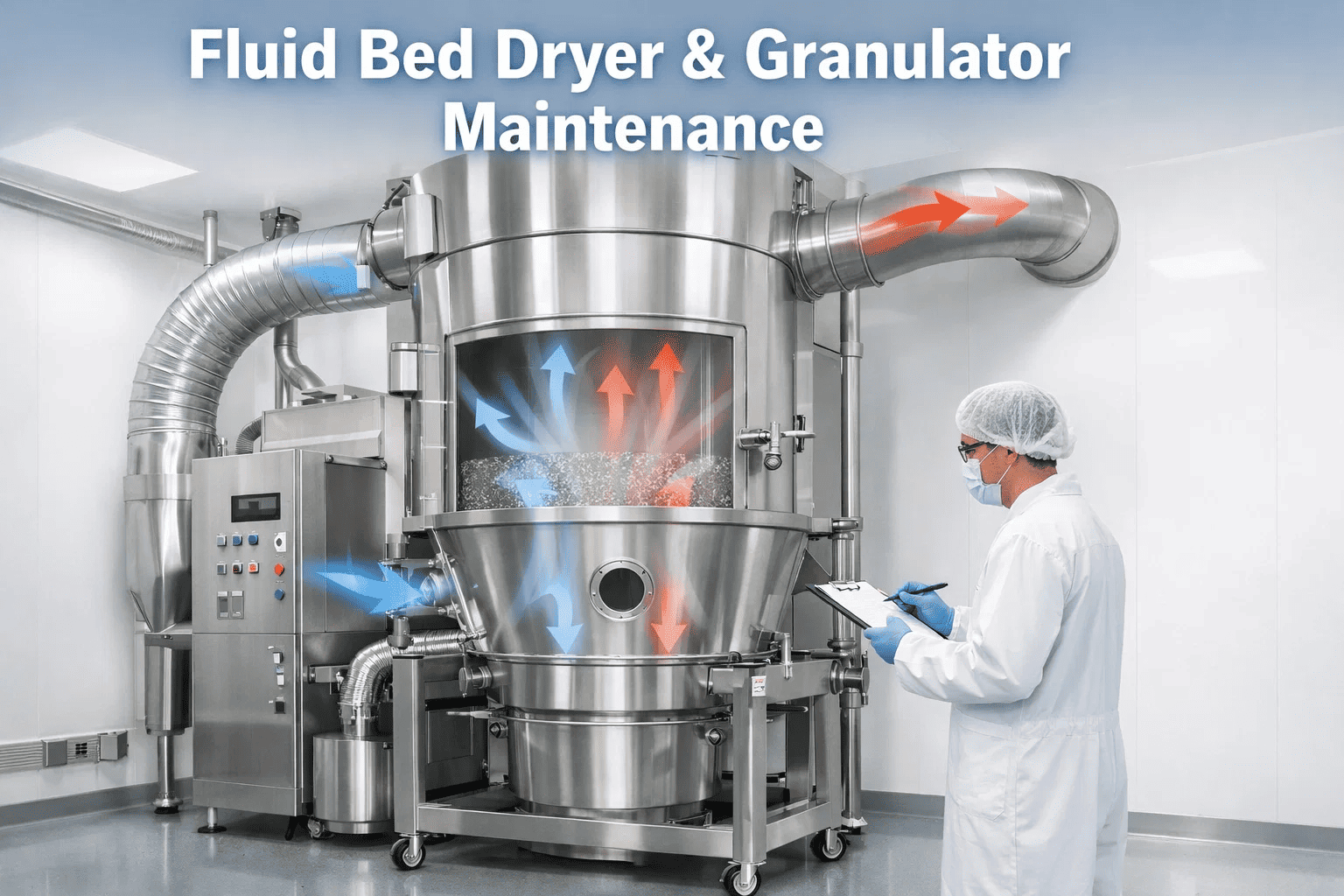
A fluid bed dryer suspends wet granules or powder in an upward stream of heated, HEPA-filtered air — creating a fluidized state where every particle is uniformly exposed to heat for rapid, consistent moisture removal. At 40–120°C inlet temperature with airflow velocity of 0.2–1.0 m/s, an FBD can dry a batch in 20–60 minutes that would take 4–8 hours in a tray dryer. Combined with a granulator in the same unit, it performs mixing, granulation, and drying in a single validated vessel.
The performance envelope is tight: moisture variation must stay within ±0.5%, temperature uniformity must hold to ±1°C across the chamber, and every surface contacting product must be clean, intact, and documented. When any component degrades — filter bag permeability, nozzle spray angle, distributor plate evenness, or gasket integrity — the process drifts out of spec before the batch record shows it. That is why FBD maintenance is a GMP imperative, not just an engineering convenience. See how Oxmaint tracks every parameter — start a free trial or book a demo to see your equipment modelled live.
The Four-Tier FBD Preventive Maintenance Schedule — What Gets Checked and When
- Inspect filter bags — check for tears, blockages, and seating integrity
- Verify inlet and outlet temperature calibration against BMR setpoints
- Check bowl-to-chamber gasket condition and clamp tightness
- Confirm pneumatic shaking cylinder operation before batch start
- Verify distributor plate is clean and free from granule accumulation
- Record LOD readings and compare against batch specification limits
- Clean FBD filters per SOP and inspect for porosity degradation
- Tighten all foundation and ducting clamps and electrical terminal connections
- Check all pneumatic pipes and valves for air leakage — replace if found
- Inspect product container trolley rollers for bearing wear
- Verify PLC interlock settings and alarm function tests
- Check filter bag hanger hooks for structural wear and corrosion
- Check filter bag shaking cylinder for air seal leakage — replace O-rings if found
- Inspect and clean steam strainers at inlet and outlet connections
- Check pneumatic cylinder piston O-rings and replace if compressed
- Verify explosion flap gasket condition and free movement
- Inspect butterfly valve O-ring for seating integrity and replace if worn
- Calibrate airflow meters and inlet air temperature sensors
- Replace all filter bags regardless of visual condition — documented changeover
- Full IQ/OQ/PQ requalification per equipment validation master plan
- HEPA filter integrity test (DOP/PAO challenge) with certification
- Exhaust blower bearing inspection and lubrication or replacement
- Full PLC firmware version review and 21 CFR Part 11 audit trail verification
- Comprehensive gasket set replacement across all product-contact seals
Every interval in this schedule should be tracked in your CMMS — not a spreadsheet. When the PM is due, the system generates a structured work order, assigns the technician, and captures the outcome with a digital signature before the equipment can be cleared for the next batch. Start a free trial and configure your first FBD PM schedule today, or book a demo to see the schedule builder in action.
Eight FBD Failure Modes That Trigger Batch Failures, Deviations, and FDA Observations
How Oxmaint Manages FBD and Granulator Maintenance Across Your Pharma Facility
Each FBD unit in your plant gets a structured asset record: equipment ID, manufacturer, model, serial number, filter bag specification, installation date, qualification status, and a complete PM and repair history. No more hunting through logbooks before an FDA inspection.
Configure PM triggers by batch count, calendar interval, or runtime hours. Oxmaint auto-generates work orders at the right interval, assigns the maintenance technician, and locks the equipment from batch release until the PM is signed off. GMP-compliant by design.
Technicians complete FBD pre-use checks on mobile — structured checklists covering filter bags, gaskets, nozzles, and airflow parameters — with photo capture, pass/fail scoring, and digital signatures. Every result timestamped and linked to the equipment record for audit.
Temperature sensors, airflow meters, and pressure gauges on FBD systems require periodic calibration. Oxmaint tracks calibration due dates for every instrument on every unit, fires alerts before expiry, and stores calibration certificates in the equipment record for ISO/FDA review.
When a technician flags a filter bag tear, a leaking gasket, or a blocked nozzle during inspection, Oxmaint generates a corrective work order immediately — with severity rating, parts needed, and assignment. The deviation is linked to the original inspection record for traceability.
Every PM, inspection, calibration, and corrective action is stored with timestamps, technician IDs, and digital signatures — structured for 21 CFR Part 211, EU GMP Annex 11, and WHO TRS 961. Generate a complete equipment maintenance dossier in minutes, not days.
Filter bags, O-rings, gasket sets, nozzle components, and pneumatic seals are tracked in Oxmaint's inventory module linked to the equipment they serve. When stock falls below minimum, a procurement request is triggered before the next PM cycle hits without parts available.
Pharmaceutical manufacturers operating multiple sites see every FBD and granulator's PM status, overdue maintenance count, calibration expiry, and open deviation work orders in a single dashboard. Standardize maintenance intervals and compare equipment performance across plants.
Paper-Based FBD Maintenance vs Oxmaint — The Operational Difference
| Maintenance Area | Without Oxmaint | With Oxmaint |
|---|---|---|
| Filter Bag Tracking | Change intervals tracked by memory or logbook entries. Bags run past service life, causing airflow restrictions that accumulate over batches. | Batch-count-based PM trigger. Work order auto-generated at interval. Replacement documented with lot number and technician sign-off. |
| Calibration Management | Calibration due dates on a wall calendar or shared spreadsheet. Expiry discovered during batch review — or during an FDA inspection. | Automated alerts 30 days before calibration expiry. Certificate stored in equipment record. Equipment locked from use if calibration lapses. |
| Deviation Linkage | Batch deviation raised separately from maintenance record. Root cause analysis requires manual cross-referencing of paper logs and batch records. | Corrective work order linked directly to the inspection finding that triggered it. Full traceability from deviation to resolution in one system. |
| Audit Preparation | 5–7 days assembling paper logbooks, calibration folders, and PM records before an FDA or customer audit. Gaps discovered during assembly. | Complete maintenance dossier per FBD unit generated in under 10 minutes. All records timestamped, signed, and structured for 21 CFR Part 211 review. |
| Nozzle Condition | Nozzle inspected when granulation PSD fails. Blockage has already run for unknown number of batches before detection. | Pre-batch nozzle inspection checklist prompts technician. Blockage caught before the run starts. No failed batches from preventable nozzle issues. |
| Multi-Site Oversight | Each site manages FBD maintenance independently. No portfolio-level visibility into overdue PM or equipment condition across plants. | All sites visible in one dashboard. Overdue PM, open deviations, and calibration expiry surfaced in real time for QA and engineering leadership. |
The gap between these two states shows up on your batch rejection rate, your audit findings list, and your maintenance overtime budget. To see what the transition looks like for your site, start a free trial or book a demo with our pharma operations team.
What Pharma Manufacturers Measure After Implementing Structured FBD Maintenance Programs
Facilities implementing structured FBD PM programs with pre-batch inspection sign-off report significant reduction in LOD-related and PSD-related batch failures within the first production year.
The industry benchmark for planned versus emergency maintenance cost differential. Every unscheduled FBD shutdown in pharma carries this multiplier — plus batch loss, deviation investigation, and revalidation costs.
Mobile work order management eliminates paper logbook handling, manual scheduling, and hunt-for-the-history time. Technicians spend more time on equipment and less time on administrative maintenance overhead.
Complete FBD maintenance dossier — all PMs, inspections, calibrations, and corrective actions — exported from Oxmaint for any date range, ready for FDA or customer audit review, in under 10 minutes.
FBD and Granulator Maintenance — What Pharma Engineers Ask Oxmaint
How should filter bag replacement intervals be determined for a pharma-grade FBD?
What documentation does Oxmaint generate for GMP compliance of FBD maintenance under 21 CFR Part 211?
Can Oxmaint track FBD-specific parameters like LOD readings, inlet temperature, and airflow data alongside PM records?
How does Oxmaint handle spare parts management for FBD consumables like O-rings, gaskets, and filter bags?
Your Next FBD Deviation Is Building Right Now — In the Log You're Not Looking At.
Oxmaint gives your biomedical and process engineering teams the structured PM scheduling, digital inspection records, calibration tracking, and audit-ready documentation to keep every fluid bed dryer and granulator in your facility running within spec — and compliant at every inspection. No implementation fee, no minimum contract. Configure your first FBD asset record and PM schedule in under a day. Start a free trial and connect your FBD fleet to a GMP CMMS today, or book a demo and see exactly how your maintenance program would run on Oxmaint.