A hospital runs on assets that can't be allowed to fail quietly — the chiller cooling an operating suite, the fridge holding a week's worth of vaccines, the generator that has to carry the building when the grid fails. A CMMS tells you when those assets are due for maintenance; IoT sensors tell you how they're actually doing, right now. Put the two together and maintenance stops being a calendar and starts being a response to the real condition of every critical asset — automatically. This guide covers how healthcare CMMS and IoT integration works, what it monitors, and what it automates. OXMAINT AI — the AI-powered maintenance management software — is where the sensor data becomes a work order.
Healthcare · CMMS & IoT Integration · Automated Maintenance · 2026
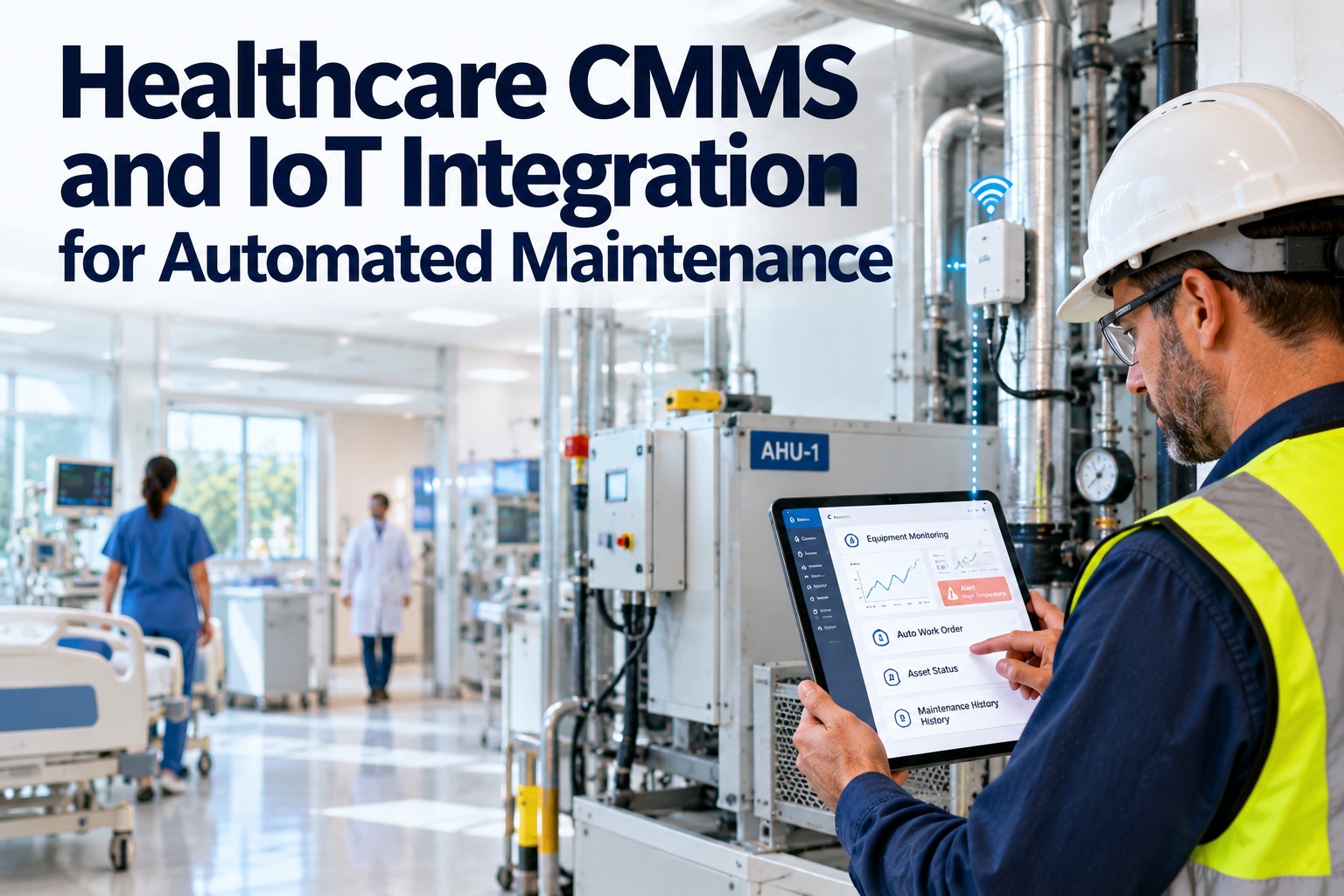
Healthcare CMMS and IoT Integration for Automated Maintenance
Sensors watch the condition; the CMMS turns it into action. Together they move hospital maintenance from a fixed schedule to an automatic response — alerts, work orders and compliance records driven by what the assets are actually doing. The OXMAINT AI maintenance management software is where the two meet.
Sense
Connect
Interpret
Act
Real condition
maintenance driven by how assets are doing, not just the calendar
Automatic
a reading crosses a line and a work order is raised on its own
Continuous
critical assets watched every minute, not sampled on a round
Documented
an unbroken record for compliance, built from the data itself
Why Hospitals Reach for This First
Healthcare raises the stakes on every part of maintenance — the assets are critical, the clock never stops, and the records are audited. That combination is exactly what CMMS and IoT integration is built for; book a demo to see it on your facility in OXMAINT AI.
Critical assets
A failed fridge or chiller isn't an inconvenience — it's spoiled medicine or a suite that can't operate.
No downtime window
A hospital runs around the clock, so catching a problem early is the only real way to avoid catching it late.
Audited records
Temperature logs, test records and maintenance history are all expected — continuous data makes them effortless.
Lean teams
Estates teams are stretched — automation covers the watching so people spend their time on the fixing.
The Integration Stack: Four Layers
CMMS and IoT integration is a stack — sensing at the bottom, action at the top, and each layer feeding the next. Here's how the data travels from an asset to a work order; start free and build the stack on OXMAINT AI.
Layer 1
Sense — IoT on the assets
Sensors on critical equipment read the things that change before a failure — temperature, humidity, pressure, vibration, power draw, runtime, differential pressure — continuously, around the clock.
Layer 2
Connect — data to the system
Gateways and the network carry those readings securely into the CMMS, so a reading taken in a plant room reaches the platform in moments — no clipboard, no manual entry.
Layer 3
Interpret — the CMMS makes sense of it
The CMMS checks each reading against thresholds and the asset's normal baseline, uses AI to spot a drift developing, and decides whether it's nothing, something to watch, or something to act on now.
Layer 4
Act — it becomes maintenance
When something needs doing, the system raises an alert and a work order — asset, reading and likely cause attached — routed to the right technician, and logs the whole event for the record.
What IoT Watches in a Hospital
The assets worth sensing are the ones where a silent failure costs most — and a hospital has more of them than most buildings. These are the usual targets; book a demo to map your critical assets in OXMAINT AI.
HVAC & air quality
Temperature, humidity and differential pressure — critical for operating rooms, isolation rooms and clean spaces.
Medical gas & vacuum
Line pressure on oxygen, medical air and vacuum, so a developing supply problem is seen before it reaches a ward.
Cold chain & refrigeration
Vaccine, blood, pharmacy and lab fridge and freezer temperatures, watched continuously against safe limits.
Power & generators
Generator runtime, load, fuel and battery, plus power quality — so backup is proven ready, not assumed.
Water systems
Water temperatures and flow for hygiene and Legionella control — the data behind a safe-water program.
Sterilizers & autoclaves
Cycle temperature, pressure and runtime, so sterilization equipment is monitored and serviced on real use.
A Sensor That Only Lights a Dashboard Is Half a Solution.
Plenty of systems will show you a red number on a screen. The value is in what happens next — and that only exists when the sensor is wired into the maintenance system. The OXMAINT AI maintenance management software turns the reading into a work order, routes it, and keeps the record, so monitoring actually ends in a fix.
What It Automates
Integration earns its keep in the work it takes off people's hands. These are the workflows that run themselves once the sensors and the CMMS are joined; start free and automate them in OXMAINT AI.
Condition-based work orders
A reading crossing a threshold raises a work order on its own — no one has to notice, decide and type it up.
Excursion alerts
A fridge drifting out of range or a gas line losing pressure triggers an immediate alert, in time to save the contents.
Compliance logging
Temperature and test records captured continuously and automatically, so the audit trail builds itself.
Usage-based PM
Preventive tasks scheduled on real runtime and condition, not a fixed date — so service matches actual wear.
Priority by criticality
Alerts ranked by how critical the asset is, so an OR chiller outranks a minor drift on a spare unit.
Early-warning trends
Slow drift surfaced as a trend, so failures are caught weeks ahead instead of discovered at breakdown.
How OXMAINT AI Brings It Together
The whole point is one system where sensing, interpreting and acting connect. Here's what the OXMAINT AI maintenance management software brings to CMMS and IoT integration; start free and run it on OXMAINT AI.
Sensor data in
Readings from IoT sensors and meters pulled in per asset, so condition is live, not a number from a round.
Threshold & AI alerts
A reading crossing a limit or drifting from baseline raises an alert at once, caught early rather than late.
Automatic work orders
Each alert becomes a work order with the asset, reading and likely cause attached, routed by priority.
Condition trends
Every reading trended per asset, so slow drift shows as a slope and failures are seen coming.
Automatic records
Temperature and event logs captured continuously, so compliance evidence is there without anyone keeping it.
Asset intelligence
Condition, history and work all on one asset record, so the full picture of every critical asset is in one place.
“
We had sensors on our pharmacy fridges and a separate maintenance system, and the two never spoke — a temperature excursion meant a frantic call and a manual work order, usually after the overnight drift had already done damage. Wiring the sensors into the CMMS changed the whole dynamic. Now a fridge drifting out of range raises an alert and a work order on its own, the temperature logs build themselves for our audits, and the team is reacting to real conditions instead of a fixed schedule. It's the difference between watching and actually doing something.
Head of Estates · Regional Hospital Group
Frequently Asked Questions
What is healthcare CMMS and IoT integration?
It's connecting IoT sensors on hospital assets to the maintenance system, so the condition data they capture — temperature, pressure, runtime and more — automatically drives maintenance: alerts, work orders, compliance records and scheduling. The CMMS provides the structure; the sensors provide the real-time condition.
Start free to see it work.
How does IoT make maintenance automatic?
Sensors read an asset's condition continuously; the CMMS checks each reading against thresholds and baselines; and when something needs attention, it raises an alert and a work order on its own, routed to the right technician and logged for the record. No one has to be watching a dashboard for the response to happen.
Book a demo to see the flow.
What hospital assets benefit most from sensors?
The critical ones where a silent failure costs most: HVAC and air quality for ORs and isolation rooms, medical gas line pressure, cold-chain fridges and freezers for vaccines and blood, generators and power, water systems for Legionella control, and sterilizers. These are where continuous monitoring turns a potential crisis into an early work order.
Does it replace preventive maintenance?
No — it sharpens it. Time-based PM still matters, but integration lets you add condition- and usage-based maintenance alongside it, so service is driven by real wear and real readings, not only the calendar. The result is fewer surprise failures and less unnecessary work on assets that don't need it yet.
How does it help with compliance?
Continuous sensor data means temperature logs, test records and maintenance history are captured automatically and kept against each asset — so the evidence a surveyor or auditor asks for is already there, complete and dated, instead of reconstructed from manual logs. The record builds itself as a by-product of the monitoring.
Stop Watching Dashboards — Let the Data Raise the Work.
Join your sensors and your maintenance system with the OXMAINT AI maintenance management software — live condition data, threshold and AI alerts, automatic work orders, condition trends and self-building compliance records. Move hospital maintenance from a fixed schedule to an automatic response to what your assets are actually doing.


.png)