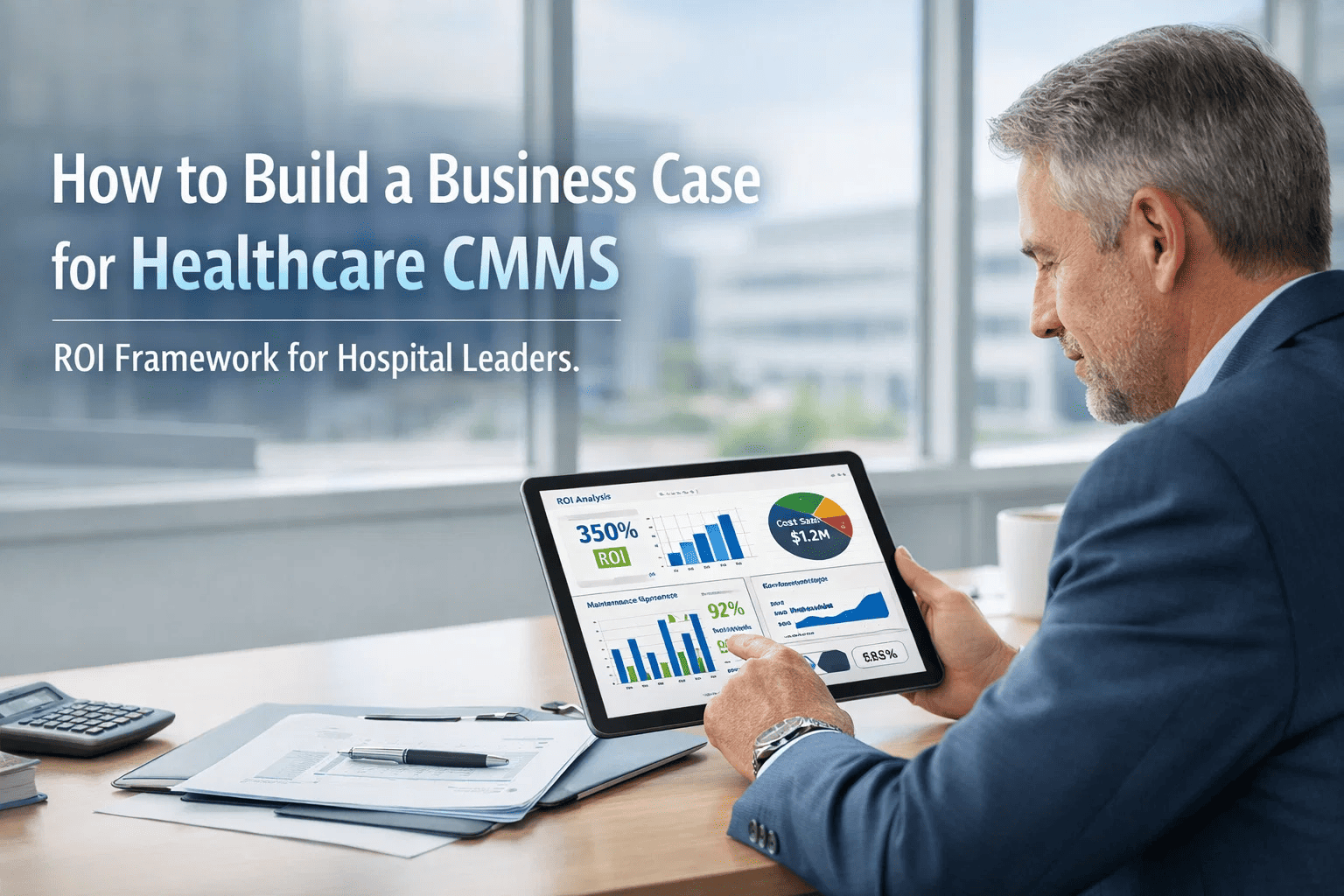
Hospital executives do not approve budgets on intent — they approve them on numbers. If you are a Facility Director or VP of Operations trying to get CMMS investment over the line, the challenge is not making the operational case. It is translating maintenance data into language the finance committee understands: payback periods, avoided costs, compliance risk exposure, and labor efficiency gains. A hospital spending $2.4M annually on maintenance in a reactive model typically reduces total spend to $1.68M under a CMMS-managed preventive model — a 30% cost reduction that funds the platform investment within 18 months. This guide gives you the exact ROI framework to build that case, step by step. Start a free trial to run these numbers against your own facility, or book a demo and we will walk through the model with you today.
What Is a Healthcare CMMS Business Case?
A CMMS business case is a structured financial document that justifies the capital investment in maintenance management software by quantifying avoided costs, productivity gains, compliance risk reduction, and asset lifecycle value. It is not a technical pitch — it is a CFO-ready financial argument that answers four specific questions with hard numbers.
What does the current maintenance model cost? What does the compliance risk exposure look like in dollar terms? How quickly does the investment recover? What does the 5-year financial picture look like? Take the guesswork out of every answer — start a free trial and use Oxmaint's built-in CapEx forecasting tools to pull your facility's data into a ready-to-present financial model today.
A hospital spending $2.4M annually on maintenance in a reactive model typically reduces total maintenance spend to $1.68M under a CMMS-managed preventive model — a 30% cost reduction that funds the platform investment within 18 months at average software pricing. This is the number your CFO needs to see first.
The 4-Pillar ROI Framework for Healthcare CMMS
Hospital finance committees respond to structured, auditable financial arguments. This four-pillar framework covers every ROI dimension your business case needs to address. Each pillar is independently quantifiable — which means you can present conservative, base, and optimistic scenarios for the same board presentation.
Calculate your facility's current unplanned downtime incidents per year, multiply by average cost per hour, and project the reduction achievable through preventive maintenance. A 28–35% downtime reduction is typical within 12 months of CMMS adoption.
Document your current ratio of reactive to preventive maintenance spend. Emergency repairs cost 4.8x more per incident. Shifting 40% of reactive volume to planned maintenance generates immediate, measurable savings without reducing maintenance coverage.
CMS penalties for documentation failures range from $2,000 to $100,000+ per incident. Joint Commission findings that trigger conditional accreditation can threaten reimbursement. CMMS eliminates the documentation gaps that generate these findings and their financial consequences.
Digital work order management reduces maintenance admin overhead by 35–41%. Condition-based asset tracking extends average equipment life by 18%, directly deferring capital replacement spend. Both translate into hard dollar savings against your annual budget.
Why Hospital Finance Teams Reject CMMS Proposals
Most CMMS proposals fail to win budget approval not because the investment is wrong — but because the financial case is built on operational language, not financial metrics. Here are the four most common reasons proposals are declined, and how to address each one before it reaches the committee.
Proposals without documented current maintenance spend — broken down by reactive vs. preventive, labor vs. parts — have no financial baseline to calculate savings against. Finance needs a "from" number before they will believe the "to."
CFOs think in payback periods. A proposal without a clear months-to-break-even calculation leaves the approver doing math they should not have to do — and that math rarely lands in your favor without the supporting data.
Saying "we have compliance gaps" is not the same as saying "our documentation exposure represents $240,000 in potential CMS penalties and conditional accreditation risk." One gets attention. The other gets tabled.
Year-one ROI alone rarely justifies enterprise software investment. Without a 3–5 year model showing compounding CapEx deferral, labor savings, and downtime reduction, the investment looks like a cost center rather than a value driver.
How to Build the Business Case: 8 Steps
Follow this sequence to produce a board-ready CMMS business case. Each step builds the financial narrative from current-state cost documentation through projected ROI and risk-adjusted payback period. If you want Oxmaint to walk through this with your actual facility data, book a demo and we will model your numbers together in a single session.
Pull 12 months of maintenance cost data from your finance system. Categorize spend into: reactive repair labor, planned maintenance labor, emergency parts procurement, contractor callouts, and compliance-related rework. This is your financial baseline — without it, no ROI calculation is credible to a finance committee.
The industry benchmark for reactive maintenance in hospitals without CMMS is 60–70% of total maintenance volume. Document your actual ratio. Every percentage point shifted from reactive to preventive represents a calculable dollar saving — typically $18,000–$45,000 per percentage point for a 200-bed hospital.
For each critical system failure event in the last 12 months, document: duration, affected departments, revenue impact, and staff redeployment cost. Sum the total. Then project what a 30% reduction in failure frequency would save. This number alone often exceeds the 3-year CMMS platform cost.
Review your last three audit cycles. Count maintenance-related findings. Map each to its potential CMS, Joint Commission, or OSHA penalty range. Multiply by your probability estimate. For most facilities, this produces a risk-adjusted annual exposure of $150,000–$500,000 — a compelling argument for any CFO.
Estimate the percentage of maintenance team time currently spent on paperwork, manual scheduling, work order chasing, and reporting. CMMS typically reduces this administrative burden by 35–41%. Multiply recovered hours by your fully-loaded maintenance labor rate to produce an annual labor efficiency value.
Identify your 5 highest-value assets due for replacement in the next 3 years. Model what an 18% extension in useful life — the documented outcome of condition-based maintenance — would save in deferred capital spend. For a hospital with $8M in near-term replacements, 18% deferral equals $1.44M in avoided CapEx.
Sum all value streams: downtime avoidance + reactive cost reduction + compliance risk mitigation + labor efficiency + CapEx deferral. Plot year-by-year against CMMS platform cost including implementation and training. The crossover point is your payback period. Present conservative, base, and optimistic scenarios.
Finance committees distrust single-point ROI estimates. Show what happens to your payback period if you achieve only 50% of projected savings. If the investment still breaks even within 24 months under the pessimistic scenario, your business case is bulletproof. Ready to model it? Start a free trial and run your facility's numbers inside Oxmaint today.
How Oxmaint Supports Each ROI Pillar
Every pillar in the business case framework maps directly to a capability inside the Oxmaint platform. This is not a generic CMMS — it is built for multi-site commercial and healthcare operations where financial accountability is non-negotiable. Here is how the platform delivers on each value stream.
Calendar, runtime, and cycle-count PM triggers auto-generate work orders before failure occurs. The primary driver of downtime cost avoidance — your largest single ROI value stream.
Rolling 5–10 year capital plans built on real asset condition scores. Replaces spreadsheet guesswork with data-driven deferral analysis your CFO can put in a board deck.
Every maintenance action timestamped with digital signatures. Compliance finding risk drops to near-zero when your documentation is structurally complete and permanently accessible.
Mobile-first work order routing, technician assignment, parts logging, and completion tracking. Cuts administrative overhead by 35–41% and reduces mean time to repair by up to 35%.
Sensor data triggers maintenance before threshold breach. Condition-based maintenance is 50% more effective at preventing critical failures than time-based scheduling alone.
Cross-site maintenance performance dashboards for VPs and asset managers. Turns maintenance data into capital allocation decisions — in real time across your full network.
Real-time parts stock with auto-reorder at minimum thresholds. Eliminates emergency procurement premiums — a direct line item saving of up to 22% on parts spend annually.
Every asset scored and tracked from purchase to end-of-life. Condition scores feed your CapEx model directly, giving finance the evidence base to approve deferrals with confidence.
Before CMMS vs. After CMMS: The Financial Picture
This comparison uses benchmark data from healthcare facilities that transitioned from reactive to CMMS-managed maintenance. These are not projections — they are documented outcomes from real hospital operations, presented in the format your finance team will recognize.
| Financial Metric | Before CMMS | After CMMS — Oxmaint |
|---|---|---|
| Reactive Maintenance Share | 60–70% of total maintenance volume | Under 30% — systematic PM prevents failures before they occur |
| Emergency Repair Cost Premium | 4.8x per incident vs. planned repair cost | Incidents reduced 40% — premium cost exposure drops sharply |
| Compliance Audit Findings | Avg. 3–6 maintenance-related findings per cycle | Near-zero findings — complete signed digital records on demand |
| Mean Time to Repair (MTTR) | Avg. 72 hours for non-emergency work orders | Resolution time cut 35–45% through digital work order routing |
| CapEx Planning Accuracy | Budget variance of 20–40% on capital replacements | Data-driven forecasts with 5–10 year rolling condition models |
| Admin Labor on Maintenance | 35–45% of team time on paperwork and scheduling | Admin burden cut 41% — hours redirected to preventive tasks |
| Parts Procurement Cost | Emergency procurement at 25–40% cost premium | Controlled inventory — 22% annual parts cost reduction achieved |
| Asset Useful Life | Assets replaced at nominal end-of-life on schedule | Condition-based tracking extends useful life by 18% on average |
The Business Case for Healthcare CMMS in Numbers
These figures represent composite ROI outcomes across healthcare facilities that implemented a structured CMMS. Use them as benchmark inputs when building the financial model for your own leadership team.
CMMS ROI Drivers by Healthcare Market
The financial case for CMMS investment varies in emphasis across markets — but the underlying ROI is compelling in every region. Here is how the primary value driver shifts by geography for your executive audience. Regardless of your market, book a demo to see how Oxmaint's ROI model adapts to your region's specific compliance and cost context.
With CMS star ratings and accreditation status tied directly to documentation quality, US hospitals face the highest compliance-driven ROI case. A single conditional accreditation event can trigger $2M+ in reimbursement risk.
NHS facilities face Health Technical Memoranda compliance requirements across medical gas, ventilation, and electrical systems. CMMS documentation is increasingly expected by CQC inspectors as evidence of systematic maintenance governance.
Australia's elevated maintenance labor rates make every hour of admin efficiency gained through CMMS worth substantially more in dollar terms. The labor efficiency pillar alone often drives a sub-12-month payback for Australian hospital groups.
UAE hospital operators building under smart facility standards require IoT-integrated maintenance platforms. CMMS with SCADA integration is a compliance requirement for new builds under Dubai Health Authority guidelines — making ROI both operational and regulatory.
Your CFO Is Waiting for the Numbers.
Oxmaint gives your team the platform to capture every value stream documented in this guide — and the CapEx forecasting tools to show your leadership team the 5-year financial picture from day one. No long implementation. No heavy fees. Live in weeks, not months.
Frequently Asked Questions
The questions hospital executives ask most when evaluating CMMS investment — answered with the same rigor you need to present to your own leadership team.
What is a realistic payback period for healthcare CMMS investment?
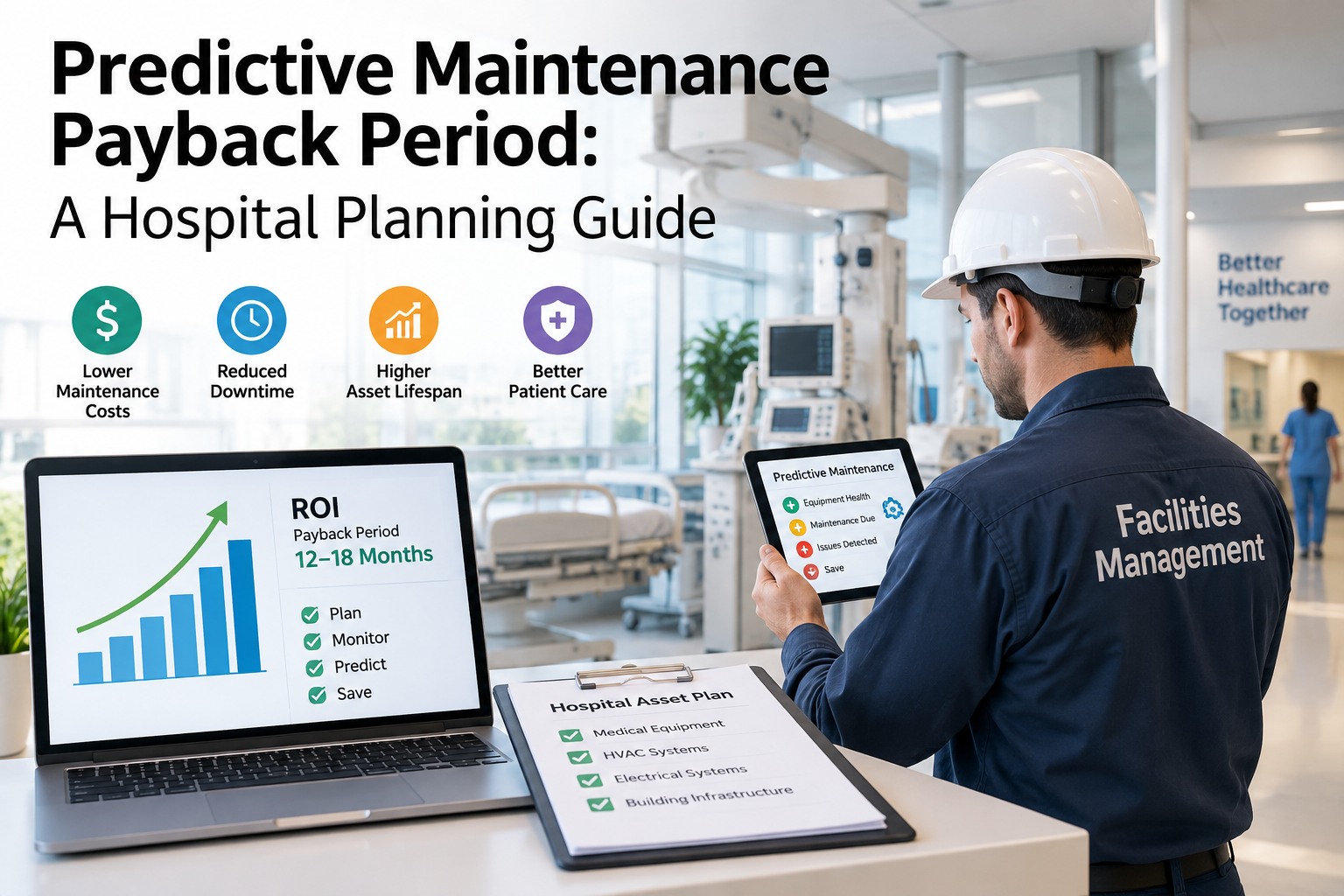
For most hospitals, the payback period falls between 12 and 24 months, with 18 months being the benchmark average across facilities of 150–400 beds. The payback accelerates when the facility has a high reactive maintenance ratio — because the cost gap between emergency and planned repairs is the fastest ROI driver. For facilities with pending accreditation reviews or active CMS findings, compliance risk mitigation can compress payback to under 12 months when regulatory penalties are included in the model. Start a free trial to model your specific payback timeline inside Oxmaint.
How do I calculate the cost of our current reactive maintenance model?
Start with your maintenance general ledger from the past 12 months. Categorize every maintenance cost line into: planned preventive maintenance labor, reactive repair labor, emergency contractor callouts, emergency parts procurement, and compliance rework. The reactive categories represent your addressable cost base. Multiply your total reactive repair cost by 0.79 to produce your conservative annual savings estimate from shifting 40% of reactive volume to planned. Most facilities find this exercise surfaces 15–25% of total maintenance budget as immediately addressable savings.
How do we quantify compliance risk in dollar terms for the business case?
Use a three-step approach: First, review your last three audit cycles and identify maintenance-related findings. Second, map each finding category to its regulatory penalty range — CMS documentation violations range from $2,000 to $100,000+, while Joint Commission findings can trigger conditional accreditation status that puts CMS reimbursement at risk. Third, apply a probability factor — typically 15–35% per year for facilities with ongoing documentation gaps — to produce a risk-adjusted annual exposure. For most hospitals with paper-based maintenance records, this produces an exposure figure between $150,000 and $500,000. Book a demo to see how Oxmaint's compliance reporting module eliminates this exposure systematically.
What implementation costs should be included in the business case?
A complete CMMS business case should include: platform subscription cost (annual), one-time data migration and setup labor (internal staff hours), technician training time (typically 4–8 hours per technician), and any IoT or SCADA integration costs if real-time condition monitoring is in scope. Oxmaint is designed for rapid deployment without heavy implementation fees — most facilities are fully operational within 2–4 weeks using internal resources. This lean deployment model positions the payback period favorably versus enterprise CMMS alternatives that carry $50,000–$200,000 in implementation costs before the first PM is scheduled.
Every Pillar Quantified. Every Number Defensible.
You now have the framework. The business case for healthcare CMMS is not a matter of if — it is a matter of building the model correctly and presenting it in financial language. Oxmaint gives your team the platform to capture every value stream in this guide and show your leadership the 5-year financial picture from day one. No long implementation. No heavy fees. Live in weeks, not months.
No credit card required. 30-day free trial. Cancel anytime.

.jpeg)