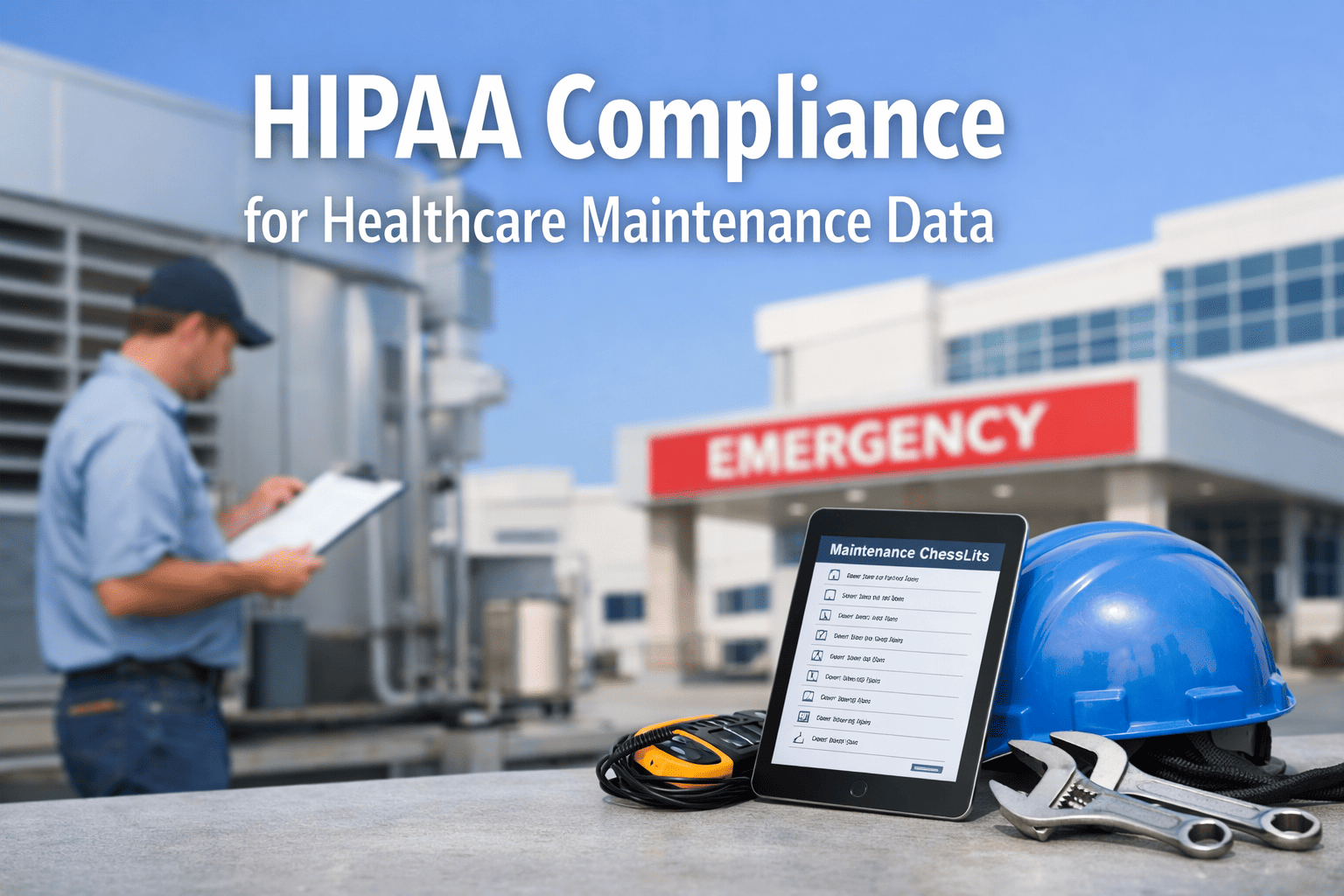
A single HIPAA breach involving unsecured maintenance access records at a US hospital carries a maximum civil penalty of $1.9 million per violation category — and the OCR audit trail begins with whether your CMMS documented who accessed patient-area equipment, when, and under what authorization. Healthcare facilities managing connected medical devices, patient wing access logs, and biomedical equipment service records on paper or disconnected spreadsheets carry compounding liability with every maintenance cycle. Oxmaint closes that gap — connecting field documentation to a HIPAA-aligned, audit-ready record automatically. Book a demo to see how Oxmaint structures HIPAA-compliant maintenance data management for your hospital operations.
HIPAA compliance for hospital maintenance operations requires documented control of four data categories: patient-area physical access logs for maintenance personnel, connected medical device service records, biomedical equipment calibration and repair documentation, and contractor credential verification before facility access. Oxmaint digitizes every record — with role-based access controls, audit trails, and OCR-ready export — closing the documentation gap that triggers HIPAA findings before the next inspection.
The Four Compliance Exposure Points in Hospital Maintenance Operations
Each carries a distinct HIPAA regulatory obligation and a distinct failure mode when managed outside a controlled digital system. Book a demo to see how Oxmaint addresses all four in a single deployment.
Every maintenance technician entering an ICU, OR corridor, patient wing, or pharmacy must have their access logged with identity, time, authorizing work order, and escort status where required. Paper sign-in sheets are not auditable, not searchable, and not defensible under OCR review. Oxmaint generates a timestamped, identity-linked access record for every patient-area work order — automatically, without manual transcription.
Infusion pumps, patient monitors, imaging systems, and networked diagnostic equipment are ePHI-adjacent assets. Service records, firmware update logs, and repair documentation must be retained with access controls matching the device's data classification. Oxmaint links every biomedical work order to the specific device asset record — with technician credentials, parts used, and post-service functional verification captured at the point of work.
Ventilators, defibrillators, anesthesia machines, and diagnostic equipment require scheduled inspection and calibration documentation — with records retained per Joint Commission and CMS standards. Equipment that cannot produce a current, complete calibration record at survey is cited as an immediate jeopardy finding. Oxmaint manages the calibration schedule, captures results at the device, and generates the complete inspection history on demand for surveyor review.
Third-party biomedical technicians, HVAC contractors, and facilities vendors working in clinical areas must have current credential verification, HIPAA training certification, and business associate agreement status confirmed before access is granted. Manual gatehouse registers and email-based credential tracking create unacceptable gaps in the BAA compliance chain. Oxmaint tracks every contractor's credential currency and blocks work order activation until compliance is confirmed.
Every Access Log. Every Device Record. Every Contractor Credential. Captured Automatically.
Oxmaint generates HIPAA-aligned maintenance records at the point of work — not reconstructed before the auditor arrives. Book a demo to see the compliance workflow for your hospital's patient-area and biomedical operations.
HIPAA Compliance Coverage by Maintenance Data Category
Oxmaint structures maintenance documentation against the specific HIPAA safeguard categories that OCR auditors review — not generic work order management.
| HIPAA Safeguard | Hospital Maintenance Obligation | Paper/Legacy Risk | Oxmaint Coverage |
|---|---|---|---|
| Physical Safeguards §164.310 | Patient-area access log with identity, timestamp, and work authorization for every maintenance entry | Unlinked sign-in sheets with no work order reference — not defensible under OCR review | Timestamped, identity-linked access record per work order — auto-archived against asset and area |
| Technical Safeguards §164.312 | Access controls and audit logs for maintenance personnel accessing networked clinical device management systems | Shared login credentials and no activity logging — HIPAA Technical Safeguard violation | Role-based access, individual technician login, full activity audit trail in Oxmaint — exportable for OCR |
| Administrative Safeguards §164.308 | Business associate agreement currency verification and HIPAA workforce training records for all maintenance staff and contractors | BAA status tracked in email threads — no real-time verification at point of access | BAA status and HIPAA training currency tracked per contractor — work order blocked until compliance confirmed |
| Device and Media Controls §164.310(d) | Documentation of maintenance activities involving hardware containing or connected to ePHI — including disposal, repair, and replacement records | Repair records in disconnected spreadsheets — no chain-of-custody documentation for ePHI-adjacent hardware | Full service history per connected device with technician identity, parts, and functional verification captured at work execution |
Compliance KPI Benchmarks — Hospital Maintenance Operations
Oxmaint vs Competing CMMS Platforms — Healthcare Compliance Capabilities
| Compliance Capability | Oxmaint | MaintainX | UpKeep | Fiix | Limble | IBM Maximo | Infor EAM |
|---|---|---|---|---|---|---|---|
| Patient-area access log per work order | Yes | Generic | No | No | No | Custom | Custom |
| Role-based access with audit trail | Yes | Partial | Partial | Partial | Partial | Yes | Yes |
| Contractor BAA verification gate | Yes | No | No | No | No | Custom | Custom |
| Biomedical device calibration scheduling | Yes | Generic | Generic | Partial | Generic | Yes | Yes |
| OCR audit export under 4 hours | Yes | Partial | Partial | Partial | Partial | Yes | Yes |
| Connected device ePHI-adjacent records | Yes | No | No | No | No | Custom | Custom |
| Deployment in weeks — no IT project | Yes | Yes | Yes | Varies | Yes | No | No |
Operational Outcomes — Hospitals Using Oxmaint
From 58% to 99% Access Log Completeness — in 60 Days
Hospitals that move from paper maintenance logs to Oxmaint close the OCR documentation gap before the next audit — not during it. Book a demo to see your current compliance gap identified in the first deployment session.
Frequently Asked Questions
Close the HIPAA Documentation Gap Before the Next OCR Audit
Patient-area access logs, biomedical device records, contractor BAA verification, and Joint Commission equipment documentation — all live in Oxmaint within 4 to 6 weeks, no IT project required. Book a demo with your facilities compliance lead and see the full access control workflow configured for your patient care areas and connected device fleet.