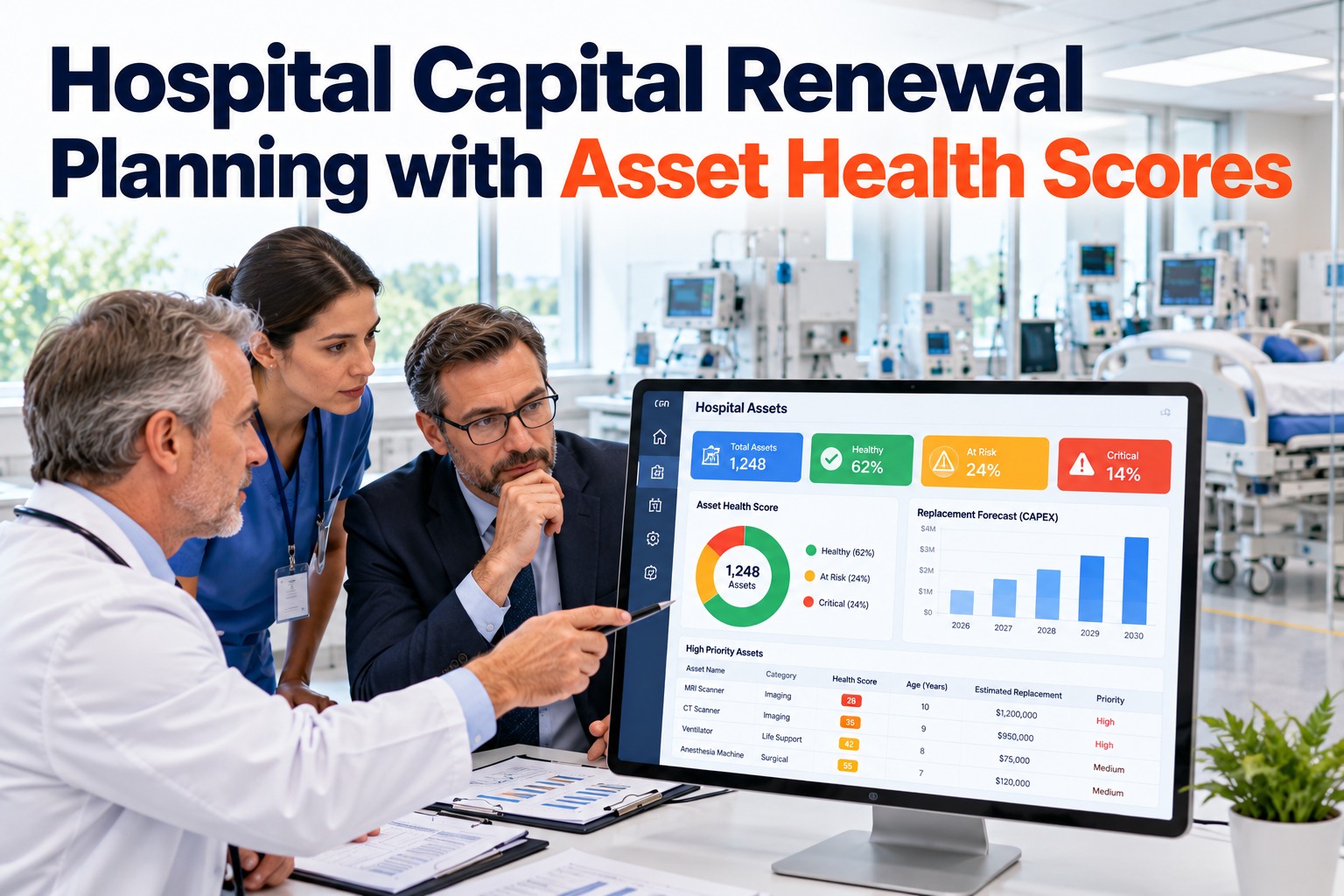
Every hospital capital budget starts as an argument. The imaging team wants a new CT; facilities wants the chillers; finance wants the list cut. Whoever tells the best story wins — and the asset quietly failing in the basement loses, until it fails on a patient floor and forces a rushed replacement at nearly five times the planned cost. Capital renewal shouldn't run on the loudest voice. OXMAINT AI, the AI-powered hospital CMMS, scores every asset's health from its own maintenance record — so the replace-or-keep call is evidence, not advocacy.
Hospital Capital Renewal Planning, Scored on Evidence
Budgets built on age and anecdote. Assets replaced too early — or too late, at emergency prices. OXMAINT AI, the AI-powered CMMS and maintenance management software, runs the whole chain on one platform: every work order and PM feeds an asset health score, each score drives a replace-or-keep verdict, and those verdicts roll up into a defensible multi-year CapEx plan — so renewal money follows condition, not the loudest request.
Age Is a Bad Proxy for Condition
The default way to plan renewal is by age: a device hits its "useful life" number and lands on the replacement list. But a well-maintained unit at year 12 can be healthier than a hard-run one at year 6. Replace by age and you scrap good assets while overworked ones fail early. OXMAINT AI scores condition from what actually happened to each asset, not the calendar. Start free and score your first assets on real data in OXMAINT AI.
One Score, Four Decisions
OXMAINT AI turns that maintenance history into a single asset health score, and the score maps to an action. Nothing is left to interpretation: a number in the red band is a documented case for renewal, and a number in the green band is a documented case for keeping the asset another year. Book a demo to see your portfolio scored in OXMAINT AI.
Replace, or Keep? Read the Signals
The hardest capital question is the closest call: is this asset worth one more year, or is next year's failure already priced in? OXMAINT AI reads both sides from the record, so the decision comes with its evidence attached instead of a gut feel. Start free and let the data make the call in OXMAINT AI.
- Repair spend approaching or exceeding replacement value
- Downtime frequency trending upward over consecutive quarters
- OEM end-of-life guidance issued for the model
- Spare parts getting scarce or back-ordered
- Cost per operating hour well below replacement value
- Condition score stable or improving after PM
- Parts availability remains strong
- No OEM end-of-life notice on the model
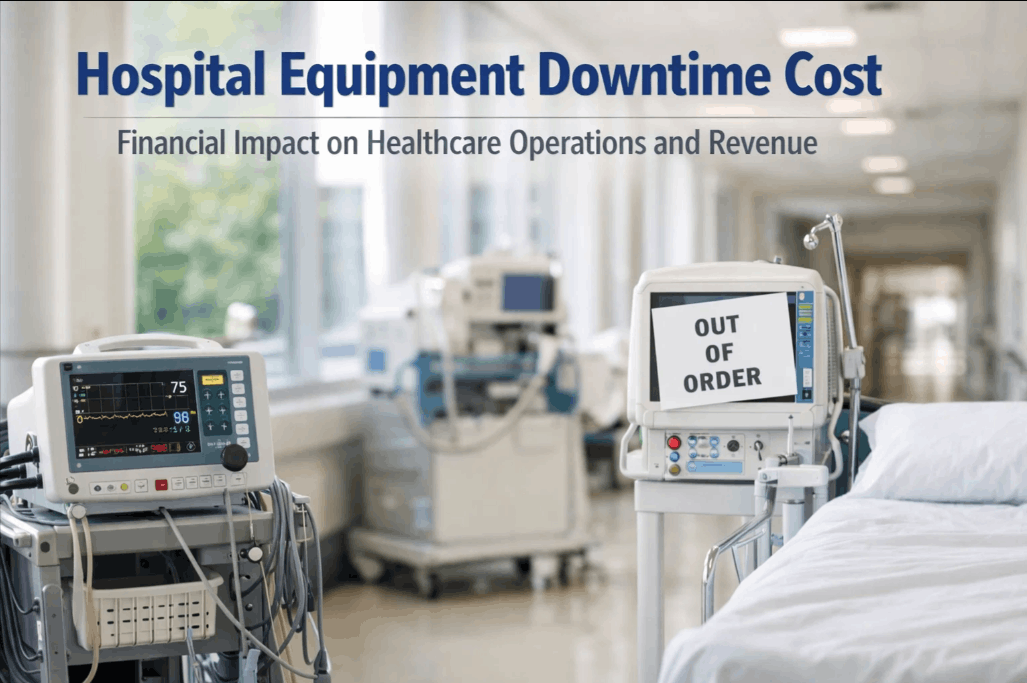
A forced replacement runs about 4.8× the planned cost, and an emergency purchase carries roughly a 22% premium over a scheduled one — the price of deciding late. Scoring surfaces the call while there's still time to plan it.
A Capital Plan Is Only as Strong as the Evidence Under It.
When renewal runs on age tables and advocacy, good assets get scrapped and failing ones get missed. OXMAINT AI puts a condition score and a cost trail behind every line of the plan — so the budget you defend is the budget the data supports.
From Score to Signed-Off CapEx Plan
A health score is a means, not the end — the end is a funded renewal plan a CFO will approve. OXMAINT AI carries the score all the way to a sequenced, costed, multi-year forecast, so the storeroom of red-flagged assets becomes a schedule instead of a scramble. Here's the chain. Book a demo to build this plan on your own fleet in OXMAINT AI.
The Rolling Multi-Year View
Renewal isn't a single year's list — it's a horizon. OXMAINT AI spreads scored candidates across a rolling forecast so no single budget cycle takes the whole hit, and so the plan updates as conditions change. A simplified view of what that looks like: Start free and build your rolling forecast in OXMAINT AI.
| Asset | Health score | Verdict | Planned window | Basis |
|---|---|---|---|---|
| Sterilizer · CSSD | 23 | Replace | This budget cycle | Repair spend ≈ replacement value |
| Chiller · Central Plant | 44 | Plan | Next 1–2 cycles | Downtime trending up, parts scarce |
| CT · Imaging | 61 | Watch | Monitor | Stable after PM; OEM support current |
| MRI · Radiology | 82 | Keep | Extend | Low cost/hour; strong condition |
Scores and windows are illustrative. The point is the shape: a costed, defensible sequence where each line is backed by the asset's own maintenance record.
What the Software Does for CapEx Planning
Capital renewal software isn't a fancier spreadsheet — it's the analysis you can't do by hand across hundreds of assets and several sites. OXMAINT AI runs it as a continuous process, not an annual fire drill. Book a demo to see the CapEx toolset in OXMAINT AI.
Our capital list used to be whoever built the best slide deck. The year we scored the whole fleet, two "must-replace" imaging units turned out to be perfectly healthy — and a sterilizer nobody had flagged was the one quietly costing us the most in repairs. We moved the money. The budget committee stopped debating opinions and started reading the same numbers we were.
Frequently Asked Questions
Fund the Assets That Need It. Keep the Ones That Don't.
Plan hospital capital renewal on the OXMAINT AI maintenance management software — asset health scores from real maintenance data, evidence-backed replace-or-keep verdicts, and a rolling multi-year CapEx forecast you can defend. Stop replacing by age and paying emergency prices for the ones you missed.