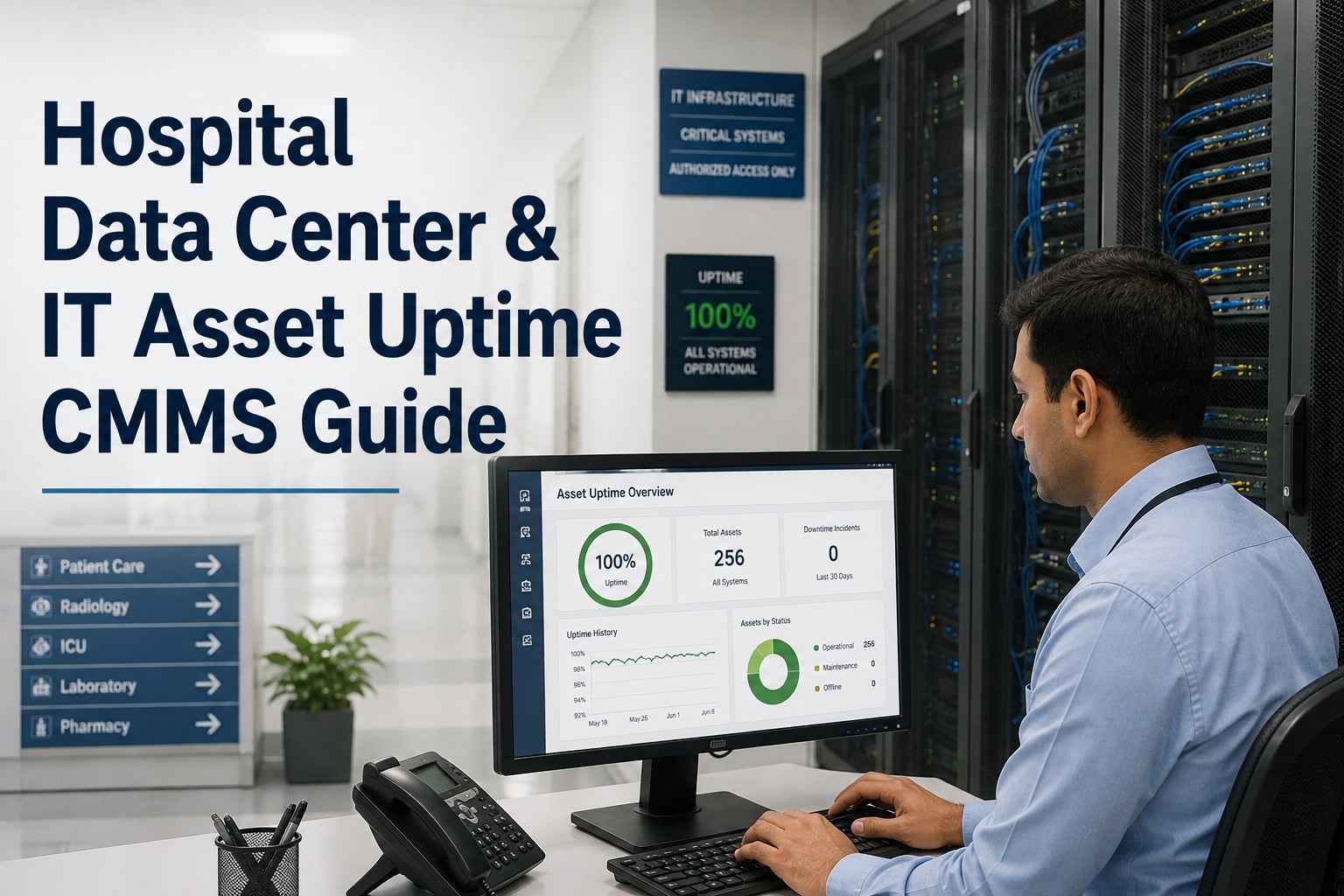
Hospital data center CMMS is no longer optional infrastructure — when EHR, PACS, and clinical systems go dark, patient safety is directly at risk and a single hour of healthcare IT downtime can exceed $300K in lost revenue and diverted care. This guide walks maintenance and reliability teams through critical IT asset management, UPS and generator readiness, cooling redundancy, and the preventive maintenance programs that keep clinical infrastructure at the 99.99%+ availability modern patient care demands. If you are ready to move beyond spreadsheets and reactive firefights, you can Start Free Trial of OxMaint in minutes — or keep reading to see the full blueprint.
Hospital Data Center & IT Uptime Guide · 2026
When the EHR goes dark, care stops. Is your hospital data center CMMS ready?
Healthcare IT infrastructure now carries the same life-safety weight as power and oxygen. Clinical downtime is not an IT ticket — it is a sentinel event. This guide maps the reliability program that keeps EHR, PACS, and critical care systems online at the availability levels patient care actually requires.
The Stakes
Why hospital data center downtime is now a patient-safety event
Over 70% of hospital clinical decisions now depend on real-time access to EHR, PACS, LIS, and connected medical device data — meaning an infrastructure outage is clinically equivalent to losing a critical care floor.
A 400-bed regional medical center running EHR and PACS on aging infrastructure averaged 4.2 unplanned outages per year — each costing an estimated $340K in diverted surgeries, lost imaging, and extended ED wait times. After deploying OxMaint CMMS for healthcare IT asset management, the facility cut unplanned downtime by 68% within the first year.
Reliability Blueprint
The 4-pillar hospital IT infrastructure reliability program
A healthcare data center guide that actually protects patients must go beyond monitoring dashboards. These four CMMS-driven pillars form the minimum viable reliability program for clinical IT infrastructure.
UPS, generator & PDU readiness
N+1 or 2N UPS configurations are only as reliable as their last load-bank test. Schedule monthly battery impedance testing, quarterly generator load tests (NFPA 110), and annual UPS inverter checks in your CMMS — with automatic work-order triggers and compliance documentation attached to each asset record.
CRAC, CRAH & chiller PM
Data center cooling in healthcare must hold ASHRAE TC 9.9 envelopes (18–27°C intake, 20–80% RH). A single failed CRAH unit can push server inlet temps past 30°C in under 8 minutes. OxMaint schedules filter changes, refrigerant top-ups, condensate pump inspections, and VFD belt replacements before thermal events occur.
EHR infrastructure & network hardware
Track every switch, router, server, and storage array by serial, warranty end-date, and firmware version. Trigger preventive maintenance on vendor-recommended cycles — and flag assets past end-of-life for capital replacement before they fail mid-shift.
HIPAA, Joint Commission & FMCSA readiness
Every PM, inspection, and repair is time-stamped, signed, and stored in a searchable audit trail. OxMaint CMMS generates one-click reports for Joint Commission environment-of-care surveys, HIPAA security audits, and internal risk reviews — eliminating the 3-day scramble for documentation.
Preventive Maintenance
Hospital data center cooling & power redundancy checklist
Use this CMMS healthcare IT checklist as the minimum preventive maintenance schedule for Tier II–III hospital data centers. Each item maps directly to a recurring work order in OxMaint.
Power & UPS (Monthly)
- UPS battery impedance & voltage test
- Generator fuel level & polish check
- ATS transfer-switch exercise under load
- PDU thermal scan for hot spots
- Inverter & rectifier alarm-log review
Cooling (Weekly–Monthly)
- CRAH/CRAC filter inspection & replacement
- Condensate pump & drain line check
- Chilled-water valve actuator test
- Hot/cold aisle containment integrity
- Refrigerant pressure & leak detection
IT Asset PM (Quarterly)
- Firmware & security patch verification
- EHR server storage capacity & I/O review
- Network switch port & SFP health check
- Backup system restore-test validation
- Warranty & end-of-life asset flagging
Compliance (Annual)
- Joint Commission environment-of-care report
- NFPA 110 generator load-bank certification
- HIPAA security risk-assessment evidence
- Disaster recovery plan tabletop exercise
- Vendor SLA & maintenance-contract audit
Reactive vs. Proactive
Spreadsheet-managed vs. CMMS-managed healthcare data centers
Most hospital IT teams still track data center assets and PM schedules on shared spreadsheets. The performance gap between that approach and a purpose-built healthcare IT CMMS is measurable — and expensive.
| Metric | Spreadsheets / Reactive | OxMaint CMMS |
|---|---|---|
| Unplanned downtime / year | 8–24+ hours | < 1 hour (99.99%+ uptime) |
| PM compliance rate | 45–60% | 92–98% |
| Time to locate asset & history | 15–30 min | < 30 seconds (QR scan) |
| Audit preparation time | 2–5 days | 1 click (instant report) |
| Spare-parts stockouts | Frequent (12–18%/yr) | Auto-reorder, <3% stockout |
| Failure prediction | None (run-to-failure) | AI-driven predictive alerts |
OxMaint Solution
How OxMaint CMMS keeps hospital data centers & clinical IT online
OxMaint is an AI-powered CMMS and EAM platform purpose-built for maintenance and reliability teams. For healthcare data centers, it maps directly to the four pillars above — turning a reactive IT shop into a proactive, audit-ready reliability program.
Automated PM scheduling & work orders
Trigger recurring work orders for UPS tests, generator load-banks, CRAH filter changes, and firmware patches — assigned to the right technician with checklists, parts, and SOPs attached.
Cut unplanned clinical IT downtime 30–50% within 6 months.
Critical IT asset tracking & QR lifecycle
Every server, switch, UPS, and chiller gets a QR tag. Scan to see full maintenance history, warranty status, warranties, and open work orders — in the field, on the data center floor.
Eliminate paper records; find any asset's history in < 30 seconds.
AI predictive maintenance alerts
OxMaint analyzes temperature, vibration, UPS battery impedance, and runtime data to flag degradation patterns before failure — shifting from time-based PM to condition-based reliability.
Predict 40–60% of critical failures before they cause downtime.
Spare-parts inventory & auto-reorder
Track spare UPS batteries, CRAC filters, belts, and SFP modules by min/max levels. OxMaint auto-generates purchase requisitions when stock dips — so the part is always on the shelf when a 2 a.m. call comes in.
Reduce parts stockouts 70%+; cut emergency parts spend 20–30%.
"We went from 4 unplanned EHR outages a year to zero in 14 months. OxMaint made PM scheduling automatic and our Joint Commission audit took two hours instead of two days. The ROI was undeniable within the first quarter."
— Director of Facilities & IT Infrastructure, 380-bed regional hospital system
See OxMaint protect your hospital data center — book a 30-minute demo
Walk through a live hospital IT asset & PM workflow. See how OxMaint schedules power and cooling PMs, tracks critical assets, predicts failures, and generates audit-ready compliance reports in one click.
FAQ
Hospital data center CMMS — frequently asked questions
What is a hospital data center CMMS and why do healthcare facilities need one?
A hospital data center CMMS is a computerized maintenance management system that schedules, tracks, and documents all preventive maintenance and repairs for critical IT infrastructure — UPS systems, generators, cooling units, servers, and network hardware. Healthcare facilities need one because clinical systems like EHR and PACS are now life-safety systems; a single outage can delay care, divert ambulances, and cost $300K+ per hour. A CMMS ensures PMs happen on time, failures are predicted, and audit evidence is always ready.
How does a CMMS improve EHR uptime in hospitals?
A CMMS improves EHR uptime by automating preventive maintenance on the power, cooling, and network infrastructure that supports EHR servers — ensuring UPS batteries are tested, generators are load-banked, and cooling redundancy is maintained before failures occur. Facilities using a CMMS like OxMaint typically see 30–50% less unplanned downtime within the first 6 months. You can Start Free Trial to test the workflow on your own assets.
What PM schedules should a hospital data center CMMS include?
At minimum, a hospital data center CMMS should schedule monthly UPS battery impedance tests, weekly-to-monthly CRAH/CRAC filter inspections, quarterly generator load-bank tests (per NFPA 110), quarterly firmware and security patch verification, and annual disaster-recovery restore tests. Each PM should auto-generate a work order with checklists, assigned technicians, and compliance documentation attached.
How long does it take to implement a CMMS for healthcare IT infrastructure?
Most hospital IT and facilities teams can implement OxMaint CMMS in 2–4 weeks. Asset import, PM schedule setup, and QR tagging are the main tasks; OxMaint provides onboarding support and templates configured for healthcare data center equipment. Teams typically see full PM compliance within 60 days of go-live.
Can OxMaint CMMS help with Joint Commission and HIPAA compliance for data centers?
Yes. Every work order, inspection, and repair in OxMaint is time-stamped, electronically signed, and stored in a searchable, exportable audit trail. The system generates one-click environment-of-care reports for Joint Commission surveys and HIPAA security risk-assessment evidence, cutting audit preparation from days to minutes.
Stop firefighting. Start preventing.
Join the hospital IT and facilities teams using OxMaint to keep EHR, PACS, and critical clinical systems online — with AI-driven predictive maintenance, automated PM scheduling, and audit-ready compliance in one platform.
Free 14-day trial · No credit card required


.png)

.jpeg)
