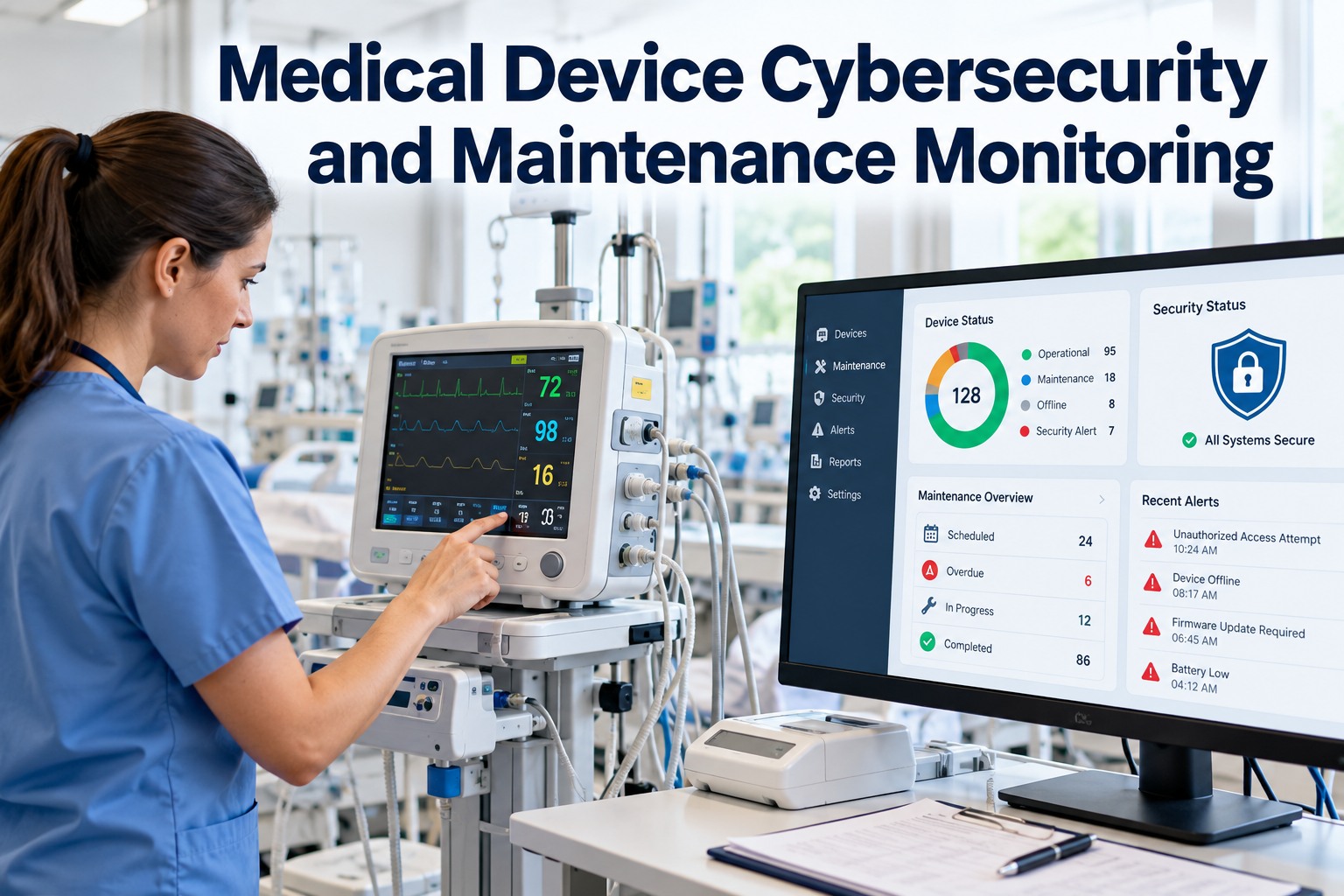
In 2024, 31% of hospital ransomware events traced their initial entry point to a maintenance or facilities system — not the EHR, not the billing platform. The CMMS. Attackers have learned what most facility managers have not yet internalized: maintenance platforms hold asset credentials, IoT integration keys, compliance records, and access pathways that sit directly adjacent to clinical networks. A breach in the work order system is no longer a back-office inconvenience — it is a potential pathway to equipment failure, regulatory exposure, and operational shutdown. Healthcare facilities running fragmented or unprotected maintenance platforms are carrying a risk that does not appear on their insurance forms until it is too late. If you want to see what a security-first maintenance platform looks like in practice, start a free 30-day trial with Oxmaint or book a direct walkthrough with our healthcare security team — zero-trust architecture, HIPAA-aligned audit logging, and encrypted IoT integration are built into the platform from day one, not bolted on as premium add-ons.
Attackers Already Know Your CMMS Holds the Keys. Does Your Security Reflect That?
Work order systems store vendor access credentials, equipment service histories, IoT integration tokens, and compliance records that regulators require on demand. When that data is unencrypted, unlocked behind a shared password, and feeding into clinical networks through unauthenticated IoT sensors — it is not a potential risk. It is an active one. The $10.9M average breach cost in healthcare is not just a data theft number. It is equipment downtime, emergency procurement, regulatory investigation, and reputational damage stacked together. Start a free trial with Oxmaint and explore how zero-trust access, immutable audit logs, and encrypted IoT integration are deployed by default — or book a 30-minute walkthrough with our team and we will map the security architecture directly to your facility's risk profile.
What Is Healthcare CMMS Cybersecurity — and Why Does It Sit at the Intersection of IT and Patient Safety?
Healthcare CMMS cybersecurity is the layered protection of a hospital's computerized maintenance management system — covering access controls, data encryption, IoT device authentication, audit logging, and incident response protocols — against unauthorized access, ransomware, data exfiltration, and operational disruption. Unlike standard enterprise IT security, CMMS protection in healthcare operates where digital systems meet physical infrastructure. A compromised work order platform does not just leak data. It can delay critical equipment repairs, generate falsified compliance records, and give attackers lateral movement access into the same networks that carry patient monitoring data. That is not a theoretical risk. In 2024, the average healthcare ransomware event caused 18 days of operational disruption and $1.27M in downtime costs — before accounting for regulatory penalties or remediation spend. Facilities that treat CMMS security as a lower-priority IT task are underestimating both the attack surface and the downstream consequences. To see how Oxmaint addresses every layer of CMMS cybersecurity by design, start a free trial and walk through the security architecture yourself — or book a demo and let our team walk through your specific threat exposure and how the platform closes each gap.
The 4 Security Layers Every Hospital CMMS Needs — and What Breaks When Any One Is Missing
4 Specific Vulnerabilities in Unprotected Maintenance Systems That Attackers Actively Target
How Oxmaint Closes Every Attack Surface — Built Into the Platform, Not Added On
Unsecured CMMS vs. Oxmaint — Every Row Is a Breach Vector That Currently Exists in One and Is Closed in the Other
| Security Area | Typical Unsecured CMMS | Oxmaint Secured Architecture |
|---|---|---|
| User Authentication | Username and password only, shared credentials common, no MFA enforcement | MFA enforced on all accounts, SSO integration, zero standing shared credentials |
| Access Permissions | Broad "admin" or "user" roles — no asset-level scoping, no session expiry | Five-level RBAC with zero-trust session verification and time-bounded vendor access |
| IoT Data Ingestion | Unauthenticated sensor feeds accepted, unencrypted transmission, default device credentials | Certificate-based device auth, TLS 1.3 encryption, rogue device rejection at gateway |
| Audit Logging | Login records only, no record-level change tracking, gaps in history | Full immutable trail — every access, modification, and export logged with metadata |
| Ransomware Recovery | Inconsistent backups, RTO measured in days, no segment isolation capability | Geo-redundant immutable backups, 4-hour RTO, network segment isolation on incident |
| HIPAA Compliance | Manual documentation, incomplete BAA coverage, audit prep takes 2 to 3 days | BAA included, auto-generated HIPAA reports, audit-ready in under 4 hours |
The Business Case Is Not Theoretical — These Are Measured Outcomes From Secured CMMS Operations
Frequently Asked Questions
How does zero-trust architecture work inside a hospital CMMS — and what does it actually prevent that standard access controls do not?
+
Standard access control grants permissions based on role at login and assumes those permissions remain valid for the duration of the session. Zero-trust architecture eliminates that assumption entirely. Every interaction — opening a work order, viewing an asset record, downloading a compliance document, exporting a report — is independently verified against the user's current assigned scope, the specific resource being accessed, and the active session context. In a hospital CMMS, this means a night-shift biomedical technician cannot view ICU equipment records unless they have an active work order assigned to that specific asset — and that access revokes automatically when the work order closes. Standard RBAC gives a technician persistent access to an asset category. Zero-trust gives them access to a specific task for a defined window. The practical result is that compromised credentials — the vector in the majority of insider incidents — have dramatically reduced blast radius, because the session scope is narrow and time-limited by design.
Which specific HIPAA requirements apply to a hospital CMMS — and what documentation does the platform need to produce for compliance?
+
HIPAA's Security Rule applies to CMMS systems in three documented scenarios: when the platform contains maintenance records for equipment that processes or stores patient data, when access logs contain staff identity information tied to PHI-adjacent systems, and when IoT integrations are connected to patient monitoring or life-safety infrastructure. The specific technical safeguards required are access controls under Section 164.312(a)(1), audit controls under 164.312(b), integrity controls under 164.312(c)(1), and transmission security under 164.312(e)(1). The facility also requires a signed Business Associate Agreement with any third-party CMMS vendor before going live. Oxmaint provides BAA documentation as standard, meets all four technical safeguard categories by default, and generates HIPAA-aligned audit reports that are ready for regulatory review — not assembled manually from logs at the time of inspection. Audit preparation time is under 4 hours rather than 2 to 3 days.
What is the correct network architecture for connecting hospital IoT maintenance sensors to a CMMS without creating lateral movement risk to clinical systems?
+
Best practice places all IoT maintenance sensors — HVAC monitors, equipment performance sensors, environmental monitoring devices, utility meters — on a dedicated OT network segment isolated from both the clinical network and general IT infrastructure. The CMMS integration gateway sits in a demilitarized zone that accepts authenticated, encrypted data from the OT segment without allowing bidirectional network access. Firewall rules are deny-by-default with specific allow rules only for authorized data flows in the direction from sensor to gateway. This architecture means a compromised sensor can at most generate false data — it cannot initiate connections into the CMMS backend or pivot toward clinical systems. This is the path that 31% of 2024 healthcare ransomware attacks used as their initial entry point. Oxmaint's IoT gateway is designed to operate within this segmented model, with certificate-based device authentication and TLS 1.3 transmission encryption configurable within any existing hospital network topology.
What should a hospital operations team do in the first 60 minutes after a CMMS breach is detected?
+
The first priority is network segment isolation — quarantining the affected CMMS infrastructure without shutting down active work orders for life-critical equipment where possible. Most ransomware events achieve maximum damage in the hours after initial detection before containment is implemented; the window for isolation is narrow. The second priority is activating the documented incident response plan and notifying the HIPAA Security Officer immediately. Under the HIPAA Breach Notification Rule (45 CFR Part 164, Subpart D), breaches involving 500 or more individuals must be reported to HHS within 60 days and to affected individuals without unreasonable delay. The third priority — and the one most often executed incorrectly — is preserving system logs before any remediation activity begins. Remediation actions can overwrite log data that is essential for forensic analysis and mandatory for regulatory reporting. With Oxmaint, immutable audit logs are continuously backed up to isolated storage accessible even while the primary system is quarantined, giving incident responders a complete, tamper-proof activity record from the moment the investigation begins.
Every Unprotected CMMS Is a $10.9M Risk Sitting Inside Your Clinical Network. Oxmaint Closes That Gap.
Oxmaint gives healthcare facilities the CMMS security architecture they need — zero-trust access controls, HIPAA-aligned immutable audit logging, certificate-authenticated IoT gateway, AES-256 encryption at rest and in transit, 72-hour patch deployment, and ransomware-resilient backup with 4-hour RTO — without the six-month implementation cycle, without heavy professional services fees, and without features gated behind enterprise pricing tiers. Built for multi-site healthcare operations managing real equipment, real compliance obligations, and real exposure. Trusted by maintenance teams across the USA, UK, Australia, UAE, and Germany — fully operational within days of starting.