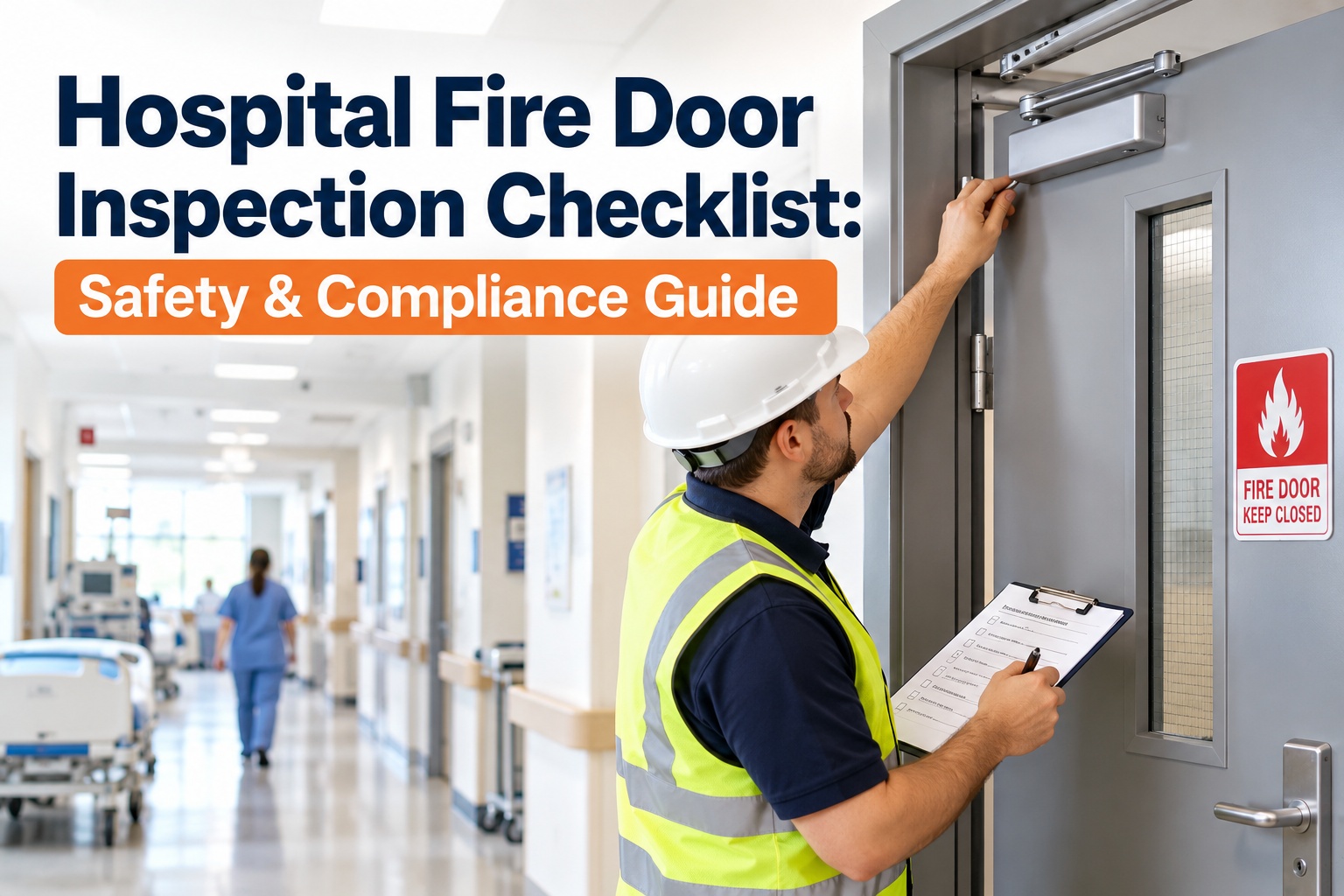
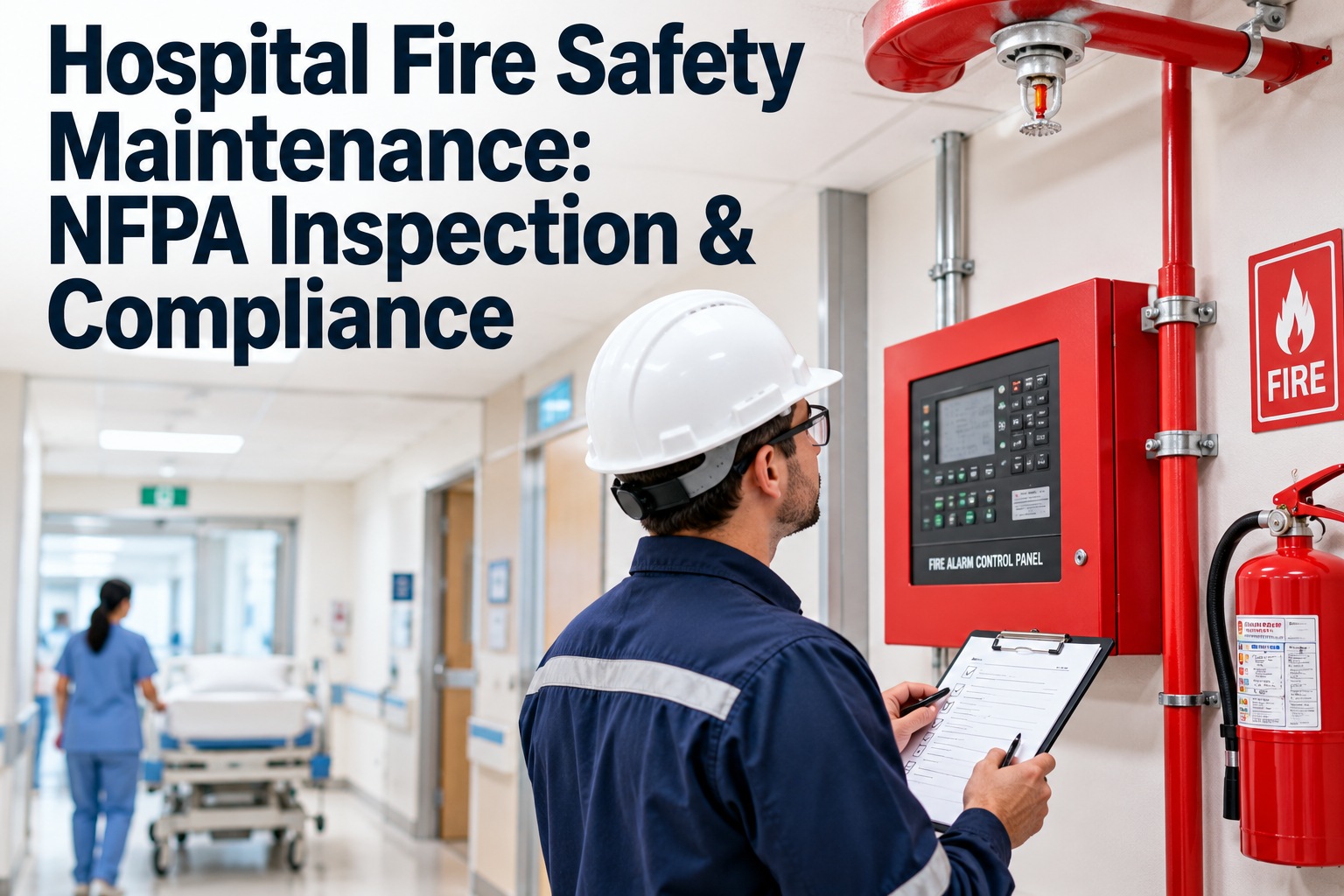
A fire door only works if every part of it works — the closer that pulls it shut, the latch that holds it, the seals that stop smoke, the label that proves its rating. In a hospital, a door propped open, a painted-over label or a worn gasket is the difference between a contained fire and a corridor full of smoke. NFPA 80 requires these doors to be inspected and documented every year. This hospital fire door inspection checklist walks the assembly point by point and logs every defect as a tracked repair in OXMAINT AI — or book a demo of fire door compliance in OXMAINT AI.
HOSPITAL FIRE DOOR INSPECTION · NFPA 80 COMPLIANCE · CHECKLIST · 2026
Hospital Fire Door Inspection Checklist: Safety & Compliance Guide
A failed closer, a missing seal or a blocked latch turns a rated fire door into an open path for smoke — and into an audit finding. OXMAINT AI is the AI-powered CMMS that runs the annual inspection route, logs each defect, and raises a scheduled repair with the record attached — so a deficiency becomes a closed work order with a paper trail, not a surprise at survey time.
1 · Inspect
2 · Log defect
3 · Schedule repair
4 · Keep the record
Annual
NFPA 80 requires fire door assemblies inspected and tested at least yearly
13
verification points in the NFPA 80 §5.2.4 annual swinging-door inspection
¾″
maximum clearance under the bottom of the door to the floor
⅛″
nominal clearance at the jambs and head for the door edge gaps
Anatomy of a Fire Door Assembly
A fire door is an assembly, not just a slab — and it's rated as a whole. If any one component is missing, damaged or modified, the rating is void. Walk these ten parts on every door. Start free and build your fire door register in OXMAINT AI.
01
Door Leaf
No holes, breaks or field-drilled modifications in the face or edges.
02
Frame
Secured, aligned, undamaged, properly anchored to the wall.
03
Hinges
All fasteners present and tight, no missing or broken parts.
04
Self-Closing Device
The closer fully shuts the door from any open position.
05
Latching Hardware
Latch engages and holds the door positively in the closed position.
06
Coordinator
On door pairs, the inactive leaf closes before the active leaf.
07
Seals & Gasketing
Smoke and edge seals present and intact where required.
08
Glazing & Vision Panel
Rated glazing intact, beads and frames securely fastened.
09
Threshold
Noncombustible threshold secure, bottom clearance within limits.
10
Fire Rating Label
Legible, not painted over, matching the opening's required rating.
Clearance & Gap Limits That Fail or Pass a Door
Clearances are the most commonly missed item — and the easiest to measure. If a gap is out of tolerance, smoke and flame pass, and the door fails. These are the NFPA 80 reference dimensions to check with a feeler gauge.
Head & jambs⅛″ nominal
Fire Door Leaf
Bottom to floor¾″ maximum
✓Top & sides: the clearance between the door edge and the frame at the head and both jambs is nominally 1/8″ — measured along the full height.
✓Meeting edge (pairs): the clearance between the two leaves of a door pair is also held to the nominal 1/8″ limit.
✓Bottom: clearance under the door to the floor must not exceed 3/4″ — a gap larger than this is a common failure.
✓How to check: use a feeler or taper gauge at the head, both jambs and the sill, and record the measured gap, not an estimate.
The NFPA 80 Fire Door Inspection Checklist
These are the thirteen verification points of the annual swinging-door inspection, grouped into five working sections. Tick each item as you inspect — the whole row toggles. Book a demo and run this checklist from a tablet in OXMAINT AI.
Defects That Fail a Fire Door Inspection
Most failures aren't exotic — they're the same handful of avoidable problems, found door after door. Watch for these first.
×Door Held or Propped Open
Wedges, kick-downs or tied-back closers — a fire door that can't close protects nothing.
×Painted-Over Label
If the rating label is illegible, the door can't be verified and fails the inspection.
×Excessive Bottom Gap
A clearance over 3/4″ under the door lets smoke pass — one of the most common findings.
×Failed Closer or Latch
A door that doesn't self-close and positively latch is not a working fire barrier.
×Missing or Damaged Gasketing
Worn smoke seals break the barrier against smoke migration between compartments.
×Field-Drilled Holes
Unapproved holes for hardware or signage void the listing and fail the assembly.
How OXMAINT AI Keeps Fire Doors Compliant
OXMAINT AI is the AI-powered maintenance management software that carries a fire door from the inspection route to the closed, documented repair — the register, the annual schedule, the defect photos and the audit trail on one platform. Build your door register when you start free and schedule annual inspections in OXMAINT AI.
Fire Door Register
Every rated door as an asset with its rating, location and inspection history in one place.
Annual Schedule
Recurring NFPA 80 inspections generated automatically so no door misses its yearly check.
Mobile Checklist
The 13-point checklist runs from a phone at the door, with photos logged on the spot.
Defect → Work Order
Each deficiency raises a prioritised repair with the photo and location attached.
Audit-Ready Records
Signed, dated inspection records retained and ready to produce at survey time.
Compliance Rollup
A live view of which doors are inspected, which have open defects and which are overdue.
A Deficient Door Is a Finding Waiting to Happen.
Caught on the annual route, a worn seal or a weak closer is a scheduled repair with a record. Missed, it's a corridor that won't hold smoke — and a citation at the next survey. OXMAINT AI makes the inspection repeatable and the paper trail automatic.
EXPERT REVIEW
Written for hospital facilities, safety and plant-operations teams. Fire door inspection in healthcare is governed by NFPA 80 (annual inspection and testing of fire door assemblies), with hospitals also accountable under the NFPA 101 Life Safety Code and the oversight of CMS and accreditation bodies such as The Joint Commission. NFPA 80 requires the inspection to be performed by a knowledgeable person, and the clearance figures cited here are standard reference dimensions — confirm the exact requirements and any adopted edition against the standard and your authority having jurisdiction. OXMAINT AI is a maintenance management platform that schedules the inspections, stores the evidence and tracks the repairs — it does not perform the inspection or replace a qualified fire door inspector.
Frequently Asked Questions
How often must hospital fire doors be inspected?
NFPA 80 requires fire door assemblies to be inspected and tested at least annually, with any deficiencies corrected without delay. Hospitals under CMS and accreditation oversight are expected to keep documented records of each annual inspection and the repairs that followed.
Start free and schedule annual fire door inspections in OXMAINT AI.
What are the 13 points of an NFPA 80 fire door inspection?
They cover the condition of the door and frame, no missing or broken parts, no unapproved field modifications, clearance and gap limits, the self-closing device, latching hardware, the coordinator on pairs, auxiliary hardware, gasketing and edge seals, glazing and vision frames, and the legibility of the fire rating label. The checklist above groups all thirteen into five working sections.
What are the clearance limits for a fire door?
As a reference, the clearance at the top and sides is held to a nominal 1/8″, and the clearance under the bottom of the door to the floor must not exceed 3/4″. An oversized bottom gap is one of the most common reasons a door fails, because it lets smoke pass between compartments.
Who is allowed to inspect a fire door?
NFPA 80 requires the inspection to be carried out by a person with knowledge and understanding of the operating components of the type of door being inspected. Many hospitals use trained in-house staff for routine checks and a qualified inspector for the formal annual inspection; your authority having jurisdiction sets the expectation.
What happens if a fire door fails inspection?
The deficiency must be documented and corrected, and the record kept to show the finding and the repair. Tracking each defect as a work order with a photo and a completion date is what turns a failed door into a closed, provable fix at survey time.
Book a demo of defect-to-repair tracking in OXMAINT AI.
Turn Fire Door Compliance Into a Closed Loop.
Run hospital fire door inspections on OXMAINT AI: a complete door register, auto-scheduled annual NFPA 80 checks, a mobile 13-point checklist, and a documented repair raised for every defect — so every door is provably inspected and every finding is provably fixed.