In a hospital, evacuation is not the fire plan — "defend in place" is. Patients cannot be moved quickly, so the building and its fire-protection systems have to contain a fire while care continues, which means every alarm, sprinkler and barrier must work on the day it is needed, and a surveyor will ask for the records that prove it. The OXMAINT AI — the AI-powered maintenance management software — runs the inspection, testing and maintenance schedule to NFPA frequencies and keeps the audit trail those surveys depend on.
Healthcare Facilities · Life Safety · NFPA Inspection, Testing & Maintenance · Compliance · 2026
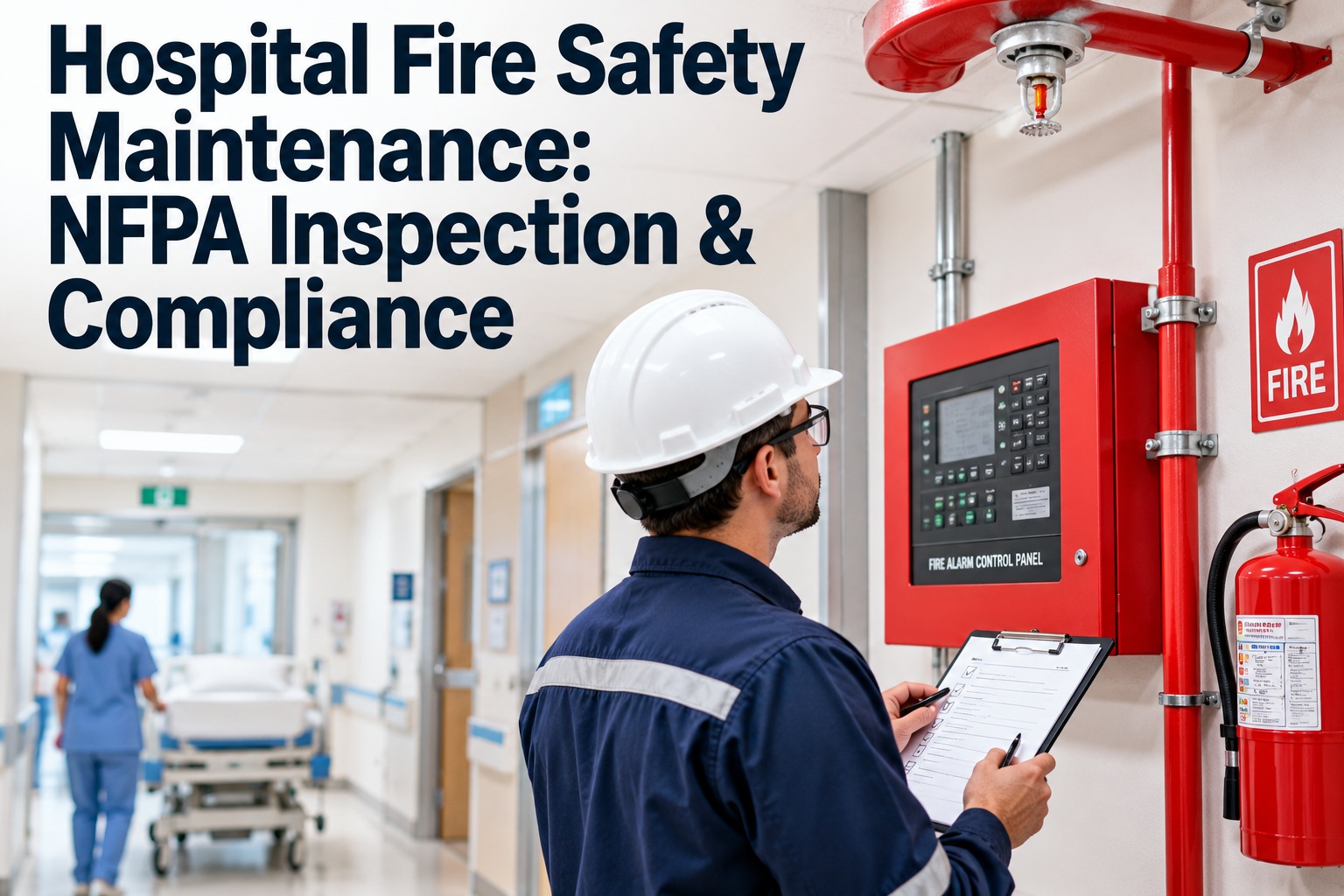
Hospital Fire Safety Maintenance: NFPA Inspection & Compliance
Fire alarms, sprinklers, fire doors, dampers and emergency power each carry their own NFPA inspection frequency — and a single lapsed record is a survey finding. OXMAINT AI schedules every task to its code frequency, captures the result, drives the corrective action and holds the evidence, so compliance is continuous rather than a scramble before the survey.
1Schedule
→
2Inspect & test
→
3Log the result
→
4Close the action
Defend in place
Patients stay; the fire systems have to work, every time
NFPA 101 & 99
CMS requires the 2012 editions for participating hospitals
By frequency
Every ITM task tied to its NFPA code interval
Survey-ready
Records kept the way a Life Safety survey expects them
Why Hospital Fire Safety Is Different
Fire maintenance in a hospital is not just a facilities task — it is a patient-safety and accreditation obligation, judged against a stricter bar than almost any other occupancy. Four realities set it apart, and together they make a managed, documented ITM program non-negotiable; start free and put your fire-safety program on a compliance footing with OXMAINT AI.
Patients cannot evacuate
Defend-in-place depends entirely on the fire systems holding — there is no quick exit to fall back on.
The building never closes
Testing and repairs happen around live clinical care, so impairments must be managed, not just scheduled.
Surveyors scrutinize it
CMS and The Joint Commission review Life Safety closely — a missed interval becomes a citation.
Documentation is compliance
If a test is not recorded, to a surveyor it did not happen — the evidence carries as much weight as the work.
The Codes That Govern It
Hospital fire safety sits on a stack of NFPA codes, each owning a different part of the building's protection — and CMS adopts specific editions that accredited hospitals are held to. Knowing which code drives which system is the first step to a defensible program; book a demo to see every system mapped to its code in OXMAINT AI.
NFPA 101
Life Safety Code
Occupancy, egress and the defend-in-place strategy for health care.
NFPA 99
Health Care Facilities Code
Risk-based requirements for building systems and utilities.
NFPA 72
Fire Alarm & Signaling
Detection, notification and the ITM of the alarm system.
NFPA 25
Water-Based Systems
Sprinklers, standpipes and fire pumps — inspection and testing.
NFPA 110
Emergency Power
Standby generators and the emergency power supply system.
10 · 80 · 96
Extinguishers · Doors · Hoods
Portable extinguishers, fire doors and kitchen hood suppression.
Inspection Cadence, at a Glance
NFPA frequencies run from monthly to multi-year, and the risk of a lapse rises with the interval — the annual and five-year tasks are the ones most easily forgotten. Grouping the program by cadence is how nothing slips; start free and let OXMAINT AI hold every cadence on schedule.
Monthly
Extinguisher checks · sprinkler & pump gauges · generator inspection
Quarterly
Alarm supervisory & water-flow devices · standpipe checks
Semiannual
Kitchen hood suppression · certain alarm initiating devices
Annual
Full fire-alarm test · fire-door inspection · generator load test · main drain
Multi-year
Sprinkler internal pipe (5-yr) · fire & smoke dampers (6-yr in hospitals)
The ITM Schedule by System
Each fire-protection system carries its own tasks, its own governing code and its own record a surveyor will ask to see. Frequencies below reflect the applicable NFPA codes — confirm the exact interval against the edition your authority enforces; book a demo to see the full ITM schedule built against your systems in OXMAINT AI.
System
Code
Key ITM tasks
Typical frequency
Record kept
Fire alarm
NFPA 72
Device, notification & panel testing
Quarterly–Annual
Test report by device
Sprinklers
NFPA 25
Gauges, valves, flow; internal pipe
Monthly–5 yr
ITM report + gauge log
Fire pump
NFPA 25
No-flow (churn) run; annual flow test
Weekly–Annual
Run & flow log
Extinguishers
NFPA 10
Visual check; annual maintenance
Monthly–Annual
Tag + service record
Fire doors
NFPA 80
Operation, gaps, latching, labels
Annual
Door inspection form
Emergency generator
NFPA 110
Inspection; monthly load run; annual
Weekly–Annual
Run log + load data
Kitchen hood
NFPA 96
Suppression service; hood cleaning
Semiannual
Service certificate
Fire & smoke dampers
NFPA 80 / 105
Operational closure test
6 yr (hospital)
Damper test log
When a System Is Impaired
A fire system out of service — planned or not — does not pause the hospital, so the gap has to be bridged with Interim Life Safety Measures until protection is restored. Handling the impairment well is itself a survey expectation; book a demo to see impairment and fire-watch logging in OXMAINT AI.
1
Assess the impairment
Identify what protection is lost, where, and for how long.
2
Put ILSM in place
Fire watch, added extinguishers, signage and extra vigilance.
3
Notify & control
Inform the right parties and limit ignition sources in the area.
4
Restore & document
Return the system to service and keep the full impairment record.
The Survey Does Not Ask If the Work Was Done. It Asks for the Record.
A binder of paper logs is where Life Safety findings are born — a missed interval, a form that cannot be found, a corrective action never closed. The OXMAINT AI maintenance management software schedules every NFPA task, captures each result and keeps the evidence in one place, so the answer to a surveyor is always a document, not a search.
How OXMAINT AI Manages Hospital Fire Safety
A fire-safety program holds up only when every task is scheduled, every result is captured and every finding is closed — and that is the job the software does. Here is what the OXMAINT AI maintenance management software brings to NFPA compliance; start free and run your Life Safety program in OXMAINT AI.
NFPA-frequency scheduling
Every ITM task set to its code interval — monthly to multi-year — so nothing falls off the calendar.
Fire-system asset register
Alarms, sprinklers, doors, dampers and generators held as assets, each with its own history.
Inspection work orders
Each inspection raised as a work order with pass or fail captured against the device.
Corrective-action tracking
A failed check becomes a tracked deficiency that is followed through to verified closure.
Impairment & fire-watch log
Every impairment and its ILSM recorded, so the gap is managed and documented, not improvised.
Survey-ready audit trail
Every task, result and signature kept and searchable, so Life Safety evidence is ready on request.
Frequently Asked Questions
What fire codes apply to hospitals?
NFPA 101 (Life Safety Code) and NFPA 99 (Health Care Facilities Code) are the backbone — CMS requires the 2012 editions for participating hospitals — alongside the system ITM codes NFPA 72, 25, 110, 10, 80 and 96.
What does "defend in place" mean?
Hospitals do not evacuate patients in most fires. The strategy is to contain the fire and protect occupants where they are, which is only possible if the fire-protection systems are reliably maintained.
How often must hospital fire systems be inspected?
By the frequency each NFPA code sets — from monthly to multi-year. For example, monthly extinguisher and gauge checks, annual fire-alarm and fire-door tests, and weekly or monthly generator and pump runs.
What happens when a fire system is impaired?
Interim Life Safety Measures are put in place — a fire watch, added extinguishers, signage and extra vigilance — until the system is restored, and the impairment and its measures are documented throughout.
How does a CMMS help with fire-safety compliance?
Make Fire-Safety Compliance Continuous, Not a Pre-Survey Scramble.
Run hospital fire safety inside the OXMAINT AI maintenance management software — NFPA-frequency scheduling, a fire-system asset register, inspection work orders, corrective-action tracking, an impairment and fire-watch log and a survey-ready audit trail — so alarms, sprinklers, doors and emergency power stay compliant and the evidence is always to hand.