A hospital carries hundreds of fire extinguishers across patient rooms, kitchens, imaging suites, mechanical rooms and loading docks — each one with a monthly visual check, an annual maintenance, a six-year internal and a twelve-year hydrostatic. One missed tag, one blocked location, one lapsed hydrostatic date and the surveyor writes it up. OXMAINT AI is the AI-powered CMMS and maintenance management software that holds every extinguisher by ID, auto-schedules each NFPA 10 cadence, captures the inspector's monthly check from a phone and flags expiries before the Joint Commission does.
HOSPITAL FIRE EXTINGUISHER · INSPECTION CHECKLIST · NFPA 10 · 2026
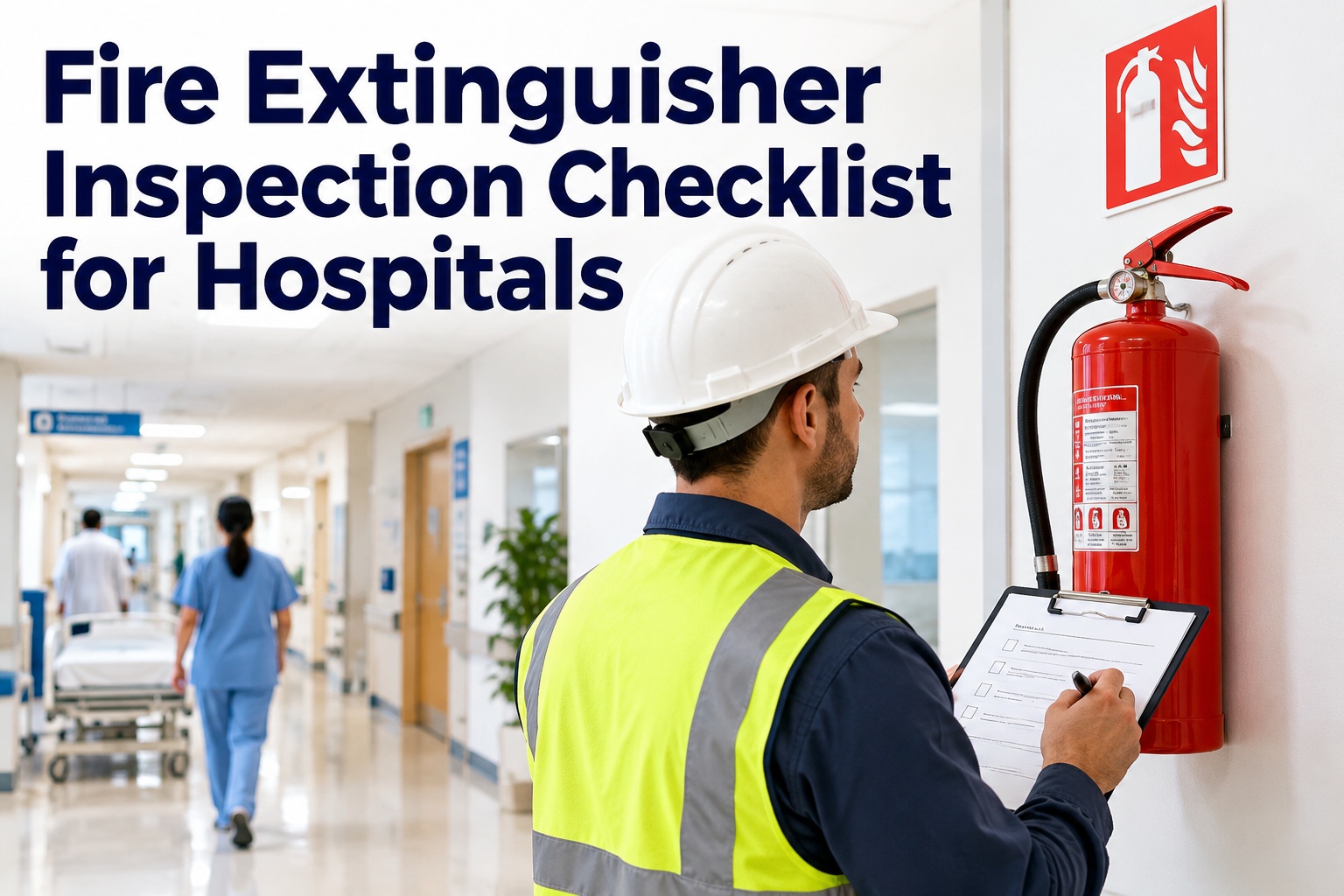
Fire Extinguisher Inspection Checklist for Hospitals
Monthly visual, annual maintenance, six-year internal, twelve-year hydrostatic — four cadences, every extinguisher, every month, every record. The OXMAINT AI software holds the extinguisher register per hospital, routes every monthly check to the facilities tech on the floor, and keeps the inspection trail ready for CMS, Joint Commission and the AHJ.
AOrdinary
BFlammable liquid
CElectrical
DMetal
KKitchen
Monthly
visual inspection of every portable fire extinguisher required under NFPA 10
75 / 50 ft
max travel distance to a Class A / Class K extinguisher under NFPA 10
6 / 12 yr
internal exam and hydrostatic retest cycles depending on extinguisher type
1
blocked, missing or expired extinguisher is enough to generate a survey finding
Five Classes — Which One Belongs Where in a Hospital
A hospital runs every fire-extinguisher class because its hazards vary room to room. OXMAINT AI holds the class per location — patient wings carry ABC, pharmacy and lab carry CO2 for electrical, dietary kitchens carry K for cooking oils, maintenance rooms carry B for flammables — schedule a walkthrough of the extinguisher-by-location register in OXMAINT AI.
A
Ordinary combustibles
Wood, paper, textiles, trash. Water, ABC dry chemical, foam. Standard patient-wing coverage.
B
Flammable liquids & gases
Fuel, oil, solvents, lab chemicals. ABC dry chemical, CO2, foam. Mechanical rooms, maintenance shops, labs.
C
Energized electrical
Live panels, servers, imaging equipment. CO2 preferred (no residue). IT rooms, imaging suites, electrical closets.
D
Combustible metals
Magnesium, lithium, sodium. Dry powder specific to the metal. Research labs where applicable.
K
Cooking media
Vegetable oils, animal fats, grease. Wet chemical only. Required within 30 ft of commercial cooking equipment (NFPA 96).
The Four NFPA 10 Cadences — What Each Covers
NFPA 10 breaks extinguisher ITM into four nested cadences. The monthly is done by in-house facilities. The annual, six-year and twelve-year are typically done by a licensed contractor — but the records live in one place. OXMAINT AI auto-raises each one against each extinguisher ID.
MONTHLY
Visual inspection
In-house 12-point visual check at every extinguisher location — filed by facilities on a phone, timestamped.
ANNUAL
Maintenance
Licensed contractor opens, inspects, verifies pressure and recharge needs; new tag with technician signature.
6-YEAR
Internal examination
Dry-chemical units emptied, internally inspected, refilled, re-sealed. Stored on the hydrostatic/internal collar.
12-YEAR
Hydrostatic test
Cylinder pressure-tested per NFPA 10 Chapter 8 — cycle may differ by type (CO2 five-year, water-based five-year).
The Monthly 12-Point Visual Checklist
Twelve items a facilities tech walks per extinguisher per month. OXMAINT AI holds each as a real checkbox against the extinguisher ID — the monthly round takes 60-90 seconds per unit and leaves a complete signed record.
The Surveyor's Clipboard Isn't Looking for Fires. It's Looking for Gaps.
Hospitals rarely fail fire-extinguisher findings because the units don't work — they fail because the monthly log for a specific unit on a specific month doesn't exist. The OXMAINT AI software captures the signed check at the extinguisher, every month, so the record is already there when the surveyor asks.
Deficiency Decoder — What Happens After an Unchecked Box
Not every finding stops the unit from being counted as in-service. OXMAINT AI routes each deficiency to the right action — replace, recharge, or remove-from-service.
MINOR
Signage, instruction label, mounting bracket not perfect but unit is functional. Log, raise planned WO, correct within the cycle.
SERVICE DUE
Annual tag expired, pressure in low-caution zone, hose damaged. Service work order against contractor; unit remains available until replaced.
OUT OF SERVICE
Discharged, missing, pressure in red, obvious damage — a replacement must be in position before the inspector leaves the floor.
Monthly Round — What a Facilities Tech Sees
On the first week of the month, the facilities team gets a route-ordered list of every extinguisher in their area, grouped by floor and wing. OXMAINT AI generates the route from the register, so the tech walks past each unit exactly once per month and never misses one.
MONTHLY INSPECTION ROUND · 3RD FLOOR WEST · 09:40
EX-304 · Rm 3W-14 corridorPressure in red — replace nowOUT OF SERVICE
EX-309 · Nurse stationAnnual tag expired 11 daysService WO raised
EX-311 · Soiled utilityAll 12 checks passedCleared
EX-315 · Pharmacy · CO2Horn clean, pressure OKCleared
How OXMAINT AI Runs Hospital Extinguisher ITM
The extinguisher register, four-cadence scheduler, mobile monthly checklist, deficiency router and audit record all live natively in the OXMAINT AI maintenance management software — spin up a free account and build your extinguisher register in OXMAINT AI.
Per-Unit Register
Every extinguisher held by ID with type, class, location, serial, manufacture date and cycle anniversaries.
Four-Cadence Scheduler
Monthly, annual, six-year and twelve-year ITM auto-raised — nothing drifts past the required date.
Mobile Round & Checklist
Route-ordered monthly list per facilities tech; native checkboxes filed at the extinguisher.
Deficiency Router
Minor / service-due / out-of-service each route to the right workflow — out-of-service triggers immediate replacement.
Contractor Record Attach
Annual, 6-year and 12-year contractor tags attached to the extinguisher ID so the full record lives in one place.
Survey-Ready Audit Trail
Every monthly check, every tag change, every replacement timestamped and retrievable in one search per unit.
Frequently Asked Questions
Is the monthly inspection required to be documented?
What's the single most common extinguisher survey finding?
Missing or expired monthly inspection records on a specific unit — followed by blocked access. Both are solved by a route-ordered monthly round that leaves a signed record per unit.
Does kitchen dietary need a different extinguisher?
Yes. NFPA 96 requires a Class K wet-chemical extinguisher within 30 feet of commercial cooking equipment, in addition to the hood suppression system. OXMAINT AI holds the Class K per kitchen location.
How fast can we build the extinguisher register?
Most hospitals complete a floor-by-floor extinguisher survey and load the register in two to three weeks per campus. Historical tag dates can be imported so cycle anniversaries are correct from day one.
Walk the Round. Sign the Record. Pass the Survey.
Put every hospital fire extinguisher on the OXMAINT AI maintenance management software — four NFPA 10 cadences auto-scheduled, monthly 12-point check filed on the floor, deficiency routed by severity, contractor tags attached to the ID. The record is ready before the surveyor arrives.




.png)

