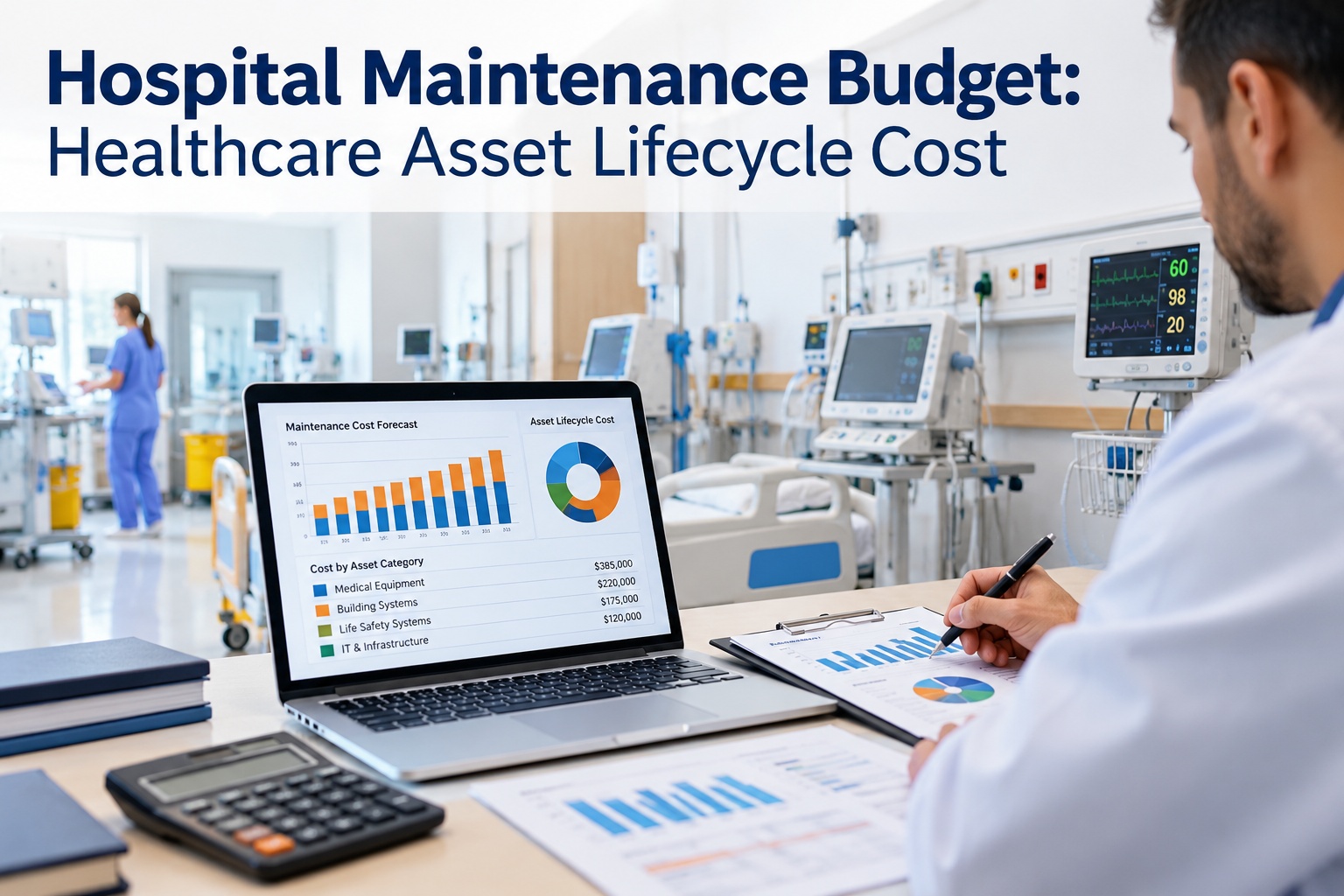
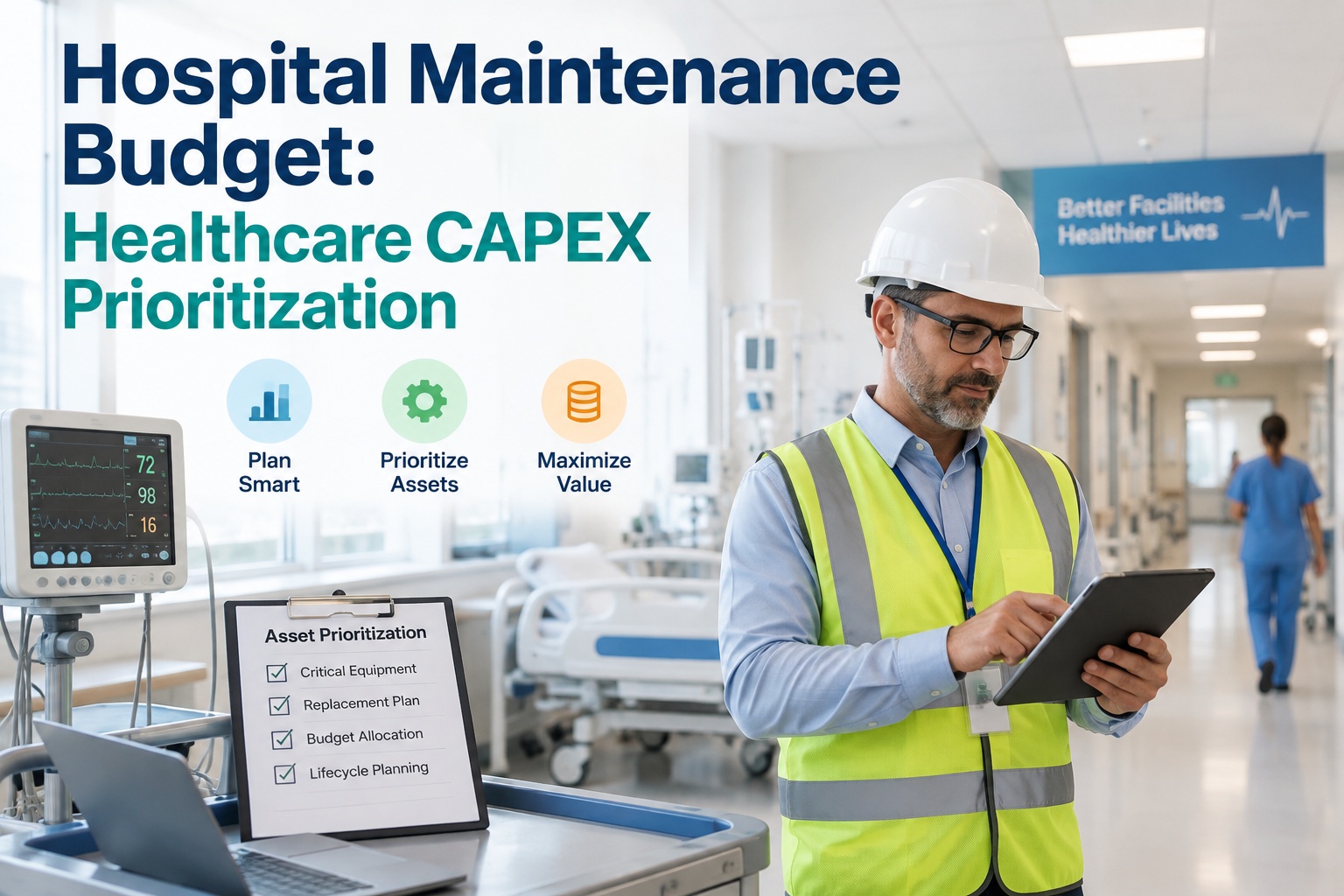
Hospital maintenance budgeting is one of the least glamorous — and most consequential — decisions a healthcare operations leader makes each year. A miscalculated budget does not just drain working capital; it accelerates asset deterioration, exposes the facility to regulatory risk, and pushes deferred costs into a future CapEx crisis. This guide breaks down what leading hospitals actually spend per bed, how to structure CapEx versus OpEx allocations, and what measurable ROI looks like when you stop guessing and start managing with data. If your organization is still building maintenance budgets from spreadsheets and institutional memory, start a free trial or book a demo to see what structured asset intelligence looks like in practice.
Hospital Maintenance Budgeting Guide (2026): Cost Per Bed, CapEx Planning & ROI
Benchmarks, frameworks, and financial models for facility managers, directors of operations, and CFOs navigating healthcare asset lifecycles in a cost-constrained environment.
What Is Hospital Maintenance Budgeting?
Hospital maintenance budgeting is the structured annual and multi-year process of allocating financial resources to keep physical assets — HVAC systems, medical equipment, electrical infrastructure, plumbing, elevators, and building envelope — operational, safe, and compliant.
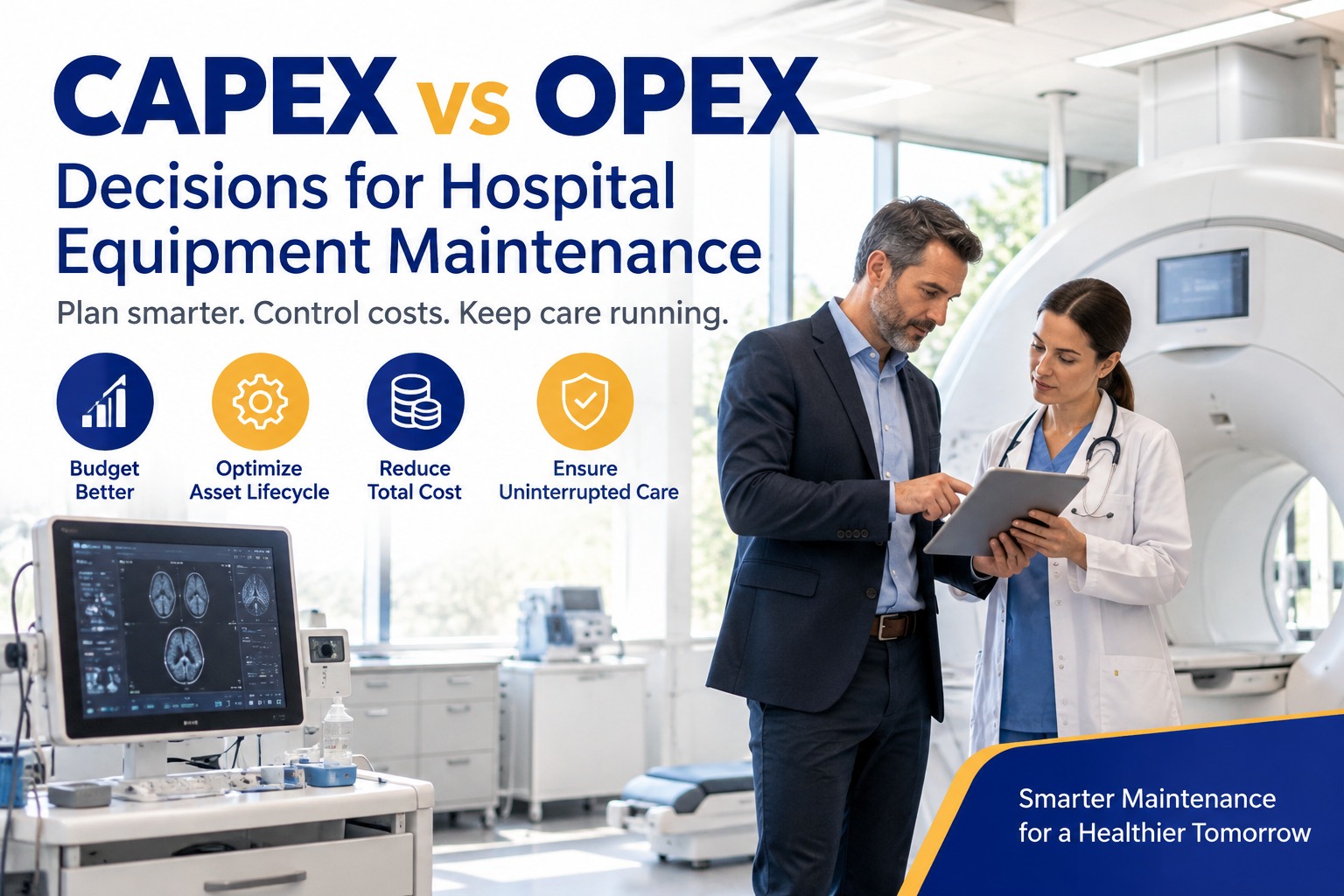
It is not simply "how much we spend on repairs." A defensible budget distinguishes between operational expenditure (OpEx) for routine and reactive maintenance, and capital expenditure (CapEx) for asset replacement or major lifecycle investment. It ties spending to asset condition, remaining useful life, and regulatory obligations — not to last year's number plus inflation.
For healthcare specifically, the stakes are clinical. An HVAC failure in an ICU, an elevator outage in a surgical wing, or a generator malfunction during a storm is not a facilities inconvenience — it is a patient safety event. Budgeting decisions made in October shape clinical risk in July. Want to build a budget model grounded in real asset data? Start a free trial or book a demo to see the Oxmaint CapEx forecasting engine.
Cost Per Bed: 2026 Benchmarks by Hospital Type
Cost-per-bed is the most widely used normalization metric in healthcare facility management. It allows comparison across institutions regardless of size. Here is where leading systems land in 2026:
| Hospital Type | Annual OpEx / Bed | Annual CapEx / Bed | Total Maintenance / Bed | Key Driver |
|---|---|---|---|---|
| Community Hospital (<200 beds) | $1,200–$1,800 | $400–$700 | $1,600–$2,500 | Aging building stock, limited FTE |
| Regional Medical Center | $1,500–$2,200 | $600–$900 | $2,100–$3,100 | High equipment density, compliance load |
| Academic Medical Center | $2,000–$2,800 | $800–$1,200 | $2,800–$4,000 | Research lab infrastructure, 24/7 operations |
| Specialty / Surgical Center | $1,800–$2,500 | $700–$1,100 | $2,500–$3,600 | Sterile environment standards, OR uptime |
| Long-Term Care / Rehab | $900–$1,400 | $300–$600 | $1,200–$2,000 | Lower acuity, building-heavy asset mix |
| NHS Trust (UK, per bed) | £950–£1,600 | £400–£800 | £1,350–£2,400 | Aging estate, backlog maintenance pressure |
Benchmarks compiled from ASHE, BOMA Healthcare, NHS Estates, and Oxmaint portfolio data. Figures represent planned + reactive maintenance; excludes major capital projects above $500K.
The Four Pillars of a Defensible Hospital Maintenance Budget
Every budget that survives CFO scrutiny is built on the same four foundations. Miss one and you are either over-funded in one area or creating a deferred liability in another.
Why Hospital Maintenance Budgets Break Down
These are not hypothetical problems. They are patterns repeated across dozens of health systems every budget cycle — and they compound year over year.
Reactive vs. Planned Maintenance: The True Cost Comparison
The financial case for shifting from reactive to planned maintenance is not theoretical. Here is what the numbers look like across comparable 300-bed facilities.
Data from Oxmaint client portfolio and ASHE Maintenance Benchmarking Survey 2024. Results will vary by facility age, asset mix, and staffing model. Ready to run this comparison for your facility? Start a free trial and model your own numbers, or book a demo with our healthcare solutions team.
How Oxmaint Structures Hospital Maintenance Budgeting
Oxmaint is not just a work order system. It is the financial and operational foundation hospitals use to build, defend, and optimize maintenance budgets — from a single campus to a multi-site health network.
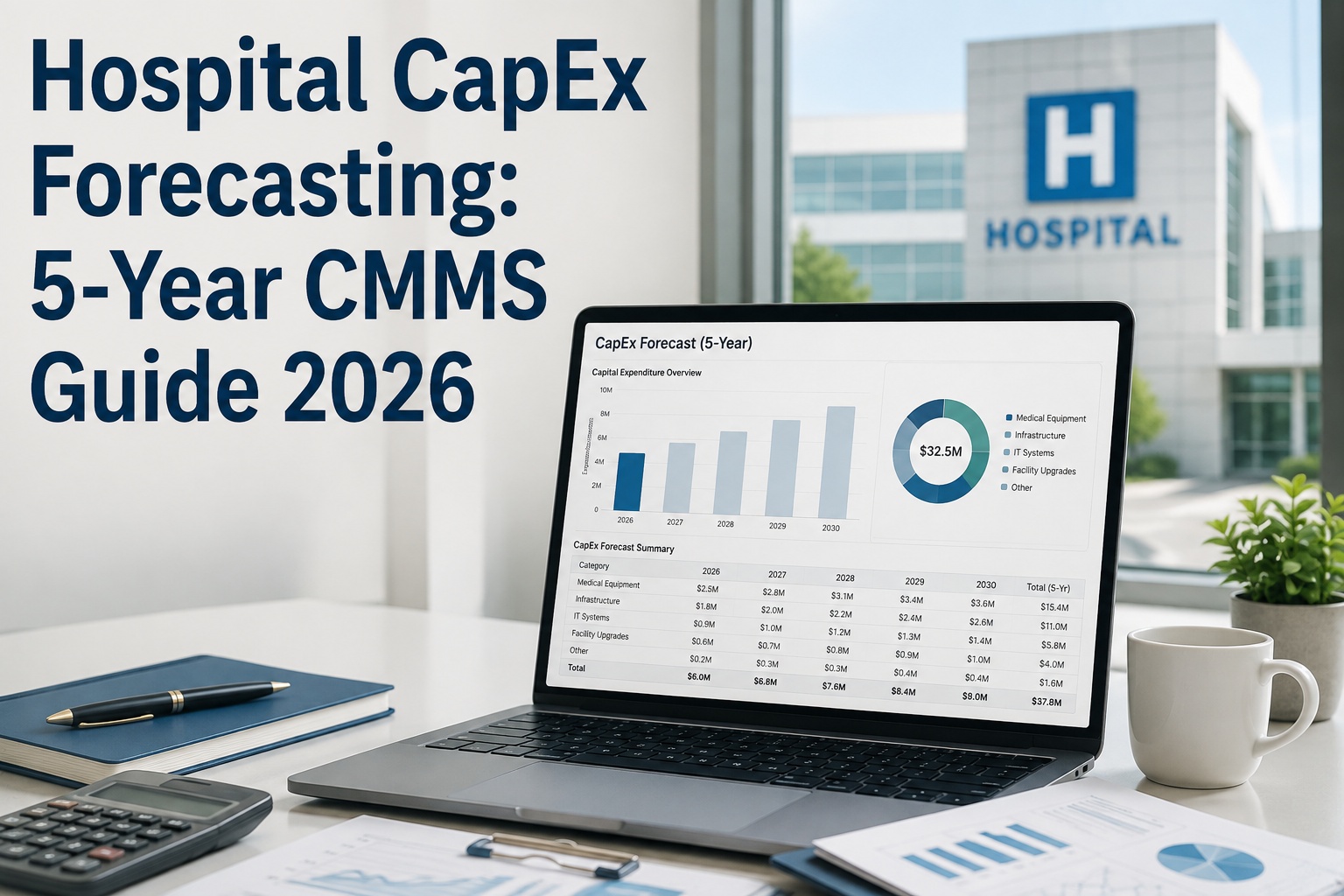
Building a 5-Year Hospital CapEx Model: Step-by-Step
Most hospitals approach CapEx planning as an annual event. High-performing systems treat it as a living model. Here is the structured process that leading facility directors use to build a defensible capital plan.
Oxmaint automates steps 1–4 and generates board-ready CapEx reports automatically from asset registry data. Teams that previously spent 6–8 weeks preparing capital presentations now generate them in under 2 hours. See this in action: start a free trial or book a demo with our team.
Measurable ROI: What Structured Maintenance Budgeting Delivers
These are not projected benefits from a vendor whitepaper. They are outcomes measured across hospitals and health systems that shifted from reactive spend management to structured asset-based budgeting.
Budgeting Pressures by Region: 2026 Snapshot
Maintenance budget pressures are not uniform across geographies. Regulatory frameworks, labor costs, and infrastructure age all shape the financial equation differently.
Budget KPIs Every Hospital Facility Director Should Track Monthly
Tracking these eight metrics monthly gives operations and finance the shared language to manage budgets proactively rather than reactively explaining variances at quarter-end.
Frequently Asked Questions: Hospital Maintenance Budgeting
What percentage of hospital revenue should go to maintenance?
Industry benchmarks suggest 2.5–4.5% of net patient revenue for combined maintenance OpEx and capital maintenance. High-performing systems with structured PM programs operate at the lower end of this range. Older facilities (20+ years) or those with high-acuity service lines (trauma, cardiac, transplant) typically fall closer to 4–5%. If your facility is below 2%, it is almost certainly accumulating deferred maintenance liability — even if the budget looks clean today.
What is a Facility Condition Index (FCI) and why does it matter for budgeting?
The Facility Condition Index is calculated as deferred maintenance cost divided by current replacement value of the asset portfolio. An FCI below 0.05 is considered "good condition." An FCI between 0.05 and 0.10 is "fair" — active management required. Above 0.10 signals critical need for capital investment. FCI is increasingly used by bond rating agencies, health system CFOs, and state health departments to assess facility risk. If you do not know your FCI, you are operating without one of the most important financial risk indicators in your portfolio.
How do you justify a maintenance budget increase to a hospital CFO?
The most effective approach combines three data points: (1) the current cost of reactive maintenance versus the projected cost of equivalent work executed as planned PM — typically a 4–5x cost differential; (2) the deferred maintenance liability and its acceleration rate — each year of deferral adds 20–30% to remediation cost; and (3) the risk of regulatory non-compliance — TJC citations for maintenance failures carry both direct costs (re-surveys, remediation) and reputational consequences. Boards respond to financial exposure quantification far more than to operational narratives. Build your ask around liability avoidance, not around departmental needs.
How quickly does Oxmaint deliver ROI for a hospital maintenance team?
Most Oxmaint healthcare clients see measurable impact within the first 90 days — specifically in PM compliance rates, emergency work order volume, and technician utilization. Full financial ROI (measured against maintenance cost per bed and reactive spend ratio) is typically documented at the 6–12 month mark. Because Oxmaint does not require heavy implementation fees or months of onboarding, the time-to-value is significantly shorter than legacy CMMS platforms. The asset registry and CapEx forecasting outputs are typically ready to present to a CFO within the first quarter of deployment. Your facility's results will depend on starting asset data quality, team size, and the degree of shift from reactive to planned work.
Stop Managing Maintenance From Spreadsheets and Hindsight
Oxmaint gives hospital facility teams the asset registry, CapEx forecasting, PM scheduling, and compliance documentation tools they need to build defensible budgets — and prove ROI to finance leadership. No lengthy onboarding. No heavy implementation cost. Operational from day one. Join the teams that reduced maintenance spend by 28% and cut emergency work orders by 41% using structured, data-driven asset management.