AI-Powered Hospital Mechanical Room Safety Inspection Checklist Guide

By Willam Jerry on October 12, 2026

hospital-mechanical-room-safety-inspection-checklist

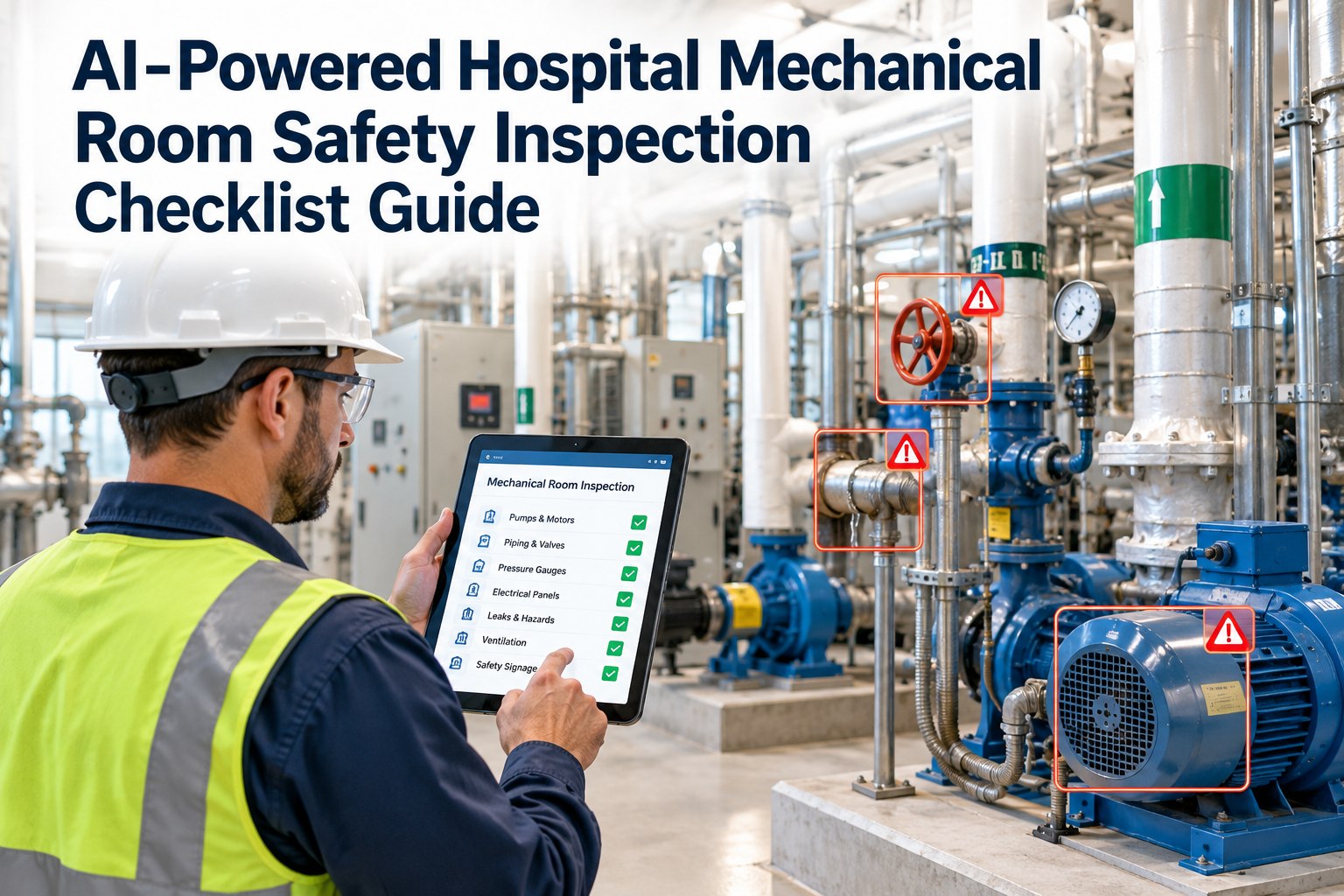
The mechanical room is the one space in a hospital almost no one sees — boilers, switchgear, pumps and chillers packed into a room most staff never enter, inspected on a periodic walk and left alone in between. That gap between inspections is where a leak spreads, a panel is blocked or combustibles pile up unnoticed. The strongest programs now run two layers: a disciplined scheduled checklist, and an AI visual layer watching between rounds. The OXMAINT AI — the AI-powered maintenance management software — runs both, and turns anything either one finds into a tracked work order.

Healthcare · Facilities Safety · Mechanical Room · AI Visual Inspection · 2026

AI-Powered Hospital Mechanical Room Safety Inspection Checklist

A disciplined walk-through checklist, plus an AI vision layer that catches the hazard the moment it appears — not at the next inspection. Tick each item, and let OXMAINT AI watch continuously, alert on a hazard and drive the corrective work order.

Two Layers, One Mechanical Room

A periodic checklist is thorough but only sees the moment it is walked; an AI vision layer is always watching but needs a human program behind it. Run together, one closes the other's gap — and that is the model this page is built on; start free and run both layers from one place in OXMAINT AI.

Layer 1
The Scheduled Checklist
Human · Periodic · Thorough
A technician walks the room on a set interval and works through every hazard category — the deep, hands-on check that confirms what a camera cannot reach.
Strength: depth and judgement
+
Layer 2
The AI Vision Layer
Automated · Continuous · Instant
Cameras watch the room between inspections and flag a leak, a blocked panel or a missing guard the moment it appears — the coverage a monthly walk cannot give.
Strength: speed and constant watch

The Mechanical Room Safety Checklist

Layer one in full — the hazard categories a thorough mechanical-room inspection walks through. Tick each item as you confirm it, and let the gaps drive the work; book a demo to run this checklist as a mobile inspection in OXMAINT AI.

01
Electrical Safety
02
Rotating & Mechanical
03
Boilers & Pressure
04
Leaks & Fluids
05
Fire, Egress & Housekeeping
06
Ventilation & Signage

What the AI Vision Layer Watches For

Layer two runs on the cameras already in the room. Between the scheduled walks, the vision models flag the hazards that cannot wait for the next inspection — each one a frame the system turns into an alert; book a demo to see AI hazard detection in OXMAINT AI.

Leaks & pooling
A spreading puddle or active drip spotted the moment it forms on the floor.
Blocked access
Clutter in front of a panel, an exit or equipment that must stay clear.
Missing guard or cover
An open electrical panel or a removed machine guard left in place.
Gauge out of range
A pressure or temperature dial read past its marked safe band.
Improper storage
Combustibles or clutter appearing in a room that must stay clear.
Smoke or flame
Early visual signs of smoke or fire, as a layer alongside the room's alarms.
1Camera sees
→
2AI flags hazard
→
3Alert sent
→
4Work order raised

The Checklist Finds It on the Round. The AI Finds It at 3 A.M.

A monthly walk is only as current as its last date — a hazard that appears the day after is loose for weeks. The OXMAINT AI maintenance management software runs the scheduled checklist and the continuous vision layer together, so whichever one catches a hazard, it becomes the same tracked, documented work order.

How OXMAINT AI Runs Mechanical Room Safety

The two layers only pay off when the checklist, the detection and the response live in one place — and that is the job the software does. Here is what the OXMAINT AI maintenance management software brings to mechanical-room safety; start free and run both layers in OXMAINT AI.

Digital inspection checklists
The hazard checklist run from a phone on the round, pass or fail captured per item.
AI visual hazard detection
Cameras flag leaks, blocked access, open panels and more between inspections.
Automated alerts
A detected hazard raises an instant alert to the right team, day or night.
Corrective-action tracking
Every finding becomes a work order assigned and followed through to closure.
Photo evidence on file
The image or inspection photo kept with the finding, so the record shows the hazard.
Compliance records
Every inspection, alert and action kept and searchable, so the room is audit-ready.

Frequently Asked Questions

What does a mechanical room safety inspection cover?
Electrical panels and clearances, rotating and mechanical equipment, boilers and pressure systems, leaks and fluids, fire and egress and housekeeping, and ventilation and signage — the core hazard categories of the room.
How does AI visual inspection work?
Cameras in the room feed vision models trained to recognise hazards — a leak, a blocked panel, an open cover — and raise an alert and a work order the moment one appears, between the scheduled human inspections.
Does the AI layer replace manual inspections?
No — it complements them. The checklist gives depth and hands-on judgement; the AI layer gives constant coverage between rounds. Together they close each other's gap, which is why the best programs run both.
What are the most common mechanical room hazards?
Blocked electrical panels and exits, fluid leaks, missing machine guards, improper or combustible storage, and poor housekeeping. Most are visible, which is exactly why continuous visual monitoring helps.
How does a CMMS tie it together?
It runs the digital checklist, takes the AI detections, raises alerts, tracks each corrective action to closure and keeps the compliance record; OXMAINT AI runs the whole mechanical-room safety program.

Watch the Mechanical Room Between the Walks, Not Just On Them.

Run mechanical-room safety inside the OXMAINT AI maintenance management software — digital inspection checklists, AI visual hazard detection, automated alerts, corrective-action tracking, photo evidence and compliance records — so a hazard is caught whether it appears on the round or at three in the morning, and every finding ends in a documented fix.
Share This Story, Choose Your Platform!