Hospital Preventive Maintenance Software: Reduce Equipment Failure and Compliance Risk
By Oxmaint on March 10, 2026
Hospital equipment doesn't get a second chance. When a ventilator fails mid-shift, an MRI goes offline before a critical scan, or a surgical suite's HVAC system drops pressure — the consequences extend far beyond repair costs. For facility and biomedical engineering teams managing hundreds of assets across a hospital campus,
start a free trial today
and discover how preventive maintenance software is the infrastructure that separates compliant, high-performing facilities from those constantly reacting to the next crisis.
4.8x
Higher cost of emergency repairs vs. planned maintenance in hospital settings
37%
Of hospital downtime incidents are linked to missed or skipped preventive maintenance
$1.4M
Average annual cost per hospital of unplanned equipment failures and emergency service calls
62%
Of Joint Commission findings cite inadequate equipment maintenance documentation as a root cause
What Is Hospital Preventive Maintenance Software?
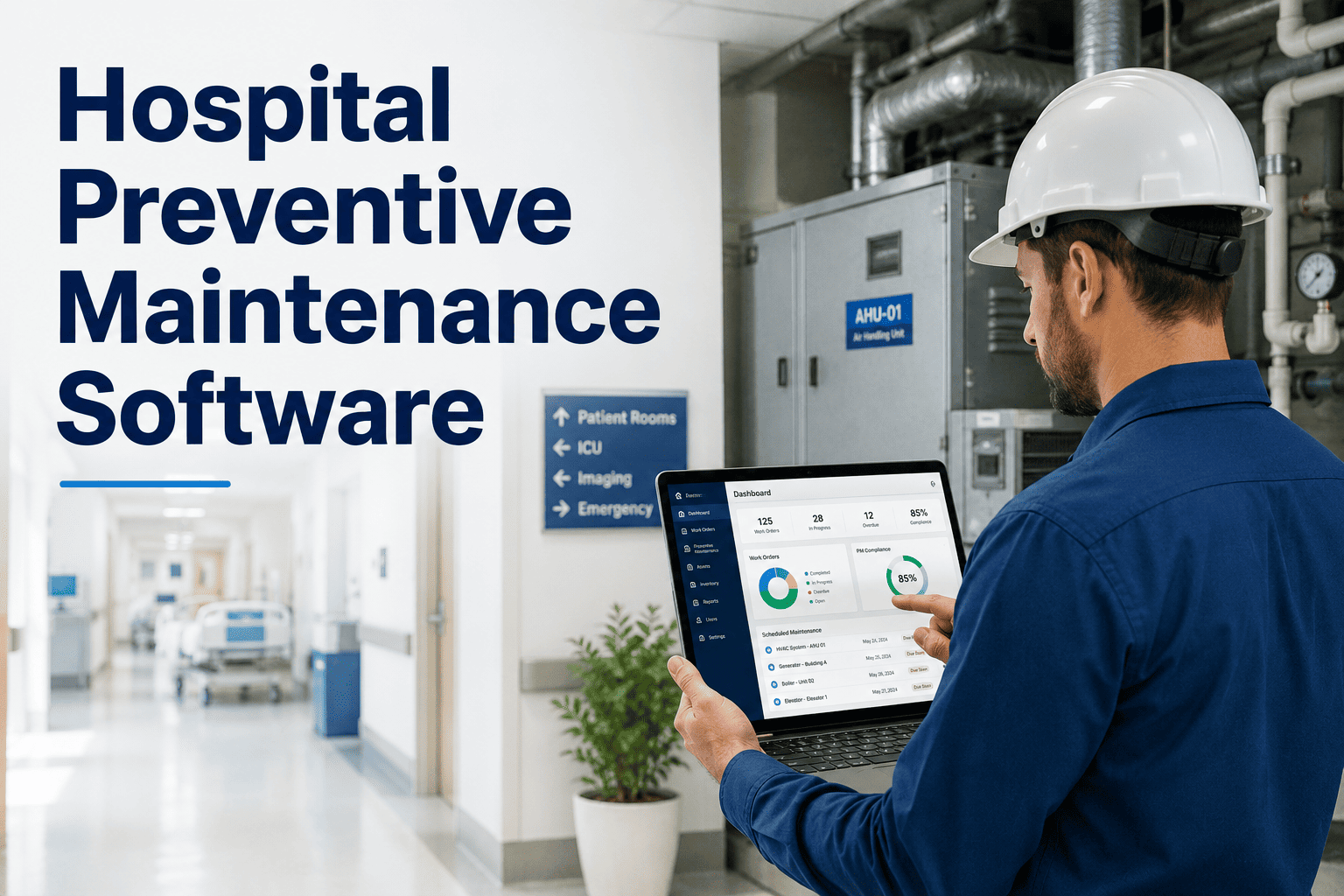
Hospital preventive maintenance software is a purpose-built platform that schedules, tracks, and documents all planned maintenance activity across medical equipment, building systems, and critical infrastructure — before failures occur. It replaces reactive, spreadsheet-driven workflows with automated scheduling tied directly to asset records, compliance calendars, and technician histories.
Unlike generic work order tools, healthcare maintenance software is built for the compliance burden that hospitals carry: Joint Commission (TJC), CMS Conditions of Participation, HTM regulatory frameworks in the UK, and OSHA standards across the US. Every PM task generates an auditable, timestamped record. Book a demo to see how audit-ready documentation works in practice.
Scheduled PM Tasks
Automatic generation of maintenance work orders based on calendar intervals, runtime hours, or usage cycles — linked to each asset record.
Compliance Documentation
Every inspection, repair, and PM task is logged with digital signatures, timestamps, and technician credentials — ready for any audit.
Asset Lifecycle Tracking
Full history from installation to disposal. Condition scoring, warranty records, and replacement forecasts on every piece of equipment.
Mobile Technician Access
Biomedical and facilities technicians log work, view asset history, and close tasks directly from mobile — no paper, no lag.
The Core Pain Points Hospitals Face Without It
Healthcare facilities operating on spreadsheets, email chains, and manual logs aren't just inefficient — they're exposed. Here are the four operational failures that drive facilities teams toward a dedicated platform. If any of these sound familiar, start a free trial and see the difference in your first week.
Reactive Maintenance Culture
Teams only respond when something breaks. No PM schedule means equipment runs to failure — and in hospitals, that failure can interrupt patient care. Studies show reactive maintenance costs hospitals 3-5x more per repair than planned work.
Audit and Compliance Exposure
Joint Commission, CMS, and NHS inspectors require documented proof that every critical asset has been maintained on schedule. Missing records — even for completed work — result in findings, citations, and in severe cases, loss of accreditation.
No Visibility Into Asset Condition
When equipment history lives in technician notebooks or disconnected spreadsheets, there is no way to forecast when a critical device will need replacement. CapEx decisions get made on gut feel, not data — leading to surprise capital requests mid-budget cycle.
Siloed Multi-Department Records
Biomedical engineering, facilities, and environmental services each track assets their own way. Across a multi-building campus, this means duplicate records, missed PMs, and no single source of truth for executive or compliance reporting.
Stop reacting. Start preventing.
Oxmaint gives hospital facilities teams the platform to manage every asset, every PM task, and every compliance record in one place. No spreadsheets. No missed schedules. No audit surprises.
Every asset — from MRI units to HVAC systems — lives in a unified registry with install date, warranty status, condition score, and full service history. Organise by building, floor, department, or system type.
Preventive Maintenance
Auto-Scheduled PM Tasks Tied to Asset Records
Set PM frequencies by calendar, runtime hours, or usage cycles. Tasks auto-generate and assign to the right technician — no manual scheduling required. PM completion rates average 94% within 30 days of Oxmaint deployment.
Compliance
Audit-Ready Documentation with Digital Signatures
Every PM task, inspection, and corrective work order is logged with technician credentials, timestamp, and digital signature. Export compliance reports for TJC, CMS, NHS, or OSHA reviews in minutes — not days.
Work Orders
Work Order Management with Full Technician History
Raise, assign, escalate, and close work orders from mobile or desktop. Every task carries the full asset context — prior repairs, parts used, labor hours. Biomedical and facilities teams work from one shared queue.
Capital Planning
Rolling CapEx Forecasting from Live Asset Data
Condition scores and maintenance histories feed directly into 5-10 year capital replacement models. Present defensible CapEx requests to CFOs and boards with data behind every line item — not estimated guesswork.
Inspections
Digital Equipment Inspections with GMP Compliance
Replace paper inspection checklists with mobile-first digital forms. Attach photos, flag failures, and auto-generate corrective work orders from inspection findings. Supports GMP and HACCP-style inspection protocols.
Inventory
Spare Parts Inventory and MRO Procurement
Track parts inventory tied to specific assets and PM tasks. Low-stock alerts prevent delays on critical repairs. Procurement workflows keep biomedical and facilities storerooms stocked without over-ordering.
Reporting
Portfolio-Level Reporting for Multi-Site Hospital Groups
For hospital networks and NHS trusts managing multiple facilities, Oxmaint aggregates maintenance KPIs, asset conditions, and compliance status across every site — from one dashboard. No manual roll-ups. No spreadsheet gymnastics.
Reactive vs. Preventive: What the Numbers Show
Operational Factor
Reactive Maintenance
Preventive Maintenance with Oxmaint
Repair Cost Per Incident
4.8x higher — emergency callouts, premium labor, expedited parts
Planned work at standard rates, parts pre-ordered and in stock
Compliance Readiness
Documentation gaps discovered at inspection — findings issued
Every task timestamped, signed, exportable — zero scramble
Equipment Uptime
Unpredictable outages disrupt clinical schedules and patient care
PM schedules extend MTBF by up to 40% on critical equipment
Asset Lifespan
Equipment replaced 20-30% earlier than optimal useful life
Condition-based lifecycle tracking maximises asset ROI
CapEx Forecasting
Surprise capital requests mid-budget cycle — board rejected or delayed
5-10 year replacement models built from live asset condition data
Technician Productivity
30-40% of shift time lost chasing paper records and status updates
Mobile-first workflows — tasks assigned, completed, and closed on device
ROI and Results: What Hospitals Report After 12 Months
94%
PM Completion Rate
Average within 30 days of full Oxmaint deployment across facility teams
31%
Reduction in Emergency Repairs
Reported by hospital facilities teams after 12 months on a structured PM program
40%
Longer Mean Time Between Failures
On critical biomedical equipment when PM schedules are consistently executed
60%
Less Time on Compliance Prep
Facilities teams spend significantly less time preparing documentation for audits and inspections
Ready to protect your patients and your budget?
Oxmaint gives hospital facilities and biomedical teams a single platform to schedule PMs, track every asset, and prove compliance on demand. Get started with a 30-day free trial — no implementation fees, no long onboarding.
Hospital maintenance compliance isn't optional — and the documentation requirements differ by region. Oxmaint is built to support the frameworks your accreditation bodies require. Whether you're preparing for a TJC survey in the US or an NHS PLACE assessment in the UK, start a free trial to see your compliance dashboard in action.
USA
Joint Commission (TJC) and CMS
Environment of Care (EC) and Life Safety (LS) standards require documented PM programs for all medical equipment and building systems. Oxmaint's audit exports map directly to EC chapter requirements.
UK
NHS HTM Standards and CQC
Health Technical Memoranda specify maintenance schedules for medical gas systems, electrical infrastructure, and clinical equipment. Oxmaint stores all HTM-required records with digital traceability.
Australia
NSQHS Standards and AS/NZS
Australia's National Safety and Quality Health Service standards require documented maintenance of high-risk equipment. Labor cost pressures make structured PM particularly high-ROI in Australian healthcare.
UAE
DHA / HAAD Smart Facility Requirements
UAE health authorities under Vision 2030 are moving toward smart building and IoT-enabled maintenance compliance. Oxmaint's IoT and SCADA integration supports real-time condition monitoring for UAE hospital networks.
Frequently Asked Questions
How does hospital preventive maintenance software differ from a generic CMMS?
A generic CMMS tracks work orders but doesn't account for healthcare-specific requirements: accreditation audit trails, biomedical equipment categories, GMP-compliant inspection protocols, or multi-building NHS/hospital campus hierarchies. Oxmaint is purpose-built for commercial and industrial operations with full compliance documentation, asset condition scoring, and CapEx forecasting — giving healthcare facilities managers the depth they need beyond basic work order tracking.
How quickly can a hospital get up and running on Oxmaint?
Most hospital teams are operational within one to two weeks. The platform requires no heavy implementation project or lengthy onboarding engagement. Asset data can be imported from spreadsheets or legacy systems, PM schedules can be configured from existing maintenance manuals, and mobile access for technicians is available immediately. Oxmaint is designed for lean facilities teams — not for organisations with dedicated IT implementation resources.
Can Oxmaint support multiple hospital buildings or a network of facilities?
Yes. Oxmaint is built for multi-site operations with an asset hierarchy that organises data at Portfolio, Property, System, Asset, and Component levels. A hospital network can maintain separate building-level views for each facility while giving senior managers and compliance officers a consolidated cross-campus dashboard. This is particularly valuable for NHS trusts, hospital groups, and healthcare REITs managing multiple sites.
Does Oxmaint integrate with IoT or SCADA systems used in hospital infrastructure?
Yes. Oxmaint supports IoT and SCADA integration for real-time condition monitoring — enabling maintenance triggers based on actual equipment readings rather than fixed calendar intervals alone. For hospital mechanical and electrical systems monitored through building management platforms, Oxmaint can receive sensor data and automatically generate condition-based PM tasks when thresholds are crossed. This is particularly relevant for UAE smart hospital initiatives and high-specification private hospital groups.
Make Equipment Failure the Exception, Not the Rule
Oxmaint gives hospital facilities and biomedical engineering teams the platform to schedule every PM, document every inspection, forecast every capital replacement, and walk into any audit fully prepared. Purpose-built for healthcare. Mobile-first. No heavy implementation. Results from week one.
.jpg)


.jpg)


