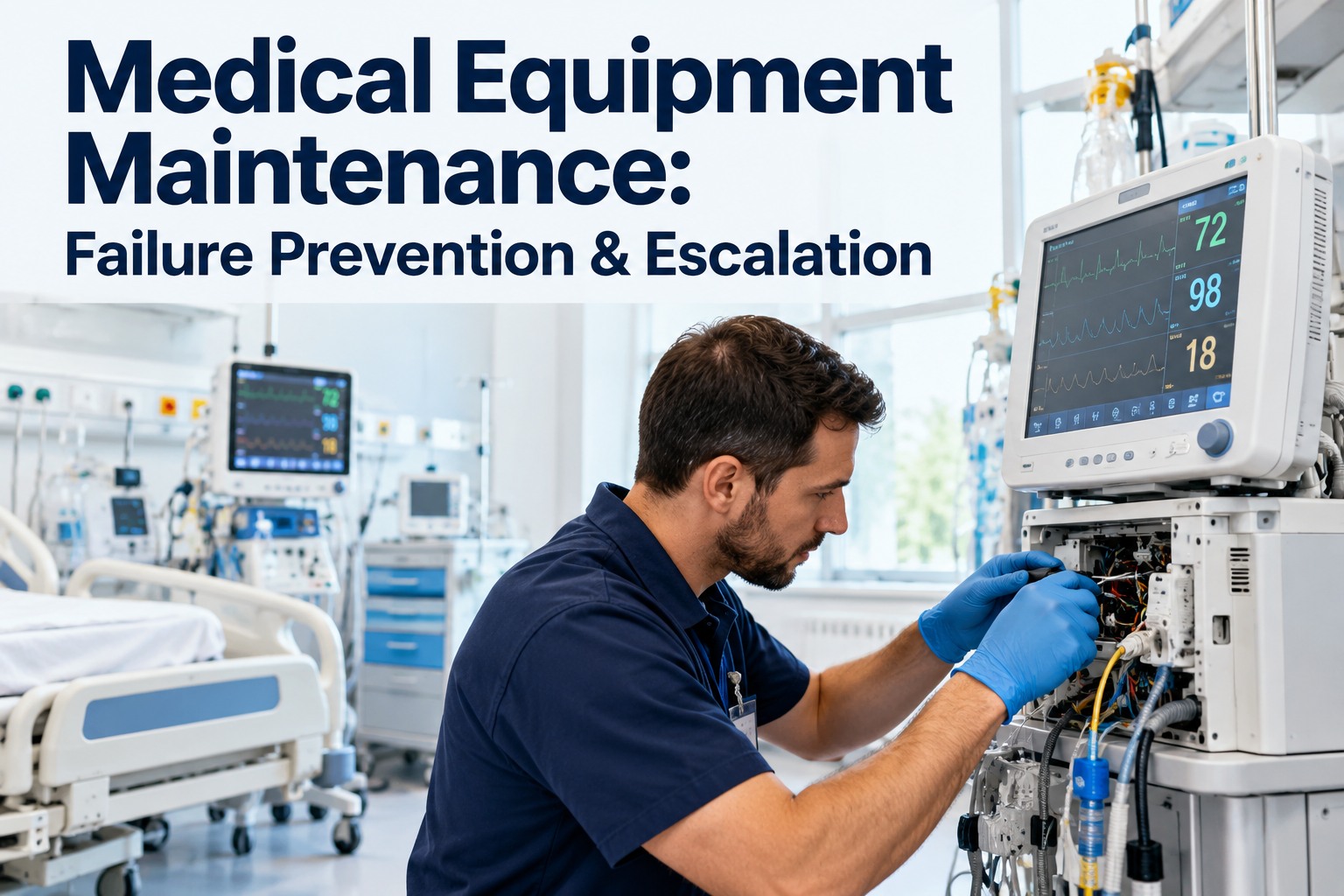
Medical Equipment Maintenance: Failure Prevention & Escalation

By Willam Jerry on October 17, 2026

medical-equipment-maintenance-failure-prevention-escalation

When a ventilator alarm fails a check, an infusion pump drifts out of tolerance or an imaging unit goes dark, the first question is never "whose job is this?" It is "how fast can we fix it, and who needs to know?" Hospitals that handle medical equipment well do two things in tandem: they prevent failures with disciplined maintenance, and they escalate the ones that still happen with a clear, fast path. This guide covers both, and shows how OXMAINT AI, the AI-powered CMMS, keeps inspections, repairs and escalations in one traceable record.

Medical Equipment Maintenance · Failure Prevention · Escalation · Downtime · Asset History

Medical Equipment Maintenance: Failure Prevention & Escalation

Prevent what you can. Escalate what you cannot. OXMAINT AI, the AI-powered CMMS and maintenance management software, helps biomedical and facility teams schedule inspections, log every fault and route urgent failures to the right person without delay.

PREVENT
Inspections, PMs, calibration records, incoming checks
+
ESCALATE
Severity triage, clear owners, fast handoffs, full record
Every Device
one register with location, owner and service history
Every Fault
logged, classified and traceable to resolution
Every Handoff
clear owners from nurse report to vendor repair
Every Record
timestamped and ready for audits and surveys

Why Equipment Failures Turn Into Bigger Problems

A single device fault rarely stays small. A missed inspection becomes an unexpected failure, a slow report becomes a cancelled procedure, and a repair with no record becomes a repeat problem. Most delays come from the same few gaps. Book a demo to see how OXMAINT AI closes them.

01
Overdue inspections
Manual trackers slip, and devices go past due without anyone noticing.
02
Slow fault reporting
Problems are passed along by phone or sticky note and lose urgency.
03
Unclear ownership
Nobody is sure whether biomedical, facilities or the vendor should act.
04
No repair history
Repeat failures go unseen because each fix lives in a different place.

Part 1: Prevent Failures Before They Reach a Patient

Prevention is a routine, not a project. Build it around three moments in a device's life, and always follow manufacturer instructions and your regulatory requirements for the interval and method. Start free and load your equipment list.

BEFORE USE
Incoming & setup
Record model, serial, location and owner
Complete incoming inspection and baseline tests
Attach manuals, warranty and service contacts
ROUTINE
Scheduled PM & checks
Auto-generate PMs at the right interval
Use standard checklists for every inspection
Log readings, calibration dates and findings
AFTER REPAIR
Verify & learn
Confirm performance before returning to service
Record cause, parts used and time to repair
Review repeat faults to adjust the PM plan

The Fastest Repair Starts With a Good Record.

When a device fails, the history should already be one click away: last service, past faults, warranty status and the right contact. OXMAINT AI keeps it all on the asset, so your team starts fixing instead of searching.

Part 2: A Failure Escalation Ladder That Works

Escalation is simply a promise: the right people hear about the right problem at the right speed. Define levels, owners and response expectations in your own policy, then let your system enforce them. Here is a practical four-level model to adapt. Book a demo to see escalation routing in OXMAINT AI.

L4
Executive & vendor escalation
Patient-impacting or long outage. Leadership informed, vendor engaged, backup plan active.
L3
Department head & clinical lead
Repair not resolved in the agreed window. Clinical teams adjust schedules and loaners.
L2
Biomedical or facilities supervisor
Technician cannot fix it on the spot. Supervisor reassigns, orders parts or calls the vendor.
L1
Technician response
Fault reported, work order created, device tagged out of service until verified.

Triage First: Match the Response to the Severity

Not every fault deserves a fire drill. A simple severity scale tells everyone how urgently to act. The examples below are illustrative, so tailor them to your facility and clinical risk policy.

SeverityExample SituationTypical Response
CRITICALLife-support or critical-care device fails a check or alarms unexpectedlyRemove from use, swap device, escalate immediately
HIGHKey diagnostic or procedure equipment goes downSame-day repair, notify department, arrange backup
MEDIUMDevice works but shows drift, noise or intermittent faultsSchedule inspection, track for repeat issues
LOWCosmetic damage or non-clinical accessory issueLog, fix at next planned visit

What Great Escalation Records Look Like

When something goes wrong, the paper trail matters almost as much as the repair. Capture the same details every time. Start free and standardize your fault reports.

✓
What happened
Device, location, symptom, who reported it and when.
✓
What was done
Actions taken, parts used, tests run before return to service.
✓
Who was informed
Escalation levels reached, with timestamps and owners.
✓
What we learned
Root cause and any change to the PM plan or checklist.

How OXMAINT AI Supports Prevention and Escalation

From the first inspection to the final sign-off, one system keeps the chain of events visible. Book a demo to walk through a live example.

◉
Equipment Register
Every device with location, specs, warranty and complete service history.
◉
Automated PM Scheduling
Inspections and checks created on time, with reminders and overdue alerts.
◉
Inspection Checklists
Reusable templates so every technician records the same details.
◉
Fast Fault Requests
Staff report issues from a phone, and the request becomes a work order.
◉
Priority & Assignment
Set severity, assign owners and reassign when a job needs to move up.
◉
AI Insights & Reports
Spot repeat failures, slow repairs and overdue tasks before they escalate.
“

Before, a fault report was a phone call and a hope. Now every request lands as a work order with an owner, and when a repair runs long the right people are already looped in. We spend far less time chasing status and far more time fixing equipment.

Biomedical Engineering Manager · Hospital Network

Frequently Asked Questions

What is medical equipment maintenance?
It is the planned inspection, testing, calibration and repair of devices used in patient care, aimed at keeping them safe, accurate and available.
How often should medical equipment be inspected?
It depends on the device, manufacturer instructions, risk level and regulatory requirements. A CMMS lets you set the right interval for each asset. Start free in OXMAINT AI.
What is failure escalation in healthcare maintenance?
It is the defined process for raising a serious or unresolved equipment fault to higher levels of responsibility, so decisions and resources arrive quickly.
Does this replace our regulatory or manufacturer requirements?
No. This guide is general information. Always follow manufacturer instructions, your facility policies and applicable regulations, and consult your clinical engineering and compliance teams.
How does healthcare CMMS software reduce downtime?
It schedules preventive work, speeds up fault reporting, routes jobs to the right owner and keeps a full history so repairs and escalations move faster. Book a demo to see it live.

Prevent the Failure. Escalate the Rest. Prove Both.

Give your biomedical and facility teams one place to schedule inspections, report faults, route urgent repairs and keep an audit-ready history. Start with OXMAINT AI and keep critical equipment available when patients need it.

Share This Story, Choose Your Platform!