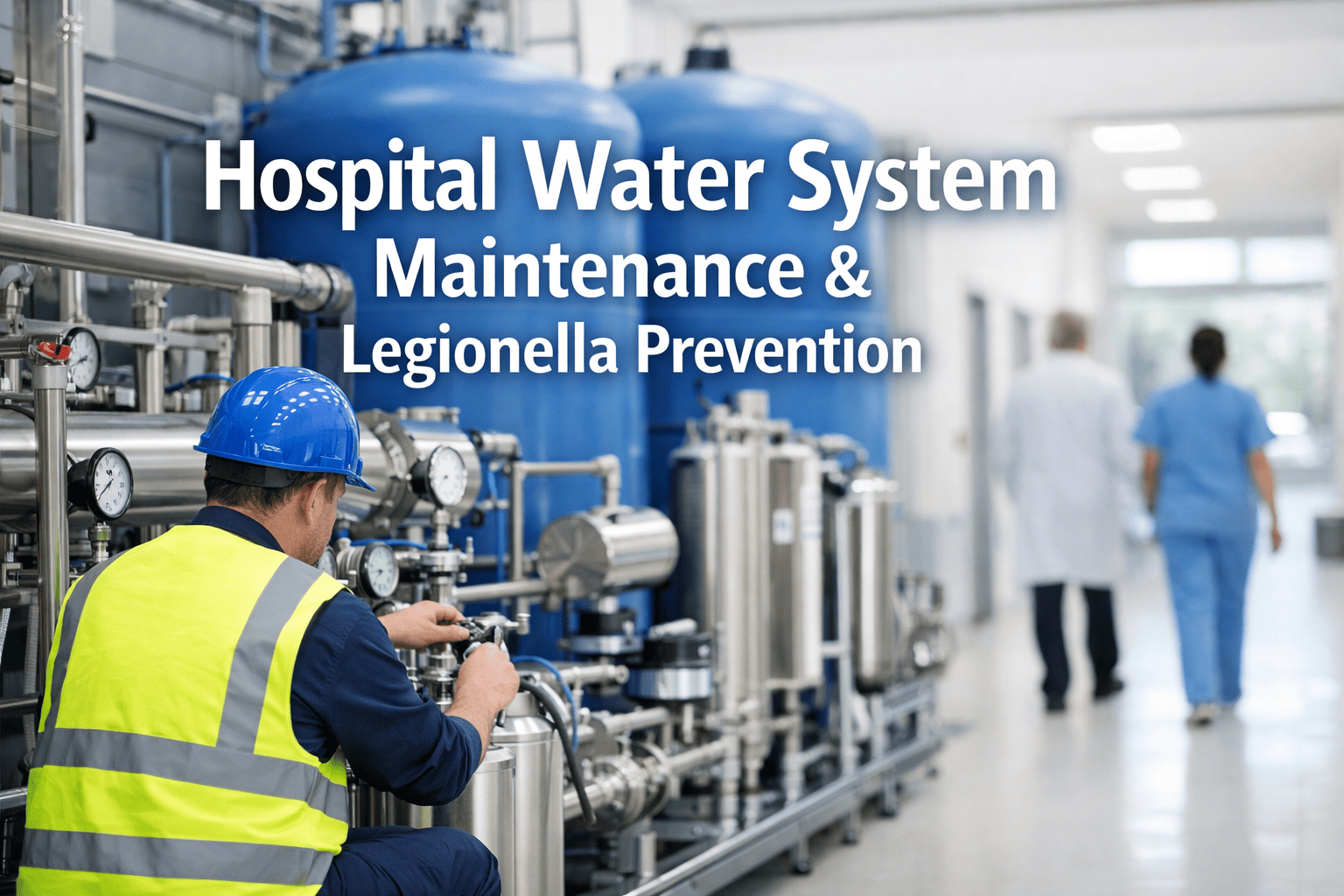
Hospital water systems are silent carriers of one of healthcare's most preventable threats. Legionella pneumophila thrives in warm, stagnant water between 77°F and 113°F — the exact conditions found inside aging hospital plumbing, cooling towers, and decorative fountains. With 8,000 to 18,000 Legionellosis hospitalizations in the U.S. each year, and hospitals accounting for a disproportionate share of outbreaks, facilities teams can no longer afford reactive water management. This checklist operationalizes ASHRAE 188 compliance into actionable inspection routines. Facilities ready to move from paper logs to automated water safety tracking can book a demo to see digital water management workflows built for healthcare compliance.
ASHRAE 188 Compliance Checklist
Hospital Water System Maintenance Checklist for Legionella Prevention
Complete water safety protocol for infection control teams and facilities managers
8,000–18,000
Annual U.S. Legionellosis Hospitalizations
CDC estimates, primarily hospital-acquired
10%
Case Fatality Rate
In immunocompromised hospital populations, up to 40%
77–113°F
Legionella Growth Range
Peak proliferation at 95–113°F in biofilm environments
57%
Outbreak Reduction
Achieved through mandatory WMP programs per CMS guidance
Foundation
What Is ASHRAE 188 and Why Does It Define Hospital Water Safety?
ASHRAE Standard 188 — Legionellosis: Risk Management for Building Water Systems — is the primary standard governing hospital water safety programs in the U.S. Published in 2015 and updated in 2018, it establishes the framework for Water Management Plans (WMPs) required by CMS since June 2017 for all healthcare facilities receiving Medicare or Medicaid funding. The standard mandates that facilities identify hazardous conditions within their water distribution systems, define control limits, establish corrective actions, and document every inspection and test with verifiable records. Non-compliance is not merely a regulatory risk — it is a patient safety failure with direct liability consequences. Want to simplify your WMP documentation? Start a free trial and see how Oxmaint centralizes water system records.
Identify water system hazards and vulnerable populations
Define control measures and acceptable limits
Monitor, respond, and document all inspections
Review and validate the WMP annually
Quick Reference
Inspection Frequency at a Glance
Daily
Hot water temperature at point-of-use
Cold water temperature sampling
Disinfectant residual readings
Weekly
Flush rarely-used outlets
Cooling tower blowdown check
Sentinel tap cultures (high-risk areas)
Monthly
Legionella culture sampling
Showerhead & faucet aerator cleaning
Ice machine inspection
Annual
Full WMP review and validation
Water system schematic update
Cooling tower full cleaning & inspection
Risk Landscape
Where Hospital Water Systems Fail
Dead Legs & Low-Flow Zones
Sections of pipe with little or no flow allow water to stagnate and warm — the #1 condition for Legionella colonization. Older hospital wings built before modern plumbing codes are high-risk zones.
Cooling Tower Drift
Cooling towers aerosolize water droplets that can travel up to 500 meters. Without regular biocide treatment and blowdown management, towers become high-volume Legionella amplifiers serving entire campuses.
Biofilm Formation
Biofilm protects Legionella from chlorine disinfection by up to 1,000 times. Once established in pipes, heat exchangers, or faucet aerators, biofilm is nearly impossible to eliminate without physical removal and thermal treatment.
Paper-Based Logging Gaps
42% of healthcare facilities still rely on paper logs for water quality tracking. Manual records miss readings, lack timestamps, and provide no early-warning capability — gaps that surveyors cite in 1 in 3 hospital water compliance audits.
Immunocompromised Patient Exposure
Transplant, oncology, and ICU wards concentrate the patients most vulnerable to Legionnaire's disease. These areas require the highest water safety vigilance — yet are often served by the same aging infrastructure as general wards.
Construction & Renovation Disruption
Pipe disturbances during renovation dislodge biofilm and introduce sediment. Without enhanced flushing and testing protocols during and after construction, hospitals see documented Legionella spikes within 2–4 weeks of major plumbing work.
Dialysis Water Requirements
Hemodialysis machines expose patients' bloodstream directly to treated water. AAMI standards require bacterial counts below 100 CFU/mL and endotoxin levels below 1 EU/mL — failures in dialysis water systems have caused multi-patient fatalities.
Ice Machine Contamination
Hospital ice is classified as a food product yet frequently overlooked in water safety programs. Contaminated ice has been linked to post-surgical infections and Legionella transmission — monthly inspection and cleaning is non-negotiable in patient care areas.
Stop Managing Water Safety on Spreadsheets
Oxmaint gives your facilities team a digital water management platform built for ASHRAE 188 compliance — automated inspection scheduling, real-time temperature logging, and survey-ready documentation in one place.
Complete Inspection Protocol
Hospital Water System Maintenance Checklist
Facilities using digital inspection platforms — start a free trial complete these checks faster, maintain audit-ready records, and automatically flag out-of-range readings before they escalate.
01
Hot Water System Temperature Control
Daily Readings
Monthly Audit
Why it matters: Legionella is killed within 2 minutes at 140°F but survives indefinitely at 77–113°F. Temperature failure is the single most common precursor to hospital Legionella outbreaks.
02
Cold Water System Temperature Monitoring
Daily Readings
Weekly Spot Checks
Why it matters: Cold water above 68°F creates optimal Legionella growth conditions. Buildings with poor cold water insulation can see point-of-use temperatures exceed 80°F during summer months.
03
Disinfectant Residual Testing
Daily
Monthly Culture
Why it matters: Low disinfectant residuals allow Legionella proliferation even in systems with correct temperatures. Monthly cultures provide early-warning data before an outbreak occurs.
04
Cooling Tower Maintenance
Weekly Biocide
Quarterly Cleaning
Why it matters: Cooling towers are responsible for 85% of community Legionella outbreaks traced to buildings. A single neglected tower can expose thousands of patients and staff through aerosol drift. Book a demo to see how Oxmaint schedules and tracks cooling tower protocols automatically.
05
Flushing Protocol — Rarely Used Outlets
Weekly
Post-Shutdown
Why it matters: Stagnant water in dead legs warms to ambient temperature within hours. Outlets in vacant rooms, discharge lounges, and seldom-used bathrooms consistently test positive at higher Legionella rates than active outlets.
06
Showerhead, Faucet Aerator & Point-of-Use Filter Management
Monthly Cleaning
Quarterly Replace
Why it matters: Showerheads and aerators concentrate biofilm and aerosolize Legionella directly at the patient's face. Studies show showerheads can harbor 10x higher Legionella concentrations than the pipes feeding them.
07
Dialysis Water Quality Compliance
Daily Testing
Monthly Culture
Why it matters: Dialysis patients receive 300–400 liters of water exposure per treatment. Contaminated dialysate directly contacts the bloodstream — bacterial or endotoxin failures cause pyrogenic reactions and sepsis.
08
Ice Machine & Decorative Water Feature Inspection
Monthly
Consider Elimination
Why it matters: Hospital ice machines have been linked to Legionella outbreaks in immunocompromised patients. Many facilities have eliminated decorative fountains following CDC guidance — the infection prevention benefit of removal consistently outweighs the aesthetic cost.
Before vs After
Reactive Water Management vs ASHRAE 188 Water Management Plan
| Program Element | Reactive Approach | ASHRAE 188 WMP |
|---|---|---|
| Temperature Monitoring | Checked when complaints arise or during annual inspection | Daily sentinel tap readings with timestamped digital logs |
| Legionella Testing | Tested only after a suspected case is identified | Monthly culture schedule per approved sampling plan |
| Cooling Tower | Annual clean when budget allows — biocide treatment ad hoc | Weekly biocide, quarterly physical inspection, annual full clean |
| Flushing Program | No formal schedule — vacant rooms flushed only on complaints | Weekly flushing of all low-use outlets, logged per outlet ID |
| Documentation | Paper logs, often incomplete — data unavailable during surveys | Digital records, searchable history, auto-generated compliance reports |
| Outbreak Response | Crisis management — source unknown, response delayed 48–72 hours | Predefined response tiers activated automatically on positive culture |
| Average Outbreak Cost | $1.2M–$4.5M per event (legal, remediation, reputational) | Prevention program cost: $40K–$120K annually |
| Regulatory Status | Non-compliant with CMS Conditions of Participation | Fully compliant — survey-ready documentation always available |
How Oxmaint Solves It
A Purpose-Built Platform for Hospital Water Safety Compliance
Scheduling
Automated Inspection Dispatch
Oxmaint auto-generates daily, weekly, monthly, and annual water safety tasks based on your WMP schedule — no manual planning, no missed cycles, no paper chase.
Data Capture
Digital Temperature & Residual Logging
Field technicians log readings on mobile — timestamped, GPS-tagged, and immediately flagged if out of range. No transcription errors. No after-the-fact fill-ins. Ready for any survey.
Culture Tracking
Legionella Sample Management
Track every sample from collection through lab result with chain of custody documentation. Automated escalation alerts when results approach or exceed action thresholds.
Asset Registry
Full Water System Inventory
Map every outlet, tank, cooling tower, TMV, and filter to your facility layout. Maintenance history and inspection results attached at the asset level — not buried in spreadsheets.
Compliance
One-Click Audit Documentation
Generate complete ASHRAE 188, CMS, and Joint Commission documentation packages in minutes — not days. Present structured evidence to surveyors with no scramble.
Response
Tiered Corrective Action Workflows
When readings exceed control limits, Oxmaint triggers predefined corrective action workflows — task assigned, deadline set, escalation path documented before the surveyor asks. Start a free trial and see it in action.
Multi-Site
Portfolio-Wide Water Safety Visibility
Manage water compliance across multiple hospitals, clinics, and care facilities from a single dashboard. Benchmark performance, identify at-risk sites, and report to leadership in one view.
Integrations
IoT & SCADA Data Integration
Connect building management systems and IoT temperature sensors to push real-time data into Oxmaint — eliminating manual readings entirely in high-priority areas like cooling towers and hot water systems.
ROI of a Structured Hospital Water Safety Program
57%
Outbreak Reduction
Documented by CMS following mandatory WMP implementation in healthcare settings
$1.2M+
Average Outbreak Cost Avoided
Per Legionella outbreak event — legal, remediation, patient harm liability combined
4.8x
Emergency vs Planned Repair Cost
Reactive water system failures cost 4.8x more than planned preventive maintenance
72 hrs
Typical Outbreak Response Time
Reduced to under 4 hours with predefined WMP response protocols and digital logs
Frequently Asked Questions
ASHRAE 188 & Hospital Water Safety: Common Questions
What does ASHRAE 188 actually require a hospital to do?
ASHRAE 188 requires healthcare facilities to develop and implement a formal Water Management Plan (WMP). This includes: assembling a WMP team with facilities, infection prevention, and administration representation; creating a water system schematic; identifying hazard analysis control points; defining control limits for temperature, disinfectant residual, and bacterial counts; establishing monitoring schedules and corrective actions; and conducting annual WMP validation. CMS made WMPs mandatory for Medicare/Medicaid facilities in June 2017 — non-compliance risks certification loss. If your team needs support implementing a digital WMP tracking system, start a free trial of Oxmaint to see how it structures each requirement.
What temperature should hospital hot water be maintained at to prevent Legionella?
Hot water storage tanks must be maintained at or above 140°F (60°C). The distribution system return loop must not fall below 124°F (51°C) at the furthest point. Point-of-use temperatures should reach a minimum of 122°F (50°C) within 1 minute of flow at sentinel taps. Thermostatic mixing valves (TMVs) protect against scalding by blending down to 110°F (43°C) or below at patient-accessible outlets, but must be located as close to the outlet as possible to minimize the section of pipe operating at Legionella-growth temperatures.
How often should hospitals test for Legionella?
ASHRAE 188 does not specify a universal culture testing frequency — it requires a risk-based schedule defined in your WMP. Most infection control experts and the CDC recommend monthly Legionella culture sampling from a defined set of sentinel locations in high-risk areas (transplant wards, ICUs, oncology), with quarterly sampling from a broader set of outlets in standard patient areas. Enhanced testing is required immediately after any positive culture result, cooling tower shutdown and restart, major plumbing work, or following any suspected or confirmed Legionellosis case in a patient who spent time in your facility.
What documentation do Joint Commission and CMS surveyors look for in water safety audits?
Surveyors reviewing water safety compliance expect: a current, signed Water Management Plan document; evidence of WMP team meetings and annual review; daily temperature logs with technician signatures for sentinel taps; disinfectant residual records; Legionella culture results with corrective action documentation for any positives; cooling tower treatment and cleaning logs; showerhead and aerator maintenance records; flushing protocol logs for low-use outlets; and point-of-use filter installation and replacement records. Documentation must be retrievable for at minimum 3 years. Facilities using Oxmaint can generate structured compliance packages for surveyor review in under 10 minutes. Book a demo to see a live audit report demonstration.
Your Next Legionella Inspection Is Already Overdue
Every day without a structured water safety program is a compliance gap and a patient risk. Oxmaint gives your facilities team a complete digital platform to implement ASHRAE 188, automate inspection scheduling, and generate audit-ready documentation — with no heavy implementation fees and no long onboarding.