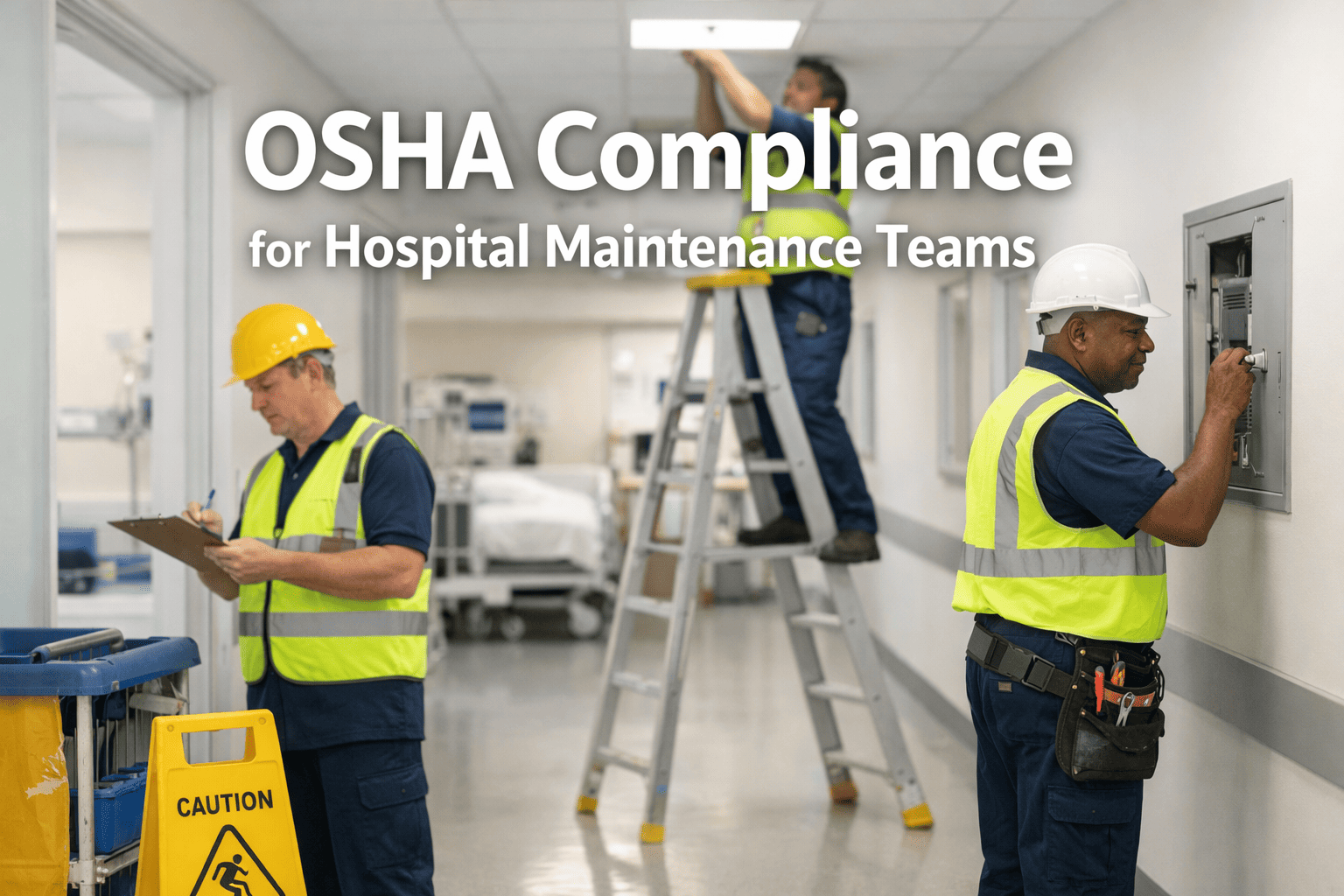
OSHA Compliance for Hospital Maintenance Teams

By Dave on April 17, 2026

osha-compliance-hospital-maintenance-teams

Your hospital maintenance team is already doing the work — isolating energy before equipment repair, responding to spills, entering mechanical rooms and utility vaults. The documentation gap is what creates the liability. A single OSHA citation for an undocumented lockout/tagout procedure at a healthcare facility costs an average $15,625 per violation, and bloodborne pathogen program failures carry potential penalties exceeding $156,000 for willful non-compliance. The risk is not in your team's competence — it is in the paper records, the missing sign-offs, and the permits that exist on clipboards but not in an auditable system. Oxmaint closes that gap permanently. Start a free trial and see every compliance obligation for your maintenance team mapped and tracked from day one.

Article OSHA Compliance for Hospital Maintenance Teams Oxmaint Editorial Team — Healthcare Facilities Compliance  |  Updated April 2026
$156K
Maximum OSHA penalty per willful bloodborne pathogen violation at a US healthcare facility
68%
Of hospital maintenance programs found with LOTO documentation gaps during routine OSHA compliance reviews
4 hrs
Average time to locate hazard communication records during an unannounced OSHA inspection — using paper-based systems
TJC
Joint Commission Environment of Care standards require documented maintenance safety programs aligned with OSHA's General Industry standards
Executive Summary

Hospital maintenance teams face four distinct OSHA compliance obligations: bloodborne pathogen exposure control, lockout/tagout energy isolation for clinical and facility equipment, hazard communication for chemical inventories, and permit-required confined space entry for utility vaults and mechanical rooms. Each carries independent documentation requirements and separate penalty exposure. Oxmaint digitizes every record, routes every permit, and delivers the audit evidence your compliance team needs — in minutes, not days.

The Four OSHA Standards Where Hospital Maintenance Teams Carry the Highest Exposure

Each standard has its own citation history in healthcare, its own documentation obligation, and its own failure mode when managed on paper. Book a strategy session to see how Oxmaint structures all four into a single compliance program for your facility.

01
Bloodborne Pathogens — 29 CFR 1910.1030
Exposure Control Plan · Annual Training Records · Sharps Log

Maintenance workers responding to plumbing failures, handling biohazardous waste infrastructure, or servicing sharps disposal systems have documented occupational exposure. OSHA requires a written Exposure Control Plan updated annually, training records per employee, and a sharps injury log maintained for 5 years. The plan must be accessible to every affected worker — on demand, not at the end of a request chain. Oxmaint hosts the live plan, tracks annual training completion per technician, and maintains the sharps log with automated 5-year retention.

Penalty Exposure: Up to $156,259 per willful violation — training record gaps and inaccessible Exposure Control Plans are the most cited failures
02
Lockout / Tagout — 29 CFR 1910.147
Energy Isolation Procedures · Annual Inspection · Technician Records

HVAC units, sterilization autoclaves, medical air compressors, elevator mechanical systems, and dietary equipment all require documented energy isolation procedures before any maintenance activity. OSHA requires a written procedure per equipment, an annual inspection of each procedure with employee sign-off, and individual technician lock records for every serviced job. Hospital LOTO failures consistently appear in OSHA's annual top-10 most cited standards because the documentation requirement is precise — and paper systems routinely fail to meet it. Oxmaint generates equipment-specific LOTO checklists, captures every lock application with technician identity and timestamp, and schedules annual procedure reviews automatically.

Penalty Exposure: $15,625 per serious violation, $156,259 per willful — LOTO ranks in OSHA's top-10 most cited standards every year
03
Hazard Communication — 29 CFR 1910.1200
SDS Accessibility · Chemical Inventory · Labeling · Training Records

Hospital maintenance departments manage disinfectants, boiler treatment chemicals, refrigerants, lubricants, and cleaning agents — each requiring a current Safety Data Sheet accessible to workers at the point of use, a maintained chemical inventory, and documented HazCom training per employee. OSHA inspectors routinely ask maintenance staff to produce an SDS for a specific chemical during an inspection. If your team cannot retrieve it within minutes, that is a citation. Oxmaint's chemical inventory module stores every SDS with QR-code access at the storage location — retrievable in under 60 seconds, on any mobile device, anywhere in the facility.

Penalty Exposure: HazCom is OSHA's most cited standard across all industries — SDS accessibility failures and incomplete chemical inventories are the primary drivers
04
Permit-Required Confined Spaces — 29 CFR 1910.146
Entry Permits · Atmospheric Testing · Rescue Plan · Attendant Records

Utility tunnels, underground electrical vaults, crawl spaces, boiler rooms with limited egress, and large HVAC plenums in hospital infrastructure commonly meet OSHA's definition of a permit-required confined space. Every entry requires a current atmospheric test record, a trained attendant on station, an entry supervisor sign-off, and a rescue plan posted at the entry point. Hospital maintenance departments frequently classify these spaces informally — and then have no documentation trail when OSHA arrives. Oxmaint generates the entry permit on mobile, captures gas readings at the entry point, and archives every permit against the space in a retrievable, timestamped record.

Penalty Exposure: Up to $156,259 per willful violation — confined space fatalities in healthcare facility maintenance have resulted in criminal referrals

Your Next OSHA Inspection Is Not Scheduled. Your Documentation Gap Is.

Oxmaint gives your compliance team a live view of every permit, training record, and chemical inventory — so the answer to an OSHA inspector's question is seconds away, not hours. Book a 30-minute strategy session to see your current documentation gaps identified before the next inspection.

Compliance KPI Benchmarks — Hospital Maintenance Programs

LOTO Procedure Currency Rate
61%

Target: 100%Below Target
Bloodborne Pathogen Training Completion
73%

Target: 100% annuallyNear Target
SDS Accessibility Compliance Rate
58%

Target: 100% at point of useBelow Target
Confined Space Permit Compliance
55%

Target: 100%Below Target
HazCom Training Record Retention
67%

Target: 100% per employeeNear Target
OSHA Inspection Readiness Score
44%

Target: 95%+Critical Gap

What Oxmaint Delivers for Hospital Compliance Leaders

Live Compliance Dashboard

Every OSHA obligation — LOTO currency, training completions, permit status, chemical inventory — visible in a single dashboard. You see the gap before the inspector does, not after.

LOTO Hard-Gate Enforcement

Work orders for clinical and facility equipment cannot advance until every isolation point is documented and every technician lock is logged — by name, timestamp, and photo. Compliance is structural, not voluntary.

SDS at Point of Use — 60-Second Retrieval

Every Safety Data Sheet linked to a QR-coded storage location. Any technician, any inspector — pulls the current SDS in under 60 seconds on any mobile device. No binders, no search delays.

Automated Training Renewal Alerts

Annual bloodborne pathogen training, HazCom refreshers, and confined space attendant recertification tracked per employee — with automated alerts 30 days before expiry. You never discover a lapse during an inspection.

OSHA-Ready Audit Export

All permits, training records, LOTO logs, and SDS access history exportable in under 2 hours for any inspection response or Joint Commission Environment of Care review. No manual assembly required.

Mobile-First Field Execution

Confined space entry permits, LOTO checklists, and incident reports completed at the work location — on any smartphone, with or without signal. Documentation happens in the field, not reconstructed afterward.

Results — Hospital Maintenance Teams Using Oxmaint

OSHA Citation Findings
Zero
OSHA citation findings in first inspection cycle post-Oxmaint deployment — versus four findings in the prior review cycle for the same facility
Training Compliance Rate
100%
Bloodborne pathogen and HazCom training completion rate within 60 days of Oxmaint activation — automated alerts closed the gap that manual HR tracking missed
Audit Preparation Time
90 min
To assemble a complete OSHA inspection response package from Oxmaint — down from 3 days of manual record gathering with the prior paper-based system
$280K
In avoided OSHA citation exposure at a regional medical center — identified by a LOTO procedure gap analysis during Oxmaint onboarding, revealing 22 equipment types without current written procedures
4 wks
From Oxmaint deployment to full OSHA program documentation active across maintenance, engineering, and environmental services — no IT project, no consultant engagement required
83%
Reduction in time spent by compliance managers on manual training record verification — from 12 hours per month to under 2 hours using Oxmaint's automated completion tracking
TJC
Joint Commission Environment of Care survey passed without findings for the first time in three survey cycles — compliance team cited Oxmaint documentation access as the primary differentiator

One Platform. Every OSHA Obligation. Always Audit-Ready.

Bloodborne pathogens, LOTO, HazCom, confined space — Oxmaint structures all four programs digitally, with mobile field execution and automated compliance tracking built in. Book a 30-minute strategy session to identify your facility's highest-exposure documentation gaps and see them closed in Oxmaint.

Frequently Asked Questions

QHow does Oxmaint handle OSHA's annual LOTO procedure inspection requirement?
Oxmaint schedules annual LOTO procedure inspections automatically per equipment, routes the review to the designated authorized employee and supervisor, captures sign-off digitally, and archives the completed inspection record against the equipment asset. The annual inspection obligation is tracked in the compliance dashboard — you see which procedures are current and which are approaching their review date, without manual calendar management. Book a demo to see LOTO annual inspection scheduling configured for your equipment inventory.
QCan Oxmaint manage bloodborne pathogen Exposure Control Plan accessibility for all maintenance staff?
Yes. The Exposure Control Plan is hosted in Oxmaint and accessible to every maintenance team member on mobile — with a timestamped access log confirming availability. Annual updates trigger a re-acknowledgment workflow, capturing each technician's confirmation that the updated plan has been reviewed. OSHA's accessibility requirement is met structurally, not by trusting that a printed binder is in the right cabinet. Book a demo to see the Exposure Control Plan accessibility module for your facility type.
QHow quickly does Oxmaint deploy across a hospital maintenance department?
Most hospital maintenance departments complete equipment LOTO procedure configuration, chemical inventory SDS upload, confined space classification, and mobile crew activation within 3 to 5 weeks — without an IT project or external consultant. Existing paper procedures serve as templates for digital configuration. Training records from prior systems can be imported to establish the compliance baseline from day one. Book a 30-minute strategy session to review the deployment timeline for your facility size and team structure.
QWhat is the financial case for a VP of Facilities or Chief Compliance Officer approving Oxmaint?
A single willful OSHA citation in bloodborne pathogens or confined space carries a maximum penalty of $156,259 — before legal costs, remediation time, and reputational impact with The Joint Commission. Oxmaint's annual program cost represents a fraction of a single citation. The secondary case is operational: compliance managers reclaim 10 or more hours per month previously spent on manual training record verification, permit filing, and audit assembly — time returned to higher-value risk management work. Book a demo to build the ROI case for your next budget approval cycle.
QDoes Oxmaint support multi-facility hospital systems with centralized compliance oversight?
Yes. Oxmaint's enterprise view gives regional compliance managers and system-level VPs a consolidated compliance dashboard across all facilities — with facility-level drill-down for LOTO currency, training completion rates, permit status, and open corrective actions. Compliance gaps at any site are visible at the system level without requiring individual facility reports. Book a demo to see multi-facility compliance visibility configured for your health system structure.

Identify Your Highest-Risk Documentation Gap — Before OSHA Does

In a 30-minute strategy session, Oxmaint's healthcare compliance team will map your current OSHA program obligations against your existing documentation — and show you exactly where the citation exposure lives. Book your session now and walk away with a prioritized compliance gap report, at no cost and no obligation.
LOTO Compliance Tracking Bloodborne Pathogen Program HazCom & SDS Management Confined Space Permits

Share This Story, Choose Your Platform!