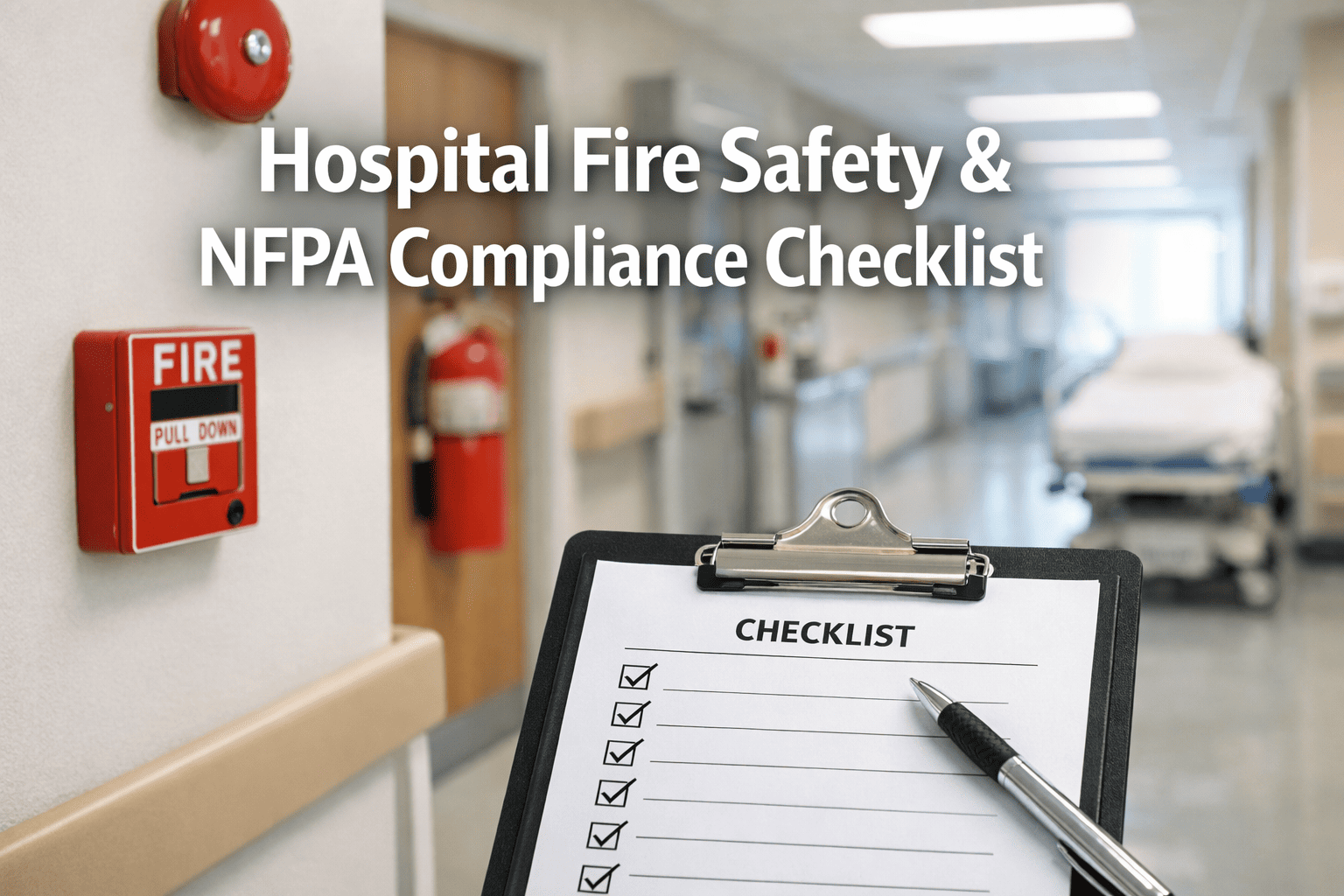
When state surveyors and CMS inspectors arrive at a hospital, they do not come to observe clinical outcomes — they come to request your NFPA 99 maintenance documentation for every Category 1 system on the floor. Medical gas piping, isolated power panels in surgical suites, emergency generators, fire suppression systems — each one carries a mandated inspection schedule under the Health Care Facilities Code, and every incomplete log entry or missed test interval becomes a compliance liability regardless of whether the equipment is functioning perfectly. The 2026 edition of NFPA 99 introduces tighter Category 1 verification intervals, expanded piped gas system testing obligations, and new accountability frameworks that paper-based maintenance programs cannot sustain at scale. Across US healthcare facilities, an estimated 52 percent of facility citations issued in 2025 trace directly to documentation failures — not equipment failures. Hospitals running structured digital maintenance operations report 40 percent fewer NFPA citations and recover hundreds of staff hours previously consumed by manual audit preparation. If your facility is ready to move from reactive compliance to a documentation framework that passes every NFPA 99 inspection on the first visit, start a free 30-day trial with Oxmaint or book a live NFPA 99 compliance framework demo with our healthcare specialists to see automated compliance tracking operating inside a real hospital environment.
NFPA 99 Hospital Maintenance Compliance: The Complete 2026 Framework Guide
Medical gas failures. Isolated power violations. Missed inspection intervals. NFPA 99 citations are driven by documentation gaps — not equipment failures. Here is the framework that ends them.
Give Your Maintenance Team a System That Documents Compliance Automatically
Oxmaint connects every NFPA 99 inspection, test record, and PM schedule into a single digital compliance trail — organized by system category, tagged by risk classification, and retrievable in seconds when surveyors arrive. Stop building binders the week before an inspection. Build a record that is always ready.
What Is NFPA 99 and Who Must Comply?
NFPA 99 — the Health Care Facilities Code — is the national standard governing the installation, inspection, testing, and maintenance of critical systems in hospitals, ambulatory surgical centers, nursing facilities, and any building classified as a healthcare occupancy under NFPA 101. Published by the National Fire Protection Association and adopted by CMS, the Joint Commission, and state licensing bodies across the United States, NFPA 99 establishes the minimum compliance baseline for medical gas and vacuum systems, electrical safety in patient care areas, emergency power systems, and fire protection infrastructure.
The defining feature of NFPA 99 is its risk-based classification system — all spaces in a healthcare facility are assigned one of four risk categories based on the likely severity of harm to a patient if a utility system fails. Category 1 spaces — operating rooms, ICUs, emergency departments — carry the most rigorous maintenance and testing requirements because a system failure there is likely to cause serious injury or death. Category 4 spaces carry minimal requirements because failure has no direct patient care impact. Every maintenance decision, PM schedule, and inspection interval is driven by the category assignment of the space being served. Want to see how Oxmaint maps your facility's risk categories to automated PM schedules? Start a free 30-day trial or book a demo with our NFPA 99 compliance team to walk through a live risk classification map.
NFPA 99 Risk Category System: The Foundation of Compliance
Every maintenance interval, test frequency, and documentation requirement in NFPA 99 flows from the risk category assigned to the space being served. Misclassifying a space — or failing to track which equipment serves which category — is itself a citation-generating error that CMMS platforms prevent automatically.
6 NFPA 99 System Areas With The Highest Citation Rates
These six system categories generate the greatest share of NFPA 99 violations in US hospitals. Each carries distinct documentation requirements, specific test frequencies, and mandatory record formats that paper-based programs consistently fail to sustain at the required standard of completeness.
4 Documentation Failures Driving NFPA 99 Citations
These are not edge cases. They are the four most commonly identified failure patterns in NFPA 99 inspections — appearing in more than half of all healthcare facility surveys conducted in 2025 and accounting for the majority of remediation costs incurred.
How Oxmaint Automates NFPA 99 Compliance Documentation
Oxmaint links every maintenance action to its governing NFPA 99 chapter, risk category, and required documentation format — generating a complete, always-current compliance record as your team works. Ready to see it running in a healthcare environment? Start a free 30-day trial or book a live NFPA 99 compliance demo to walk through actual inspection records in a hospital using Oxmaint today.
Manual NFPA 99 Compliance vs. Oxmaint-Automated Documentation
The operational and financial difference between paper-based and CMMS-automated NFPA 99 compliance is measurable in citation rates, staff hours, and remediation costs across every survey cycle.
| Compliance Area | Manual / Paper-Based | Oxmaint CMMS |
|---|---|---|
| Medical Gas Test Records | Paper logs, missing fields, unsorted by zone | Structured digital form, all fields required, auto-sorted by zone and chapter |
| Isolated Power Monthly Tests | Calendar reminders, 28% interval miss rate | Auto-triggered monthly, escalating alerts before due date, 98%+ adherence |
| Annual Inspection Prep Time | 650+ staff hours assembling documentation | Under 2 minutes — auto-generated survey package by chapter and category |
| Risk Category Tracking | Manual mapping, inconsistently applied | Automated category assignment driving PM frequencies and documentation format |
| Technician Credential Logging | Often omitted or reconstructed from memory | Digital signature captured at submission, linked to technician credentials on record |
| Emergency Generator Records | Separate spreadsheets, incomplete load data | Structured load test records with kW readings, run times, and transfer switch data |
| Documentation Citation Rate | 52% of findings are documentation gaps | 40% fewer documentation-related citations — structural gaps eliminated at record creation |
| Multi-Building Visibility | Isolated per building, no portfolio view | Unified compliance dashboard across all buildings, campuses, and sites simultaneously |
The ROI of Automated NFPA 99 Compliance
These figures reflect the operational and financial impact of replacing manual NFPA 99 documentation with CMMS-driven compliance automation across healthcare facilities in the USA, UK, Australia, and UAE — based on ASHE benchmarks and compliance consulting data.
NFPA 99 Compliance: Frequently Asked Questions
What are the most commonly cited NFPA 99 violations in hospital inspections?
The highest-frequency NFPA 99 citation categories in 2025 were piped medical gas documentation deficiencies (Chapter 5), missed monthly electrical safety tests for isolated power systems and GFCI outlets in patient care areas (Chapter 6), and incomplete emergency generator test records (Chapter 6, cross-referenced to NFPA 110). Medical gas citations typically involve missing zone valve test data, absent technician credentials on inspection records, or gaps in the quarterly testing log. Electrical safety citations most commonly involve missing or undated monthly line isolation monitor test records for Category 1 procedure rooms. Clinical equipment documentation — particularly for infusion pumps and anesthesia machines — rose significantly as a citation category in 2024 and 2025 as surveyors began cross-referencing actual service dates against manufacturer-specified PM intervals. If your facility has a compliance gap in any of these areas, start a free 30-day Oxmaint trial or book a compliance gap assessment demo to review your current documentation against NFPA 99 requirements.
How does the NFPA 99 risk category system affect maintenance scheduling?
The risk category assigned to each space in your facility directly determines the inspection frequency, documentation format, and system redundancy requirements for every utility system serving that space. A Category 1 operating room requires monthly isolated power system tests, quarterly medical gas outlet verification, and annual generator load tests with specific load data. The same generator serving only a Category 3 administrative wing carries substantially lighter documentation requirements. The challenge for maintenance teams is that a single building typically contains all four category types — and the systems serving them are sometimes shared or branch off from common infrastructure. Tracking which assets serve which risk categories, and scheduling them accordingly, is operationally impractical without a CMMS platform that maintains the asset-to-category mapping and drives PM schedules automatically from that relationship.
Can a CMMS replace manual NFPA 99 compliance binders for regulatory inspections?
Yes — and this is now standard practice at major health systems in the US and UK. NFPA 99 requires that maintenance records be maintained and available for inspection. It does not specify paper format. Digital records in a CMMS platform fully satisfy this requirement when the records are complete, include all required fields, are properly timestamped, and identify the performing technician. Surveyors from The Joint Commission, DNV, and state health departments regularly review digital compliance records presented on screens or printed from CMMS platforms — and consistently accept them as equivalent to or superior to paper binders, particularly when the digital system can filter and sort records by chapter, date, and asset more efficiently than any physical filing system. The key requirement is that every record contains all NFPA 99-required fields — which is exactly what a CMMS with correctly configured work order templates ensures by making those fields mandatory for record submission.
How long does it take to implement Oxmaint for NFPA 99 compliance in a hospital?
Most hospital facilities and biomedical teams are actively capturing compliant NFPA 99 documentation in Oxmaint within 5 to 10 business days of onboarding. The implementation sequence is straightforward: import your asset inventory with risk category assignments, configure PM schedule frequencies against NFPA 99 chapter requirements for each system type, set up work order templates with the required data fields for each inspection type, and assign technician access. Historical records from spreadsheets or paper logs can be imported to maintain continuity of the 12-month audit trail. There are no heavy implementation fees, no consultant-led onboarding phases, and no extended contracts before achieving operational compliance documentation capability. Facilities start capturing citation-proof records from day one — which means a hospital onboarding in early 2026 can walk into a Q4 survey with a complete, structured 12-month digital compliance history already built.
Stop Assembling Binders. Start Running Compliance That Is Always Inspection-Ready.
Oxmaint maps every maintenance action — medical gas tests, isolated power checks, generator exercises, fire system inspections — to its NFPA 99 chapter and risk category, generating a complete, always-current compliance record automatically as your team works. No documentation gaps. No manual audit preparation. No remediation plans from preventable findings.
Trusted by Facility Managers, Safety Officers, and Biomedical Engineers across the USA, UK, Australia, UAE, and Germany. Built for multi-site healthcare portfolios with full NFPA 99 chapter mapping, digital signatures, risk category tracking, and one-click survey reporting from day one.