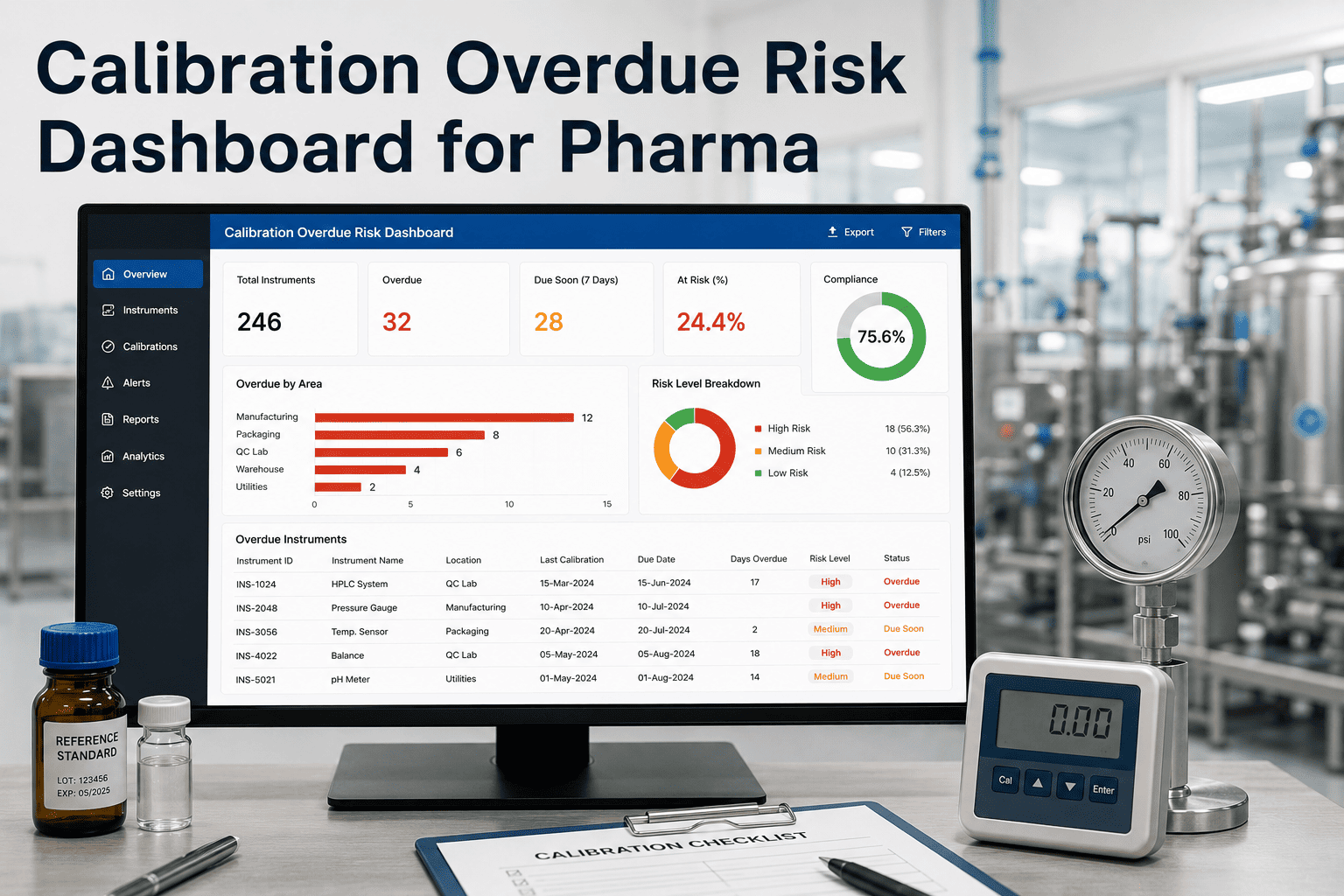
An out-of-calibration instrument discovered after a batch has already been released is not a maintenance problem — it is a regulatory crisis. Under 21 CFR Part 211.160(b)(4) and ICH Q7 Section 5.35, deviations from approved calibration standards on critical instruments must be investigated to determine their effect on every batch manufactured since the last successful calibration. In 2024–2025 FDA inspections, calibration and equipment qualification deficiencies appeared in over 68% of warning letters issued to drug manufacturers — not because calibration was skipped, but because the impact assessment, CAPA trail, and batch linkage that regulators demand were incomplete or unretrievable. Book a demo to see how OxMaint links every calibration event to its affected batches, deviation records, and CAPA history in one audit-ready workspace — or start free and connect your first GMP instrument today.
Calibration & Qualification · GMP Compliance · Batch Impact
Out-of-Calibration Impact on Pharma Batches: The Investigation Workflow Regulators Expect
What happens to batches when an instrument fails calibration, how FDA expects the impact assessment to be structured, and how a linked CMMS prevents a calibration deviation from becoming a recall or import alert.
$450K+
Average remediation cost per out-of-calibration incident
68%
FDA warning letters citing calibration deficiencies (2024–25)
21 CFR 211.160
Requires calibration at suitable intervals with documented records
ICH Q7 §5.35
Mandates batch impact investigation since last successful calibration
The Regulatory Chain Reaction — What One Failed Calibration Triggers
A single out-of-tolerance result on a critical instrument does not stay contained. It opens a mandatory investigation chain that regulators will audit end-to-end. Each stage must produce documented evidence before the next can proceed.
1
Out-of-Tolerance (OOT) Result Identified
Calibration technician finds instrument reading outside acceptance criteria. Instrument must be taken out of service immediately. All measurements recorded since the last passing calibration are now in question — not just the most recent result. The clock on investigation response time starts here.
Ref: 21 CFR 211.160(b)(4) · ICH Q7 Section 5.35
2
Lookback Period Established — "Since Last Successful Calibration"
The investigation must identify every batch, lot, or manufacturing operation where the out-of-calibration instrument was used between the last passing calibration date and the date the deviation was discovered. This lookback window can span days, weeks, or months depending on calibration interval. Without a linked asset history, identifying every affected use record is a manual, error-prone process that delays batch disposition decisions.
Ref: FDA Guidance – Investigating OOS Test Results (Level 2, 2024)
3
Batch Impact Assessment Completed
For each affected batch, the quality team evaluates whether the instrument's deviation from calibration could have affected the measurement result, and whether that measurement result, if wrong, could have affected product quality or safety. Low-risk deviations (minor drift on non-critical parameters) may result in continued release with documented justification. High-risk deviations (critical parameter, significant drift) may trigger OOS investigation, quarantine, or recall evaluation.
Ref: EU GMP Chapter 4 · 21 CFR 211.192
4
Root Cause Analysis and CAPA Executed
Root cause investigation determines whether the drift was due to mechanical wear, environmental conditions, improper handling, inadequate calibration interval, or laboratory error. A CAPA must address the specific root cause — not just recalibrate the instrument. Weak CAPA systems are cited under 21 CFR 211.192 as a frequent repeat violation because the correction does not prevent recurrence.
Ref: ICH Q10 · 21 CFR 211.192
5
Batch Disposition Decision Documented
Each affected batch receives a documented quality disposition decision: approved for release, rejected, or quarantined pending additional testing. Every decision must reference the impact assessment findings and be traceable to the original calibration deviation record. Batches released to commerce before the deviation was discovered require retrospective review and, if risk warrants, field notification to regulatory authorities.
Ref: 21 CFR 211.180 · EU GMP Annex 11
Instrument Criticality vs Batch Risk — The Decision Matrix
Not every calibration deviation carries the same batch risk. The impact assessment decision depends on two factors: how critical the instrument is to product quality, and how far its reading drifted from the acceptance limit. This matrix guides the disposition response.
| Instrument Criticality |
Minor Drift (<25% of tolerance) |
Moderate Drift (25–75%) |
Major Drift (>75% or beyond limit) |
| Critical (direct patient impact — pH, balance, HPLC) |
Documented review. Batch may be released with justified risk statement |
Full OOS investigation required. Batch quarantine pending assessment |
Batch rejection or recall evaluation mandatory. Regulatory notification may apply |
| Major (indirect impact — thermometer, pressure gauge) |
Documented notation. Release permitted with brief justification |
Risk-based assessment. Batch release with documented impact evaluation |
Full investigation. Batch disposition based on worst-case measurement scenario |
| Minor (utility or non-product-contact — environmental monitor) |
Record only. No batch impact expected |
Documented review. Batch release routine |
Assessment required. Batch release with environmental deviation justification |
Every Calibration Deviation Needs a Batch Trail. OxMaint Builds It Automatically.
OxMaint links each instrument to its calibration history, every batch record it contributed to, and every deviation it has generated — so your quality team retrieves the full investigation package in minutes, not days.
What FDA Inspectors Find — And What the Warning Letters Say
The FDA's FY 2024 enforcement record shows consistent patterns in calibration-related violations. These are not citations for missing calibration — they are citations for missing linkage, incomplete investigation, and unverifiable impact assessment.
01
Failure to Establish Lookback Period
Investigators cite firms that cannot determine which batches were produced using an out-of-calibration instrument because instrument use records are not linked to batch production records. Without this linkage, the firm cannot demonstrate that any batch produced during the affected period was unaffected — which regulators treat as an unresolved risk to every batch in that window.
21 CFR 211.68(a) — Equipment must be calibrated, inspected, and checked according to a written program with records maintained
02
Impact Assessment Concluded Without Evidence
Warning letters cite investigations that conclude "no batch impact" without supporting scientific justification. FDA expects documented worst-case analysis: if the instrument was drifted by X amount, could the affected measurement result have been outside specification? If the answer requires calculation or historical data, that data must be in the record.
21 CFR 211.192 — All unexplained discrepancies shall be investigated and conclusions recorded
03
CAPA Closed Without Verification of Effectiveness
The 2024 Viatris warning letter cited a retrospective review of three years of invalidated OOS data where CAPAs were closed on paper without verified effectiveness checks. Closing a CAPA requires evidence that the corrective action prevented recurrence — not just that the corrective action was implemented.
21 CFR 211.192 · ICH Q10 Section 3.2 — CAPA system must verify effectiveness
04
Data Integrity Failure: Paper Records Cannot Be Cross-Referenced
Inspectors increasingly place plants on Import Alert 66-40 when calibration records, batch records, and deviation records exist in separate paper systems that cannot be cross-referenced without manual reconstruction. ALCOA+ principles (Attributable, Legible, Contemporaneous, Original, Accurate, plus Complete, Consistent, Enduring, Available) require that records be immediately retrievable and traceable — a standard paper logbooks structurally cannot meet.
21 CFR Part 11 · EU GMP Annex 11 · ALCOA+ data integrity standard
Expert Review
"The calibration investigation that fails an FDA audit is almost never the one where the team didn't know the instrument was out of tolerance. It's the one where they knew, they investigated, but they couldn't produce a traceable record showing which batches used the instrument, what measurement those batches relied on from that instrument, and what the worst-case impact of the drift would have been on the measured parameter. Regulators don't require that every batch produced with an out-of-calibration instrument be rejected — they require that every batch be evaluated with documented scientific rationale. A CMMS that links the instrument to its calibration history, the batches it contributed to, and the deviation records associated with each event is not an IT project. It is the infrastructure that makes a defensible impact assessment possible in hours rather than weeks."
Dr. Anita Mehta, PhD, RAC
Regulatory Affairs Certified · 20 years pharmaceutical GMP compliance and FDA inspection readiness · Former FDA Office of Pharmaceutical Quality reviewer · Specialist in calibration deviation management and batch impact assessment methodology
Frequently Asked Questions
How far back must the impact assessment go when an instrument is found out of calibration?
ICH Q7 Section 5.35 requires investigation of every batch produced using the instrument
since the last successful calibration. The lookback period starts at the last documented passing calibration date — not the most recent use date. If the previous calibration was 6 months ago, all batches using that instrument in the intervening 6 months are in scope. OxMaint retrieves the full lookback window instantly by querying the instrument's calibration history and linked batch records.
Book a demo to see the batch-instrument linkage in action.
Can a batch be released if it was measured with an out-of-calibration instrument?
Yes — but only with documented scientific justification showing that the instrument's drift, even at its worst-case deviation, could not have produced a measurement error that would have caused the batch to fail its specification. This requires knowing the drift magnitude, the measurement value recorded, and the specification limit. If the drift was small and the measurement result was well within specification, a risk-based documented justification typically supports release. If drift was significant or the measurement result was near the limit, full OOS investigation and potential rejection apply.
What is the difference between OOS (Out-of-Specification) and OOT (Out-of-Tolerance) in pharma?
OOT (Out-of-Tolerance) refers specifically to a calibration result that falls outside the instrument's predefined calibration acceptance criteria — this is a
calibration event that triggers an instrument deviation and batch impact assessment. OOS (Out-of-Specification) refers to a batch test result that falls outside the product specification — this is a
product quality event that triggers an OOS investigation under 21 CFR 211.192. An out-of-calibration instrument can be the root cause of an OOS result, making the two investigations linked.
Start free to configure OOT and OOS investigation workflows in OxMaint.
How does OxMaint support calibration deviation investigations in GMP environments?
OxMaint links every instrument asset to its calibration schedule, calibration history, and the batch or work orders it was used in. When a calibration deviation is logged, the system identifies the lookback window, lists every batch potentially affected, and generates a structured investigation record that satisfies 21 CFR 211.192 and ALCOA+ requirements. CAPA assignment, effectiveness verification, and linked deviation closure are all tracked in the same record — producing the complete audit trail FDA inspectors expect in a single retrievable file.
A Calibration Deviation Without a Linked Batch Trail Is a Warning Letter Waiting to Be Written
OxMaint connects every GMP instrument to its calibration history, affected batch records, deviation reports, and CAPA closure — so your quality team builds an audit-ready impact assessment in hours, not days of manual record reconstruction.