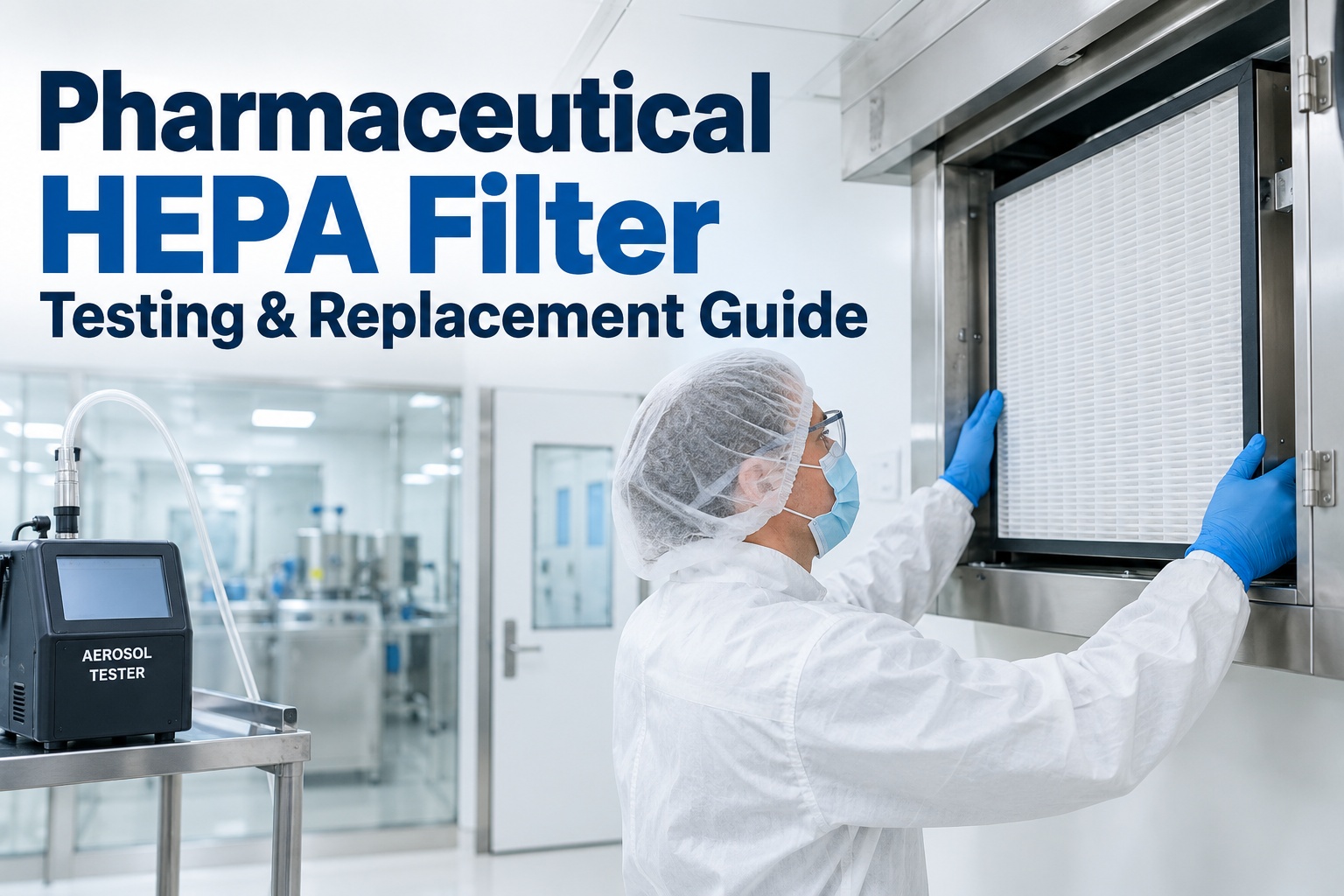
A HEPA filter's performance isn't a fixed property it ships with — it's a balance you either maintain or slowly lose across its whole service life. The same filter can hold ISO 5 on clean, uniform airflow at a sensible pressure drop, or it can quietly drift: airflow sagging, energy climbing, dead zones forming, life burning up faster than it should. Optimization is the work of keeping the filter at its best for as long as possible — and most of that work happens upstream of the filter, not on it. This guide covers HEPA filter performance optimization for pharmaceutical manufacturing: the efficiency-energy-lifespan triangle, the performance-decay curve, why pre-filtration is the biggest lever you have, airflow uniformity, and the monitoring loop that catches drift before it becomes a deviation. Start free on OxMaint to track every filter's performance against its baseline, or book a demo.
HEPA Filter Performance Optimization for Pharmaceutical Manufacturing
Peak performance isn't installed — it's maintained. And most of the maintenance happens upstream.
30–40%
fewer HEPA change-outs when facilities move to a proper multi-stage pre-filter strategy
Biggest cost
the energy to push air through HEPA banks is a major share of total cleanroom operating cost
3 demands
cleanliness, energy, and filter life pull against each other — optimization balances all three
~0.45 m/s
typical terminal HEPA face velocity for unidirectional flow — the target performance holds to
The Three Demands That Pull Against Each Other
Every HEPA performance decision is a negotiation between three things that don't want the same outcome. Push efficiency up and resistance rises, which costs energy and can starve the room of air changes. Chase energy savings and you risk falling below the airflow the room needs. Stretch filter life too far and cleanliness suffers. Optimization isn't maximizing any one corner — it's holding all three in balance, and understanding which lever moves which corner.
Cleanliness
The room must hold its ISO class — right efficiency, enough air changes to dilute particles faster than people and process generate them, uniform flow with no dead zones.
Energy
Higher-efficiency media resists airflow more, so the fan works harder. Pushing air through HEPA banks is one of the largest line items in a cleanroom's running cost.
Filter Life
Every gram of dust the HEPA catches shortens its life and raises its pressure drop. Protecting it upstream is what keeps it performing without early replacement.
The trap: chase any single corner and you lose the other two. A filter run to failure to "save money" drives up energy the whole time and risks the room's class. The win is the balance — and the balance is mostly won upstream.
How Performance Actually Decays
A HEPA filter doesn't fail on a date — it degrades along a curve. Efficiency at the most-penetrating particle size stays high, but resistance climbs as the media loads with dust, and that rising resistance is what quietly costs you. Reading the curve is how you optimize the timing of every intervention.
Fresh
Low initial resistance, full airflow at design fan speed, energy at its floor. This is the baseline every later reading is measured against — so it has to be logged at install.
Loading
Dust accumulates, resistance rises gradually, the fan ramps to hold airflow. Energy climbs invisibly here — the room still passes, but it's costing more every week.
Near Final
Resistance approaches ~2x the initial baseline. The fan is near its ceiling; airflow uniformity starts to suffer. This is the optimization decision point — plan the change now.
Overrun
Pushed past final resistance, the fan can't hold face velocity, air changes drop, and the room's class is at risk. Running here to "extend life" costs more than it saves.
Pre-Filtration · The Biggest Lever You Have
Here's the counterintuitive core of HEPA optimization: the most effective thing you can do for an expensive terminal filter is to spend a little on the cheap filters in front of it. Pre-filters catch the bulk dust that would otherwise load the HEPA, keeping its resistance low, its airflow steady, and its life long. Facilities that move to a two- or three-stage pre-filter strategy commonly cut HEPA replacement rates by 30–40% at minimal added cost.
Stage 1
Coarse Pre-Filter
Catches the large debris, lint, and bulk dust from incoming and recirculated air — the cheapest media taking the heaviest load.
→
Stage 2
Fine Pre-Filter (F7–F9)
Removes the finer particles that would embed in HEPA media. High dust-holding capacity here is what multiplies terminal-filter life.
→
Stage 3
Terminal HEPA
Arrives at the room already handling clean air, so it loads slowly, holds its pressure drop, and delivers its rated efficiency far longer.
The economics flip once you see it this way: replacing a low-cost pre-filter on schedule is how you avoid replacing an expensive terminal HEPA early. The pre-filter isn't a lesser component — it's the HEPA's life-support.
Track Every Filter Against Its Baseline — Free Forever
Sign up on OxMaint's free forever plan and log initial pressure drop, airflow, and stage for every filter in the chain. Watch resistance trend toward the change point, schedule pre-filter swaps that protect the HEPA, and keep the whole air-filtration system on one maintenance record. No card, no time limit.
Airflow · Where Performance Is Won or Lost
A filter can pass its integrity test and still underperform if the air isn't moving the way the room needs. Efficiency is only half the job; the other half is delivering clean air uniformly, at the right velocity, in the right direction. These are the airflow factors that make or break real-world performance.
Face Velocity
Terminal HEPAs for unidirectional flow run around 0.45 m/s; central AHU banks far higher. Too low and dead zones form; too high and turbulence disrupts laminar flow.
Uniformity
A smooth, even sheet of downward air sweeps particles out consistently. Uneven flow leaves pockets where particulates accumulate — a clean filter with a dirty corner.
Bypass Leakage
Even a small leak around the frame or seal lets unfiltered air past — compromising the whole system regardless of how good the media is. Installation and seal integrity matter.
Pressure Cascade
Cleaner rooms held at higher pressure so air flows outward toward less-clean zones. When a HEPA's resistance climbs, it can pull the cascade out of balance.
The Optimization Loop · Baseline to Action
Optimization is a continuous loop, not a one-time tune. You establish what "good" looks like, watch for drift, and act while the intervention is still cheap. Run this loop and performance stays near its peak; skip it and you only find out at the next certification — or the next deviation.
1
Baseline at Install
Record initial pressure drop, airflow, and velocity for every filter. Without the baseline, you can't tell drift from normal — every later reading is meaningless in isolation.
2
Monitor the Trend
Track differential pressure and airflow over time, alongside continuous particle counts that verify the room stays in its classified state during operation.
3
Act at the Right Point
Swap pre-filters on schedule, plan HEPA change-out as resistance nears 2x initial — before airflow fails, not after. The trend tells you when, not the calendar.
4
Re-Baseline & Repeat
Every new filter resets the baseline and the loop restarts — with a documented history that shows performance was managed, not assumed, for every audit.
How OxMaint Keeps Filters at Peak Performance
Optimization lives or dies on whether the trend data actually gets watched and acted on. In OxMaint, every filter's baseline, pressure trend, and change schedule sit on the same asset record as the rest of the cleanroom — so drift surfaces as a task, not as a surprise at certification.
Baseline
Logged at Install
Initial pressure drop, airflow, velocity, and stage recorded for every filter — the reference every later reading is judged against.
Trend
Pressure Toward 2x
Log differential-pressure readings and watch the curve climb — change-out forecast well before airflow ever falls out of spec.
Protect
Pre-Filter Schedule
Recurring pre-filter swaps scheduled as the cheapest lever — each one extending terminal-HEPA life and holding the whole chain's performance.
Balance
Airflow & Cascade
Face-velocity and pressure-cascade checks tracked per zone, so a loading filter that pulls the balance is caught before the room drifts.
Alert
Before the Threshold
Automated alerts fire ahead of every change point and test date — the intervention happens while it's cheap, not after a failed certification.
Prove
Performance History
A documented trend for every filter shows performance was actively managed — the record that turns a certification review into a formality.
Stop Losing Performance You Can't See
Free forever plan — no card, no time limit. Baseline every filter, trend its pressure toward the change point, schedule the pre-filter swaps that protect your HEPAs, and keep a performance history ready for any audit. Or book 30 minutes and we'll map your cleanroom's filter-optimization program end to end.
Frequently Asked Questions
What's the single most effective way to optimize HEPA performance?
Pre-filtration. Protecting the terminal HEPA with a proper two- or three-stage pre-filter chain keeps bulk dust off the expensive media, so resistance stays low, airflow stays steady, and life extends — facilities commonly cut HEPA change-outs by 30–40% at minimal added cost. It's the highest-return, lowest-cost lever available.
Why does a loading HEPA filter raise energy costs?
As the media loads with dust, its resistance to airflow climbs. To hold the room's required air-change rate, the fan has to work harder and draw more power — so a filter that still passes its class can quietly cost more in energy every week. Pushing air through HEPA banks is one of the biggest components of cleanroom operating cost.
How do I know when performance is drifting rather than normal?
You compare against the baseline logged at install. Differential pressure trending toward about 2x the initial value, airflow needing more fan speed to hold velocity, or particle counts creeping up all signal drift. Without a recorded baseline, a single reading tells you nothing — the trend is what matters.
Can a filter pass its integrity test and still underperform?
Yes. Integrity testing confirms the media and seal are leak-free, but performance also depends on airflow — face velocity, uniformity, and no bypass leakage around the frame. A perfectly intact filter can still leave dead zones or fail to hold the pressure cascade if the airflow isn't right.
Does optimizing for energy risk compromising GMP compliance?
Only if done blindly. The room must always hold its air-change rate and classified state, so energy savings can't come at the cost of airflow. Done right — through pre-filtration, timely change-outs, and low-resistance media — you cut energy while maintaining compliance, because a well-maintained filter resists airflow less.
Start free or
book a demo.