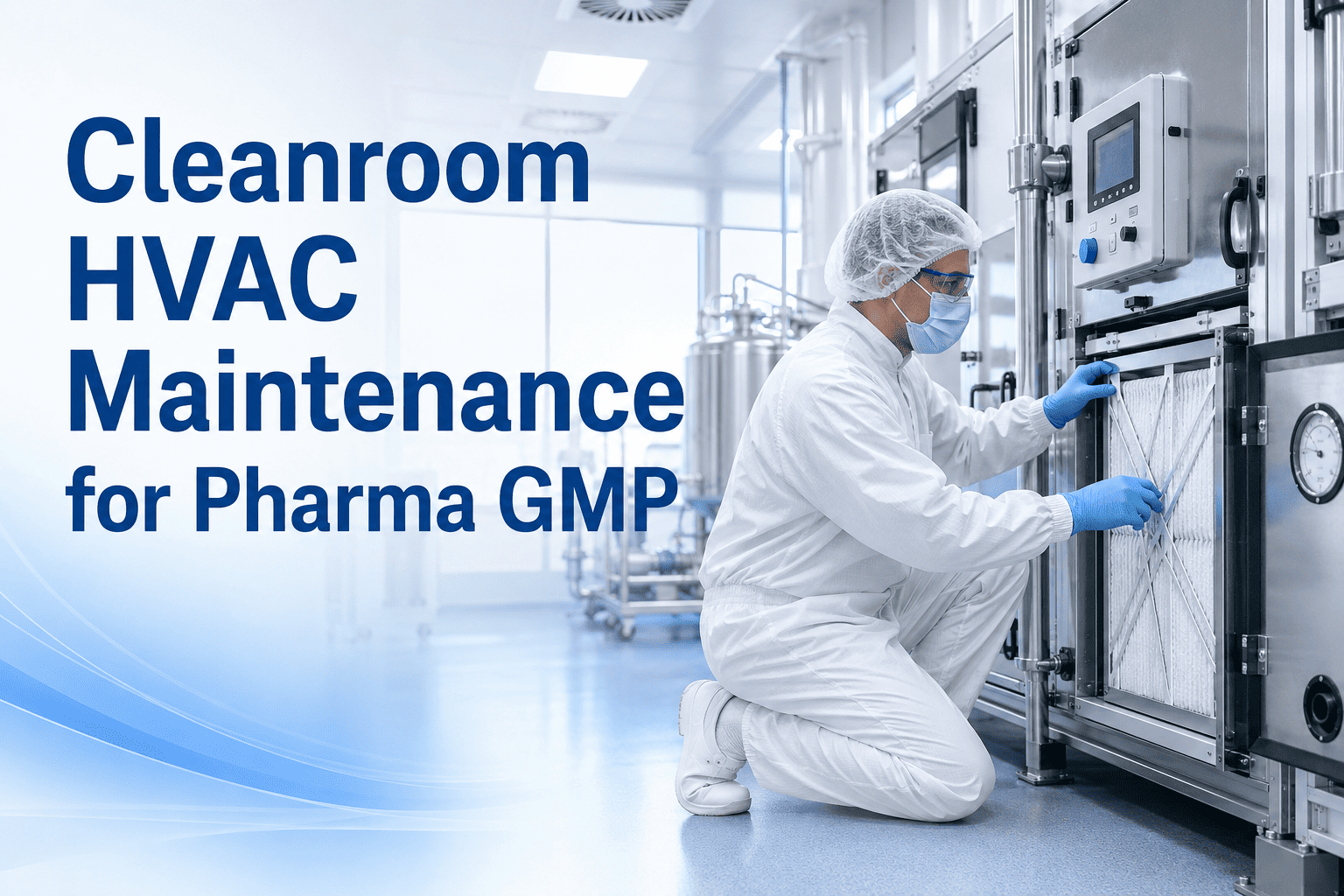
Every undetected HEPA filter leak in a pharmaceutical cleanroom carries a single-event financial exposure of $30,000–$50,000 in batch rejection costs — before factoring in the FDA 483 observation, the unplanned shutdown, or the regulatory burden that follows. Over 68% of FDA Form 483 observations in sterile manufacturing facilities cite deficiencies in cleanroom environmental monitoring and filter documentation. The filters were scheduled. The procedures existed. The failure was in the connection between field execution and a complete, defensible audit trail. Under FDA 21 CFR 211.46, EU GMP Annex 1 (2022 revision), and ISO 14644-3, HEPA filter integrity testing is not a periodic maintenance activity — it is a continuous regulatory obligation triggered by schedule, by installation events, and by any pressure spike or maintenance event affecting the filter housing. Book a demo to see OxMaint's HEPA filter maintenance workflow for pharmaceutical cleanrooms — or start free and configure your first cleanroom PM schedule today.
Guide · Cleanroom & HVAC · GMP HEPA Maintenance · ISO 14644
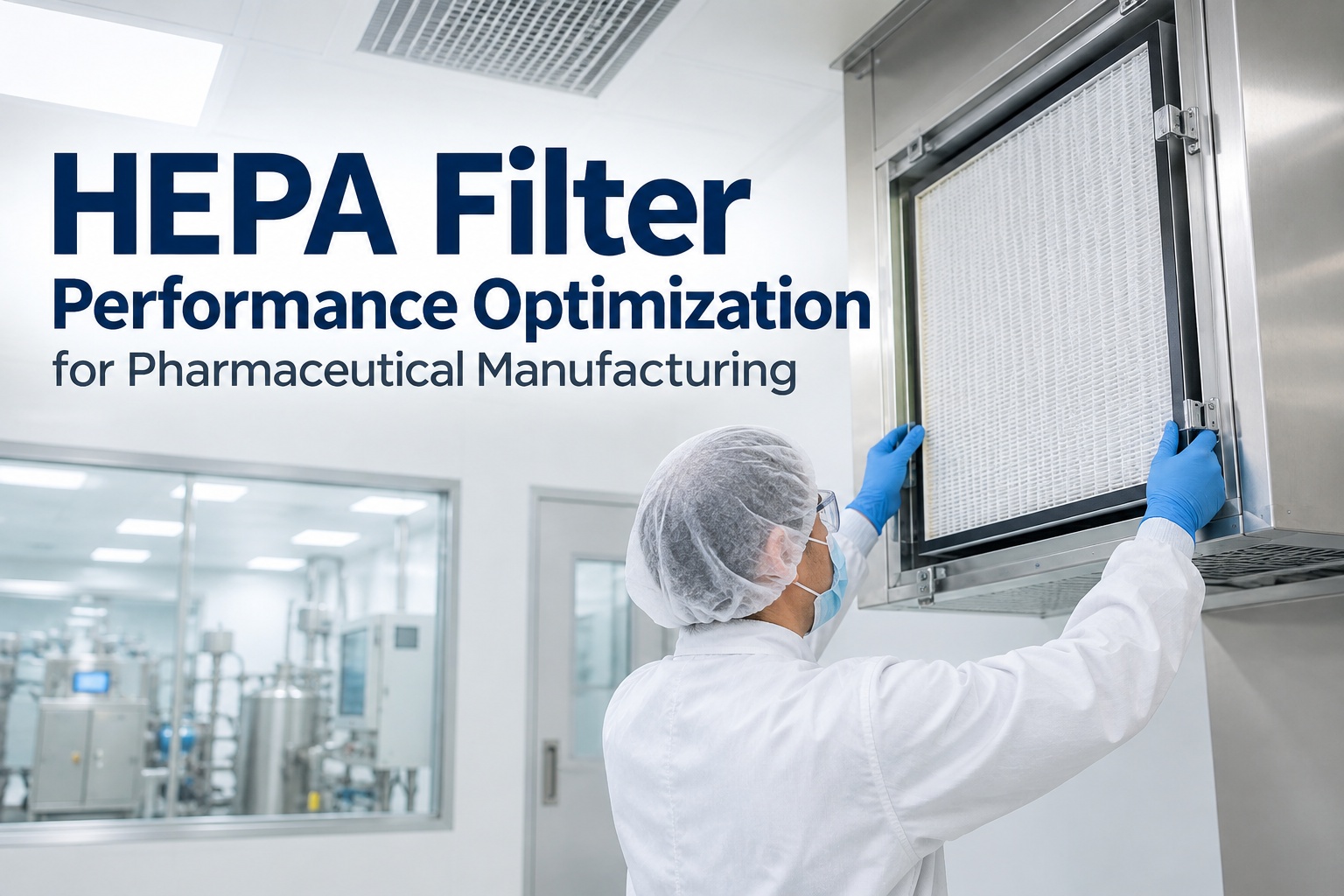
HEPA Filter Maintenance for Pharma Cleanrooms
Leak test schedules by cleanroom grade, DOP/PAO test workflow, filter replacement triggers, differential pressure management, and the documentation that makes every HEPA maintenance event audit-ready under FDA, EU GMP Annex 1, and ISO 14644-3.
$30K–$50K
Single-event batch rejection cost from undetected HEPA filter leak
68%
Of FDA 483 observations in sterile facilities cite cleanroom monitoring/filter documentation failures
6 months
Maximum leak test interval for Grade A/B and ISO Class 5 environments
HEPA Filter Testing Requirements by Cleanroom Grade and Regulatory Framework
Testing frequency is driven by cleanroom classification — not by how long the filters have been installed. The matrix below covers the four primary GMP cleanroom grades across FDA, EU GMP, and ISO frameworks, with their mandatory testing intervals and the specific regulatory authority for each requirement.
Grade A / ISO 5
EnvironmentAseptic core — open product, critical surfaces, fill/finish operations
Leak test intervalEvery 6 months minimum; after any maintenance event on filter or housing
Regulatory authorityEU GMP Annex 1 (2022) §8.63; ISO 14644-3; FDA Aseptic Guide (2004)
DP monitoringContinuous — alert limit and action limit defined; any DP excursion triggers immediate investigation
Particle requalificationContinuous active monitoring during operation; formal classification at minimum every 6 months
Grade B / ISO 7 (Background)
EnvironmentBackground environment for Grade A operations — preparation areas, aseptic gowning
Leak test intervalEvery 6 months; EU GMP Annex 1 mandates testing after any pressure spike or maintenance event regardless of schedule
Regulatory authorityEU GMP Annex 1 (2022) §4.2; ISO 14644-3 Table D.4; USP <1116>
DP monitoringContinuous; minimum 10–15 Pa positive pressure versus Grade C
Particle requalificationContinuous monitoring during operation; at rest and in operation classification every 6 months
Grade C / ISO 7–8
EnvironmentPreparation of solutions to be sterile filtered; less critical aseptic processing steps
Leak test intervalEvery 12 months; after replacement or maintenance event involving filter housing or HVAC system
Regulatory authorityISO 14644-3 §B.6 (maximum 24-month interval for ISO 7/8); EU GMP Annex 1 event-based triggers
DP monitoringContinuous; minimum 10–15 Pa positive pressure versus Grade D
Particle requalificationMonitoring during operation; formal classification every 12 months
Grade D / ISO 8
EnvironmentHandling of components before washing; preparation of products not requiring strict asepsis
Leak test intervalEvery 12–24 months; site-justified based on risk assessment; after any maintenance event
Regulatory authorityISO 14644-3 §B.6 (24-month maximum); site SOPs validated by risk assessment
DP monitoringContinuous or periodic per risk assessment; positive pressure versus general area
Particle requalificationFormal classification every 12–24 months based on risk; monitoring frequency per site SOP
DOP / PAO Integrity Test Workflow — From Preparation to Certificate
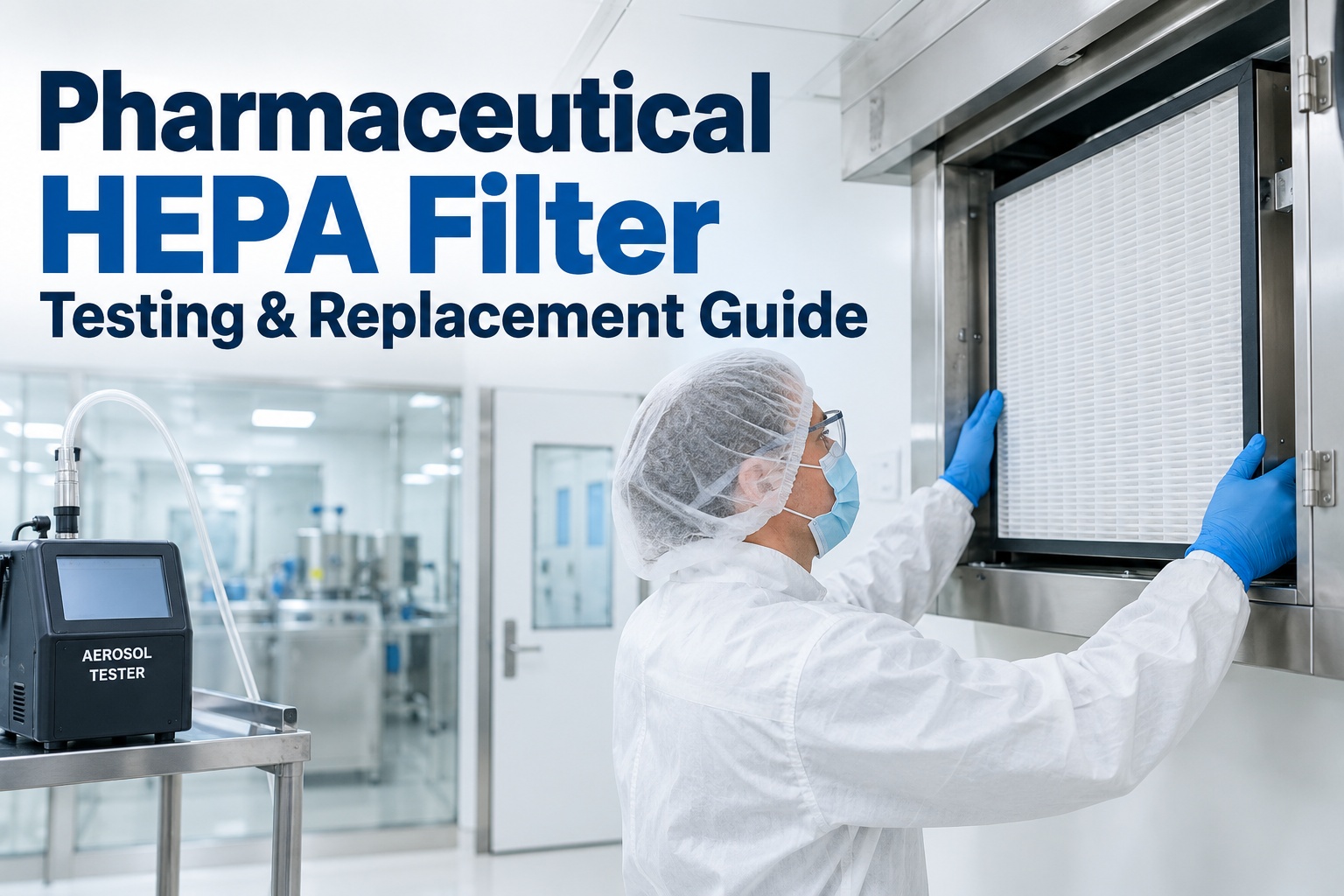
The DOP (Dioctyl Phthalate) or PAO (Polyalphaolefin) aerosol challenge test is the primary method for HEPA filter integrity testing in pharmaceutical cleanrooms under ISO 14644-3 and EU GMP Annex 1. This is the complete test workflow that must be documented at each test event.
1
Pre-test preparation and area clearance
Cleanroom cleared of product, materials, and personnel not involved in the test. Area documented as "Under Test — No Product." HVAC system confirmed at normal operating airflow. Pre-test differential pressure readings logged. Any current deviations on environmental monitoring resolved or documented before test begins.
2
Challenge aerosol generation and upstream concentration measurement
PAO or DOP aerosol generated upstream of the HEPA filter at the concentration specified in the test protocol (typically 10–80 μg/L). Upstream concentration confirmed with photometer before downstream scanning begins. Upstream concentration recorded as the reference value for penetration calculation. Concentration must remain stable ±15% throughout the test.
3
Downstream face scanning at ISO 14644-3 specified scan rate
Photometer probe traversed across the downstream face of the filter at 1–2 cm/second, 2–3 cm from the filter face, with overlapping passes covering 100% of the filter area including all frame seals and mounting hardware. Any downstream reading exceeding 0.01% of upstream concentration (ISO 14644-3 acceptance criterion) is a filter failure — not a retest trigger.
4
Pass result — document and return to service
Filter passes test: all downstream readings below 0.01% penetration. Certificate generated with: test date, technician identity, upstream concentration, maximum downstream reading, filter identification (serial number or location ID), test equipment calibration reference, and digital or wet-ink signature. Area returned to service. Next test due date calculated and scheduled in CMMS.
!
Fail result — immediate area quarantine and investigation
Any downstream reading exceeding 0.01% penetration requires immediate quarantine of the affected area. All batches processed in the zone since the last passing integrity test must be assessed for product impact. A deviation record is opened, linked to: the failing test result, the affected batches, the planned corrective action (filter replacement), and the post-replacement retest requirement. The area cannot return to GMP production until a passing retest is documented and approved by QA.
GMP HEPA MAINTENANCE · OXMAINT · ISO 14644
Every HEPA Test Is a Compliance Event. OxMaint Makes Every Compliance Event Audit-Ready.
OxMaint schedules HEPA leak tests by cleanroom grade, triggers event-based tests after maintenance events, stores test certificates against each filter asset record, generates deviation work orders automatically on test failure, and produces the compliance report that FDA and EMA inspectors request — without manual assembly.
HEPA Filter Replacement Triggers — When to Replace, Not Just When to Test
Failed integrity test
Any reading exceeding 0.01% penetration on a GMP-grade HEPA filter requires immediate replacement — no repair patches on Grade A/B filters. The filter is removed, the deviation opened, and the area quarantined until the replacement filter passes a post-installation integrity test.
Timing: Immediate — area cannot return to service until replacement test passes
Differential pressure exceeds DP limit
Filter loading — the accumulation of captured particles — increases the pressure drop across the filter over time. When DP across the filter exceeds the manufacturer's maximum design pressure (typically 600–800 Pa for HEPA), the filter must be replaced. The energy cost of overcoming the high DP also becomes a utility management issue at this stage.
Timing: At maximum DP threshold — OxMaint alert when DP reading approaches limit
Airflow velocity below design specification
As filters load, airflow velocity decreases. For Grade A environments, the required unidirectional flow velocity of 0.45 m/s ± 20% must be maintained. A filter that can no longer sustain design airflow velocity has exceeded its useful life regardless of whether it has failed an integrity test — the contamination protection it provides is compromised by insufficient air changes per hour.
Timing: When velocity falls below design minimum; semi-annual velocity verification required
Physical damage or housing integrity event
Any event that could have compromised the filter media or frame — a pressure shock, a maintenance access event that touched the filter frame, a gowning procedure violation, or visible physical damage — requires an immediate integrity test rather than waiting for the next scheduled test. EU GMP Annex 1 (2022) is explicit that event-based testing supplements scheduled testing, it does not replace the need for scheduled testing.
Timing: Immediately after the event — before the area returns to GMP production
Expert Review
"The 68% FDA 483 observation rate in sterile manufacturing for cleanroom and filter documentation failures is the number that should focus every pharmaceutical facility manager's attention on the connection between their HEPA maintenance programme and their CMMS. In every one of those observations, the regulatory finding was not that the tests were not done — in most cases, the tests were done on schedule. The finding was that the documentation was not complete, not retrievable on demand, or not connected to the batch records and deviations it was supposed to support. The EU GMP Annex 1 (2022) revision introduced a critical new requirement that has amplified this gap: the contamination control strategy must explicitly address HEPA filter integrity as a patient safety control, not just a facility maintenance activity. That means the HEPA maintenance record is no longer just a maintenance document — it is a patient safety document. It needs to be treated with the same documentation rigour as a batch record, linked to the batch records it supports, and available on demand in an audit without manual assembly. The CMMS is the system that makes that possible — if it is configured to treat HEPA maintenance as the GMP-critical function it is."
Dr. Priya Nair, PE, CCP, LEED AP
Licensed Mechanical Engineer · Certified Commissioning Professional (AABC) · LEED Accredited Professional · 16 years pharmaceutical GMP cleanroom design, validation, and HVAC qualification · EU GMP Annex 1 (2022) implementation specialist
Frequently Asked Questions
How often do HEPA filters need to be leak tested in pharmaceutical cleanrooms?
Leak test frequency is determined by cleanroom grade, not by filter age. Under ISO 14644-3 and EU GMP Annex 1 (2022):
Grade A (ISO 5) and Grade B environments require DOP/PAO integrity testing every 6 months minimum;
Grade C and D (ISO 7–8) environments require testing every 12 months, with a maximum 24-month interval under ISO 14644-3 for justified risk-based programmes. EU GMP Annex 1 additionally requires integrity testing after any filter replacement, any maintenance event affecting the filter or its housing, and after any pressure spike or HVAC event in the cleanroom. Scheduled interval testing does not eliminate event-triggered testing — both are required.
Book a demo to see how OxMaint schedules both time-based and event-triggered HEPA test work orders.
What is the acceptance criterion for a HEPA filter DOP/PAO integrity test?
The ISO 14644-3 acceptance criterion for HEPA filter integrity is a downstream penetration of not more than 0.01% of the upstream aerosol concentration at any point on the downstream face of the filter, including all frame seals and mounting perimeter. For H14-grade HEPA filters (the GMP standard for Grade A/B), this corresponds to the filter's rated efficiency of ≥99.995% for 0.3 μm particles under the ISO 29463 / EN 1822 test standard. Any single-point reading exceeding 0.01% is a test failure — it is not averaged against other readings, and there is no GMP-acceptable repair patch for Grade A/B filter media. The filter must be replaced and a post-installation retest performed.
What documentation must a HEPA filter integrity test record contain?
A compliant HEPA integrity test record under EU GMP Annex 1 and ISO 14644-3 must contain:
filter identification (serial number, location ID, installation date);
test date and technician identity with attribution;
upstream challenge concentration and aerosol type (PAO/DOP);
test equipment identification and calibration status (photometer serial number and calibration certificate reference);
scan pattern confirmation (100% coverage including frame seals);
maximum downstream reading as a percentage of upstream concentration;
pass/fail result; and
QA review signature. The record must be linked to the filter's asset record, the cleanroom area record, and any batch records associated with the test period. OxMaint generates this record template automatically when a HEPA test work order is created and stores the completed record against the filter asset ID with a tamper-evident audit trail.
Start free to configure OxMaint's HEPA test documentation workflow.
What actions are required when a HEPA filter fails an integrity test in a GMP cleanroom?
A HEPA filter test failure in a GMP environment triggers a defined set of mandatory actions: Immediate quarantine of the affected cleanroom area — no GMP production until the issue is resolved; batch impact assessment — all batches processed in the zone since the last passing test must be reviewed for potential contamination impact and a Quality decision made on disposition; deviation investigation — a formal deviation record opened and linked to the failing test, the affected batches, and the investigation outcome; corrective action — filter replacement (no repair patches on Grade A/B) followed by post-installation integrity test confirmation; and QA approval before the area returns to GMP production. The deviation must also assess whether EU GMP Annex 1 contamination control strategy documentation needs to be updated to address the root cause.
HEPA MAINTENANCE · GMP CLEANROOMS · OXMAINT
68% of FDA 483 Observations in Sterile Facilities Are Documentation Failures. OxMaint Closes That Gap.
OxMaint schedules HEPA integrity tests by cleanroom grade, triggers event-based tests automatically after maintenance events, stores PAO/DOP test certificates against each filter asset record, generates deviation work orders on failure, and produces the full compliance documentation chain that FDA, EMA, and ISO 14644-3 audits require — without manual assembly, without paper, and without gaps.