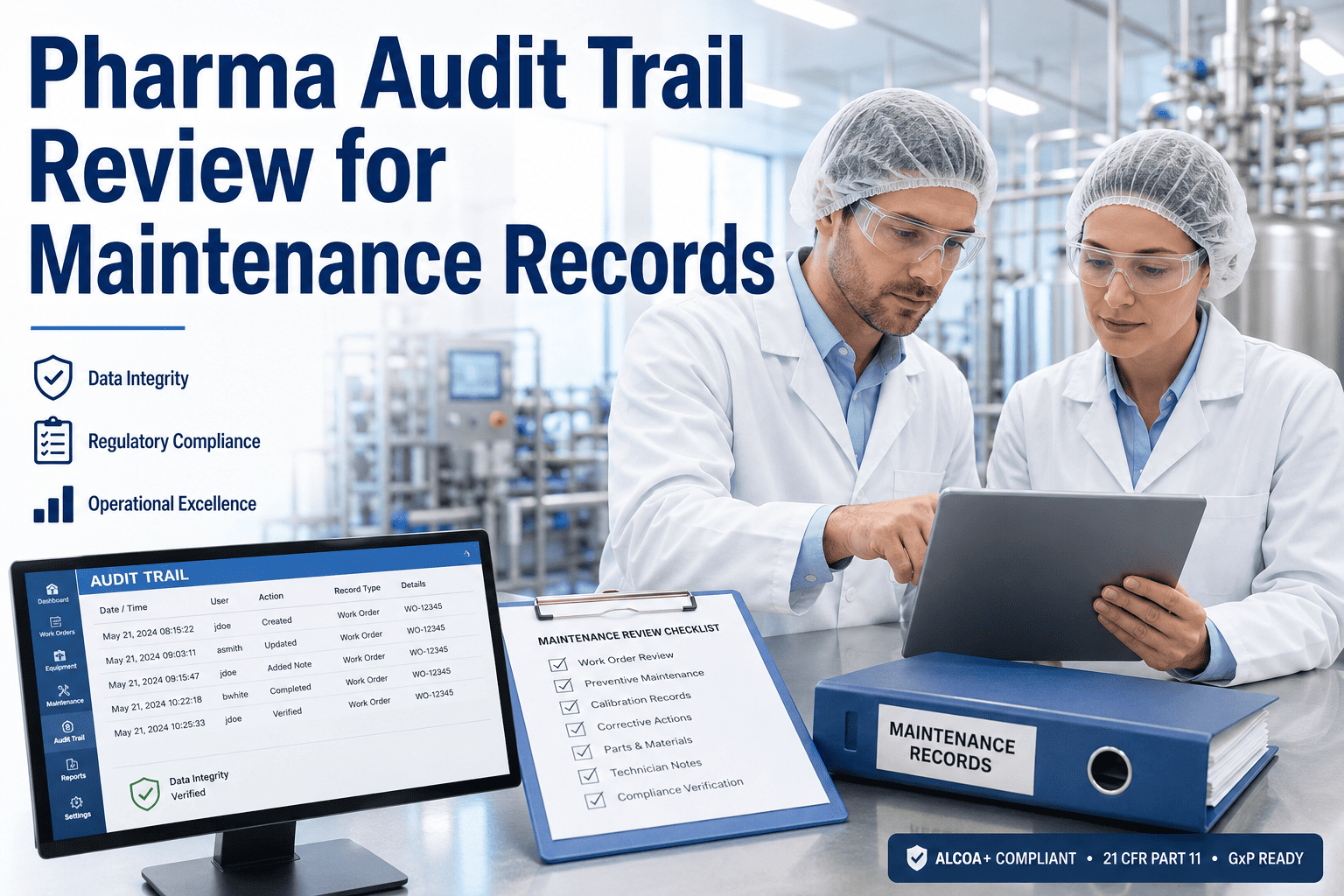
The FDA conducted 1,927 facility inspections in 2024 and issued Warning Letters following 42% of them. Most maintenance-related Form 483 observations share a single root cause: the records existed, but could not be produced in the format, speed, or traceability level the inspector required. Under 21 CFR 211.68, 211.182, and 211.192, equipment maintenance logs, calibration certificates, deviation records, and CAPA documentation must be complete, current, and retrievable on demand — not assembled over two days while the investigator waits in the conference room. Book a demo to see how OxMaint builds the maintenance audit trail that turns a 483-vulnerable facility into an inspection-confident one — or start free today.
FDA Audit Readiness · Landing Page · cGMP Records
FDA 483 Maintenance Response for Pharma Plants
The maintenance records, equipment evidence, and CAPA documentation that FDA investigators request on Day 1 of an inspection — and the CMMS workflows that ensure every document is retrievable in minutes, not days.
1,927
FDA facility inspections conducted in 2024
42%
Resulted in Warning Letters — most from documentation failures
2 hrs
FDA expectation for document retrieval from the time of request
15 days
Response deadline after receiving a Form 483 observation
Top 5 FDA 483 Maintenance Observations — And What Evidence Closes Each One
These are the maintenance-related 483 observations most frequently cited across North American pharmaceutical sites in 2024–2025. Each observation has a documented pattern and a specific evidence package that resolves it — both at the time of inspection and in the written response.
01
Equipment maintenance not performed at defined intervals
21 CFR 211.182 — Written equipment maintenance schedule required; records must show work was done on schedule
What the investigator found
PM work orders exist in paper logbooks but are incomplete, missing technician signatures, or cannot be produced for the full 2-year lookback. Several critical assets have no written PM schedule. Completion dates are estimated rather than timestamped.
Evidence that closes this observation
CMMS-generated PM schedule per asset with timestamped completion records, technician attribution, and automatic escalation for overdue tasks. Full 2-year PM history retrievable per equipment ID in under 5 minutes.
02
Calibration records incomplete or not traceable to certified standards
21 CFR 211.68(b) — Equipment shall be calibrated at suitable intervals per written programme; records retained
What the investigator found
Calibration certificates exist but are filed separately from instrument records. Some instruments are past their calibration due date. Certificates reference external labs but traceability to NIST standards is not documented. pH meter calibration log is a handwritten notebook with illegible entries.
Evidence that closes this observation
Digital calibration record per instrument with certificate attachment, due date tracking, and NIST traceability chain documented. Automated alert when calibration due date is 30 days out. Overdue instruments flagged in real time — no inspector finds an expired calibration that the facility didn't already know about.
03
Deviations from maintenance procedures not investigated
21 CFR 211.192 — All unexplained discrepancies and equipment failures shall be investigated
What the investigator found
Equipment breakdown records exist but do not link to formal deviation reports. Three instances where critical equipment failed during production were documented only as maintenance call-out tickets — no formal investigation, no root cause analysis, no CAPA raised. Repeat equipment failures on the same asset across 18 months with no trend analysis.
Evidence that closes this observation
Work order system that auto-generates a deviation investigation requirement when a critical equipment breakdown is logged. Linked CAPA record per deviation with root cause, corrective action, effectiveness check, and closure date. Equipment failure trend report retrievable per asset — shows the facility monitored and acted on repeat failures.
04
CAPA not effectively implemented or verified for closed items
21 CFR 211.192 / ICH Q10 §3.2 — CAPA effectiveness must be verified; closed CAPA must demonstrate prevention
What the investigator found
Multiple maintenance CAPAs closed without documented effectiveness verification. Three CAPAs that were closed as "complete" have the same root cause recurring within 6 months. Written CAPA records state "retrain technician" without evidence that training occurred or that it prevented recurrence.
Evidence that closes this observation
Digital CAPA record that cannot be marked closed without an attached effectiveness verification record. Repeat-failure trend monitoring per equipment ID shows the interval between same-cause failures has increased after CAPA — demonstrating effectiveness. Training records linked to the CAPA record as attached evidence.
05
Cleaning and sanitation records for equipment not maintained
21 CFR 211.67 — Equipment shall be cleaned, maintained, and sanitised at appropriate intervals; records retained
What the investigator found
Cleaning logs exist for production equipment but are not equipment-specific — the same generic log covers multiple machines. Several equipment cleaning records for the 3 months prior to inspection are missing. Cleaning validation protocols reference equipment by ID but cleaning logs reference equipment by location, making cross-reference impossible.
Evidence that closes this observation
Equipment-specific cleaning work orders tied to the asset ID matching the cleaning validation protocol. Timestamped completion with technician attribution per cleaning event. 2-year cleaning history per equipment ID retrievable instantly — cross-referenced to batch records for that equipment during the same period.
When an FDA Investigator Asks for Your Equipment Records, OxMaint Answers in 5 Minutes
Every maintenance event, calibration, deviation, and CAPA in one searchable system — retrievable by equipment ID, date range, or batch number. No binder assembly. No 2-day scramble.
Audit Day Evidence Request — What Investigators Ask for in the First 2 Hours
FDA investigators issue their first document requests within 30–60 minutes of arrival. Below is the standard evidence package for a manufacturing site inspection. Each item must be retrievable per equipment ID within 2 hours of request — paper-based systems routinely fail this timeline.
Day 1 FDA Evidence Request — Maintenance Records Package
21 CFR Part 211 / cGMP
Equipment maintenance schedule and last 24 months of PM records for all critical equipment
Must show scheduled vs actual completion dates, technician name, equipment ID, and task description per 21 CFR 211.182. Any gap in the PM schedule for a critical asset is an immediate observation finding.
Calibration certificates and calibration history for all critical instruments
Must include the external lab certificate with NIST traceability statement, acceptance criteria, pass/fail result, and due date for next calibration. Any instrument past its calibration date is an immediate observation.
Equipment deviation and breakdown records for the past 2 years, linked to formal investigation records
Every equipment failure on a critical or major instrument must have a linked investigation record per 21 CFR 211.192. An equipment call-out with no investigation is a documentation gap — not a maintenance gap.
All open and closed CAPAs related to equipment or maintenance, with effectiveness verification records
CAPAs closed without an attached effectiveness verification record are a common repeat observation. Investigators cross-reference closed CAPAs against subsequent failure records for the same equipment to verify the CAPA actually prevented recurrence.
Equipment cleaning and sanitation logs for the past 2 years, cross-referenced to batch records
Per 21 CFR 211.67, cleaning must be documented by equipment ID — not by location or generic log. Investigators will cross-reference cleaning dates against batch production dates for the same equipment to confirm no batch was produced in a non-cleaned state.
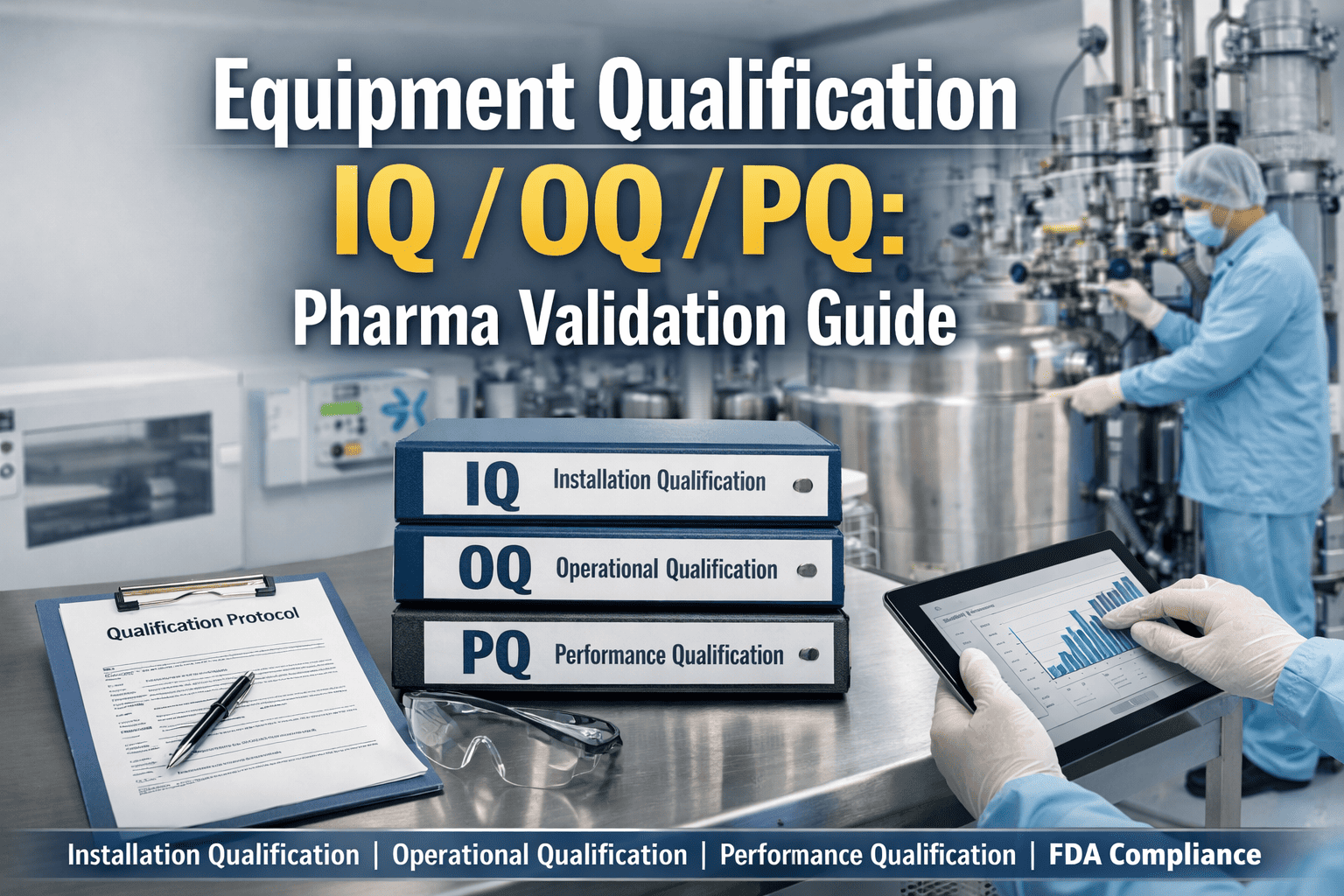
Equipment qualification records (IQ/OQ/PQ) and any re-qualification records after modification
Any modification to critical equipment since its original qualification requires documented change control and, where impact warrants, re-qualification. Investigators will ask whether any equipment has been modified since its last qualification record — any unqualified modification is an immediate critical observation.
Expert Review
"In my experience reviewing pharmaceutical facility inspections, the sites that receive the most serious 483 observations are rarely the ones with genuinely poor maintenance practices. They are the ones where the maintenance was done adequately but the documentation cannot demonstrate that it was done. An FDA investigator who cannot find the PM completion record for a critical mixer from 14 months ago does not conclude that the PM was performed without documentation — they conclude the PM was not performed. The burden of proof is entirely on the facility, and digital maintenance records with timestamped completion, technician attribution, and linked equipment IDs are orders of magnitude more defensible than paper logbooks that can be backdated, lost, or simply incomplete for a specific period. The 2-hour document retrieval expectation is not a suggestion — it is the implicit standard that investigators apply. A facility that takes 2 days to produce a 2-year PM history for one piece of equipment has already communicated to the inspector that its document control system is inadequate."
Dr. Jonathan Reyes, Esq., CPCU
Pharmaceutical regulatory compliance attorney · Certified Property Casualty Underwriter · 17 years FDA inspection response and warning letter remediation for North American pharmaceutical manufacturers · Former FDA Office of Regulatory Affairs consultant
Frequently Asked Questions
What maintenance records does FDA most commonly request during a pharmaceutical facility inspection?
FDA investigators typically request: equipment PM schedules and 24-month completion history per critical asset; calibration certificates with NIST traceability for all in-scope instruments; equipment breakdown and deviation records linked to formal investigation reports; all maintenance-related CAPAs with effectiveness verification; and equipment cleaning/sanitation logs cross-referenced to batch records. All of these must be retrievable per equipment ID within approximately 2 hours.
Book a demo to see OxMaint generate the full maintenance evidence package for any equipment ID in under 5 minutes.
How long does a pharmaceutical facility have to respond to a Form 483?
FDA does not legally require a written response to a Form 483, but the strong industry standard is to submit a written response within 15 business days of receiving the 483. The response must address each observation individually with a root cause analysis, the specific corrective actions taken or planned, a timeline for completion, and supporting evidence. Observations not addressed with documented corrective actions within a reasonable period increase the risk of escalation to a Warning Letter, which carries enforcement implications including import alert, consent decree, or injunction.
What is the difference between a Form 483 observation and an FDA Warning Letter?
A Form 483 is issued at the conclusion of an inspection and lists observations of conditions that may violate FDA regulations — it is not a finding of violation, and no enforcement action automatically follows. A Warning Letter is issued when FDA determines that a firm has significant cGMP violations that were not adequately addressed after the 483, or that represent a serious threat to public health. Warning Letters are publicly posted, may trigger import alerts, and require formal commitments to remediation. The quality of the 483 response — speed, depth, and evidence — is the primary factor in whether an observation escalates to a Warning Letter.
How does OxMaint reduce the risk of maintenance-related FDA 483 observations?
OxMaint eliminates the four most common maintenance documentation failures that generate 483 observations: it auto-generates PM work orders at defined intervals so no scheduled maintenance is missed; it links calibration certificates to instrument records with due date tracking so no instrument can be used past its calibration date without an alert; it creates a formal deviation investigation record automatically when a critical equipment breakdown is logged; and it requires effectiveness verification before any maintenance CAPA can be closed. The result is a maintenance programme where the documentation standard meets FDA's audit expectation before the investigator arrives, not after.
Start free to configure your first equipment PM schedule in OxMaint.
Your Maintenance Records Are Either Your Best Defence or Your Biggest Liability. OxMaint Makes Them the Former.
OxMaint delivers the timestamped PM history, linked calibration certificates, deviation-to-CAPA trails, and equipment cleaning records that FDA investigators expect — all retrievable by equipment ID in minutes, not days. Book a demo and walk through a simulated FDA document request on your equipment types.