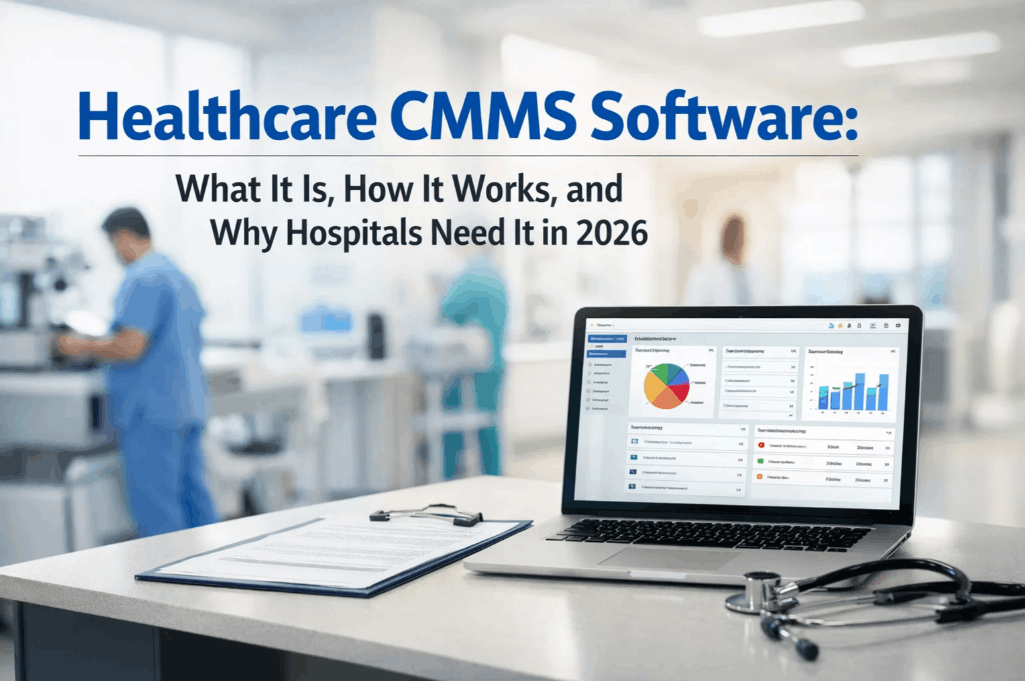
The hospital maintenance landscape is undergoing its mostsignificant transformation in decades. In 2026, healthcare facilities worldwide are rapidly abandoning the old break-fix mentality and embracing AI-driven autonomous maintenance systems that predict failures, optimize resources, and keep critical medical equipment running when patients need it most. With the average hospital losing over $3 million annually to equipment downtime, the shift from reactive repairs to intelligent, self-governing maintenance operations is no longer optional — it is a survival strategy. This blog explores how artificial intelligence is reshaping hospital maintenance from the ground up, and why forward-thinking healthcare leaders are making the switch today.
From Reactive to Autonomous: How AI Is Transforming Hospital Maintenance Operations in 2026
The future of hospital infrastructure is intelligent, predictive, and self-optimizing
The Costly Reality of Reactive Hospital Maintenance
For decades, hospitals have operated under a reactive maintenance model — waiting for equipment to fail before taking action. This approach creates a dangerous cycle: an MRI machine breaks down unexpectedly, patient appointments are canceled, emergency repair crews are called at premium rates, and clinical workflows grind to a halt. A single day of MRI downtime can cost a facility upward of $13,000 in lost revenue alone, not counting the ripple effects on patient satisfaction, staff morale, and institutional reputation.
The financial toll is staggering. Unplanned downtime across critical hospital systems — from HVAC and electrical infrastructure to ventilators and imaging devices — drains resources that could otherwise be invested in patient care. Emergency repairs often cost 3 to 5 times more than planned maintenance, and the unpredictability strains already thin budgets. With healthcare costs rising and staffing shortages persisting, this model is simply unsustainable.
Beyond finances, reactive maintenance poses serious compliance and safety risks. Regulatory bodies like the Joint Commission and CMS require hospitals to maintain equipment to strict standards. When failures happen without warning, facilities risk citations, legal exposure, and most importantly, patient harm. The question every hospital administrator should ask: why wait for failure when you can prevent it? Start your journey toward smarter maintenance — sign up for OxMaint and see the difference immediately.
The Evolution: Reactive, Preventive, Predictive, and Now Autonomous
Understanding where we are in 2026 requires appreciating the evolution of maintenance strategies. Each stage represents a significant leap in intelligence, efficiency, and patient safety outcomes.
Reactive Maintenance
Fix it when it breaks. High costs, unpredictable downtime, safety risks. Still used by a surprising number of facilities today.
Preventive Maintenance
Scheduled inspections and servicing at fixed intervals. Reduces surprises but often results in unnecessary work or missed issues between checkups.
Predictive Maintenance
IoT sensors and data analytics monitor equipment in real time, predicting failures before they occur. Dramatically improves uptime and reduces costs.
Autonomous Maintenance (2026)
AI agents independently schedule, prioritize, and initiate maintenance actions. Self-learning systems continuously optimize operations without manual intervention.
In 2026, leading hospitals are entering Stage 4 — where AI does not just predict problems but autonomously orchestrates the response. These systems analyze sensor data, cross-reference with manufacturer guidelines, evaluate technician availability, order parts, and schedule repairs during optimal windows — all without a human having to pick up the phone. This is the essence of the autonomous maintenance revolution.
Ready to Move Beyond Reactive Repairs?
Join over 1,000 organizations worldwide that trust OxMaint to keep their operations running at peak performance. Experience AI-powered maintenance management built for healthcare.
How AI Powers Autonomous Hospital Maintenance
The autonomous maintenance model relies on several interconnected AI technologies working together as a unified ecosystem. Here is how each layer contributes to transforming hospital operations:
IoT Sensor Networks
Connected sensors embedded across hospital infrastructure — in HVAC systems, imaging equipment, elevators, sterilization units, and backup generators — stream continuous performance data. They track vibration patterns, temperature fluctuations, energy consumption, and usage cycles in real time.
Predictive Analytics and Machine Learning
Advanced algorithms process millions of data points to identify subtle patterns that signal impending failure. Machine learning models improve with every data cycle, becoming more accurate over time and adapting to the unique operating conditions of each facility.
AI-Powered Decision Engines
Beyond prediction, these systems make autonomous decisions. They evaluate risk priority, compare maintenance options, assess technician schedules, and trigger the optimal action — whether that is a repair order, a part procurement request, or a temporary operational adjustment.
Digital Twin Technology
Virtual replicas of hospital systems simulate scenarios and test maintenance strategies before implementation. This allows facilities to model the impact of decisions without risking real-world disruptions to patient care.
Smart CMMS Integration
At the center of it all is the Computerized Maintenance Management System — the operational brain that ties everything together. A modern AI-powered CMMS like OxMaint centralizes asset data, automates work orders, tracks compliance, and provides actionable dashboards for facility managers.
Natural Language Reporting
AI generates human-readable reports, maintenance summaries, and compliance documentation automatically. Facility managers get clear insights without wading through raw data, saving hours of administrative work each week.
Hospitals that want to take the first step toward this integrated approach can book a demo with OxMaint to see how AI-powered CMMS brings these capabilities together in a single, easy-to-use platform.
Real-World Impact: What the Numbers Tell Us
The shift to AI-driven maintenance is not theoretical — hospitals and equipment manufacturers are reporting measurable improvements across every key metric. Predictive maintenance solutions for MRI machines alone have shown unplanned downtime reductions of up to 60%, while customer-initiated service calls have dropped by as much as 35%. In broader healthcare operations, facilities that implement comprehensive predictive strategies are achieving 40 to 50 percent downtime reduction within just 12 months.
The predictive maintenance market itself is projected to grow from $10.6 billion in 2024 to $47.8 billion by 2029, reflecting the massive industry-wide recognition that proactive, data-driven maintenance delivers superior outcomes. For healthcare leaders exploring this transition, signing up for OxMaint is the fastest way to start capturing these benefits.
Why 2026 Is the Tipping Point for Healthcare
Several converging forces make 2026 the defining year for autonomous maintenance adoption in hospitals:
Workforce Shortages Are Intensifying
With 67% of healthcare leaders citing staff burnout as a major challenge and hospital turnover rates averaging 18.3%, organizations cannot afford to waste skilled technicians on preventable emergency repairs. AI autonomy fills the gap by handling routine decision-making and freeing staff for higher-value work.
Aging Infrastructure Demands Smarter Management
Many hospitals operate with equipment and systems that are decades old. As these assets age, their failure patterns become more complex and unpredictable. AI excels at analyzing these aging systems and finding the optimal balance between repair, replacement, and continued monitoring.
Regulatory Pressure Is Increasing
CMS, Joint Commission, and state regulatory bodies are raising the bar for equipment maintenance documentation and compliance. AI-powered CMMS platforms automatically generate audit trails, compliance reports, and maintenance histories — reducing the risk of costly citations.
IoT and AI Costs Have Dropped Significantly
Sensor technology, cloud computing, and AI processing power are now accessible at a fraction of what they cost five years ago. This makes autonomous maintenance systems financially viable for mid-size and community hospitals, not just large academic medical centers.
The convergence of these factors means that hospitals waiting to adopt AI-driven maintenance are falling behind competitors who are already realizing the benefits. To see how your facility can make this transition smoothly, book a demo with OxMaint today.
Building Your Autonomous Maintenance Roadmap
Transitioning from reactive to autonomous maintenance does not happen overnight. It is a phased journey that builds capability progressively. Here is a practical framework for hospital facility managers:
Audit your current maintenance operations. Identify your most critical assets and their failure histories. Deploy a modern CMMS to centralize all maintenance data, work orders, and asset records. This creates the data backbone everything else depends on.
Install IoT sensors on high-priority equipment — start with imaging devices, HVAC systems, and backup power. Connect sensor feeds to your CMMS. Begin collecting baseline data and establishing normal operating parameters for each asset.
Activate predictive analytics models. Train algorithms on your facility-specific data. Begin receiving failure predictions and automated maintenance recommendations. Validate accuracy and refine models based on real outcomes.
Enable autonomous work order generation, parts procurement triggers, and optimized scheduling. AI now manages the routine while your team focuses on strategic oversight, complex repairs, and continuous improvement.
OxMaint is designed to support you at every phase of this journey. Whether you are digitizing paper-based processes or ready for full AI autonomy, the platform scales with your needs. Sign up today and begin building your autonomous maintenance future.
Transform Your Hospital Maintenance Operations with OxMaint
From intelligent work order management to predictive analytics and automated compliance reporting — OxMaint gives healthcare facilities the tools to move from reactive chaos to autonomous excellence. Trusted by 1,000+ organizations globally with over 1 million app downloads.
Frequently Asked Questions
What is autonomous maintenance in hospitals
Autonomous maintenance refers to AI-driven systems that can independently monitor equipment health, predict failures, generate work orders, schedule repairs, and optimize resource allocation — all without requiring manual intervention from facility managers. It represents the most advanced stage of maintenance management evolution, building on predictive analytics and IoT sensor technology to create self-governing maintenance operations.
How does AI-powered predictive maintenance differ from traditional preventive maintenance
Traditional preventive maintenance follows fixed schedules — inspecting and servicing equipment at set intervals regardless of actual condition. AI-powered predictive maintenance continuously monitors real-time equipment data through IoT sensors and uses machine learning algorithms to detect early signs of deterioration. This means maintenance is performed only when truly needed, reducing both unnecessary servicing and unexpected failures.
What kind of hospital equipment benefits from AI-driven maintenance
Virtually all critical hospital systems benefit, including diagnostic imaging equipment (MRI, CT, X-ray), HVAC and environmental control systems, backup power generators, elevator systems, sterilization and autoclave units, ventilators and respiratory equipment, laboratory instruments, and building infrastructure like plumbing and electrical systems.
How much can hospitals save by switching to predictive maintenance
Healthcare facilities implementing comprehensive predictive maintenance strategies typically achieve 40 to 50 percent downtime reduction within 12 months while reducing maintenance costs by 25 to 35 percent. The predictive maintenance market research indicates cost reductions of up to 40 percent compared to reactive approaches, along with equipment lifespan extensions of 20 to 40 percent.
Is OxMaint suitable for small and mid-size hospitals
Absolutely. OxMaint is designed to scale with your facility. Whether you manage a 50-bed community hospital or a large multi-campus medical center, the platform adapts to your asset count, team size, and operational complexity. The cloud-based architecture means there is no heavy upfront infrastructure investment, and mobile access ensures technicians can use it anywhere in the facility.
How long does it take to implement AI-powered maintenance in a hospital
Most facilities can have a foundational CMMS system operational within weeks. Building out IoT sensor networks and predictive analytics typically takes 3 to 6 months for initial deployment on high-priority assets. Full autonomous maintenance capability is generally achieved within 12 to 18 months, depending on facility size and complexity.
Does OxMaint integrate with existing hospital management systems
Yes. OxMaint is built with integration flexibility in mind, supporting connections with hospital information systems, building management platforms, enterprise resource planning tools, and IoT sensor networks. The platform provides APIs and standard integration protocols to ensure seamless data flow across your facility's technology ecosystem.
What compliance requirements does autonomous maintenance help address
AI-powered CMMS platforms automatically maintain detailed audit trails, equipment maintenance histories, inspection records, and regulatory compliance documentation. This supports Joint Commission accreditation, CMS requirements under tag A-0724, state health department regulations, and manufacturer-recommended maintenance protocols — all with significantly reduced administrative burden.

.png)