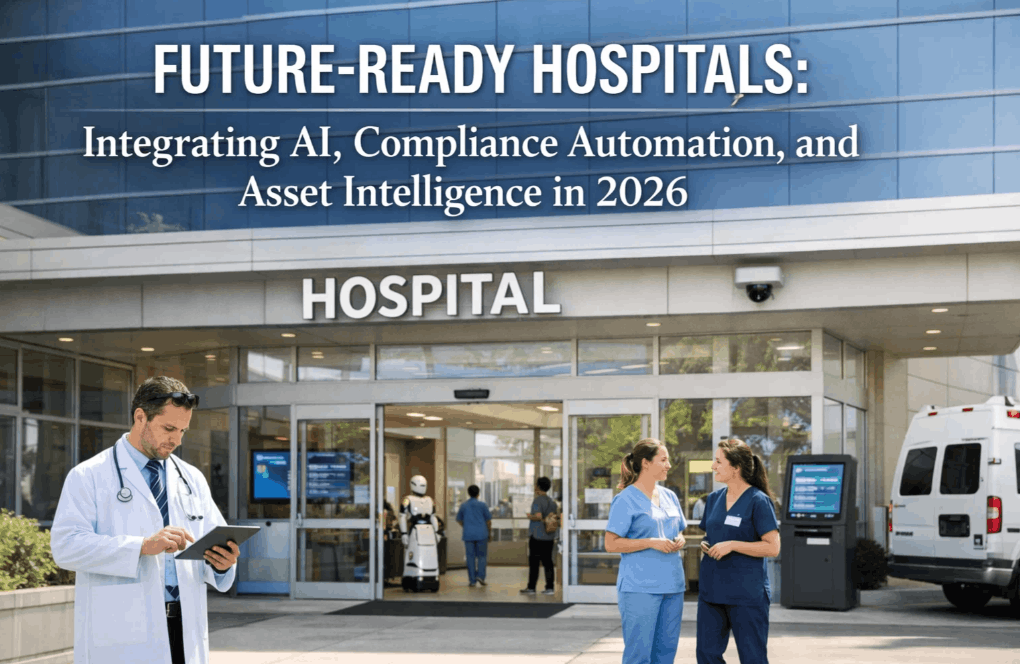
Hospitals have long operated on a painful paradox: the most critical equipment in human care is also the most vulnerable to unexpected failure. A malfunctioning ventilator, an offline imaging system, or a misbehaving surgical robot does not just cost money — it costs time, trust, and in worst-case scenarios, lives. For decades, maintenance teams responded to breakdowns after they occurred, patching and replacing in a perpetual cycle of reactive firefighting. But in 2026, that paradigm is collapsing. Autonomous AI-powered maintenance systems are fundamentally transforming how smart hospitals manage their infrastructure, predicting failures before they manifest, dispatching automated work orders, and optimizing equipment lifecycles with intelligence that no human team could match at scale.
Ready to eliminate reactive repairs and move to AI-powered autonomous maintenance? Start your free 15-day trial today — no credit card required. Experience full predictive asset intelligence, automated work orders, and compliance tracking across your entire hospital fleet, completely free for 15 days.
The Shift From Reactive to Autonomous: What Changed?
Traditional hospital maintenance relied on scheduled preventive routines and break-fix responses. Technicians would inspect equipment on fixed calendar intervals — monthly, quarterly, annually — regardless of actual usage patterns, operational stress, or early warning signals embedded in sensor data. The problem with this model is structural: it treats all equipment as equal when, in reality, a CT scanner running three shifts per day ages far faster than one used intermittently. Fixed schedules either over-maintain low-use assets or dangerously under-service high-demand ones.
The arrival of Internet of Things sensors, edge computing, and machine learning models trained on failure patterns has made something entirely new possible. Modern smart hospital infrastructure generates millions of data points per day across HVAC systems, imaging devices, infusion pumps, elevator banks, and building automation networks. AI systems can ingest this continuous telemetry, detect anomalous vibration signatures in centrifugal pumps, flag temperature drift in pharmaceutical refrigeration units, and identify compressor degradation in MRI cooling systems — all weeks or months before any visible symptom appears.
This is the core shift: from scheduled maintenance based on time to condition-based and predictive maintenance based on real equipment health intelligence. Platforms like Oxmaint are purpose-built to power this transition for healthcare facilities of every size.
Core Technologies Powering Autonomous Hospital Maintenance
Autonomous maintenance in smart hospitals is not a single technology — it is a convergence of several interdependent systems working in concert. Understanding these layers clarifies how facilities can plan and deploy them effectively with the right CMMS platform.
Predictive Analytics Engines
Machine learning models trained on historical failure data, sensor telemetry, and manufacturer degradation curves identify equipment entering pre-failure states. These engines can predict bearing failures in HVAC motors, capacitor degradation in imaging power supplies, and seal wear in sterilization autoclaves with accuracy rates exceeding 85% in peer-reviewed hospital deployments.
Digital Twin Infrastructure
A digital twin is a real-time virtual replica of a physical asset or facility zone. Smart hospitals use digital twins to simulate maintenance interventions, model the downstream effects of equipment downtime on patient flow, and test configuration changes before applying them to live systems. Digital twins transform maintenance from a reactive discipline into a strategic planning function.
Autonomous Work Order Generation
When AI systems detect anomalies or predict impending failures, they automatically generate prioritized work orders in the facility's CMMS — specifying the affected asset, suspected failure mode, recommended parts, required technician skills, and urgency tier. This eliminates the manual reporting bottleneck and ensures high-priority issues surface instantly without relying on a technician's observation.
Natural Language AI Interfaces
Modern AI maintenance platforms allow biomedical engineers and facility managers to query their entire asset fleet using plain language. Instead of navigating complex software dashboards, a maintenance director can ask "which imaging devices are showing elevated failure probability this quarter?" and receive an immediate, data-driven response with supporting evidence and recommended actions.
Edge Computing and Real-Time Sensor Networks
Cloud-only architectures introduce latency that is unacceptable for critical medical equipment monitoring. Smart hospitals deploy edge computing nodes that process sensor data locally, enabling sub-second anomaly detection and alarm generation for life-critical systems. Edge intelligence also ensures maintenance monitoring continuity during network disruptions.
CMMS Integration and Automated Scheduling
AI-driven maintenance systems reach their full potential when tightly integrated with a Computerized Maintenance Management System. The CMMS serves as the operational backbone — receiving AI-generated work orders, tracking technician assignments, logging completion records, and maintaining the audit trail required for Joint Commission and CMS compliance reviews.
Asset Categories Transformed by Autonomous Maintenance
Not every hospital asset benefits equally from autonomous maintenance intelligence. The highest-value applications cluster around equipment where unexpected failure carries clinical consequences, where replacement costs are significant, and where failure patterns are detectable through sensor data.
| Asset Category | AI Monitoring Method | Key Failure Mode Detected | Clinical Impact of Failure |
|---|---|---|---|
| MRI & CT Imaging Systems | Vibration, thermal, power draw analysis | Gradient coil degradation, cooling failure | Diagnostic delays, emergency department backlog |
| HVAC & Air Handling Units | Airflow sensors, differential pressure, motor current | Filter saturation, bearing wear, belt failure | Infection control risk, operating room contamination |
| Surgical Robots | Torque sensors, joint position encoders | Actuator drift, cable tension loss | Procedure cancellations, patient safety events |
| Sterilization Autoclaves | Pressure, temperature, cycle time analysis | Seal failure, heating element degradation | Instrument contamination, surgical delays |
| Pharmaceutical Refrigeration | Continuous temperature, door seal integrity | Compressor failure, thermostat drift | Medication spoilage, patient harm risk |
| Infusion Pumps | Occlusion pressure, motor current patterns | Pump mechanism wear, software anomalies | Medication delivery errors |
| Emergency Power Systems | Battery voltage, generator load testing | Battery capacity loss, transfer switch delay | Life-safety system failure during outages |
How Autonomous Maintenance Eliminates the Reactive Repair Cycle
To understand the depth of the transformation, consider a conventional scenario: a hospital's central chiller begins showing intermittent cooling anomalies. In a reactive maintenance environment, this problem surfaces when a nurse calls to report uncomfortable temperatures in a patient wing, or when the chiller alarms after a compressor overload. By that point, the facility faces an emergency repair requiring expedited parts procurement, overtime labor costs, and temporary patient relocation — all while the root cause was developing for weeks in observable sensor data.
In an autonomous maintenance environment, the same scenario unfolds differently. Vibration analysis sensors on the chiller compressor begin detecting a subtle frequency shift three weeks before failure. The AI platform cross-references this signature against its failure pattern library and assigns a high-probability prediction of bearing wear. An automated work order is generated, parts are pre-ordered through the CMMS procurement integration, and a scheduled maintenance window is identified during low-demand hours. The technician arrives with the correct components, performs the repair in a planned procedure, and the chiller continues operating without a single patient-impacting interruption.
This is not a theoretical scenario — it is the documented operational reality at health systems that have deployed mature predictive asset intelligence platforms. The financial calculus is equally compelling: a planned bearing replacement costs a fraction of emergency compressor failure with associated water damage, patient relocation, and regulatory scrutiny. Book a demo to see how Oxmaint delivers this intelligence for your facility.
Implementation Roadmap for Smart Hospital Maintenance Transformation
Hospitals pursuing autonomous maintenance transformation do not need to overhaul their entire infrastructure overnight. A phased approach that builds capability progressively delivers measurable ROI at each stage while managing implementation risk.
Asset Inventory and Sensor Baseline
Register every maintainable asset in a centralized CMMS with complete nameplate data, installation dates, maintenance history, and current condition assessments. Deploy IoT sensors on high-priority assets — imaging systems, HVAC units, sterilization equipment — and establish baseline performance data for machine learning model training. This foundation phase typically spans 60 to 90 days and sets the data quality standard that determines AI prediction accuracy.
Predictive Model Deployment and Validation
Activate AI analytics engines against the sensor telemetry collected in Phase 1. Allow models to generate predictions alongside existing scheduled maintenance routines for a 90-day validation period. Track prediction accuracy against actual maintenance findings, refine model parameters, and build technician confidence in AI-generated work orders before reducing manual oversight.
Autonomous Work Order Integration
Enable automated work order generation from AI predictions, fully integrated with the CMMS scheduling, parts procurement, and technician assignment workflows. Establish escalation protocols that route high-urgency predictions to appropriate clinical engineering leadership. This phase marks the transition from AI-assisted maintenance to genuinely autonomous maintenance operations.
Digital Twin and Fleet Intelligence
Build digital twin models for critical facility zones and equipment clusters. Use fleet-level intelligence to optimize capital replacement planning, negotiate vendor service agreements from a position of data-driven evidence, and develop facility-specific failure prediction models that improve with every maintenance event captured in the system.
Regulatory Compliance and Documentation in the Autonomous Era
One concern hospital leadership frequently raises about AI-driven maintenance is compliance documentation. Joint Commission surveyors, CMS inspectors, and state health department reviewers require documented evidence that equipment is maintained according to defined schedules and manufacturer specifications. The question is whether autonomous systems can satisfy these requirements — or whether they introduce new audit complexity.
The answer, when implemented correctly, is that autonomous maintenance systems dramatically simplify compliance documentation rather than complicating it. Every AI-generated work order carries a timestamp, the sensor data that triggered it, the maintenance action performed, the technician who executed it, and the outcome recorded. This creates a continuous, tamper-evident audit trail that is richer in evidence than any paper-based or spreadsheet-driven maintenance log could produce.
For biomedical engineering leaders preparing for accreditation surveys, autonomous CMMS platforms can generate comprehensive compliance reports on demand — filtering by asset category, date range, regulatory standard, or inspection criteria — eliminating the manual report preparation burden that historically consumed significant engineering staff time before survey events. Sign up for Oxmaint to experience compliance-ready documentation at your fingertips.
Key Compliance Frameworks Supported by Autonomous Maintenance Systems
Automated documentation of all equipment maintenance activities with technician signatures, completion timestamps, and deviation records satisfies Environment of Care chapter requirements for medical equipment management programs.
AI-driven maintenance platforms provide the documented evidence of systematic maintenance programs that CMS surveyors require, including performance testing records and corrective action documentation for equipment failures.
For facilities maintaining FDA-regulated medical devices, autonomous CMMS systems capture the calibration records, service history, and firmware version documentation required for device management compliance and adverse event reporting readiness.
The Human Role in an Autonomous Maintenance Future
A natural concern about autonomous maintenance systems is whether they eliminate the need for skilled biomedical engineers and facilities technicians. The evidence from early adopter health systems points firmly in the opposite direction: autonomous systems elevate the role of human expertise rather than replacing it.
When AI absorbs the cognitive load of monitoring thousands of data streams, generating routine work orders, and tracking maintenance completion, skilled technicians are freed from administrative overhead and reactive firefighting to focus on complex diagnostic challenges, equipment optimization, and strategic capital planning. The most experienced biomedical engineers report that AI platforms allow them to apply their expertise at a higher level — reviewing AI-generated predictions, mentoring junior technicians, engaging vendor engineers on specification improvements, and contributing to procurement decisions with evidence-based equipment performance data.
Workforce development in smart hospitals increasingly centers on building AI literacy among maintenance professionals — training technicians to interpret predictive model outputs, validate sensor data quality, and recognize when human judgment should override algorithmic recommendations. This hybrid intelligence model, combining machine monitoring scale with human technical judgment, represents the genuine future of hospital maintenance excellence. Schedule a conversation with the Oxmaint team to explore how your facility can build this capability today.
Transform Your Hospital's Maintenance Operations with Autonomous AI
Oxmaint's AI-powered CMMS platform brings predictive asset intelligence, automated work order generation, and compliance-ready documentation to healthcare facilities of every size.
Frequently Asked Questions
What is autonomous maintenance in the context of smart hospitals?
Autonomous maintenance in smart hospitals refers to AI-driven systems that continuously monitor equipment health through IoT sensors, predict failures before they occur, automatically generate maintenance work orders, and optimize maintenance schedules without requiring manual initiation. These systems replace reactive break-fix approaches with proactive, data-driven asset management that reduces downtime and extends equipment lifecycles.
How accurate are AI predictive maintenance systems in healthcare settings?
Leading AI predictive maintenance platforms deployed in clinical environments have demonstrated failure prediction accuracy rates between 80% and 92% depending on asset type, sensor coverage, and the maturity of training data. Accuracy improves over time as models incorporate facility-specific failure patterns. Even conservative accuracy rates significantly outperform reactive maintenance in terms of downtime reduction and cost avoidance.
Which hospital assets benefit most from AI-driven predictive maintenance?
The highest-value applications include imaging systems (MRI, CT, PET), HVAC and air handling units critical to infection control, sterilization autoclaves, emergency power infrastructure, pharmaceutical refrigeration, and surgical robotics. These assets combine high replacement cost, clinical criticality, and detectable failure patterns that AI systems can reliably identify through continuous sensor monitoring.
Does implementing autonomous maintenance require replacing existing CMMS systems?
Not necessarily. Many AI predictive maintenance platforms are designed to integrate with existing CMMS infrastructure, feeding AI-generated work orders and sensor data directly into established workflows. However, facilities with outdated CMMS systems often find that migrating to a modern AI-native platform like Oxmaint delivers greater operational benefit by unifying asset tracking, predictive analytics, and compliance documentation in a single intelligent system.
How does autonomous maintenance support Joint Commission accreditation?
Autonomous CMMS platforms generate comprehensive, timestamped documentation for every maintenance action — including AI-triggered predictive repairs, scheduled preventive tasks, and corrective interventions. This creates the continuous audit trail that Joint Commission Environment of Care standards require, and allows facilities to produce compliance reports on demand during accreditation surveys without manual data compilation.
What is the typical ROI timeline for AI-driven hospital maintenance systems?
Health systems report positive ROI within 12 to 18 months of full deployment, driven by reductions in emergency repair costs, decreased equipment downtime, extended asset lifecycles, and labor efficiency gains as technicians shift from reactive firefighting to planned maintenance execution. Facilities with high-density imaging or surgical equipment fleets often achieve faster payback given the high cost of unplanned failures in those categories.

.png)

.jpg)