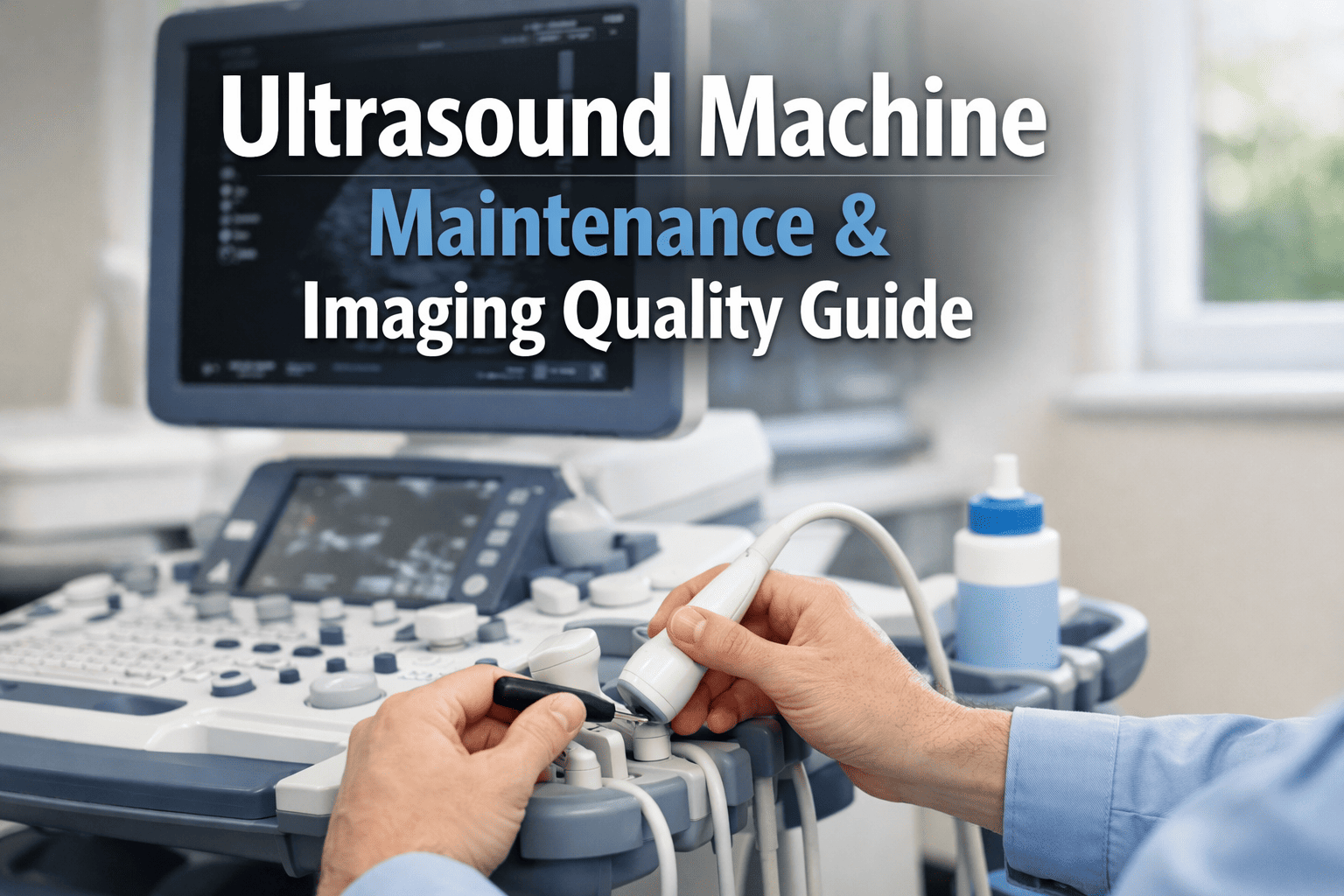
41 percent of ultrasound adverse event reports trace back to transducer degradation that a scheduled PM inspection would have caught. The machine powers on. The image appears. The diagnosis is compromised. That gap — between operational equipment and clinically accurate imaging — drives $126K+ in avoidable probe replacement costs, repeat scan volume, and accreditation risk at a typical 300-bed hospital annually. Oxmaint closes it. Schedule a 30-minute strategic briefing to quantify your ultrasound fleet's PM compliance gap and accreditation exposure.
Hospital ultrasound fleets carry four compounding risk exposures: transducer degradation that silently erodes diagnostic accuracy, phantom QC gaps that trigger accreditation findings, electrical safety lapses that force equipment offline, and documentation failures that surface only during Joint Commission or ACR surveys. Oxmaint eliminates all four by scheduling PM at the individual probe level, capturing test results at the point of service, and producing audit-ready documentation automatically. Deployment takes 3 to 4 weeks. ROI is realized on the first two probe failures prevented.
Four Risk Exposures — One Digital System
Each carries distinct financial and regulatory consequences. All four are addressable with a single platform deployment. Schedule a strategic briefing to assess your current exposure across all four domains.
Acoustic lens cracks, element dropout, and cable damage degrade image quality 18 to 30 percent before clinical staff notice. Oxmaint tracks each probe as an individual asset with its own PM schedule, inspection photo log, and acoustic test baseline — catching degradation at inspection, not during a patient scan.
Phantom tests detect element dropout and resolution loss that visual inspection cannot. Industry average completion rate: 58%. Missing phantom records result in ACR accreditation denial or conditional status. Oxmaint schedules phantom tests per transducer, captures images and measurements, and auto-calculates pass/fail against ACR baselines.
Failed leakage current or ground continuity tests trigger immediate equipment removal from service — plus state health department follow-up. Oxmaint generates IEC 62353-aligned safety work orders with pass/fail fields per test point and auto-flags failed units out of service until remediation is documented.
Joint Commission surveyors audit PM completion evidence, not PM schedules. 68% of EC.02.04.01 findings involve incomplete medical equipment PM records. Oxmaint produces completion evidence automatically from work order closure — eliminating the gap between work performed and work documented.
$126K in Avoided Probe Failures. Zero Joint Commission Findings. 3-Week Deployment.
Oxmaint captures PM documentation at the point of service — not reconstructed from memory at a desktop. Schedule a strategic briefing to see the ultrasound PM workflow for your fleet size.
PM Schedule — What Gets Tracked, at What Interval
Aligned to ACR, AIUM, and Joint Commission requirements. Every interval is automated in Oxmaint — no manual scheduling, no missed cycles.
| PM Task | Interval | What It Catches | Oxmaint Automation |
|---|---|---|---|
| Transducer visual inspection | Daily / shift start | Lens cracks, cable damage, connector corrosion, housing integrity failures — before the probe reaches a patient | Mobile checklist per probe with mandatory photo on damage finding. Auto-escalation to biomed. |
| HLD reprocessing verification | After each patient use | Disinfection compliance for endocavitary and intraoperative probes. Chemical contact time, lot tracking, cycle count per probe. | Per-probe reprocessing log with cycle counter. Housing inspection alerts at OEM-recommended thresholds. |
| Phantom image quality test | Monthly | Element dropout, resolution loss, depth of penetration degradation, distance measurement drift — the failures invisible to visual inspection | Per-transducer QC work order with image upload and pass/fail auto-calculation against ACR baselines. |
| System-level PM | Semi-annually | Monitor calibration, fan/filter condition, UPS battery, DICOM connectivity, software version currency, storage capacity | Component-specific checklist. Software version captured for recall and update tracking. |
| Electrical safety testing | Annually | Ground continuity, chassis and patient-applied leakage current, power cord integrity — IEC 62353 compliance | Pass/fail per test point. Auto-OOS flag on failure until remediation documented. |
| Acoustic output verification | Annually | Output power versus manufacturer spec and FDA 510(k) declared levels. Progressive element loss trending. | Annual work order per probe. Measurement values logged against baseline with year-over-year trend tracking. |
The Probe Fleet Problem — Why System-Level PM Is Not Enough
A 30-system ultrasound operation carries 120 to 240 individual transducers — each with its own failure trajectory, replacement cost, and accreditation documentation requirement. Managing probes as accessories instead of tracked assets is the primary driver of avoidable replacement spend and QC gaps.
Vascular, MSK, thyroid, breast imaging. High-frequency elements are the most susceptible to dropout — a single failed element creates a blind spot clinicians may not recognize until it affects a diagnosis.
Abdominal and OB imaging. Curved lens surface is more vulnerable to impact damage. Gel trapped under a delaminating lens degrades the deep penetration that OB measurements depend on.
Cardiac echo and transcranial Doppler. Element failure degrades beam steering — producing spatial distortion in cardiac chamber measurements that directly affects clinical decision-making.
Transvaginal and transrectal imaging. Repeated high-level disinfection accelerates housing degradation. Reprocessing cycle count is a critical PM metric that paper logs consistently fail to track accurately.
120 to 240 Probes. Each One a Tracked Asset. Each One on Schedule.
Oxmaint registers every transducer independently — with its own PM schedule, inspection history, reprocessing count, and acoustic baseline. Start a free trial to register your probe fleet.
Oxmaint vs Competing Platforms — Ultrasound-Specific Capabilities
Most CMMS platforms manage work orders at the system level. They do not manage probe-level PM, phantom test logging, or HLD reprocessing documentation.
| Capability | Oxmaint | MedMaint Pro | IBM Maximo | Nuvolo | Accruent | TMA Systems | Infor EAM |
|---|---|---|---|---|---|---|---|
| Individual transducer asset tracking | Yes | Yes | Custom | Partial | Custom | No | Custom |
| Phantom test logging with images | Yes | Partial | Custom | No | No | No | Custom |
| HLD reprocessing cycle count per probe | Yes | Partial | No | No | No | No | No |
| ACR accreditation documentation export | Yes | Yes | Custom | Partial | Partial | No | Custom |
| Electrical safety auto-OOS on failure | Yes | Partial | Yes | Yes | Partial | Partial | Yes |
| Probe-level PM scheduling | Yes | Partial | Custom | No | No | No | Custom |
| Joint Commission survey-ready reports | Yes | Yes | Yes | Yes | Partial | Partial | Yes |
| Deploys in weeks, no consultant | Yes | Yes | No | Varies | No | Yes | No |
Measured Outcomes — Hospital Deployments
Before and After Oxmaint
| Area | Before Oxmaint | After Oxmaint |
|---|---|---|
| Survey documentation retrieval | 2 to 3 weeks compiling from spreadsheets and email | Under 4 hours — automated export |
| Phantom test history per probe | Paper binders — missing for 30 to 40% of probes | Digital record with images per probe per test cycle |
| Endocavitary reprocessing tracking | Manual tally sheets — cycle counts lost at staff turnover | Automated counter per probe with threshold alerts |
| Transducer damage detection | Found when image quality degrades during patient scan | Found at daily shift inspection — before clinical use |
| Electrical safety compliance | Spreadsheet — overdue units unknown until audit | Auto-scheduling with overdue alerts and auto-OOS flag |
| Capital replacement justification | Based on age alone — no condition data | Element dropout trends, repair history, and phantom degradation curves |
From 58% to 100% Phantom Compliance — in 60 Days
Close the documentation gap before the next survey cycle, not after. Schedule a strategic briefing to identify your current PM compliance gap in the first session.
Platform Capabilities at a Glance
Each transducer tracked as an individual asset — its own serial number, PM interval, inspection history, and replacement cost. Scheduled independently from the parent system.
Monthly work orders per probe with image upload, measurement entry, and pass/fail auto-calculation. Year-over-year trending flags progressive degradation before failure.
Per-probe cycle tracking for endocavitary and intraoperative probes. Automatic housing inspection alerts at OEM-recommended thresholds.
IEC 62353-aligned work orders. Auto-OOS flag on failure. Equipment cannot return to service until remediation is documented and closed.
ACR, Joint Commission, and state survey documentation assembled in under 4 hours. PM completion evidence, phantom logs, and safety records in one export.
Live PM currency per probe, element dropout trends, replacement cost forecasting, and fleet age distribution — capital budget decisions backed by condition data, not age alone.
Frequently Asked Questions
Eliminate Ultrasound PM Risk Before the Next Survey Cycle
Probe-level PM scheduling, phantom QC tracking, HLD documentation, and accreditation-ready exports — operational in 3 to 4 weeks. Schedule a 30-minute strategic briefing with your Biomed Engineering team to quantify your current compliance gap and see the full workflow configured for your fleet.


.png)

