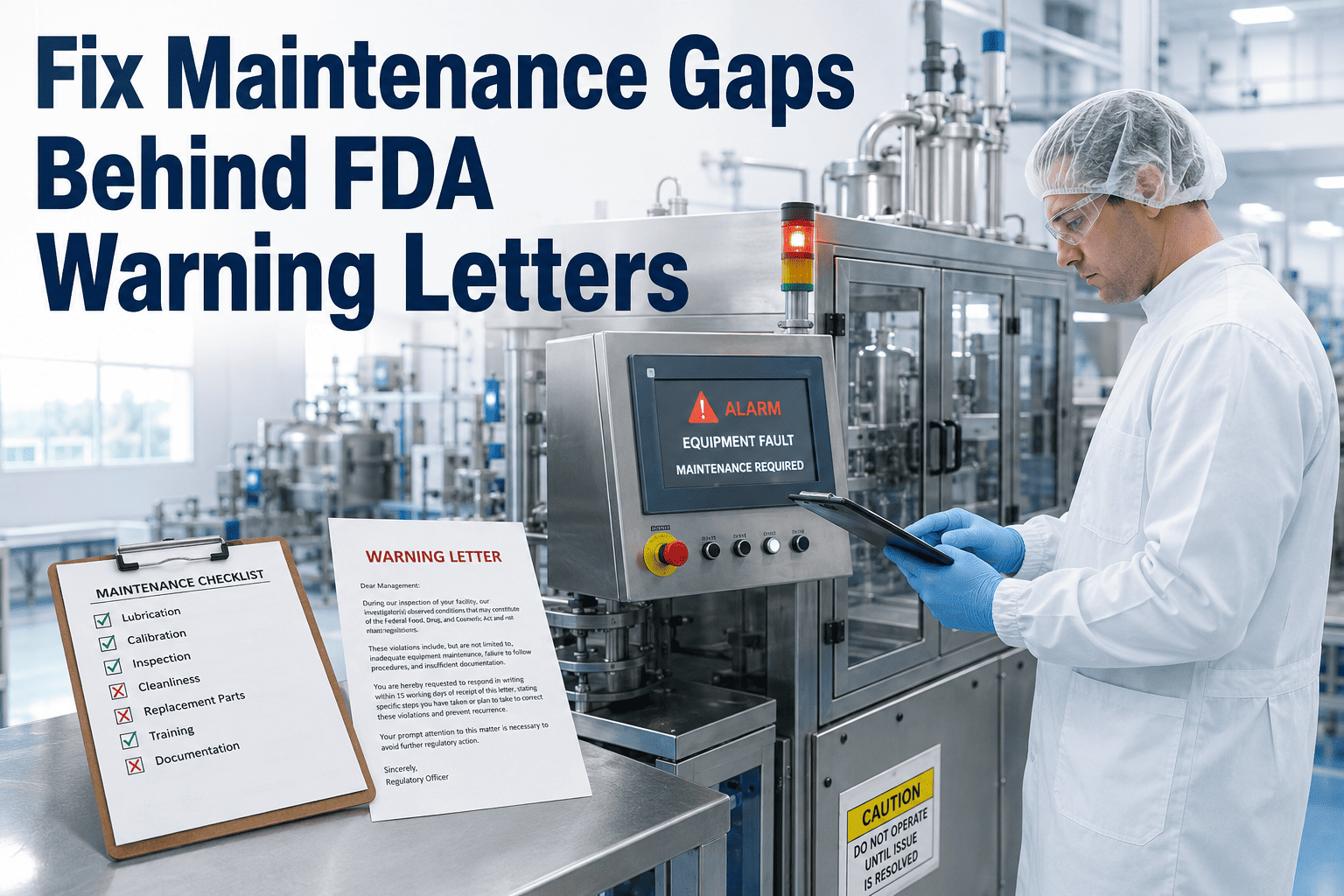
In October 2025, Scientific Protein Laboratories received an FDA warning letter that contained a sentence every pharma maintenance director should read aloud: "your CAPA plan to implement routine, vigilant operations management oversight of facilities and equipment." That phrase — operations management oversight of facilities and equipment — is the FDA telling a manufacturer that its maintenance system failed, in writing, on the public record. Of 470 warning letters issued by FDA in 2025, a meaningful share traced back to the same root cause: maintenance documentation that could not stand up when an inspector asked for it. PMs done but not recorded. Calibrations performed but not signed. CAPAs opened but never closed with effectiveness data. OxMaint's pharma compliance module exists specifically to close these documentation gaps before they appear on Form 483. This article walks through what the FDA actually finds during inspections, the maintenance failures that escalate from 483 observation to warning letter, and the remediation steps that work.
FDA Audit Readiness · Warning Letter Remediation · Maintenance Compliance
Fix the Maintenance Gaps Behind FDA Warning Letters
How pharma maintenance documentation, CAPA workflows, and PM records turn into 483 observations — and how to close them before they escalate into public enforcement action.
470
FDA warning letters issued in 2025 to regulated industries
34%
Of pharma lab warning letters cite failure to investigate OOS results
29%
Cite missing or inadequate written procedures (maintenance SOPs included)
15 days
FDA expected response window from receipt of a Form 483
How a Maintenance Gap Becomes a Warning Letter
A warning letter is rarely the first time the FDA flagged the issue. The escalation path is well documented: an inspector sees something during an audit, raises it on Form 483, gives the firm 15 working days to respond, then evaluates whether the response addresses the root cause and prevents recurrence. If the response is inadequate, the agency escalates. Most warning letters are preventable — they reflect 483 observations that were never closed properly the first time.
Stage 01
Routine Inspection
FDA investigator arrives at the site. Reviews batch records, equipment logbooks, calibration certificates, PM completion records, and deviation files. Asks targeted questions about maintenance practices.
Stage 02
Form 483 Observation
Inspector issues written observations at inspection close-out. Each observation cites a specific regulation (e.g. 21 CFR 211.67) and the documented evidence that triggered it. Firm has 15 working days to respond with corrective action plan.
Stage 03
Response Evaluation
FDA reviews the response. Inadequate root cause analysis, weak CAPA, or generic "human error" explanations get flagged. If the agency concludes the firm has not understood the systemic nature of the gap, escalation begins.
Stage 04
Warning Letter Issued
Warning letter is published on the public FDA website. Names the firm. Quotes specific findings. Demands a written response and remediation plan. Can lead to import alerts, consent decrees, batch holds, product seizures.
The Five Maintenance Gaps That Most Often Escalate to Warning Letters
Reading warning letters from the last 24 months produces a recurring set of maintenance failure patterns. Each one is preventable. Each one is documented in real FDA enforcement records. The pattern matters more than the individual citation — inspectors look for systemic weakness, not isolated mistakes.
Gap 01
21 CFR 211.67(a)(b)
Failure to clean, maintain, and follow written procedures for equipment
The most common manufacturing system citation. Triggered by missing PM completion records, equipment cleaned but not logged, sanitation procedures not followed at validated intervals, or maintenance done without a signed work order. The Acino Products warning letter directly cited operations management oversight of facilities and equipment as the remediation expectation.
Remediation Every PM, cleaning, and sanitation task linked to an asset record with electronic signature on completion, scheduled triggers that cannot lapse without change control, and an immutable audit trail per 21 CFR Part 11.
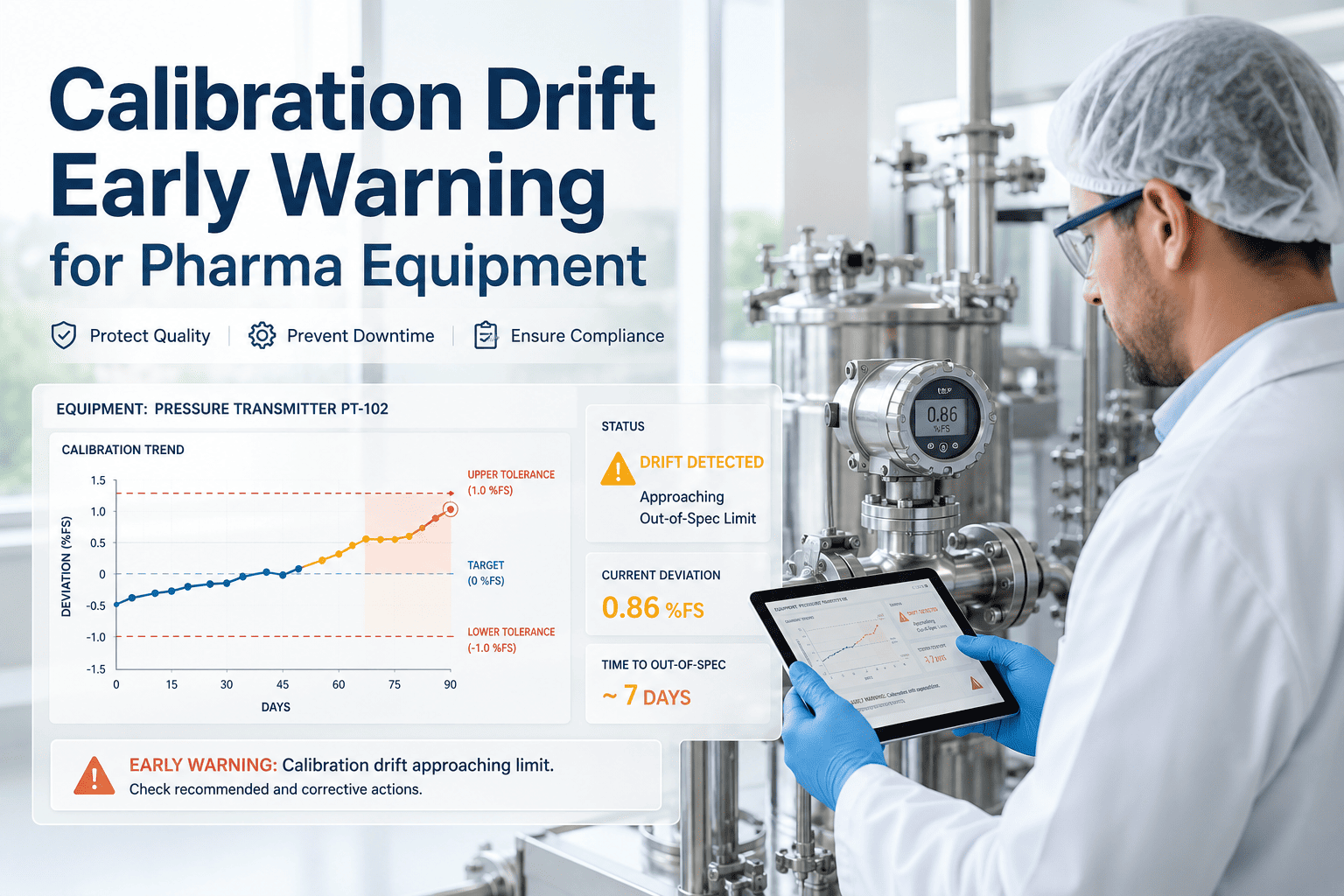
Inadequate calibration of automatic, mechanical, and electronic equipment
Calibration certificates missing, expired during the production window, lacking traceability to a national standard, or signed by personnel without documented qualification. Out-of-tolerance events not investigated for batch impact. Every measurement taken on an uncalibrated instrument is retrospectively questionable.
Remediation Calibration schedule per instrument with automated alerts 30, 14, and 7 days before expiry. As-found and as-left readings captured. Out-of-tolerance events trigger automatic deviation workflow with impact assessment.
Failure to investigate deviations and out-of-specification results
Cited in 34% of 2025 pharma lab warning letters. Deviations closed without scientifically justified root cause. "Human error" used as a catch-all without systemic analysis. Out-of-spec results explained away rather than investigated. Equipment-related deviations not linked back to PM, calibration, or condition history.
Remediation Every deviation linked to the asset history including PM completion, calibration status, prior deviations, and condition monitoring trends. Root cause analysis structured around the 5-why or fishbone method with documented evidence at each step.
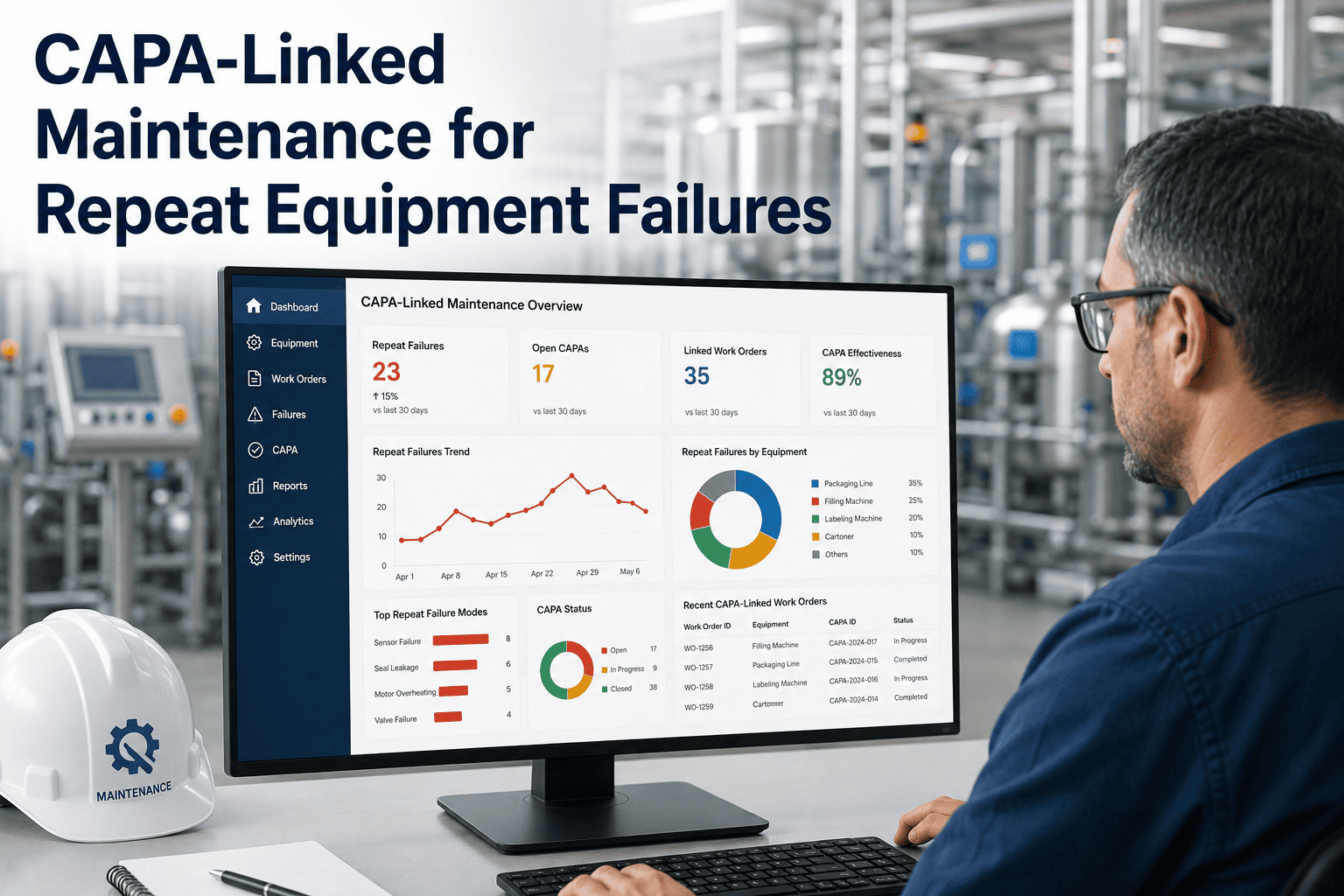
CAPA opened but not closed with effectiveness verification
CAPA exists on paper but the corrective action did not actually prevent recurrence. The 2025 syringe-disconnection warning letter is the textbook example: CAPA opened in June 2023, ineffective corrective actions, 221 complaints and 177 MDRs filed before the firm acted on the trending data its own VOE plan flagged as failing.
Remediation CAPA effectiveness checks scheduled as mandatory work orders. Effectiveness criteria pre-defined and measurable. Failed effectiveness reopens the CAPA — not closes it. Trending data routes back into the CAPA system, not into a parallel logbook.
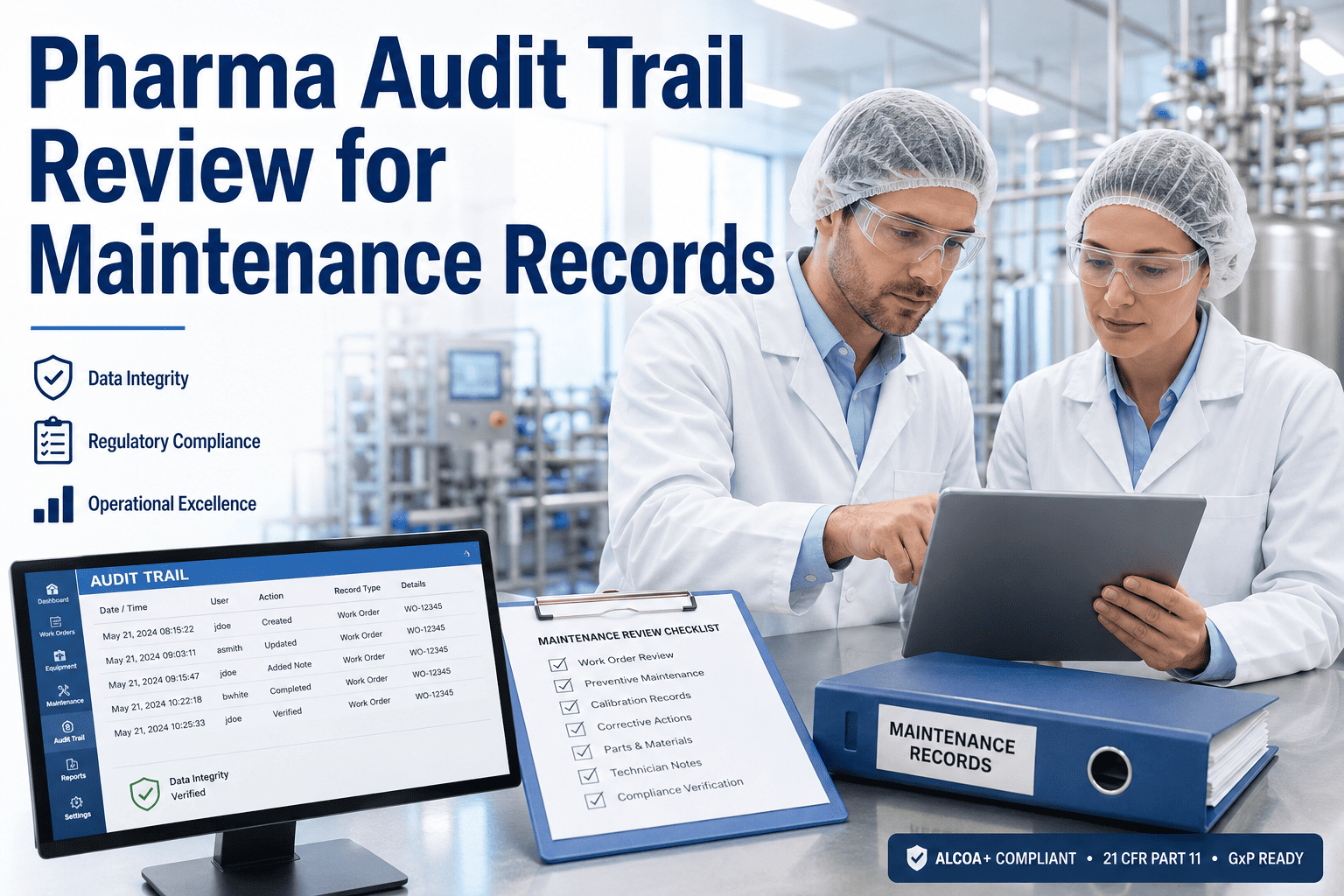
Inadequate maintenance documentation and record retention
Records exist but cannot be retrieved in the time an inspector waits. PM completion captured on paper that lives in a binder in the maintenance shop. Calibration certificates filed by date instead of by asset. Deviation files separated from equipment history. The inspector concludes the quality system cannot demonstrate control.
Remediation All maintenance records digital, linked to the asset, retrievable by serial number, work order ID, deviation number, or date range. Records retained for the regulatory period plus margin. Export packages available in inspector-ready format.
Close the Five Most Cited Maintenance Gaps Before Your Next FDA Inspection
OxMaint links every PM, calibration, deviation, and CAPA into one validated record. Inspectors get evidence in seconds. Quality gets defensible audit packages. Maintenance gets a system that actually works.
Anatomy of a Real Warning Letter — What the FDA Actually Quotes
Warning letters are public documents. They quote specific findings verbatim and reference the regulation each finding violates. Reading them is the single best way to understand exactly what the FDA expects maintenance documentation to look like. Below is the citation language pattern that repeats across recent enforcement actions — paraphrased here for clarity.
21 CFR 211.67
Equipment Cleaning & Maintenance
"Your firm failed to clean, maintain, and sanitize equipment and utensils at appropriate intervals to prevent malfunctions or contamination, and you failed to establish and follow adequate written procedures for cleaning and maintenance of equipment."
Translation: PMs were not done on schedule, or were done but not recorded, or were done and recorded but the procedure was not adequate. Any of the three triggers the citation.
CAPA Remediation Demand
Operations Management Oversight
"Your CAPA plan to implement routine, vigilant operations management oversight of facilities and equipment, ensuring prompt detection of equipment performance issues, effective execution of repairs, adherence to preventive maintenance schedules."
Translation: The FDA does not consider this a maintenance issue. It considers this a management oversight issue — and expects the response to include systemic governance, not just fixing the individual gap.
21 CFR 211.192
Deviation Investigation
"You failed to conduct adequate investigations into out-of-specification results. Your investigation identified the sampling procedure as the potential root cause but did not adequately evaluate equipment, calibration history, or systemic causes."
Translation: Naming a root cause is not enough. The investigation must evaluate equipment condition, maintenance history, and calibration status as potential contributors before they can be ruled out.
CAPA Effectiveness
Trending Data Ignored
"Your verification of effectiveness plan established a threshold. The actual data exceeded the threshold in three consecutive quarters. The firm did not reopen the CAPA or trigger field action despite the trending evidence."
Translation: A CAPA system that does not act on its own trending data is worse than no CAPA system at all — because the firm has documented evidence it knew the issue was not solved and chose not to act.
Maintenance Documentation Inspectors Will Ask For — And How Long They Wait
FDA investigators have a finite inspection window. They ask for documents and expect them in a defined time. The table below maps the most common requests against the time most inspectors will tolerate before noting a documentation gap as a citation in its own right. Sites with paper-based records routinely miss these windows even when the underlying maintenance work was done correctly.
| Document Requested |
Inspector Wait Tolerance |
Paper-Based Reality |
OxMaint Retrieval Time |
| PM completion records for asset for last 24 months |
10–15 minutes |
2–8 hours (logbook search) |
Under 30 seconds |
| Calibration certificate trail for critical instrument |
10 minutes |
1–4 hours (file room) |
Under 30 seconds |
| Deviation investigation file with all linked records |
15–20 minutes |
4–12 hours (cross-referencing) |
Under 1 minute |
| CAPA effectiveness verification data trend |
15 minutes |
Often unavailable |
Under 1 minute |
| Equipment history including all interventions |
20 minutes |
Half a day or more |
Under 1 minute |
| Training records for technician executing a work order |
10 minutes |
1–3 hours (HR system) |
Under 30 seconds |
| Change control records affecting an asset |
15 minutes |
2–6 hours (cross-system) |
Under 1 minute |
The Remediation Playbook — What a Strong 483 Response Looks Like
Most warning letters trace back to a weak 483 response. The agency reads the response, concludes the firm did not understand the systemic nature of the gap, and escalates. A defensible response follows a documented pattern: acknowledge specifically, investigate broadly, remediate systemically, verify with measurable data.
01
Acknowledge the Specific Observation
Quote the observation language. Confirm the agency's finding. Do not minimise. Do not argue scope at this stage. The response begins with the firm taking the citation seriously and demonstrating it understands what was found.
02
Conduct a Broad Systemic Investigation
Investigate the cited asset and all comparable assets in the facility. A single PM gap is rarely a one-off. The agency expects to see evidence the firm looked across the whole quality system, not just the equipment named in the observation.
03
Document Root Cause with Evidence
Name the root cause and show how it was determined. "Human error" without systemic analysis is the single most common reason responses fail. Show what the investigation considered, what it ruled out, and why. Reference equipment history, PM records, calibration data, training matrix.
04
Build CAPA with Measurable Effectiveness Criteria
Define what success looks like before implementing the corrective action. State the metric, the threshold, the measurement frequency, and the review point. A CAPA without measurable effectiveness criteria is the textbook example the agency uses to justify escalation.
05
Implement Systemic Controls, Not Patches
Add system-enforced gates, not procedural reminders. Calibration alerts that prevent work order completion if calibration is overdue. Stage gates that block production until PMs are current. Electronic signatures that cannot be bypassed. The agency credits systemic controls; it discounts SOP updates without enforcement.
06
Submit Verification Evidence on Schedule
Track effectiveness measurements per the CAPA plan. Submit interim updates if any commitment slips. The agency forms its enforcement view based on whether the firm meets its own commitments. A missed effectiveness check is read as evidence the system is still broken.
Expert Review
"
After twenty-one years inside FDA's drug regulatory programmes and now consulting for pharma manufacturers facing warning letter remediation, the single most consistent pattern I see is the gap between maintenance work performed and maintenance work provable. Plants do the PMs. Technicians calibrate the instruments. Engineering investigates deviations. But when the inspector arrives and asks for the documentation trail, the firm produces a binder, an email, a signed cover sheet — and the underlying records linking the asset to the technician to the procedure to the outcome cannot be retrieved in the time the inspector waits. That gap is what escalates a routine inspection into a 483 observation, and a 483 into a warning letter. The fix is mechanical, not cultural. It is a maintenance system that produces inspector-ready evidence as a by-product of every completed task, not as a separate documentation exercise. Sites that operate that way receive citations at a fraction of the industry average — and recover from them faster when they do occur.
Dr. Margaret Halloran, RAC, PMP
Regulatory Affairs Certified (US) · Former FDA Drug Enforcement Branch · 21 years pharma compliance · Warning letter remediation specialist · Lead investigator on 14 FDA consent decree recovery programmes · Author of three FDA-published guidance documents on quality system governance
Frequently Asked Questions
F1
What is the actual difference between a 483 and a warning letter?
A Form 483 is an inspector's written list of observations at the close of an inspection — not an enforcement action. A warning letter is a public, agency-level document issued when 483 observations were not adequately addressed, or when violations are serious enough to warrant immediate public action. Warning letters trigger import alerts, batch holds, and downstream regulatory scrutiny across EMA, MHRA, and TGA.
OxMaint helps firms produce defensible 483 responses before the agency considers escalation.
F2
How can a CMMS reduce the risk of a maintenance-related FDA citation?
A validated CMMS produces inspector-ready evidence as a by-product of every completed task. PMs cannot lapse without change control. Calibrations cannot expire without alerts. Deviations link automatically to the asset history. CAPAs route back into the work order system. The result is that when an inspector asks for documentation, the firm can produce it in seconds — which is the single strongest indicator of audit readiness.
F3
What makes a CAPA response "effective" in the eyes of the FDA?
An effective CAPA has measurable effectiveness criteria defined before implementation, a documented metric and threshold, scheduled effectiveness checks, and trending data that routes back into the CAPA system. If effectiveness fails, the CAPA reopens — it does not close. The 2025 syringe-disconnection warning letter is the textbook negative example: trending data exceeded the threshold in three quarters and the firm did not act.
Book a demo to see how OxMaint wires effectiveness criteria into the work order lifecycle.
F4
How long does the FDA give us to respond to a Form 483?
15 working days from receipt is the response window the FDA expects. A complete response includes acknowledgement of each observation, root cause analysis, corrective and preventive actions, implementation timeline, and verification of effectiveness criteria. Late or incomplete responses are themselves cited as escalation factors.OxMaint's CAPA workflow generates the documentation backbone needed to produce a defensible response within the 15-day window.
F5
Can OxMaint be deployed quickly enough to help with active warning letter remediation?
Yes. Phased remediation deployments typically activate the asset register, calibration tracking, and CAPA workflow within 30 days for the cited equipment. Full site rollout follows over 60–90 days. Many firms in active remediation use OxMaint specifically to evidence systemic controls in their CAPA response — the agency credits system-enforced gates more than procedural updates alone.
Sign in to OxMaint to start a remediation-focused rollout or
book a demo to scope the deployment.
The Maintenance Trail Is the Audit Trail. Make Sure Yours Holds Up.
OxMaint turns every PM, calibration, deviation, and CAPA into inspector-ready evidence. Validated for 21 CFR Part 11. Built for pharma. Deployed in days. The firms that close their maintenance documentation gaps before the next inspection do not appear on the FDA enforcement page.