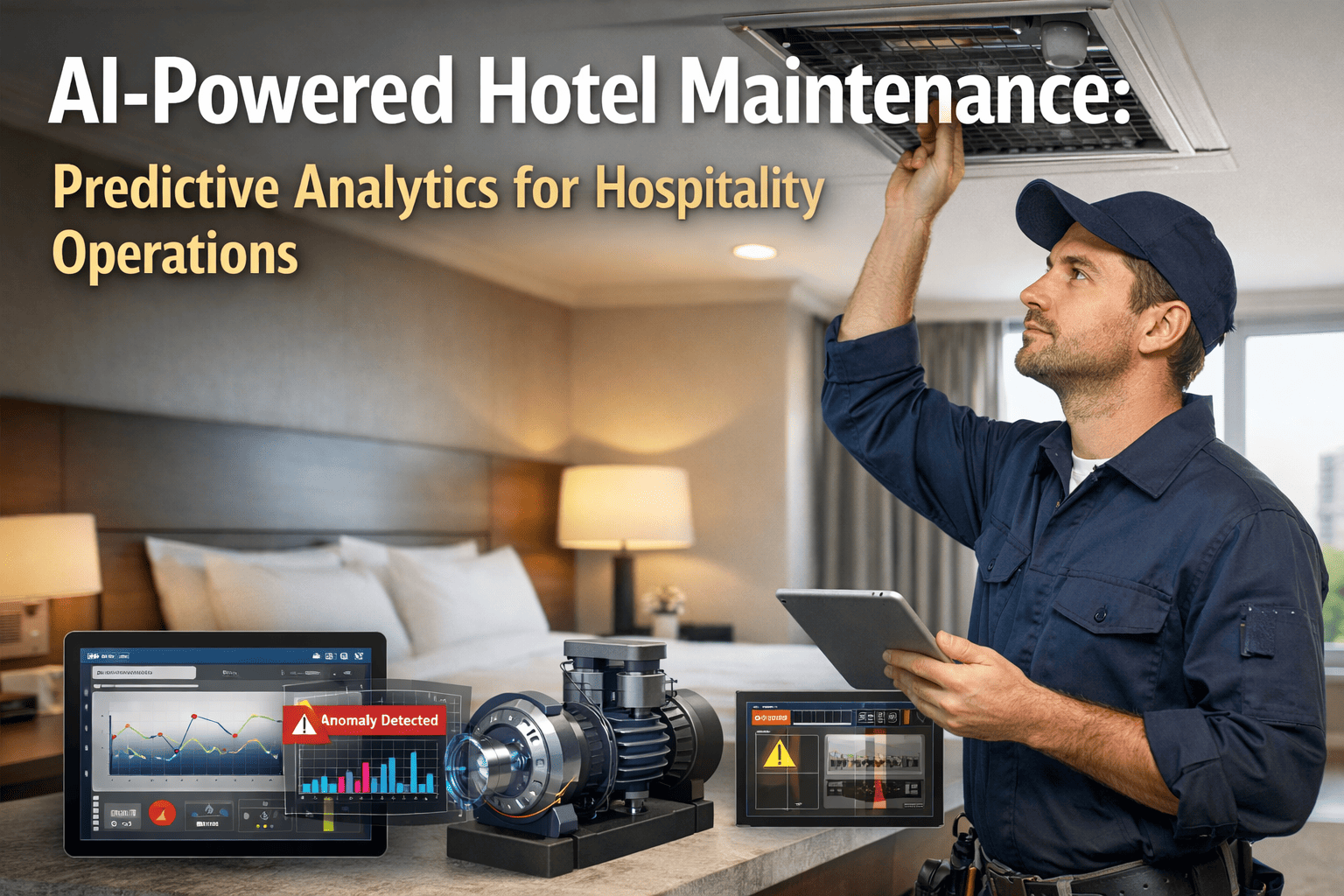
A regional hotel group operating eleven properties across four states had a maintenance problem that only became visible at scale. Each property ran its own work order system — some on spreadsheets, two on legacy CMMS tools, three on paper logs. Corporate engineering had no visibility into whether a chiller at property seven was three months past its PM interval, whether property two had recurring HVAC failures that signaled a systemic parts issue, or whether the total maintenance spend across the portfolio was trending 18% over budget. They found out about equipment failures the same way their guests did — when something stopped working. After deploying a centralized AI maintenance platform across all eleven properties, the group reduced unplanned downtime by 41%, recovered $47,000 in previously missed warranty claims in the first year, and for the first time, the VP of Engineering could pull a live cross-portfolio asset health dashboard from a single screen. That is the operational shift that separates hotel chains managing maintenance from hotel chains that have AI-powered CMMS platforms doing the heavy work across every property simultaneously.
78%
Of hotel chains already using AI across operations, with 89% planning expansion in the next 24 months
41%
Average reduction in unplanned downtime events after AI maintenance platform deployment
$47K
Average annual warranty claims recovered through automated asset documentation in hotel portfolios
670%
First-year ROI documented by hotel groups deploying AI-powered preventive maintenance scheduling
Why Managing Maintenance Across a Hotel Chain Is Fundamentally Different
A single-property maintenance manager can carry institutional knowledge in their head — they know which boiler runs hot in January, which elevator motor has been repaired twice, which wing has chronic drain issues. Scale that to five, ten, or fifty properties and that institutional knowledge becomes dangerous because it no longer exists anywhere. Each property develops its own tribal maintenance culture, its own documentation habits, and its own threshold for what counts as urgent. Corporate engineering is left making capital allocation decisions based on self-reported data from property-level teams who have every incentive to underreport deferred maintenance and overreport completed PMs.
An AI maintenance platform solves this at the architecture level, not through better reporting policies. When every property writes work orders, closes inspections, and logs asset data in the same cloud system, the AI layer can identify patterns that no human reviewing individual property reports would catch — a motor failure mode appearing at properties three, seven, and nine that predicts a fleet-wide failure risk across all motors of the same make and age. That cross-property intelligence is the unique value of an enterprise AI maintenance platform, and it is the reason chains that have deployed them are achieving results that property-by-property CMMS tools cannot replicate. Properties evaluating platforms can schedule a free assessment to model portfolio-wide savings against their current maintenance spend and asset base.
Fragmented Management
Cross-Property Visibility
None — each property manages independently
Failure Pattern Detection
Impossible across disparate systems
Brand Standard Compliance
Self-reported, unverifiable
Capital Planning Data
Anecdotal, unreliable for CapEx decisions
Vendor Contract Leverage
Each property negotiates independently
AI Maintenance Platform
Cross-Property Visibility
Live asset health dashboard across all sites
Failure Pattern Detection
AI identifies fleet-wide risk from property data
Brand Standard Compliance
Audit-ready documentation, auto-generated
Capital Planning Data
Asset age, cost, and lifecycle data portfolio-wide
Vendor Contract Leverage
Consolidated spend data supports bulk negotiation
Hotel chains on centralized AI platforms reduce total maintenance costs by 25–35%with 200–400% ROI documented within 18–24 months of full portfolio deployment
Six Core Capabilities That Separate Enterprise AI Platforms from Basic CMMS Tools
The hospitality market has no shortage of maintenance software options. Most handle work orders at a single property. Very few are actually built for the portfolio-level operational intelligence that a hotel chain needs. These six capabilities define the difference — and determine whether a platform delivers chain-level ROI or just digitizes the same fragmented processes that existed on paper.
01
Cross-Portfolio Asset Intelligence
Foundation Capability
Every asset across every property lives in a single registry with age, maintenance history, failure log, and total cost of ownership. Corporate engineering sees fleet-wide asset health in real time, not through quarterly reports that are already outdated when they arrive.
02
AI Predictive Failure Alerts
High Impact
Machine learning models trained on hospitality failure patterns analyze IoT sensor data and maintenance records to predict failures 2–4 weeks before they occur. Cross-property learning means a failure pattern identified at one property automatically updates risk thresholds across all properties with similar equipment.
03
Automated Work Order Generation
Daily Operations
Predictive alerts, scheduled PM triggers, and guest request integrations all flow automatically into structured work orders — assigned to the right technician at the right property, with asset context attached. No dispatcher, no manual triage, no lost alerts between shifts.
04
Brand Standard Compliance Engine
Chain Critical
Configurable PM schedules enforce brand maintenance standards across every property automatically. Compliance rates are visible at the portfolio level, and audit-ready documentation exports in one click — eliminating the pre-audit scramble that consumes engineering management time at every brand review.
05
Multi-Property Parts and Inventory
Cost Control
Consolidated parts inventory across the chain reveals which properties are overstocking, which are buying the same parts repeatedly indicating chronic failures, and where bulk purchasing contracts can replace one-off emergency orders. Multi-property operators reduce parts spend 15–25% through consolidated visibility alone.
06
CapEx Forecasting and Asset Lifecycle
Executive Visibility
Asset age, accumulated maintenance cost, failure frequency, and remaining useful life data across all properties enables data-driven capital planning. Chains using AI lifecycle data replace the guesswork capital budget process with forecast models that prevent both premature replacements and catastrophic late failures.
How AI Maintenance Platforms Learn and Improve Across a Hotel Portfolio
The difference between a CMMS and an AI maintenance platform is not just a feature list — it is a fundamentally different relationship with data over time. A traditional CMMS stores what happened. An AI platform learns from what happened, applies those learnings to predict what will happen, and gets more accurate as more properties feed it more data. For hotel chains, this creates a compounding operational advantage that widens every year the platform is in use.
01
Data Collection
IoT sensors feed live asset data chain-wide
Work orders log repair actions and outcomes
Inspections capture condition scores per asset
PMS integration adds occupancy load context
Output: Unified Data Lake
02
Pattern Recognition
AI identifies failure precursors by asset class
Seasonal and load-based trends mapped per brand
Repair-to-failure time modeled per asset type
Cross-property anomaly correlation flagged
Output: Fleet Risk Models
03
Predictive Alerts
Failures predicted 2–4 weeks before occurrence
Alert severity scored by guest impact potential
Work orders auto-generated from each alert
Chain-wide risk bulletins issued on fleet patterns
Output: Proactive Intervention
04
Continuous Learning
Every repair outcome refines prediction models
False positives reduced as baselines sharpen
New properties onboard to existing model base
Accuracy improves with every property added
Output: Compounding Accuracy
See What Cross-Portfolio AI Maintenance Looks Like for Your Chain
OxMaint is built for hotel chains that need one platform across every property — live asset health, automated work orders, brand compliance documentation, and AI predictive alerts that improve as your portfolio grows.
The Portfolio ROI Case: What Hotel Chains Actually Save at Scale
The ROI model for an AI maintenance platform changes materially when evaluated at portfolio scale rather than per-property. A single property deployment delivers operational savings. A chain-wide deployment delivers those savings multiplied by property count, plus the portfolio-exclusive benefits — cross-property parts consolidation, fleet-wide failure prevention, vendor contract leverage, and capital planning accuracy — that simply do not exist in any per-property tool.
Emergency Repair Reduction
AI catches failures 2–4 weeks early across all 10 properties — planned repairs cost 3–4x less than reactive ones
$310,000
Recovered Warranty Claims
Automated documentation recovers an average $47,000 per year in warranty-covered repairs previously missed
$47,000
Parts Inventory Consolidation
Cross-property visibility eliminates duplicate stock and enables bulk purchasing — 15–25% reduction in parts spend
$68,000
Labor Productivity Gain
AI-scheduled work orders increase technician wrench time by 30–40% across all properties — less time searching, more time fixing
$94,000
Energy Waste Elimination
Degraded equipment identified before drawing excess current — 15–25% energy cost reduction across portfolio
$57,000
Brand Audit Preparation Cost
Automated compliance documentation eliminates 18+ hours per property of manual audit prep per brand review cycle
$24,000
Total Annual Portfolio Value
$600,000
Platform investment for 10 properties: $48,000–$72,000/yr. Net annual savings: $528,000–$552,000. Payback period: 4–7 weeks per property added.
The Seven Challenges AI Maintenance Platforms Solve for Hotel Chain Engineering
Hotel chain engineering leaders consistently identify the same operational pain points regardless of chain scale. These seven challenges are the ones an AI maintenance platform is specifically designed to eliminate — not partially mitigate through better policies, but structurally remove through architecture.
01
No Portfolio-Wide Asset Visibility
Corporate engineering cannot see real-time equipment health across all properties. AI platforms create a live multi-property asset dashboard that replaces monthly property reports with continuous visibility into what every critical system is doing right now.
02
Inconsistent PM Compliance Across Properties
Each property interprets maintenance schedules differently. AI platforms enforce standardized PM intervals chain-wide, auto-generate overdue alerts, and provide corporate-level compliance scorecards that make deferred maintenance visible before it becomes a brand audit issue.
03
Surprise CapEx Driven by Deferred Maintenance
Without asset lifecycle data, capital budgets are built on gut feel and self-reported condition assessments. AI platforms provide asset age, accumulated repair cost, failure frequency, and predicted remaining useful life across all properties — converting CapEx requests from narratives into data-backed proposals.
04
Repeated Failures of the Same Equipment Type
When the same motor model fails at property three and property eight in the same quarter, a fragmented system treats them as unrelated incidents. An AI platform identifies the fleet-wide pattern and issues proactive alerts for all properties running the same equipment before the third failure occurs.
05
Onboarding New Properties Takes Months
Acquired properties arrive with their own asset records, work order histories, and maintenance cultures. Cloud AI platforms onboard new properties in days — asset data imports, existing PM schedules migrate, and technicians start using mobile work orders immediately without IT infrastructure setup at the property level.
06
Manual Compliance Documentation for Brand Audits
Engineering managers spend 18-plus hours per property assembling maintenance logs before each brand review. AI platforms generate audit-ready compliance packages automatically — inspection records, PM completion rates, and regulatory documentation all exportable in one click from the corporate dashboard.
07
Technician Productivity Lost to Administrative Work
Property-level technicians spend 30–40% of their time on administrative tasks — logging completed work, finding asset records, submitting parts requests. AI-driven mobile CMMS platforms eliminate paper forms and manual lookups, returning that time to actual maintenance work and increasing wrench time across the entire portfolio.
What to Demand From an AI Maintenance Platform Built for Hotel Chains
The platform evaluation process for a hotel chain looks very different from a single-property purchase decision. Architecture choices that are acceptable at one location become blocking problems at fifty. These are the non-negotiable requirements for a platform being evaluated to run maintenance operations across a hotel portfolio.
True multi-property architecture — not a single-property tool with a portfolio dashboard bolted on top
AI cross-property learning that identifies fleet-wide failure patterns from individual property data streams
Hardware-agnostic IoT integration — must accept sensor data from any existing telematics provider without forcing hardware replacement
PMS integration that connects guest room status and occupancy load to maintenance scheduling automatically
Role-based access — property technicians see their property, regional managers see their region, corporate engineering sees the full portfolio
Chain-level compliance reporting with one-click audit export, not per-property exports that require manual consolidation
Rapid new property onboarding measured in days, not months — cloud-native with no on-premises infrastructure required
Per-seat or per-asset pricing that makes adding properties financially punishing as the portfolio grows
No true AI layer — just rule-based alerts that require manual threshold configuration per asset with no learning capability
Data siloed per property — no portfolio-level asset registry, no cross-property analytics, no consolidated reporting
Proprietary hardware lock-in that requires replacing existing sensors and telematics devices to use the platform
Desktop-only interface that field technicians at all ten properties will abandon within weeks of rollout
6-to-12-month enterprise implementation timelines that delay ROI and require IT resourcing the chain does not have
No CapEx forecasting module — cannot generate asset lifecycle data that supports portfolio capital planning decisions
OxMaint Is Built for Hotel Chains, Not Adapted for Them
Multi-property asset registry, AI predictive alerts with cross-portfolio learning, automated work orders, brand compliance documentation, mobile-first technician tools, and hardware-agnostic IoT integration — all in one cloud-native platform that deploys in days. Join 1,000-plus organizations already running maintenance operations on OxMaint.
Frequently Asked Questions
What is an AI maintenance platform for hotel chains and how is it different from a standard CMMS?
A standard CMMS manages work orders and preventive maintenance schedules at the property level — it stores maintenance history and automates task creation, but it does not learn from that data or apply intelligence across multiple properties. An AI maintenance platform adds a machine learning layer that analyzes asset condition data, historical failure patterns, and cross-property signals to predict failures before they occur and continuously improve prediction accuracy as more data is collected. For hotel chains specifically, the critical distinction is portfolio architecture — AI platforms built for chains maintain a unified asset registry across all properties, enable cross-portfolio failure pattern detection, enforce brand standards chain-wide, and provide corporate engineering with live visibility that property-level tools never can.
How long does it take to deploy an AI maintenance platform across a hotel chain?
Cloud-native AI maintenance platforms like OxMaint deploy individual properties in days, not months. A ten-property chain rollout typically completes in two to four weeks depending on the volume of historical asset data being migrated from legacy systems. There is no on-premises server installation, no IT infrastructure procurement, and no hardware purchasing required at individual properties. Technicians access the platform through web browsers and mobile apps immediately after their property goes live. The phased approach typically starts with two to three flagship properties in week one, uses the learnings to refine the rollout configuration, and then completes the remaining properties in parallel. Most chains are running full portfolio operations by week four and begin seeing AI predictive alert value within thirty days of each property's activation.
Can an AI maintenance platform work with the different asset types and building systems across different hotel brands in the same portfolio?
Yes. Multi-brand portfolios are a core use case for enterprise AI maintenance platforms. Each brand or property type can have its own maintenance schedule templates, inspection checklists, compliance standards, and PM intervals — while all sharing the same underlying platform, asset registry, and reporting infrastructure. Corporate engineering sees the full portfolio in one dashboard while regional managers and property teams see only their relevant scope. The AI layer learns failure patterns at the asset class level, meaning learnings from a Marriott-branded property's HVAC fleet inform predictions for a Hilton-branded property's HVAC fleet if they share the same equipment manufacturers or usage profiles.
What integrations does an AI hotel maintenance platform need to be effective?
The three most important integrations are property management systems, IoT and telematics hardware, and accounting or ERP platforms. PMS integration allows the platform to receive occupancy data that adjusts maintenance scheduling — high-occupancy periods trigger different PM windows than low periods. IoT integration allows sensor data from HVAC controllers, electrical panels, elevator systems, and other monitored assets to feed the AI prediction layer automatically. Accounting integration allows maintenance cost data to flow into financial reporting without manual re-entry. OxMaint provides open APIs and pre-built integrations for all three categories, and its hardware-agnostic architecture means existing sensors and telematics devices at each property can feed the platform without requiring hardware replacement across the chain.
What ROI should a hotel chain realistically expect from an AI maintenance platform?
Hotel chains implementing AI maintenance platforms typically document 200–400% ROI within 18–24 months of full portfolio deployment. The value comes from multiple compounding streams: emergency repair cost reduction of 25–35% through predictive intervention, recovered warranty claims averaging $47,000 annually across the portfolio, parts inventory consolidation savings of 15–25%, labor productivity improvements of 30–40% through AI-scheduled work orders, energy waste elimination through early equipment degradation detection, and the elimination of brand audit preparation costs through automated compliance documentation. The payback period for most hotel chain deployments is 4–7 weeks per property — meaning the platform costs are recovered faster than the typical quarterly budget cycle.
Book a demo to model the specific ROI for your portfolio based on current maintenance spend and asset count.