Hotel BMS to CMMS Integration (OPC-UA, BACnet, Modbus Guide)
By Mark Strong on April 18, 2026
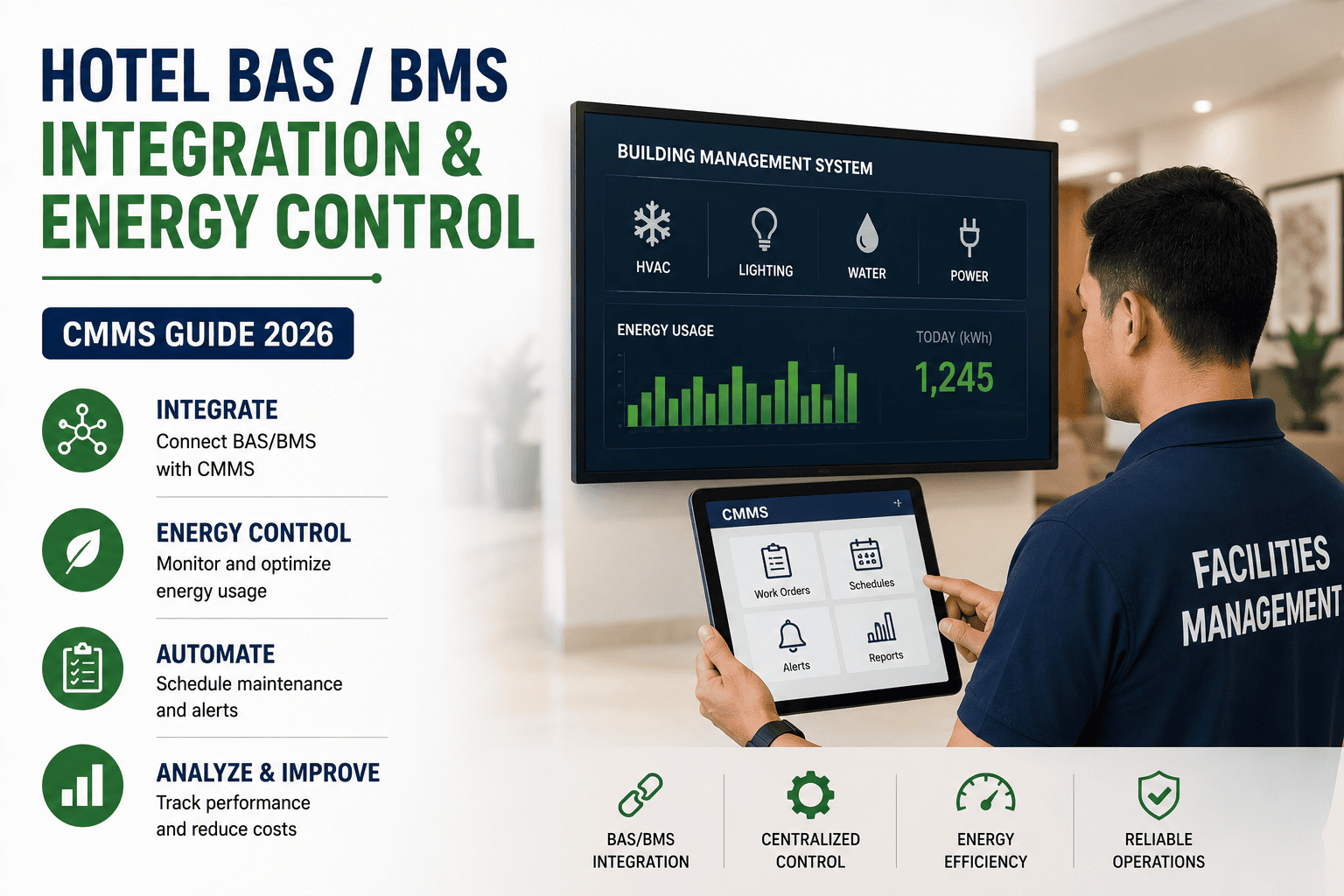
A hotel's building management system knows the chiller is losing efficiency before anyone on the engineering team does. It flags the drift. The alarm sits in a controls interface that no one is actively watching. Three weeks later, the unit fails on a sold-out Saturday night. The emergency repair costs six times what a condition-triggered PM would have. The guest complaint feeds a negative review. The revenue impact from two rooms out of service compounds through the weekend. The BMS had the answer — it just had no way to tell maintenance. Bridging that gap is what OPC-UA, BACnet, and Modbus integration with a CMMS is designed to do. Book a demo to see how OxMaint connects to your hotel's BMS.
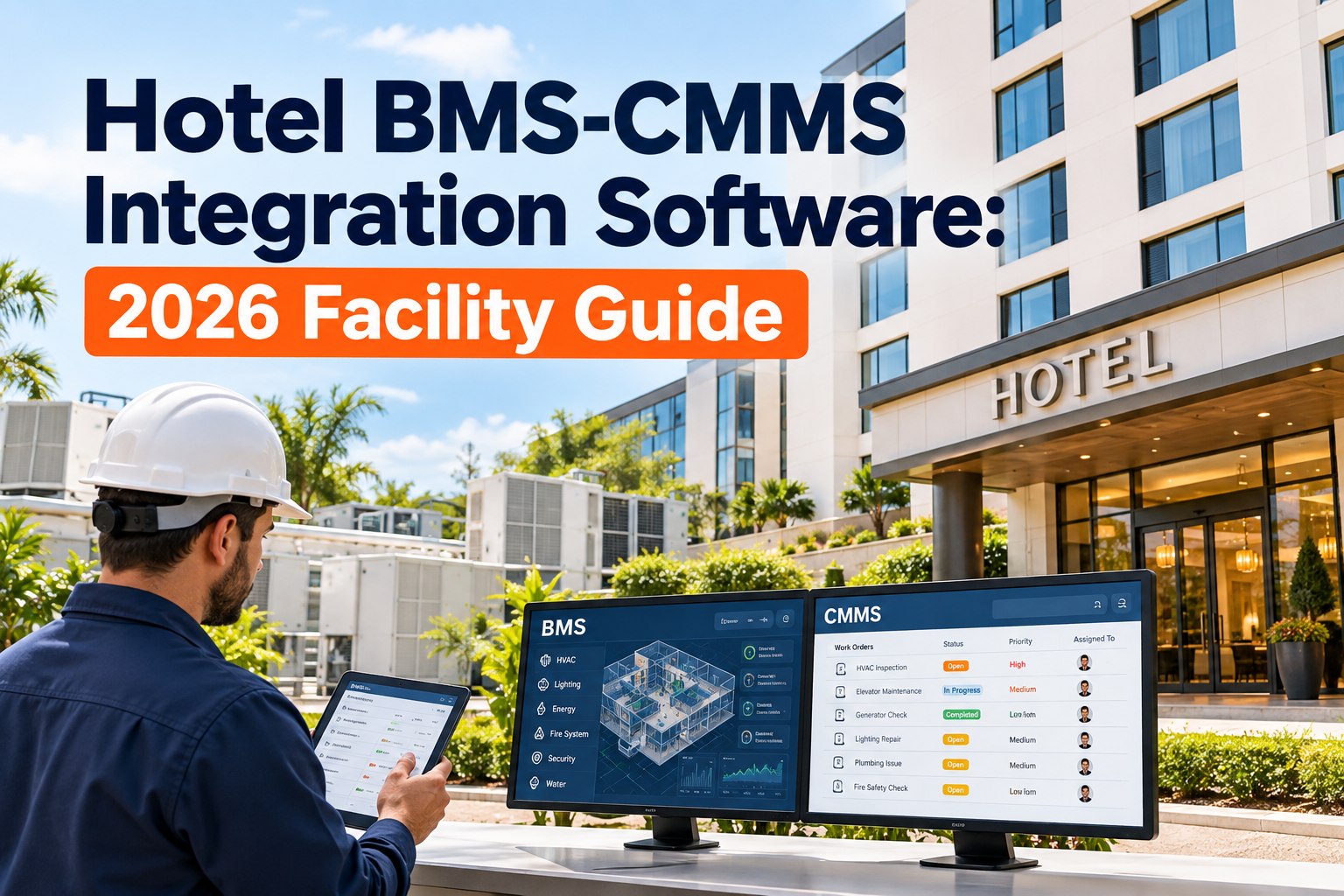
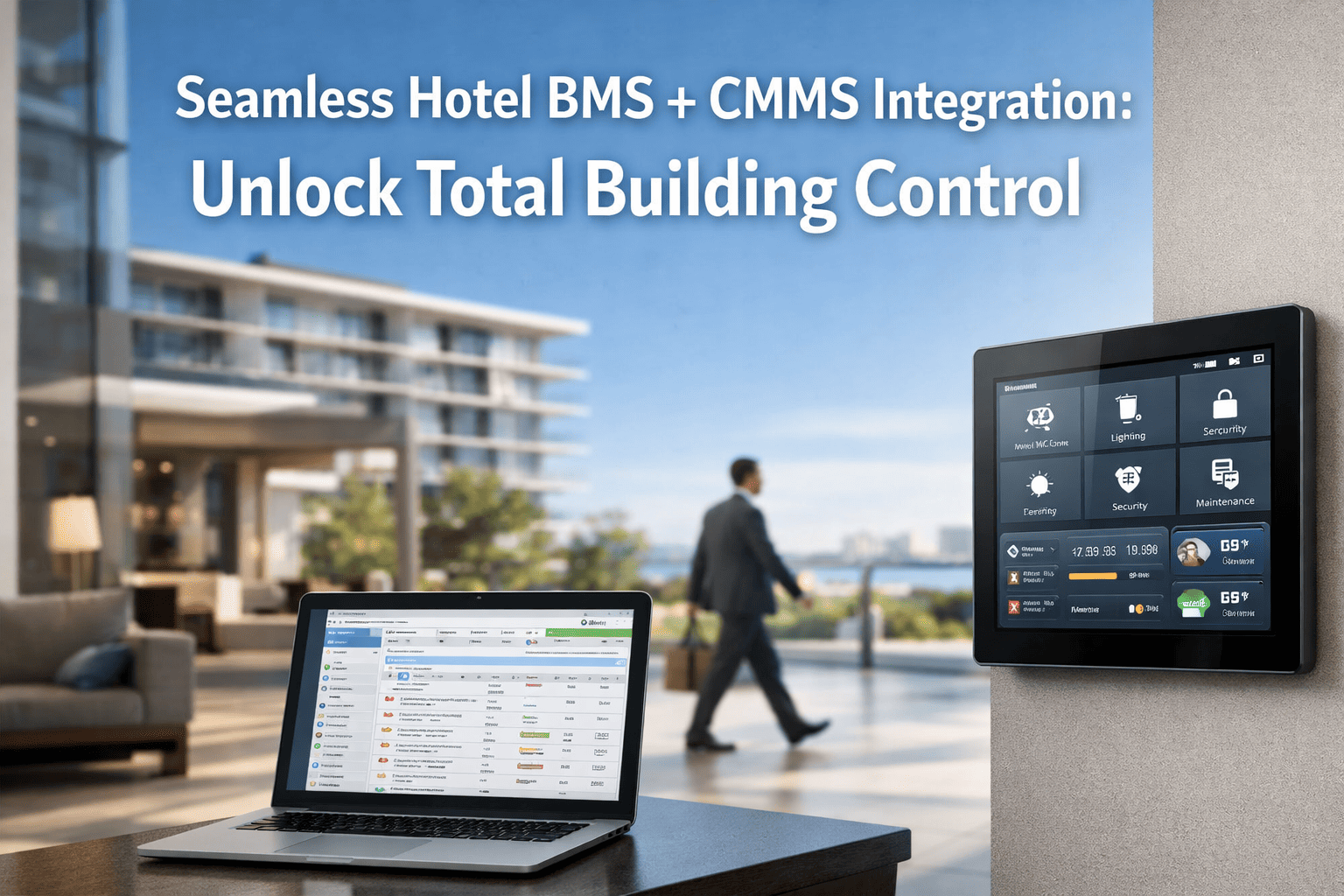
Hotel BMS to CMMS Integration
OPC-UA, BACnet & Modbus — from sensor alarm to closed work order, automatically
5 min
Fault-to-work-order time with BMS integration vs. 4–8 hours manually
45–65%
Reduction in unplanned equipment downtime after BMS-CMMS connection
15–30%
Annual energy savings from condition-based maintenance replacing calendar PMs
25%
Of BMS fault alerts in unintegrated buildings go unacknowledged for over 24 hours
Why Your Hotel BMS and CMMS Are Speaking Different Languages
A modern hotel generates thousands of data points every hour — chiller approach temperatures, AHU supply air, VAV box positions, boiler flue gas readings, cooling tower conductivity. The BMS captures all of it. The CMMS manages work orders and PM schedules. Without an integration layer, these two systems operate in separate worlds: the BMS logs what the equipment is doing, and the maintenance team responds to what guests notice. The result is a systematic gap where degradation signals arrive too late — or not at all.
Without Integration
Alarm fatigue in the controls room
BMS alarms pile up in a dashboard the maintenance team rarely checks. Critical faults go unacknowledged for hours or days while the equipment continues to degrade.
Calendar PM that misses real conditions
Scheduled maintenance runs on fixed intervals regardless of what the BMS is reporting. A chiller coil fouling over three weeks is serviced on month six — not when the data says it needs it.
No diagnostic context at the work order
Technicians receive a fault description with no BMS trend data, no sensor history, no related alarms. Diagnosis time extends. First-time fix rate suffers.
With BMS-CMMS Integration
Automatic work order on every fault
Every BMS alarm above a configurable threshold generates a CMMS work order — prioritised, assigned to the right technician, with full sensor context attached. No manual triage required.
Maintenance is scheduled when the BMS data says it is needed — hours of operation, delta-T degradation, filter pressure drop — not when the calendar says it might be needed.
Full diagnostic context pre-loaded
Technicians open the work order to find the fault timeline, related sensor readings, and prior work order history for that asset — before they reach the plant room.
The Three Integration Protocols: What Each Does in a Hotel Context
Hotels typically contain a mix of building automation equipment from multiple eras and vendors. No single protocol covers everything — understanding what each one does and where it fits is the starting point for any integration project.
BACnet / IP + MS/TP
The Building Automation Standard
BACnet is the dominant protocol in commercial HVAC — designed specifically for building automation and used natively by Siemens, Honeywell, Johnson Controls, and Schneider systems. It describes equipment as objects with defined properties and states, giving the CMMS structured, meaningful data rather than raw register values. BACnet/IP runs over standard Ethernet; BACnet MS/TP runs over RS-485 wiring in legacy installations.
OxMaint connects as a native BACnet client — no changes to BMS programming required.
Modbus TCP / RTU
The Industrial Workhorse
Modbus is the most widely deployed protocol in industrial and building subsystems — simple, robust, and supported by virtually every meter, drive, and controller on the market. In hotels, it appears most often in energy meters, boilers, VFDs, and legacy HVAC controllers. Modbus TCP runs over IP networks; Modbus RTU runs over RS-485 serial and requires a gateway to become IP-accessible.
Typical hotel assets:
BoilersEnergy metersVFDsPumpsPool controllers
Legacy Modbus RTU systems require a serial-to-IP gateway before CMMS integration can be applied.
OPC-UA
The Secure Modern Standard
OPC-UA is the platform-independent, encrypted data exchange standard built for secure IT/OT integration — the protocol of choice when BMS data needs to reach cloud analytics, AI layers, or multi-site CMMS deployments. It models rich, typed data and exposes it over authenticated sessions. In hotels, OPC-UA appears in newer plant rooms, energy management systems, and anywhere a cloud-connected maintenance platform needs to aggregate data from multiple vendor systems without a custom middleware layer for each.
Typical hotel assets:
Modern chiller plantsEMS platformsMulti-vendor BMSSCADA layers
OPC-UA is recommended for new installations and multi-property integrations requiring encrypted data transport.
Connect Your Hotel BMS to OxMaint in 3–6 Weeks
OxMaint reads BACnet/IP, Modbus TCP, and OPC-UA natively — no middleware layer, no changes to your BMS programming, no IT project. Pre-built fault libraries for Siemens, Honeywell, JCI, and Schneider included. Your plant data becomes automated work orders from day one.
Protocol Selection Matrix: Which One for Each Hotel Asset
Most hotel properties will use two or three protocols depending on equipment vintage and vendor. This matrix maps common hotel assets to the appropriate integration approach.
Hotel Asset Integration Protocol Reference
Hotel Asset
Primary Protocol
Alternative
Integration Priority
Chiller Plant
BACnet/IP
Modbus TCP / OPC-UA
Critical
Cooling Tower
BACnet/IP
Modbus TCP
Critical
Air Handling Units
BACnet MS/TP
BACnet/IP
High
Boilers
Modbus RTU/TCP
BACnet
Critical
Energy / Utility Meters
Modbus TCP
OPC-UA
High
Variable Frequency Drives
Modbus RTU
BACnet
High
BMS Supervisor Layer
OPC-UA
BACnet/IP
Critical
Pool & Spa Controllers
Modbus TCP
REST API
Medium
Fire & Life Safety
BACnet/IP
Proprietary gateway
Critical
Lifts / Elevators
Modbus / Proprietary
OPC-UA gateway
High
Implementation Blueprint: Hotel BMS to CMMS in 90 Days
Integration projects fail most often not at the technical layer but at the scoping and suppression configuration stage. The roadmap below reflects what actually works — protocol assessment first, suppression rules before go-live, performance validation at 30 days.
90-Day Hotel BMS Integration Roadmap
Days 1–21
Protocol Audit & Point Mapping
Identify all BMS controllers, protocols in use, and network topology
Export BAS point database — tag each point as maintenance-relevant or operations-only
Build energy performance dashboard correlating maintenance activity with utility consumption
Expand point subscription list based on first 30-day operational review
What the Integration Delivers: Performance Outcomes
Hotel BMS-CMMS Integration: Three Operational Gains
Speed of Response
Under 5 minFault-to-work-order creation — vs. 4–8 hours with manual monitoring
45–65%Reduction in unplanned equipment downtime across integrated hotel assets
60–80%Reduction in actionable work order volume after suppression rule tuning
Energy Performance
15–30%Annual HVAC energy savings from condition-based maintenance vs. calendar scheduling
5–15%Energy recovered by eliminating simultaneous heating-cooling conflicts detected by BMS
25–35%Maintenance cost reduction (AHLA 2025) across properties running integrated platforms
Guest Experience
40–50%Reduction in equipment-related guest complaints from proactive fault resolution
$17,653Estimated revenue loss per day per room out of service due to maintenance failure
EliminatedSaturday-night emergency shutdowns through weekday condition-triggered interventions
Stop Waiting for Guest Complaints to Tell You About Equipment Faults
OxMaint connects natively to BACnet/IP, Modbus TCP, and OPC-UA — no middleware, no BMS reprogramming, no IT project. Pre-built fault libraries for Siemens, Honeywell, JCI, and Schneider. Deployed in 3–6 weeks. Your BMS data becomes automated, audit-ready maintenance workflows from the first day of go-live.
Does BMS integration require changes to existing BMS programming or control logic?
No. OxMaint connects as a read-and-subscribe client — it reads alarm states, sensor values, and trend data without writing to or modifying any BMS programming, control sequences, or setpoints. The only BMS-side requirement is enabling BACnet/IP (or the applicable protocol) and confirming the integration server has network access to the BMS supervisor layer. Your controls contractor does not need to be involved in the integration.
What is the difference between BACnet and Modbus in a hotel context?
BACnet was designed specifically for building automation and describes equipment as structured objects with properties and states — giving the CMMS meaningful, contextual data. It is the standard protocol for major HVAC systems from Siemens, Honeywell, JCI, and Schneider. Modbus is simpler and more broadly deployed — it appears in energy meters, boilers, VFDs, and legacy controllers where the primary requirement is reliable transmission of measurements. Most hotels use both: BACnet for the central HVAC plant and BMS supervisor, Modbus for subsystems and instrumentation.
What is OPC-UA and when is it the right protocol for a hotel integration?
OPC-UA is the modern, platform-independent standard for secure industrial data exchange — it encrypts data in transit, authenticates clients, and models rich typed data across vendor systems. It is the recommended protocol when a hotel needs to aggregate data from multiple vendor BMS systems into a single CMMS, when multi-property cloud connectivity is required, or when IT security policy requires encrypted OT-to-IT data transport. For single-property integrations with a modern BACnet-based BMS, BACnet/IP or BACnet/SC is usually sufficient.
How long does a hotel BMS to CMMS integration take to implement?
Implementation timelines range from 3–6 weeks for hotels with well-documented BAS point databases and modern IP-accessible systems, to 10–16 weeks for properties with legacy BACnet MS/TP or Modbus RTU infrastructure requiring gateway hardware and point mapping remediation. The most time-intensive phase is typically suppression rule configuration and fault code library development — not the technical integration itself. Buildings that invest time in suppression rule design before go-live avoid the alarm fatigue that undermines most integration projects within the first month.
What happens to existing BMS alarms once the CMMS integration is live?
BMS alarms continue to appear in the controls interface as before. The CMMS integration layer does not replace the BMS — it listens to the same alarm stream and routes maintenance-relevant faults into the work order system automatically. Suppression rules filter out non-actionable alarms (transient faults, equipment in maintenance mode, duplicate alerts with open work orders) so the maintenance team receives a prioritised, manageable queue — not a raw alarm dump. Most hotels reduce actionable work order volume by 60–80% after suppression rule tuning is complete.