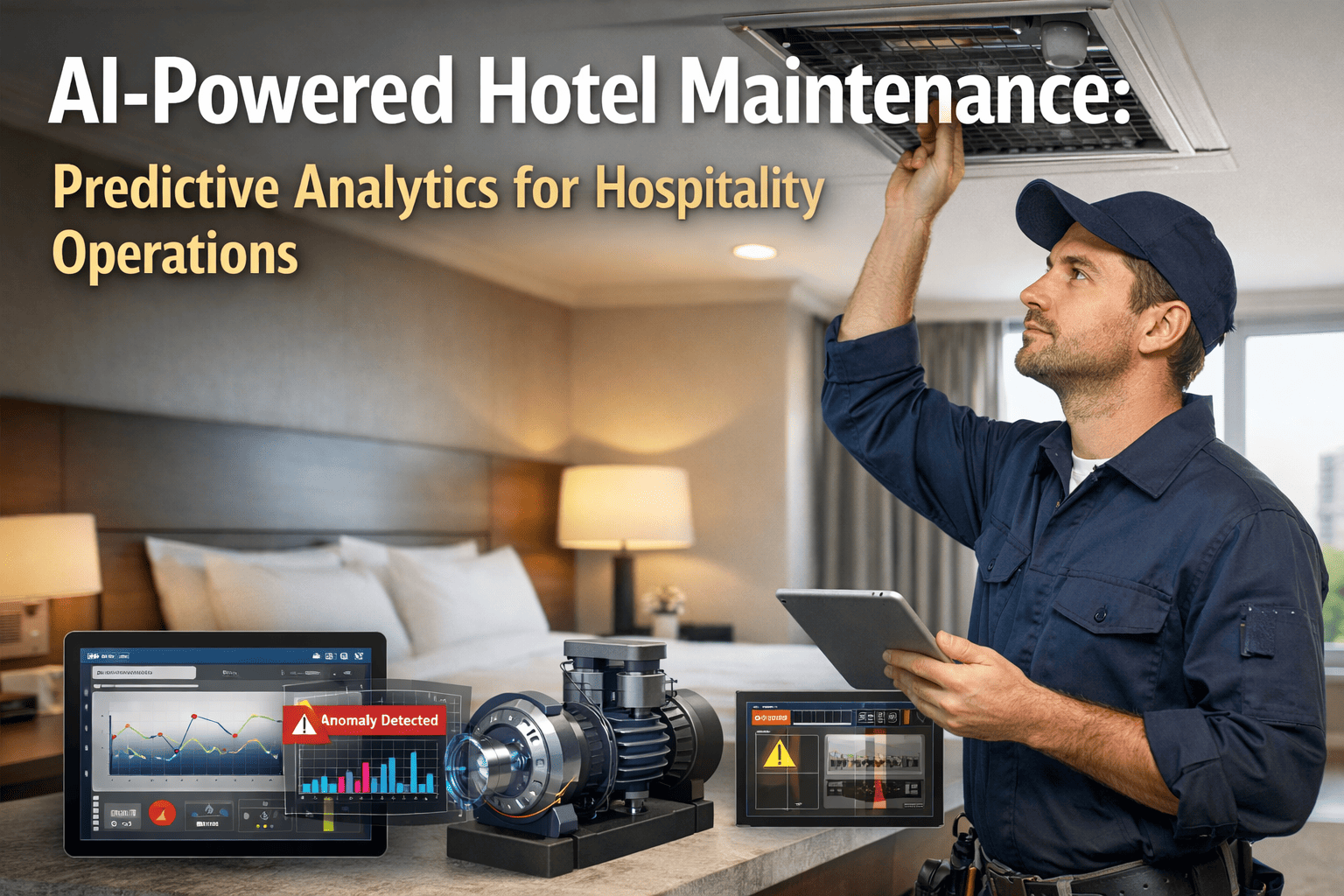
Hotels running on reactive maintenance lose an average of $1.4 million annually to unplanned equipment failures, guest complaints, and emergency repair premiums. AI-powered facility management changes the equation entirely — shifting operations from guesswork to precision, from reactive firefighting to data-driven prevention. If you want to see this in action, start a free trial with Oxmaint or book a demo and explore what AI-driven hospitality operations look like in practice.
47%
Reduction in unplanned equipment failures
Hotels using AI-based predictive maintenance
$1.4M
Average annual loss from reactive maintenance
Mid-to-large hotel properties, per facility
32%
Lower maintenance spend per asset
Versus properties using legacy CMMS or paper logs
8.5x
ROI on AI facility analytics investment
Measured across 3-year asset lifecycle horizon
Foundation
What Is AI-Powered Hotel Facility Management?
AI-powered hotel facility management is the application of machine learning, predictive analytics, and IoT sensor data to automate, prioritize, and optimize the full maintenance lifecycle of hotel assets — from HVAC systems and elevators to guest room fixtures and kitchen equipment.
Real-Time Monitoring
IoT sensors stream live data from critical assets directly into your CMMS — no manual checks, no data gaps.
Predictive Analytics
AI models analyze usage patterns, failure history, and sensor readings to predict equipment failure weeks before it occurs.
Automated Work Orders
Anomalies auto-generate prioritized work orders routed to the right technician with asset history, manuals, and parts lists attached.
CapEx Forecasting
AI-driven asset lifecycle models generate rolling 5–10 year capital expenditure forecasts grounded in actual condition data.
Core Concepts
The AI Facility Management Framework
Effective AI facility management in hotels is built on four interconnected layers. Each layer amplifies the next — and all of them run through a unified CMMS that keeps data flowing and teams aligned. Want to understand how Oxmaint structures this for hospitality operations? Book a 30-minute demo and see the full system live.
01
Data Collection Layer
IoT sensors, SCADA integration, and mobile inspection apps feed real-time data into a central asset registry. Every asset has a live condition score updated continuously.
Sensors · IoT · SCADA · Mobile
02
Analytics and Intelligence Layer
Machine learning models process historical failure data, usage cycles, and real-time sensor readings to generate failure probability scores and maintenance recommendations.
ML Models · Failure Prediction · Scoring
03
Action and Execution Layer
Alerts auto-generate work orders. Technicians receive mobile dispatches with full asset context. Completion data loops back to refine the AI model continuously.
Work Orders · Mobile Dispatch · Feedback Loop
04
Reporting and Strategy Layer
Executive dashboards surface asset health scores, maintenance KPIs, and CapEx forecasts for ownership groups and asset managers — no spreadsheets required.
CapEx Reports · KPI Dashboards · Ownership Views
Pain Points
Why Hotel Facility Teams Are Losing Control
Without AI analytics, hotel facility operations run on tribal knowledge, outdated spreadsheets, and reactive instincts. These four problems cost hotels millions every year — and they compound across multi-property portfolios.
Blind Equipment Failures
No visibility into asset condition means failures hit without warning. A seized chiller during peak season costs $80,000+ in emergency repair and lost revenue from displaced guests.
60% of hotel equipment failures are predictable with sensor data
Fragmented Asset Records
Maintenance history scattered across paper logs, email threads, and disconnected spreadsheets makes it impossible to assess true asset condition or justify replacement budgets to ownership.
74% of hotel GMs report incomplete asset records as their top FM challenge
CapEx Based on Guesswork
Without condition-based asset scoring, capital replacement decisions are driven by age alone — which means over-spending on healthy assets and under-investing in degraded ones that fail before budget cycle.
Age-based CapEx planning misallocates up to 38% of replacement budgets
Multi-Property Visibility Gap
Portfolio managers and asset management teams have no centralized view of maintenance performance across properties. Each site operates as a silo, making portfolio-level decisions nearly impossible to get right.
Portfolio properties with siloed data average 2.3x higher emergency repair spend
4.8x
Emergency vs Planned Repair Cost
Every reactive repair costs nearly 5x more than the same planned job
22%
Guest Satisfaction Drop
Average NPS impact from a single high-visibility facility failure per stay
$180
Lost Revenue Per Failed Room Night
When HVAC or plumbing failures pull rooms from inventory unexpectedly
3 Wks
Avg Lead Time AI Provides Before Failure
Enough time to schedule planned repair during low-occupancy windows
Oxmaint Solution
How Oxmaint Delivers AI-Powered Hotel FM
Oxmaint is built for multi-site hospitality operations — combining asset lifecycle tracking, predictive maintenance scheduling, and investor-grade reporting in one platform. No heavy implementation. No data silos. Ready to explore the features? Start a free trial today and see how the platform adapts to your property's asset structure.
Asset Intelligence
Full Asset Registry with Condition Scoring
Every asset — from rooftop chillers to guest room minibars — gets a live condition score updated by sensor data and inspection history. No more guessing which assets are healthy.
Predictive Maintenance
AI-Triggered Preventive Schedules
Maintenance schedules driven by actual usage cycles, runtime hours, and sensor thresholds — not arbitrary calendar dates. Oxmaint triggers PMs when assets actually need them, cutting unnecessary labor by 28%.
Work Order Intelligence
Auto-Generated, Priority-Ranked Work Orders
When AI detects an anomaly, Oxmaint creates a work order instantly — with asset history, attached manuals, required parts list, and recommended technician. Zero manual dispatch delay.
Portfolio Reporting
Multi-Property Dashboard for Ownership Groups
Asset managers and ownership groups get a consolidated view of maintenance KPIs, asset health scores, and CapEx forecasts across every property in the portfolio — no spreadsheet exports needed.
Capital Planning
Rolling 5–10 Year CapEx Forecasting
Oxmaint's forecasting models use actual asset condition scores and remaining useful life estimates to generate defensible CapEx projections — not age-based guesses. Ownership-ready reports built in.
Compliance & Audit
Audit-Ready Documentation with Digital Sign-Off
Every inspection, work order, and repair is timestamped, geo-tagged, and signed off digitally. Compliance audits that used to take days now take hours — all records instantly exportable.
Mobile-First Operations
Technician App for On-the-Go Execution
Maintenance teams receive work orders, complete digital checklists, capture photos, and log parts usage from their phone — with or without an internet connection. No clipboard, no paper, no re-entry.
IoT Integration
Live Sensor Data from Every Critical System
Oxmaint integrates with IoT and SCADA systems to pull live readings from HVAC, BMS, elevators, and utility meters — feeding real-time data into the AI analytics engine continuously.
Comparison
Reactive Maintenance vs. AI-Driven FM
The operational and financial gap between reactive and AI-powered maintenance widens every year. Here's what that contrast looks like in a real hotel environment.
Without AI — Reactive Approach
Equipment Visibility
None until failure occurs. Teams discover problems through guest complaints or complete breakdowns.
Work Order Source
Manual. Technicians or guests report problems. Average response lag: 4.2 hours.
Maintenance Spend
Unpredictable. 60–70% of spend on emergency and corrective repairs at premium rates.
Asset Condition Data
Absent or fragmented. Age and gut feel drive replacement decisions.
CapEx Planning
Based on asset age and manager estimates. Up to 38% of budget misallocated annually.
Compliance Documentation
Manual logs, paper trails, and inconsistent records. Audit prep takes days.
With Oxmaint AI — Predictive Approach
Equipment Visibility
Live condition scores on every asset. Anomalies flagged 2–3 weeks before failure threshold.
Work Order Source
Automated. AI triggers work orders from sensor data. Response time under 12 minutes.
Maintenance Spend
Controlled. 80%+ of spend on planned preventive work. Average 32% total cost reduction.
Asset Condition Data
Continuous. Every asset scored on real condition, usage, and failure probability in real time.
CapEx Planning
AI-generated 5–10 year rolling forecasts based on actual asset condition and RUL estimates.
Compliance Documentation
Fully automated. Every action logged, timestamped, and signed digitally. Audit-ready in minutes.
ROI and Results
What AI-Powered FM Delivers in Practice
These results are drawn from hospitality operations that have deployed AI-powered CMMS platforms. The numbers represent averages across mid-size to large hotel properties and portfolios. To model your property's specific ROI, book a consultation with the Oxmaint team.
47%
Fewer Unplanned Failures
Predictive detection shifts teams from reactive firefighting to scheduled, controlled repairs
32%
Maintenance Cost Reduction
Less emergency spend, fewer unnecessary PMs, optimized parts procurement
18 Mo
Average Payback Period
Most hotel properties recoup AI CMMS investment within 12–18 months of full deployment
25%
Asset Lifespan Extension
Condition-based maintenance delays costly capital replacements by 2–4 years on average
Ready to Make the Shift?
Stop Reacting. Start Predicting.
Oxmaint gives hotel facility teams the AI analytics, asset tracking, and automated work order management they need to eliminate reactive maintenance — and the investor-grade reporting that ownership groups demand. Whether you manage a single flagship property or a portfolio of 50+, Oxmaint scales to your operation without heavy implementation fees or a six-month onboarding process.
How does AI predict hotel equipment failures before they happen?
AI models are trained on historical failure data, manufacturer specifications, and live sensor readings from assets in operation. By continuously analyzing vibration, temperature, runtime hours, and performance trends, the AI identifies deviation patterns that precede failure — typically 2–3 weeks before the equipment actually breaks down. Oxmaint integrates with IoT sensors and SCADA systems to feed this data in real time, allowing the platform to auto-trigger preventive maintenance before failure occurs. Curious how it applies to your property's specific asset types? Book a demo to explore the detection capabilities.
What hotel assets benefit most from AI-powered facility management?
The highest-impact assets are HVAC systems, chillers, boilers, elevators, commercial kitchen equipment, and water systems — all of which are high-cost, guest-facing, and failure-sensitive. These assets account for 60–70% of total hotel maintenance spend and are exactly where predictive analytics delivers the strongest ROI. Oxmaint's asset hierarchy (Portfolio → Property → System → Asset → Component) supports detailed tracking at any level of granularity. Start a free trial to build your asset registry today.
Can Oxmaint integrate with the building management systems we already have?
Yes. Oxmaint connects via API and direct integrations with major BMS, IoT sensor platforms, and SCADA systems. Real-time data streams from your existing infrastructure feed directly into the Oxmaint CMMS — eliminating the need to rip and replace current technology investments. Integration typically takes days, not months, with no custom development required for standard protocol connections. For a detailed integration overview, book a technical demo with the Oxmaint team.
How does AI-powered FM help with hotel CapEx planning and ownership reporting?
Oxmaint's AI analytics engine continuously scores every asset's condition and calculates remaining useful life based on real operational data — not just age. These scores feed into rolling 5–10 year CapEx forecasting models that ownership groups and asset managers can use to plan capital replacement cycles with confidence. Reports are generated automatically in formats designed for investor and ownership review, eliminating the hours typically spent assembling spreadsheets before budget meetings. Start a free trial and explore the CapEx reporting module.