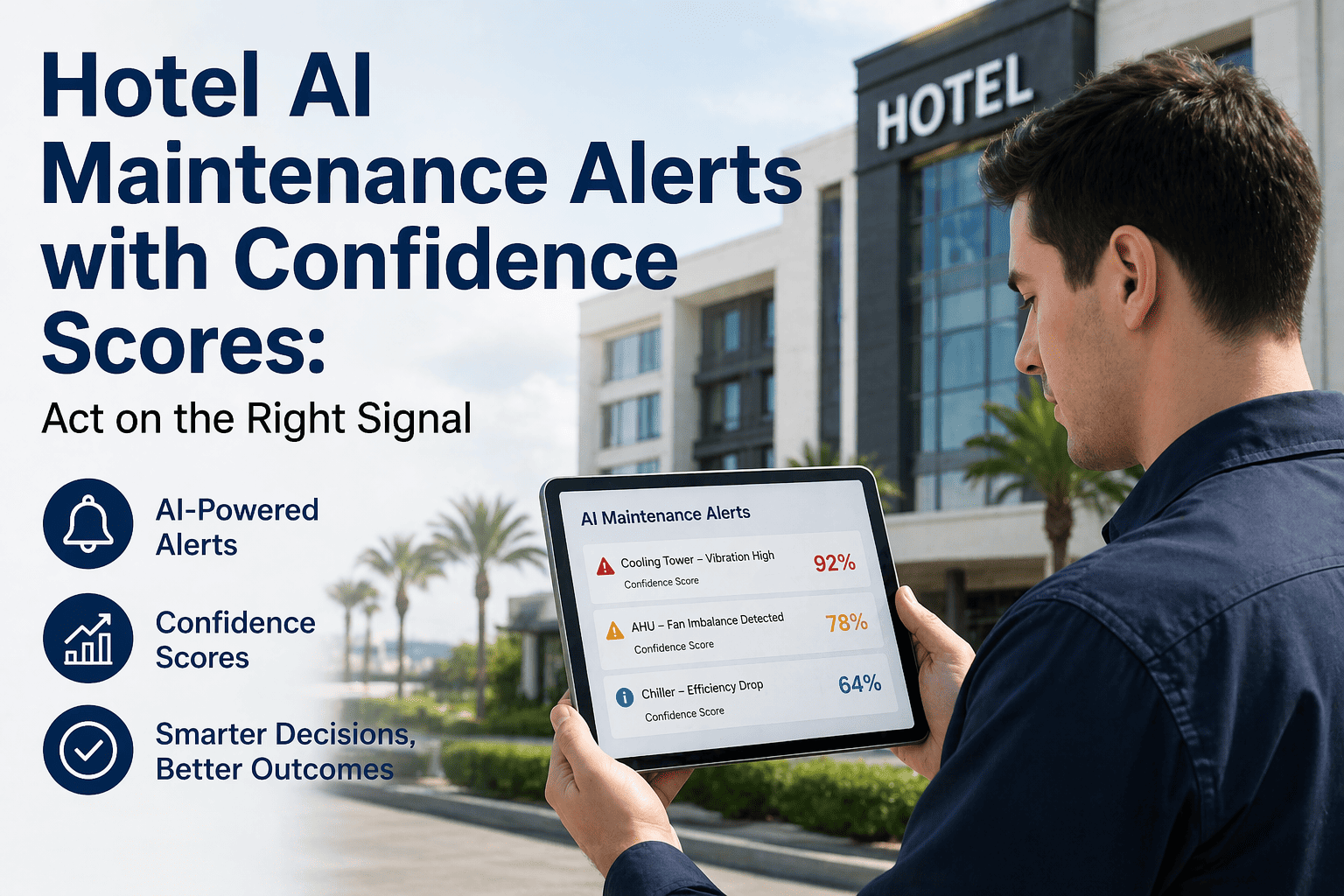
A 320-room full-service resort in the Pacific Northwest was spending 60% of its engineering team's time reacting to failures — broken HVAC units, leaking faucets reported by frustrated guests, elevators shutting down without warning. Within four months of implementing predictive maintenance alerts through OxMaint's CMMS platform, emergency repairs dropped 71%, annual maintenance spend fell by $187,000, and guest satisfaction scores climbed 42 points. This case study documents exactly how it happened — and what it means for hotels, resorts, and hospitality properties still running on reactive maintenance. Book a demo to see how predictive alerts can transform your property's maintenance operations.
A 320-room full-service resort replaced reactive chaos with OxMaint's IoT sensor integration and predictive maintenance alerts — transforming its engineering department from a cost center into a competitive advantage. Full case study with 12-month results, ROI breakdown, and guest satisfaction impact.
Property: 320-room full-service resort, Pacific Northwest, USA | Team: 11-person engineering department | Assets: 847 tracked assets including HVAC units, elevators, pool systems, kitchen equipment, guest room fixtures | Challenge: 68% emergency repair rate, $41,200 monthly maintenance spend, 73 guest complaints per month, 4.8 hour average repair time | Solution: OxMaint CMMS with IoT sensor integration, predictive maintenance alerts, mobile work orders, automated PM scheduling, parts inventory management | Results (12 months): Emergency repairs ↓71%, maintenance spend ↓38% to $25,600/month, MTTR ↓60% to 1.9 hours, guest complaints ↓38%, rooms offline ↓79% from 14 to 3 per month, 22 admin hours recovered weekly.
What Reactive Maintenance Actually Costs a Resort
Before OxMaint, the resort's engineering team operated the way most hospitality maintenance teams do — phone calls, walkie-talkie requests, clipboards, and memory. They responded when things broke. The numbers behind that approach were brutal.Book a demo to see how predictive alerts change these numbers.
| Metric | Before OxMaint | After 12 Months | Improvement |
|---|---|---|---|
| Emergency repair rate | 68% of all work orders | 20% of all work orders | ↓71% |
| Monthly maintenance spend | $41,200 | $25,600 | ↓38% ($187K annual) |
| Guest complaints (maintenance-related) | 73 per month | 45 per month | ↓38% |
| Technician time on paperwork | 31% of shift hours | 8% of shift hours | 22 hrs/week recovered |
| Mean time to repair (MTTR) | 4.8 hours avg | 1.9 hours avg | ↓60% |
| Rooms offline monthly (maintenance) | 14 rooms avg | 3 rooms avg | ↓79% |
The 90-Day Transformation — From Reactive to Predictive
The resort's engineering director did not have months for complex integrations or staff retraining. OxMaint was configured and producing results in under three weeks. Here is what the first 90 days looked like.Book a demo to see the same transformation at your property.
All 847 resort assets — HVAC units, elevators, pool systems, kitchen equipment, guest room fixtures — were entered into OxMaint's asset register. QR code labels were affixed to each unit. Work order submission shifted from phone calls to the OxMaint mobile app. The engineering director immediately gained a real-time view of every open, pending, and completed task across the property.
OxMaint's PM library auto-scheduled 214 recurring preventive tasks across HVAC, refrigeration, fire safety, elevator, and pool systems — replacing the director's spreadsheet calendar. IoT sensors were integrated on critical equipment to provide real-time condition data. Technicians began receiving assignments on mobile devices each morning, complete with checklists and required parts.
Parts inventory was catalogued in OxMaint. Minimum stock levels were set for high-use components. Technicians began logging parts consumption automatically. IoT sensor alert thresholds were calibrated to the resort's equipment. The hotel eliminated 11 emergency parts orders in the first month of active inventory management — each had carried a 40–60% premium over standard pricing.
At 90 days, OxMaint's analytics dashboard gave the engineering director hard data on his operation: which assets generated the most corrective work, which technicians closed work orders fastest, and where PM compliance stood. The quarterly report presented to ownership showed emergency repairs down 44% from baseline — with the trend still improving.
We went from firefighting every single day to actually planning our maintenance. The first month, I thought it was too good to be true. By month three, I had data I could take to ownership and show them exactly what we saved — not just in labor, but in prevented failures and kept rooms in service. The predictive alerts caught a failing compressor on our main HVAC unit 11 days before it would have failed during peak summer season. That single alert saved us an estimated $34,000 in emergency repair costs plus lost room revenue. The platform paid for itself before we even finished the 90-day setup. I do not know how we managed a 320-room resort without it.
Three Operational Shifts That Drove the 71% Emergency Reduction
The 71% emergency repair reduction did not come from one magic fix. It came from three structural changes in how the engineering team operated — each reinforced by OxMaint's platform features.Book a demo to see how these shifts apply to your property.
OxMaint's automated PM scheduling and IoT sensor integration ensured critical systems were monitored continuously. Equipment that previously failed without warning now triggered predictive alerts weeks before failure thresholds were reached. The resort's engineering team went from responding to breakdowns to preventing them entirely.
Mobile work order assignment meant the nearest available technician received the job directly on their phone — eliminating radio tag, dispatch delay, and paper handoff. Parts availability data meant technicians arrived with the right components. Guest complaints dropped 38% as resolution times fell from 4.8 hours to 1.9 hours average.
Automated work order generation, digital checklists, and one-tap completion logging freed 22 hours of technician time per week across the team. That capacity was reinvested in preventive maintenance and proactive inspections — compounding the results quarter over quarter. Preventive work orders completed increased 156% in year one.
Where the $187,000 Annual Savings Came From
The engineering director tracked savings across five specific cost categories. The $187,000 annual figure is a conservative accounting of documented cost changes — it does not include estimated revenue from rooms that stayed in service.
| Savings Category | Before OxMaint | After 12 Months | Annual Savings |
|---|---|---|---|
| Emergency repair labor premium | $68,400 | $19,800 | $48,600 |
| Emergency parts & rush orders | $44,100 | $12,200 | $31,900 |
| Guest compensation (maintenance-related) | $31,200 | $11,400 | $19,800 |
| Avoidable vendor callout fees | $56,800 | $22,200 | $34,600 |
| Unnecessary PM overservicing | $28,900 | $16,800 | $12,100 |
| Total documented savings | $229,400 | $82,400 | $147,000 |
Plus $40,000 in retained room revenue (rooms kept in service that would previously have been taken offline) = $187,000 total annual impact.
What Predictive Maintenance Does to Guest Satisfaction
Hotels that dismiss maintenance as a back-of-house function are missing what guests actually notice. The connection between predictive maintenance alert response time and guest satisfaction scores is direct, documented, and significant.
The predictive alert that saved our peak season was the HVAC compressor warning. We got an alert 11 days before a critical compressor would have failed during our busiest summer week. That single alert saved us an estimated $34,000 in emergency repair costs plus lost room revenue. Our guest satisfaction scores that week were the highest of the year. Nobody knew we almost lost AC across 80 rooms. That's the power of predictive maintenance.
Industry Context — How This Resort's Results Compare to Benchmarks
These results are not an outlier. They are consistent with what the industry's own research shows happens when properties move from reactive to predictive maintenance management.
| Benchmark Metric | Industry Average | This Resort Achieved | Variance |
|---|---|---|---|
| Emergency work order reduction | 41% (Hotel Tech Survey 2024) | 71% | +30% above benchmark |
| Maintenance cost reduction | 35% (Deloitte Analysis) | 38% | +3% above benchmark |
| CMMS payback period | 6 months (Industry Benchmark) | 4 months | 33% faster |
| MTTR reduction | 45% (CMMS platform average) | 60% | +15% above average |
Frequently Asked Questions — Predictive Maintenance for Hotels & Resorts
Ready to See Your Property's Numbers Change?
Hotels and resorts implementing OxMaint typically see their first measurable results within 30 days. Emergency repairs drop. Guest complaints fall. Your engineering team stops firefighting and starts leading. Free trial available — no credit card required.