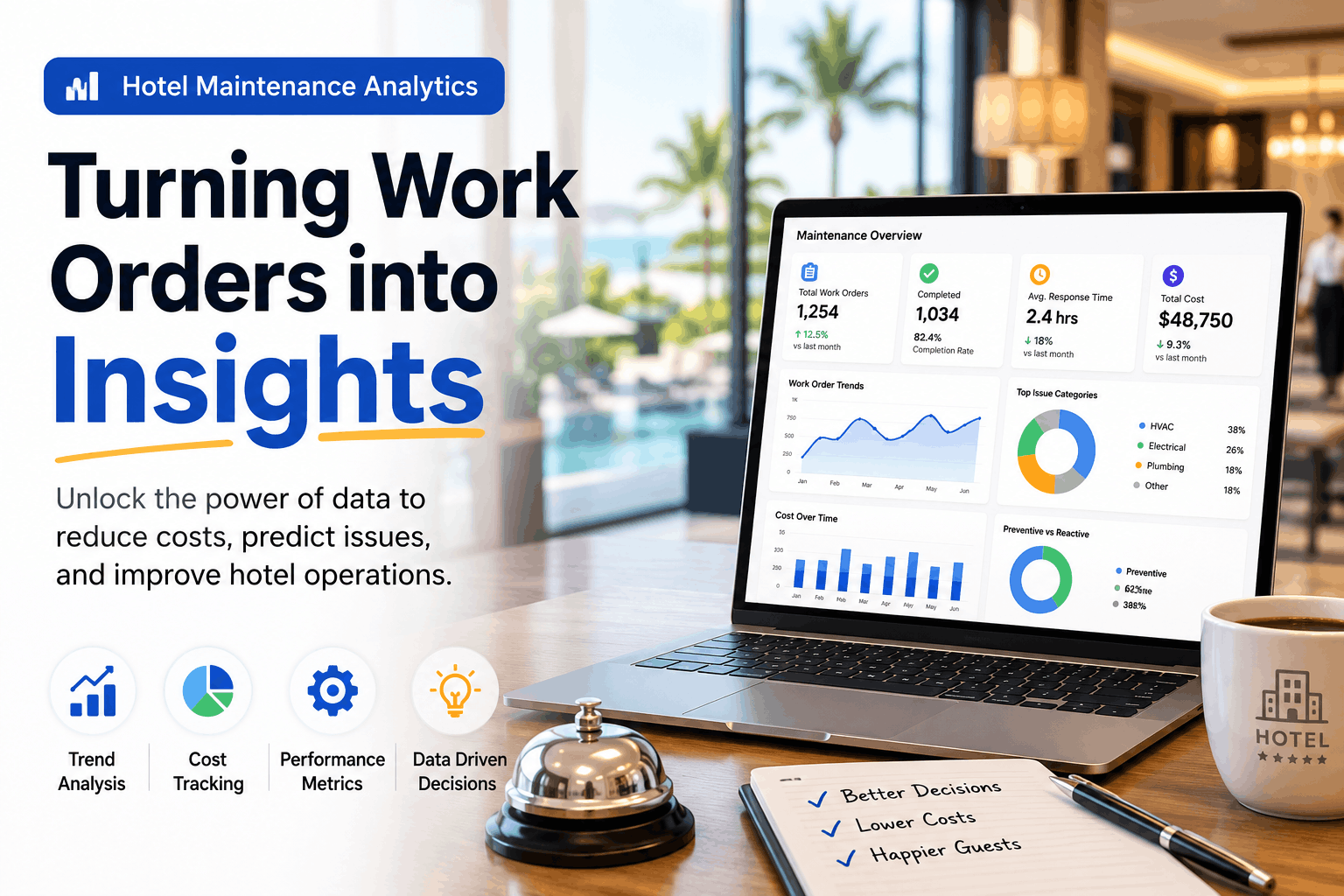
A 420-room full-service hotel was spending $340,000 annually on maintenance labor—and couldn't explain why. Their CMMS contained 6,200 service requests from the previous year, but nobody had ever analyzed the data. A 4-hour AI audit revealed the answer: 34% of all work orders were repeat requests for the same 12 failure points. PTAC units on floors 8–12 were generating guest complaints at 3.4× the rate of identical units on other floors—because those floors sat above the laundry room, running hotter cycles that degraded capacitors 60% faster. Bathroom exhaust fans in a specific wing were failing every 4.2 months instead of the expected 18 months—because the housekeeping team in that wing was using a chemical spray that corroded fan motor brushes. None of this was visible in the raw work order log. It only became visible when AI analyzed the patterns. The hotel restructured its PM schedule around the AI findings, replaced the 12 chronic failure points proactively, and reduced total service request volume by 43% in 6 months—saving $96,000 in labor and parts. The data had been there all along. AI finally made it legible. Hotels that implement OXmaint's AI-powered CMMS platform transform dormant work order history into a strategic maintenance intelligence system that prevents failures before they generate the next service request.
Automated Prevention & Cost Reduction Actions
Auto PM Rescheduling
Root Cause Alerts
Budget Forecasting
AI Pattern Recognition & Trend Detection
Recurrence Mapping
Location Clustering
Seasonality Analysis
Technician Efficiency
Continuous Service Request Data Collection
Work Order History
Guest Complaint Logs
Resolution Times
Asset Performance
Labor Records
How AI Turns Service Request Data Into Failure Prevention
Most hotels treat service requests as individual tickets—open, complete, close, repeat. AI trend analysis treats them as a continuous data stream revealing systemic failures, misaligned PM schedules, and equipment that is silently degrading. Instead of asking "how do I close this ticket?" AI asks "why does this ticket keep appearing?"—and answers it with pattern analysis across thousands of historical work orders that no human reviewer could process manually. Properties ready to move from reactive firefighting to intelligent prevention can schedule a free AI trend analysis consultation to see what patterns are hiding in their own maintenance data.
01
Recurrence Frequency Analysis
Monitors: Repeat requests per asset, room, zone, equipment type, and technician
Insight Window:
Identifies patterns in as few as 90 days of data
Use Case: Flag the 10% of assets generating 40% of work orders for root cause review
AI detects when a "repaired" issue returns faster than expected—signaling inadequate fix vs. underlying cause
02
Location & Zone Clustering
Monitors: Request density by floor, wing, building system, and occupancy zone
Insight Window:
Spatial patterns visible within 60 days
Use Case: Identify floors or wings with abnormal failure rates indicating systemic infrastructure issues
When floor 7 generates 3× the HVAC requests of identical floors, AI flags a zone-specific root cause
03
Seasonality & Demand Forecasting
Monitors: Request volume patterns by month, occupancy level, and weather correlation
Forecast Accuracy:
88% volume prediction 4 weeks ahead
Use Case: Pre-staff and pre-order parts for predictable demand spikes before they create backlogs
AI predicts June pool equipment request surge in March, enabling proactive service before peak season
04
Resolution Time & Backlog Analysis
Monitors: Time-to-close by category, technician, shift, and priority level
Optimization Impact:
24–38% reduction in mean time to repair
Use Case: Identify bottlenecks where specific request types consistently exceed resolution SLAs
Detects when certain technicians consistently resolve requests 40% faster—enabling best-practice training
05
Cost & Labor Trend Modeling
Monitors: Parts cost per asset, labor hours per category, total cost of ownership trends
Budget Accuracy:
92% annual maintenance cost forecast precision
Use Case: Identify assets where cumulative repair cost now exceeds replacement value threshold
AI flags when an asset's 24-month repair total crosses 60% of replacement cost—triggering capex planning
06
Cross-Asset Correlation Detection
Monitors: Relationships between service requests across connected systems and equipment chains
Root Cause Accuracy:
87% correct systemic cause identification
Use Case: Detect when boiler degradation is driving 6 downstream service requests across 3 departments
AI maps request chains to identify single upstream failures generating cascading downstream tickets
Hotel Operations Most Transformed by AI Trend Analysis
AI service request trend analysis delivers the highest ROI when applied to the operational areas where pattern recognition reveals systemic issues that individual ticket management cannot expose. These are the departments where data exists, patterns are real, and acting on AI insights produces measurable cost and guest satisfaction improvements within 90 days of deployment.
HVAC & Guest Room Comfort
Key AI Insight
PTAC failure clustering by floor
Avg. Repeat Request Rate
34% of HVAC tickets are repeats
AI Reduction Potential
Up to 58% fewer repeat calls
Annual Savings Potential
$18,000–$42,000 per property
#1 source of guest complaints—AI stops recurrence before reviews are written
Plumbing & Water Systems
Key AI Insight
Fixture failure rate by wing & age
Avg. Repeat Request Rate
28% of plumbing tickets are repeats
AI Reduction Potential
Up to 52% fewer repeat calls
Annual Savings Potential
$12,000–$28,000 per property
Leak clustering reveals water pressure or pipe age issues before major damage occurs
Electrical & Lighting
Key AI Insight
Circuit overload patterns by zone
Avg. Repeat Request Rate
22% of electrical tickets are repeats
AI Reduction Potential
Up to 47% fewer repeat calls
Annual Savings Potential
$8,000–$19,000 per property
Repeat outlet and breaker trips signal wiring degradation before safety incidents
Kitchen Equipment
Key AI Insight
Failure frequency vs. service intervals
Avg. Repeat Request Rate
31% of kitchen tickets are repeats
AI Reduction Potential
Up to 63% fewer repeat calls
Annual Savings Potential
$14,000–$31,000 per property
Fryer and oven repeat failures expose misaligned PM intervals AI can correct
Elevators & Life Safety
Key AI Insight
Door & motor fault recurrence cycles
Avg. Repeat Request Rate
19% of elevator tickets are repeats
AI Reduction Potential
Up to 71% fewer repeat calls
Annual Savings Potential
$9,000–$22,000 per property
Door sensor repeat failures precede entrapment events—early trend detection is a safety imperative
Laundry & Housekeeping
Key AI Insight
Chemical-driven failure correlations
Avg. Repeat Request Rate
38% of laundry tickets are repeats
AI Reduction Potential
Up to 55% fewer repeat calls
Annual Savings Potential
$11,000–$24,000 per property
Highest repeat rate of any department—AI surfaces operational causes invisible to PM schedules
AI Trend Analysis vs Manual Review: Performance Comparison
Repeat Service Request Rate
AI reduces repeat requests by 74% vs no analysis—eliminating the chronic failure loop
Mean Time to Root Cause Identification
AI identifies systemic root causes in hours vs weeks of manual data review
Annual Maintenance Labor Cost (per 300 rooms)
AI delivers $146K annual labor savings vs unanalyzed reactive maintenance programs
Guest-Impacting Maintenance Events per Year
AI prevents 89% of guest-facing maintenance failures vs unmonitored operations
Expert Analysis: AI Trend Intelligence in Hotel Operations
"Every hotel CMMS contains a gold mine of operational intelligence that nobody is reading. Service request patterns reveal which equipment is failing systematically, which PM schedules are misaligned with actual wear rates, which buildings have infrastructure problems disguised as routine tickets, and which staff behaviors are accelerating asset degradation. AI makes this analysis instantaneous and continuous—turning what used to be a quarterly management report into a real-time operational dashboard. The hotels that embrace AI trend analysis aren't just reducing costs. They're fundamentally changing how they allocate maintenance resources—from reacting to the loudest problem to preventing the most costly ones."
PM Interval Optimization
AI compares manufacturer-recommended PM intervals against actual failure patterns in your specific environment. When your PTAC units fail at 8-month intervals but PM is scheduled at 12 months, AI detects the gap and recommends interval adjustment—eliminating the recurring failures that standard PM schedules completely miss.
Behavioral Correlation Analysis
AI cross-references service request patterns with staff schedules, cleaning products, and operational procedures to detect behavior-driven failures. When a specific housekeeping team generates 3× the appliance service requests of comparable teams, AI surfaces the correlation before the warranty claim or safety incident that would otherwise trigger the investigation.
Predictive Budget Intelligence
AI models maintenance cost trajectories based on current trend data—forecasting which assets will cross the repair-vs-replace threshold in the next 12–24 months. This transforms capital planning from gut-feel guesswork into data-supported budget requests with documented failure trend evidence that finance teams can evaluate objectively.
Your Work Order History Is Already Telling You What's Failing Next
OXmaint's AI trend analysis engine continuously scans your service request data to identify recurrence patterns, location clusters, cost trajectories, and root causes—then automatically adjusts PM schedules and generates prioritized corrective action plans before patterns become crises.
Frequently Asked Questions
How does AI trend analysis reduce service request volume in hotels?
AI reduces service request volume by identifying and eliminating the root causes of repeat tickets rather than just closing them individually. When a guest room HVAC generates 4 work orders in 6 months, a CMMS without AI logs 4 separate completed tickets. AI recognizes the recurrence pattern and flags it as a systemic failure requiring root cause investigation—prompting a PM schedule adjustment, component replacement, or operational change that stops the cycle. Properties using AI trend analysis report 43–61% reductions in total work order volume within 6 months of deployment, because they stop treating symptoms and start eliminating causes. The 10–15% of assets generating 40–50% of work orders become immediately visible, enabling targeted intervention that delivers outsized volume reduction.
What data does AI need to perform service request trend analysis?
AI trend analysis requires structured work order history including asset ID, location, request category, date submitted, date resolved, technician assigned, parts used, and resolution notes. Most hotels with 12+ months of CMMS data have sufficient history for meaningful pattern detection—AI typically identifies actionable trends within 90 days of data. Richer data sets (3+ years, IoT sensor integration, guest complaint correlation) enable more sophisticated analysis including failure prediction and seasonal forecasting. Properties using OXmaint can begin trend analysis immediately if they have existing work order history, or build the required data foundation within 90 days of platform adoption using structured digital work orders that capture all necessary fields automatically.
How quickly do hotels see ROI from AI service request trend analysis?
Most hotels see measurable ROI within 60–90 days of AI trend analysis deployment. The fastest returns come from immediate identification of the highest-recurrence assets—typically 3–5 chronic problem points that AI flags within the first analysis cycle. Eliminating just 2–3 chronic failures can reduce work order volume by 15–20% and recover $15,000–$40,000 in annual labor cost within the first quarter. Full ROI realization, including PM interval optimization, seasonal demand forecasting, and capital planning improvements, typically occurs within 6–9 months. For a 300-room hotel investing $12,000–$20,000 annually in an AI-enabled CMMS platform, documented returns of $85,000–$140,000 annually represent 5–8× ROI fully realized by month 12.
Can AI trend analysis integrate with existing hotel CMMS and PMS systems?
Yes. Modern AI maintenance platforms including OXmaint integrate with existing CMMS platforms via API to ingest historical work order data without requiring data re-entry. Integration with Property Management Systems enables guest complaint correlation—linking front desk complaint logs to engineering work orders to identify which maintenance failures are generating negative reviews. IoT sensor data integration adds real-time equipment health context to trend analysis, improving failure prediction accuracy from 72% (history-only) to 92% (history plus live sensor data). Most integrations are configured in 1–2 weeks using standard API connections. Properties without existing structured data can begin building the required foundation immediately using OXmaint's mobile-first digital work order system, which captures all trend analysis data fields from day one.