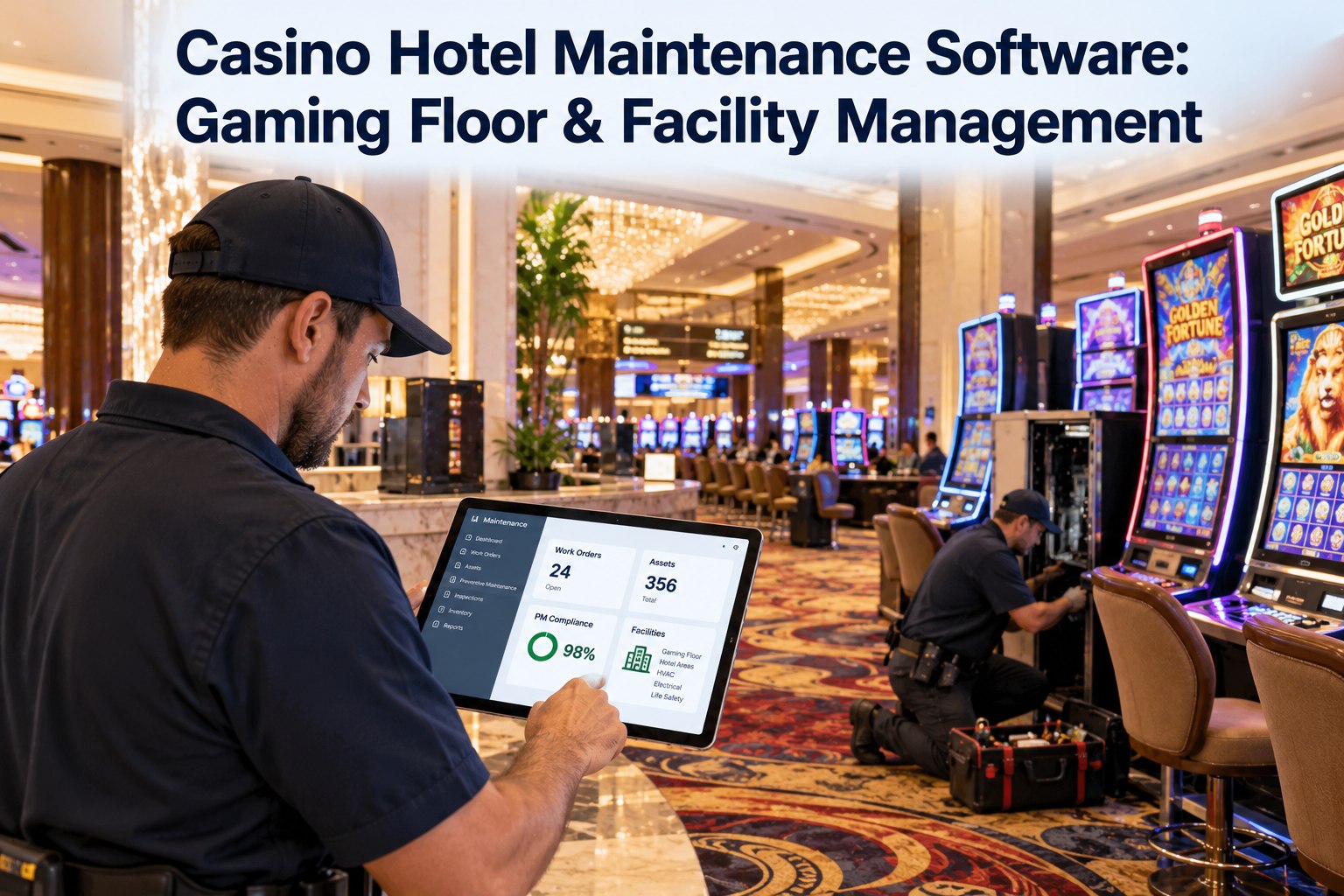
A casino that goes dark — even for 15 minutes — loses tens of thousands of dollars and the trust of every guest on the floor. Casino maintenance management is not a back-office function. It is a 24/7 operational discipline that directly controls revenue, compliance, and the seamless guest experience that keeps players coming back. This guide breaks down exactly how high-performing gaming facilities use structured CMMS-driven strategies to protect their gaming floors, slot machines, HVAC systems, and lighting — around the clock, without disruption. Sign up free and see how OxMaint powers zero-downtime casino operations.
Zero Downtime Starts Here
OxMaint gives casino operations teams 24/7 maintenance scheduling, gaming equipment tracking, and zero-disruption workflows — purpose-built for facilities that never close.
Why Casino Maintenance Is Unlike Any Other Facility
Most facilities shut down for scheduled maintenance. Casinos cannot. Gaming floors operate 24 hours a day, 365 days a year — which means every maintenance task, from slot machine servicing to HVAC filter changes to lighting calibration, must be planned and executed without pulling the guest experience apart. The cost of unmanaged maintenance in a casino is not just a broken machine. It is regulatory violations, gaming commission penalties, guest complaints, and brand damage that compounds with every hour of disruption. Sign up free to build your casino's zero-downtime maintenance program today.
The Four Critical Maintenance Zones in a Casino
Slot machines and electronic gaming equipment are the highest-revenue assets in the building. Each unit requires regular bill validator cleaning, button panel inspection, currency handling mechanism servicing, and software integrity verification. A CMMS tracks every machine by asset ID, logs each service event, and auto-schedules PM tasks before degradation affects payout accuracy or player experience.
Casino floors are high-occupancy, high-smoke environments that place extreme demand on HVAC systems. Air handling units, ductwork, and filtration systems require more frequent service intervals than standard commercial buildings. Failure creates immediate guest discomfort, air quality violations, and in gaming jurisdictions with indoor air quality regulations, direct regulatory exposure.
Casino lighting is both an operational requirement and a revenue driver. Dim or flickering lighting on a gaming floor signals neglect and degrades the player experience. LED system health checks, control panel inspections, signage lighting, and emergency egress lighting must all be maintained on separate schedules — with compliance documentation attached to every inspection event.
Elevators, escalators, fire suppression systems, surveillance infrastructure, and electrical panels form the backbone of casino facility operations. These assets are subject to mandatory inspection intervals from gaming commissions and building authorities. Missing a single compliance inspection can trigger license risk — making automated PM scheduling and digital record-keeping non-negotiable.
24/7 Maintenance Scheduling: How Casinos Keep the Floor Running
The defining challenge of casino maintenance is time — specifically the absence of any window when the facility is closed. Every maintenance activity must be planned around peak and off-peak guest traffic patterns, shift rotations, and the critical constraint that gaming equipment can rarely be taken offline during business hours. A CMMS solves this by enabling shift-aware, zone-aware scheduling that slots every PM task into the lowest-impact window automatically. Book a demo to see how OxMaint handles 24/7 casino scheduling.
Casino Maintenance Performance Benchmarks
Gaming facilities that implement structured CMMS-driven maintenance programs consistently outperform reactive-only operations across every key metric. The data below reflects outcomes from casino and gaming facility operators that have transitioned from manual maintenance tracking to automated PM scheduling and equipment monitoring. Sign up free and start benchmarking your facility from day one.
| Metric | Reactive Baseline | CMMS-Driven Operations | Improvement |
|---|---|---|---|
| Slot Machine Uptime | 88% – 92% | 97% – 99.5% | 5–10% uptime gain |
| PM Compliance Rate | 50% – 62% | 90% – 97% | 40–50% improvement |
| Mean Time to Repair (MTTR) | 62 – 110 minutes | 18 – 35 minutes | 65–70% faster |
| Emergency Maintenance Events | 14 – 22 per month | 3 – 6 per month | 75–80% reduction |
| Compliance Audit Readiness | 3–5 days prep time | On-demand, under 30 min | Near elimination |
| HVAC-Related Guest Complaints | 8 – 15 per month | 0 – 2 per month | 85–90% reduction |
Zero-Disruption Workflows: How CMMS Protects the Guest Experience
Quick-Swap Equipment Protocol
When a slot machine requires servicing during peak hours, technicians follow a pre-staged swap protocol — a pre-tested replacement unit is brought in from the maintenance hold area, the original machine is swapped without floor disruption, and serviced off-floor before returning to rotation. CMMS tracks every unit's swap history, service status, and floor location in real time.
Shift-Aware Work Order Routing
CMMS auto-routes work orders to the correct shift team based on the scheduled maintenance window. Night shift technicians receive their PM task queue automatically at shift start — no verbal handoffs, no missed tasks, no duplication of effort. Every completed task is logged with technician sign-off and timestamp before the next shift begins.
Compliance-Triggered PM Automation
Gaming commission inspection requirements, fire safety certifications, and elevator compliance intervals are loaded directly into the CMMS as recurring PM tasks. The system generates the work order, assigns it, tracks completion, and stores the signed record automatically — so no compliance deadline is ever missed and every audit request is answered instantly.
Predictive Alert Escalation
IoT sensors connected to HVAC units, power distribution systems, and high-use gaming equipment monitor temperature, vibration, and electrical load in real time. When readings drift from baseline, CMMS fires an alert to the on-shift supervisor — turning what would be a 2 AM emergency into a scheduled 4 AM PM task before guests arrive.
Gaming Equipment Tracking: What Your CMMS Must Capture
Casino gaming equipment is among the most regulated and highest-value assets in any facility category. Each machine carries a unique asset ID linked to gaming commission records, payout configuration data, and service history that regulators can request at any time. A CMMS that does not capture full asset-level detail for gaming equipment is not fit for casino operations. Book a demo to see OxMaint's gaming asset tracking in action.
OxMaint: Built for 24/7 Casino Maintenance Operations
From zero-disruption gaming floor workflows and shift-aware PM scheduling to gaming equipment tracking and instant compliance documentation — OxMaint is the CMMS built for facilities that never close. Book a 30-minute demo and see what zero-downtime operations look like for your property.
Frequently Asked Questions: Casino Maintenance Management
How do casinos manage maintenance without shutting down the gaming floor?
Casinos use shift-aware maintenance scheduling to route all significant PM tasks to low-traffic windows — typically 2 AM to 6 AM — while peak hours are reserved for reactive repairs and visual inspections only. A CMMS automates this routing, ensures every shift team receives their task queue at shift start, and logs all completed work with digital sign-off. Quick-swap protocols for gaming machines allow individual units to be serviced off-floor without any guest-visible disruption.
What is the most critical casino maintenance checklist item?
Gaming commission compliance inspections are the highest-priority maintenance events in any casino facility because missing them creates direct license risk. Beyond regulatory requirements, HVAC and air quality maintenance ranks as the most operationally critical item — casino floors are high-occupancy, high-smoke environments, and HVAC failure creates immediate guest discomfort and air quality violations that affect both reputation and compliance standing.
How does a CMMS handle slot machine maintenance tracking?
A CMMS assigns a unique asset record to every slot machine on the floor, capturing its gaming commission registration, service history, software update log, parts replacement record, and downtime events. PM tasks are auto-scheduled based on usage cycles and manufacturer intervals, and every service event is logged with the technician's sign-off and timestamp. This creates the complete, auditable maintenance record that gaming regulators require.
What CMMS features matter most for 24/7 casino operations?
The four most critical CMMS capabilities for casino operations are: shift-aware work order routing that automatically assigns tasks to the correct crew without manual coordination; mobile-first technician workflows that allow work orders to be opened, completed, and closed from anywhere on the floor; gaming equipment asset tracking with compliance documentation; and predictive alert integration that catches equipment degradation before it becomes a floor disruption during peak hours.
How does preventive maintenance reduce casino maintenance costs?
Reactive emergency repairs in casino environments cost 3–5x more than the same repair performed as a scheduled PM task — due to premium contractor rates, emergency parts procurement, and extended downtime on high-revenue floor assets. Gaming facilities with structured CMMS-driven PM programs reduce emergency maintenance events by 75–80%, shift their maintenance ratio from reactive-dominant to planned-dominant, and extend gaming equipment asset life by 20–30% through consistent servicing.