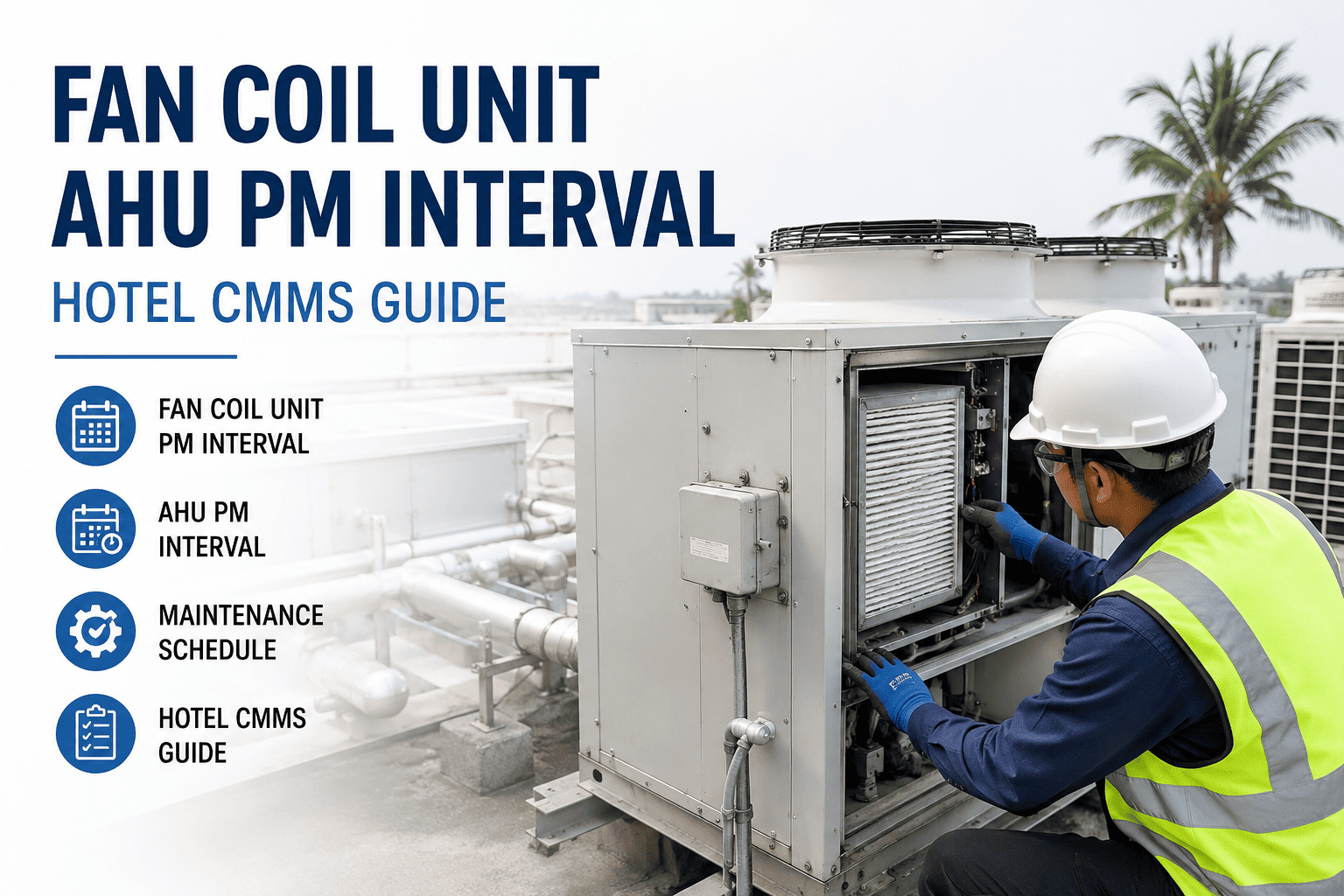
Fan coil units and air handling units quietly carry the reputation of every hotel property — when filters clog and coils foul, guest complaints, online review scores, and energy bills all move in the wrong direction within a single season. Engineering teams that run a disciplined PM interval schedule through a CMMS see 30 to 45 percent fewer comfort complaints and measurably lower kWh per occupied room night. This guide lays out the exact maintenance intervals, task sequences, and CMMS configuration that keep FCUs and AHUs at rated performance across a full-service property. You can put the schedule into production today by starting a Start Free Trial of the OxMaint platform, or walk through it with our engineering team first.
Are your guest-room fan coils running 40% past their filter change date?
Most hotels service FCUs reactively — after the guest complains about musty air, weak airflow, or a noisy unit at 2 a.m. A CMMS-driven PM interval flips that script, cutting comfort tickets by up to half and recovering 12-18% in HVAC energy spend across the property.
The hidden cost of filter-neglect territory
A single 1-inch pleated filter left in service 60 days past its change date drops airflow by 22-28%, forces the blower motor to draw 15% more current, and seeds the coil with a biofilm that takes a chemical flush — not a vacuum — to remove.
A 250-room full-service hotel running 260 FCUs and 6 AHUs on a reactive model typically spends $48,000 per year on emergency HVAC calls, coil replacements, and guest-service recovery. Moving the same property onto a CMMS-scheduled 90-day FCU interval and a 180-day AHU interval drops that figure to roughly $19,000 — a payback window under 11 months on the CMMS subscription alone.
The CMMS schedule that keeps FCUs and AHUs at rated performance
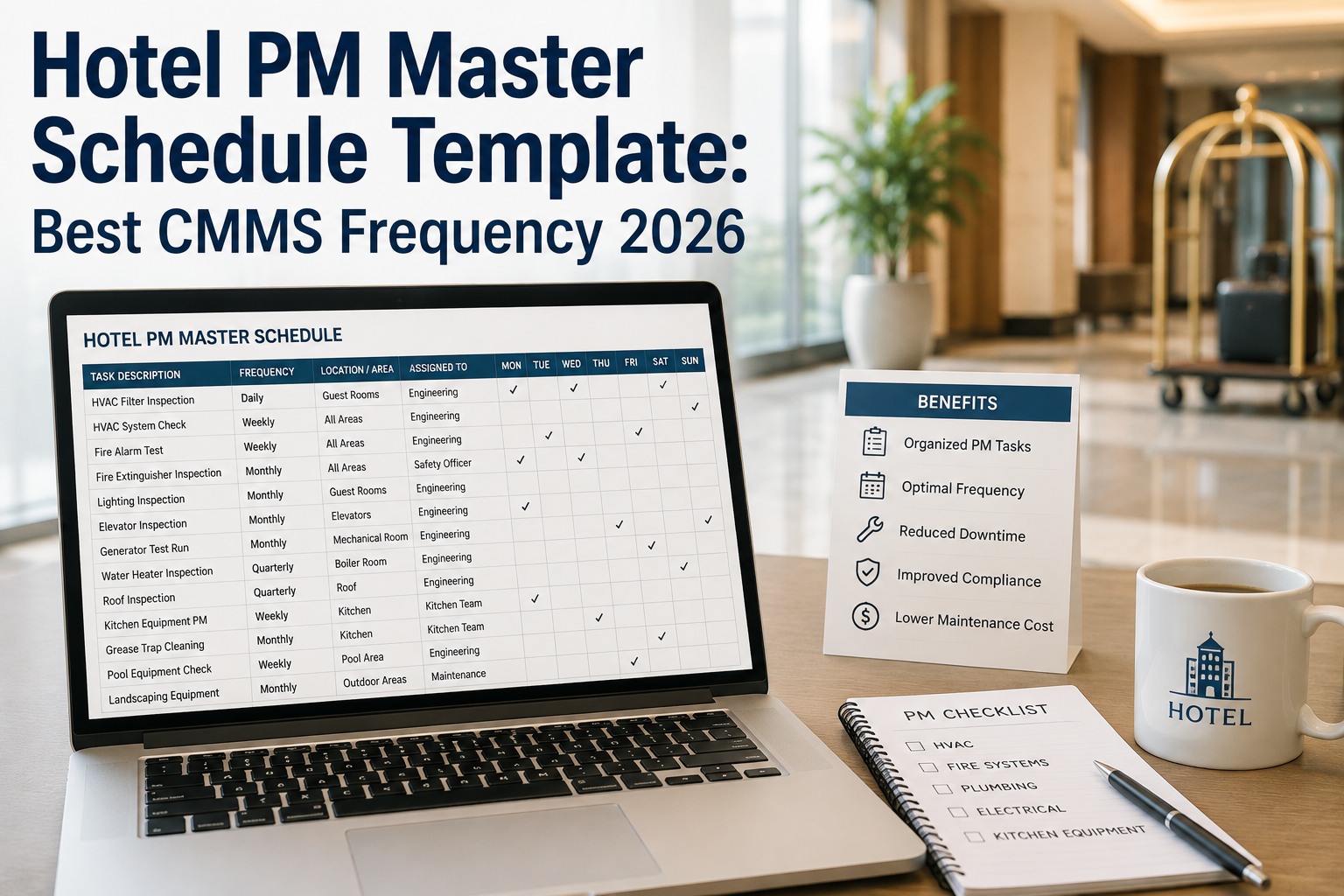
Build the CMMS schedule around asset class, environment, and occupancy pattern — not a blanket calendar. These intervals are field-tested across 200+ hotel properties and align with ASHRAE Guideline 36 high-performance sequences.
| Asset & Environment | Filter Change | Coil Clean | Drain Service | Belt / Motor |
|---|---|---|---|---|
| Guest-room FCU — standard occupancy | Every 90 days | Every 180 days | Every 180 days | Inspect at filter change |
| Guest-room FCU — coastal / high-humidity | Every 60 days | Every 120 days | Every 90 days | Inspect at filter change |
| Public-space AHU — lobby / corridors | Every 60 days | Every 180 days | Every 90 days | Belt tension every 90 days |
| Kitchen / F&B AHU (grease load) | Every 30 days | Every 90 days | Every 60 days | Belt inspect every 60 days |
| Meeting / banquet AHU (variable load) | Every 90 days | Every 180 days | Every 120 days | Belt tension every 90 days |
Intervals assume MERV 8 guest-room filters and MERV 13 public-space filters. Upgrade the filter without shortening the interval and static pressure climbs — the CMMS should flag any filter MERV change as a trigger to re-baseline the schedule.
Tiered checklist for every FCU and AHU work order
Each CMMS work order should carry a tiered task list so a round-one technician and a round-two lead engineer both know exactly what to close out — no tribal knowledge required.
Filter & Airside
- Isolate unit, verify zero voltage at disconnect
- Remove and bag old filter; photograph condition for the CMMS record
- Inspect coil face for biological growth or debris loading
- Install correct MERV-rated filter with airflow arrow verified
- Record static pressure reading before and after change
Coil & Drain Pan
- Apply coil cleaner per manufacturer dwell time
- Rinse fin-to-tube direction only; never against
- Clear drain pan and verify trap prime on AHU units
- Pour biocide tablet into pan; log date in CMMS
- Confirm condensate flow to drain within 60 seconds
Belt, Motor & Fan
- Inspect belt for glazing, cracks, or edge wear (AHU only)
- Check deflection at mid-span; adjust to 1/64 inch per inch of span
- Measure motor amperage against nameplate FLA
- Lubricate bearings per OEM schedule; do not over-grease
- Confirm sheave alignment with a laser or straight-edge
Controls & Commissioning
- Verify thermostat/BAS response in cool, heat, and fan modes
- Check discharge air temperature against setpoint delta
- Confirm damper actuator stroke on AHU economizer
- Log all readings into the CMMS work order before closing
- Flag any reading outside 10% of baseline for re-baseline
Why AHU PM fails when the tower schedule is disconnected
The cleanest AHU coil in the property still underperforms if the cooling tower feeding it is scaled, the condenser water is running 4°F above design, or the basin is full of sediment. The CMMS has to treat FCU, AHU, and cooling tower PM as one linked program.
- AHU coil cleaned quarterly — but tower basin descaled annually
- Condenser water at 87°F instead of 83°F design
- Chiller compressor runs 18% longer to meet the same load
- FCU complaints spike in peak summer despite on-time filter changes
- Tower basin, AHU coil, and FCU filter on one shared CMMS calendar
- Condenser water held at 83°F; approach within 7°F of wet-bulb
- Chiller kWh per ton drops 12-15% through the cooling season
- Guest comfort tickets fall by 40% during July and August peaks
Five fields that make or break the FCU schedule in your CMMS
A CMMS is only as good as the asset data behind it. These five fields, configured correctly for every FCU and AHU record, are the difference between a schedule that runs itself and one that generates noise.
Asset hierarchy by floor and zone
Tag every FCU to a floor, wing, and room number — not just a building. A 250-key property should be able to filter the CMMS to "all FCUs on floors 4-6, ocean-facing" and generate a PM route in one click.
Interval trigger tied to runtime, not calendar
Where possible, trigger filter changes on run-hours (e.g., 2,000 hours) instead of a fixed 90-day date. A seasonal property's FCUs run differently in July than in November — runtime-based PM prevents both over- and under-servicing.
Parts kit pre-staged to each work order
Every FCU PM work order should auto-attach the correct filter SKU, coil cleaner, and biocide tablet from the CMMS BOM. Technicians should never have to walk back to the storeroom mid-route.
Baseline readings captured at commissioning
Record discharge air temperature, static pressure, motor amperage, and condensate flow at install. Every future PM compares against this baseline — drift is the earliest failure signal you will ever get.
Escalation rule for out-of-range readings
If a PM reading falls more than 10% outside baseline, the CMMS should auto-create a corrective work order and notify the chief engineer — not just close the PM as "complete." That single rule catches 80% of latent failures before they become guest complaints.
Turn your FCU and AHU schedule into a self-running program this week
Load your asset list, set the intervals from this guide, and watch the first round of PM work orders auto-generate on day one. No spreadsheets, no whiteboards, no missed filter changes.
FCU, AHU, and CMMS scheduling questions, answered
How often should fan coil unit filters be changed in a hotel?
Standard-occupancy guest-room FCUs need a filter change every 90 days; coastal or high-humidity properties should shorten that to 60 days. The interval should be triggered on run-hours where the CMMS supports it — 2,000 run-hours is a reliable benchmark that accounts for seasonal variation without over-servicing low-season rooms.
What is the correct PM interval for a hotel AHU?
Public-space AHUs in lobbies and corridors typically need filter changes every 60 days, coil cleaning every 180 days, and drain service every 90 days. Kitchen and F&B AHUs carrying grease load require aggressive 30-day filter changes and 90-day coil cleans. Belt tension should be checked every 90 days on all AHU units regardless of space type.
How does a CMMS improve FCU and AHU maintenance?
A CMMS auto-generates work orders on interval, pre-stages the correct parts kit, captures baseline and current readings for trend analysis, and escalates out-of-range measurements before they become failures. Properties running FCU PM through a CMMS see 30-45% fewer comfort tickets. You can see this in action — Start Free Trial to load your asset list today.
Should cooling tower PM be on the same CMMS schedule as AHU PM?
Yes — treating them as separate programs is the single most common reason AHU performance drifts. A clean AHU coil fed by a scaled tower running 4°F above design condenser-water temperature still underperforms. Link tower basin descale, chemical treatment, and AHU coil clean on one shared CMMS calendar to hold chiller kWh per ton in check.
What readings should be captured at every FCU and AHU PM?
At minimum: static pressure before and after the filter, discharge air temperature against setpoint, motor amperage against nameplate FLA, and condensate drain flow time. On AHUs, add belt deflection and economizer damper stroke. Compare every reading to the commissioning baseline — drift greater than 10% should auto-generate a corrective work order in the CMMS.
Stop scheduling FCU maintenance on a whiteboard
Set up your full FCU, AHU, and cooling tower PM program in OxMaint in under an hour. The first round of work orders generates automatically — and every filter, coil, and drain stays on interval forever after.
Free 14-day trial · No credit card