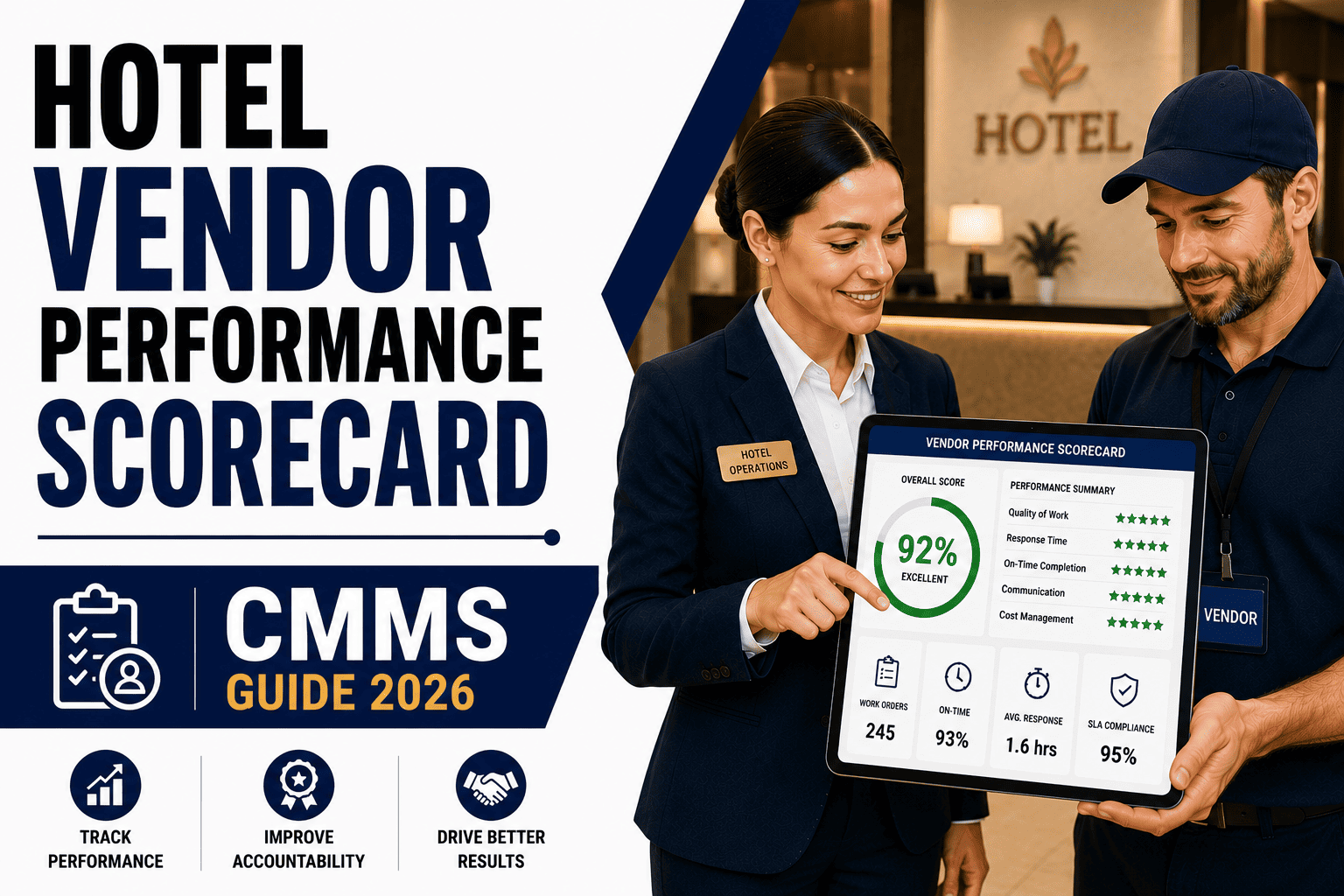
Casino properties operate under a unique paradox: the gaming floor never closes, yet maintenance must happen continuously to keep thousands of assets performing flawlessly. When a slot machine goes dark or the HVAC system fails in a high-roller suite, every minute of downtime translates directly to lost revenue—estimates suggest losing just one player per day can cost a casino $20,000 annually. The vendors maintaining your gaming equipment, HVAC systems, elevators, and kitchen equipment hold your property's reputation in their hands. Without a systematic way to measure their performance against franchise standards and contractual SLAs, you're gambling with your operation's most critical partnerships.
24/7
Operations
Maintenance windows measured in minutes, not hours—vendors must respond around the clock
$15-30K
Per Slot Machine
Gaming equipment represents massive capital investment requiring specialized vendor expertise
3 Levels
Regulatory Oversight
Local, state, and federal compliance demands documented vendor accountability
$20K/yr
Per Lost Player
Equipment failures and environmental issues drive guests to competing properties
Modernize Hospitality Service Quality Through Predictive Maintenance
Traditional vendor management relies on reactive measures: something breaks, you call the vendor, you hope they respond quickly. Casino properties can't afford this approach. Predictive maintenance transforms vendor relationships from reactive to proactive by using IoT sensors and AI analytics to identify equipment issues before they cause downtime. When your CMMS detects an HVAC compressor trending toward failure, it automatically generates a work order, assigns the appropriate vendor based on your scorecard rankings, and tracks response time against SLA commitments. Properties exploring this transformation can connect with our casino specialists to understand how predictive capabilities integrate with vendor scoring.
Traditional Approach
Equipment fails
Staff discovers issue
Manual vendor contact
Unknown response time
Revenue loss during downtime
VS
Predictive + Scorecard Approach
IoT sensors detect anomaly
CMMS auto-generates work order
Top-rated vendor auto-assigned
SLA tracking begins automatically
Issue resolved before failure
Building Your Vendor Performance Scorecard
A vendor scorecard transforms subjective impressions into objective, data-driven evaluations. For casino properties, effective scorecards must capture the metrics that actually matter: response time compliance, first-time fix rates, regulatory documentation accuracy, and cost performance. The scorecard structure should weight metrics based on your property's priorities—a casino prioritizing gaming floor uptime will weight response time differently than one focused on cost control.
Emergency Response Time
Target: <30 min
4.8
Standard Response Time
Target: <4 hrs
4.5
After-Hours Availability
Target: 24/7
3.8
First-Time Fix Rate
Target: >90%
4.6
Repeat Issue Rate
Target: <5%
4.4
Workmanship Quality
Target: No callbacks
3.9
Gaming Commission Compliance
Target: 100%
5.0
Documentation Accuracy
Target: >98%
4.7
Certificate Currency
Target: Always current
4.0
Budget Variance
Target: ±5%
3.7
Invoice Accuracy
Target: >99%
4.5
Cost per Work Order
Target: Below benchmark
4.2
Properties implementing vendor scorecards typically review critical vendors monthly and standard vendors quarterly. The key is consistency: scores must be calculated automatically from your CMMS data to eliminate subjective bias. Teams ready to build their own scoring framework can schedule a demo to see how automated scorecard generation works in practice.
Standardizing Compliance at Scale: A Hospitality Governance Model with Automation
Casino properties operating multiple locations or under franchise agreements face an additional layer of complexity: ensuring vendor performance meets brand standards consistently across every property. A centralized governance model with automated monitoring creates the visibility and accountability needed to maintain franchise compliance while managing dozens of vendor relationships.
Corporate Standards
SLA Templates, Scorecard Criteria, Compliance Requirements, Approved Vendor List
Property A
Avg Score: 4.2
Compliant
Property B
Avg Score: 3.8
Review Needed
Property C
Avg Score: 4.5
Compliant
Property D
Avg Score: 2.9
Action Required
Automated Governance Features
Auto-Scoring
Scorecards calculated automatically from work order data
Threshold Alerts
Notifications when vendors fall below minimum scores
Compliance Reports
One-click franchise audit documentation
Trend Analysis
Performance tracking over time across all properties
SLA Tiers by Vendor Category
Not all vendors require the same response commitments. Gaming equipment technicians need different SLAs than landscaping contractors. A tiered SLA structure ensures your contracts match the operational criticality of each vendor category while providing clear, enforceable standards for performance measurement.
Tier 1: Critical
Gaming Equipment, Security Systems, Fire Safety, Elevators
Emergency:
15-30 min response
Urgent:
2 hour response
Standard:
4 hour response
Penalty: Service credits + escalation rights
Tier 2: High Priority
HVAC, Plumbing, Electrical, Kitchen Equipment
Emergency:
1 hour response
Urgent:
4 hour response
Standard:
Same day response
Penalty: Service credits on repeated misses
Tier 3: Standard
Landscaping, Cleaning, Pest Control, General Maintenance
Emergency:
4 hour response
Urgent:
Same day response
Standard:
Next business day
Penalty: Performance review triggers
Build Your Vendor Scorecard System
See how casino properties are automating vendor performance tracking, enforcing SLA compliance, and maintaining franchise standards across multiple locations.
Expert Perspective: Making Vendor Data Actionable
Industry Insight
"Your vendor partners' reliability and performance are paramount to your enterprise's growth and success. Hence, ensuring that your vendors consistently meet their commitments is crucial. To achieve this, carefully monitoring key performance indicators becomes your guiding light in navigating the vendor management landscape."
— Yogesh Chowdhary, CEO, FieldCircle
Data-Driven Decisions
Scorecard data transforms vendor reviews from subjective conversations into evidence-based negotiations.
Early Warning System
Trend analysis reveals declining performance before it becomes a crisis, enabling proactive intervention.
Contract Leverage
Documented SLA violations provide concrete grounds for contract renegotiation or vendor replacement.
Implementation: From Manual Tracking to Automated Scorecards
Most casino properties start with spreadsheets and manual vendor tracking. The transition to automated scorecard generation follows a structured path that builds capabilities incrementally while delivering value at each stage. Properties that consult with our implementation team typically complete this transformation within 6-8 weeks.
01
Discovery & Design
Weeks 1-2
Vendor inventory and categorization, SLA tier definition, Scorecard metric selection, Weight assignment by priority
02
System Configuration
Weeks 3-4
Vendor portal setup, SLA tracking automation, Scorecard calculation rules, Alert threshold configuration
03
Vendor Onboarding
Weeks 5-6
Vendor portal training, Mobile app deployment, Work order workflow testing, Documentation standards communication
04
Go-Live & Optimization
Weeks 7-8
Full scorecard activation, Dashboard deployment, First review cycle completion, Process refinement
Your Vendors Are Being Scored—By Your Guests
Every equipment failure, every delayed repair, every environmental complaint gets scored by your guests in online reviews and return visit decisions. The question isn't whether to evaluate vendor performance—it's whether you'll do it systematically before problems reach your guests, or reactively after the damage is done. Casino properties that implement vendor scorecards gain the visibility to hold partners accountable, the data to negotiate better contracts, and the documentation to satisfy gaming commission compliance requirements.
Ready to transform vendor management from a cost center into a competitive advantage? Book a personalized demo to see how Oxmaint's vendor scorecard capabilities work for casino properties, or reach out to our hospitality team for a confidential assessment of your current vendor management approach.
Take Control of Vendor Performance
Oxmaint gives casino properties automated vendor scorecards, SLA tracking, and compliance documentation that satisfies gaming commission requirements and franchise standards.
Frequently Asked Questions
What is a vendor performance scorecard for casino properties?
A vendor performance scorecard is a structured evaluation tool that measures and tracks how well your maintenance and service vendors meet contractual obligations and operational standards. For casino properties, scorecards typically include metrics for response time compliance, first-time fix rates, regulatory documentation accuracy, cost performance, and 24/7 availability. Scores are calculated from actual CMMS data—work order response times, completion rates, and quality assessments—providing objective, data-driven vendor evaluations rather than subjective impressions.
How do SLA tiers work for different casino vendor categories?
SLA tiers establish different response time requirements and accountability standards based on vendor criticality. Tier 1 (Critical) vendors—gaming equipment, security systems, fire safety—typically require 15-30 minute emergency response with service credit penalties for misses. Tier 2 (High Priority) vendors—HVAC, electrical, kitchen equipment—require 1-4 hour response times. Tier 3 (Standard) vendors—landscaping, general maintenance—operate on same-day or next-business-day response. This tiered approach ensures your most critical vendor relationships receive the strictest accountability.
How does predictive maintenance improve vendor performance?
Predictive maintenance uses IoT sensors and AI analytics to detect equipment issues before they cause failures. When integrated with vendor scorecards, predictive systems automatically generate work orders when anomalies are detected, assign the highest-rated vendor for that equipment category, and begin SLA tracking immediately. This shifts vendor relationships from reactive emergency responses to proactive scheduled maintenance, improving both equipment uptime and vendor performance metrics by eliminating the urgency that leads to SLA violations.
What vendor metrics matter most for gaming commission compliance?
Gaming commissions require documented accountability for all equipment affecting gaming operations and guest safety. Critical metrics include documentation accuracy (service records, calibration certificates, compliance certifications), response time logs for gaming equipment maintenance, and audit trail completeness showing who performed work, when, and what was done. Automated CMMS scorecards capture this data continuously, providing instant access to compliance documentation during gaming commission audits without manual record assembly.
How long does it take to implement vendor scorecards?
Most casino properties complete vendor scorecard implementation within 6-8 weeks using a phased approach. Weeks 1-2 focus on vendor categorization and scorecard design. Weeks 3-4 involve CMMS configuration and automation setup. Weeks 5-6 cover vendor onboarding and training. Weeks 7-8 activate full scorecard tracking and complete the first review cycle. Properties with existing CMMS platforms can often accelerate this timeline since vendor and work order data already exists in the system.