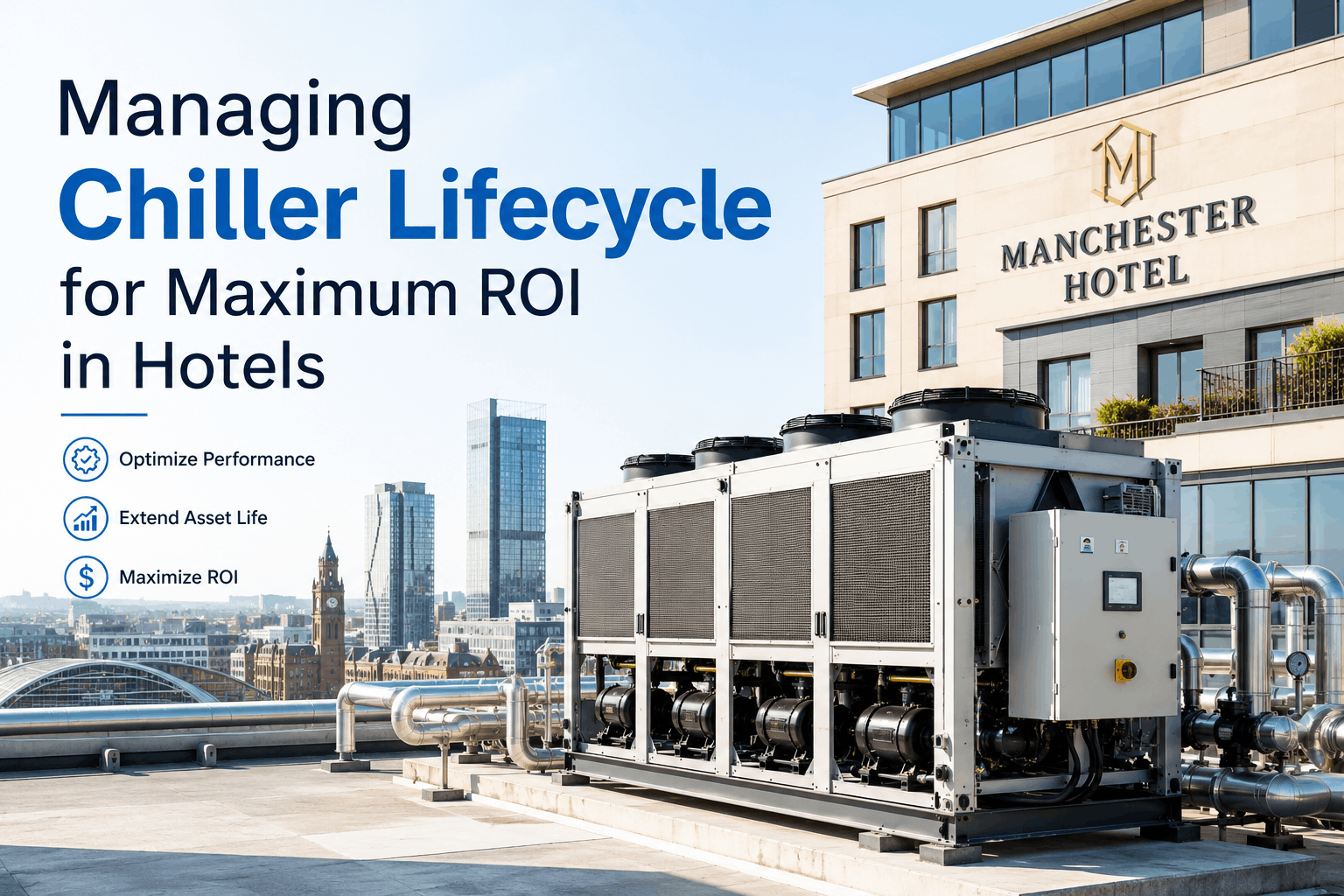
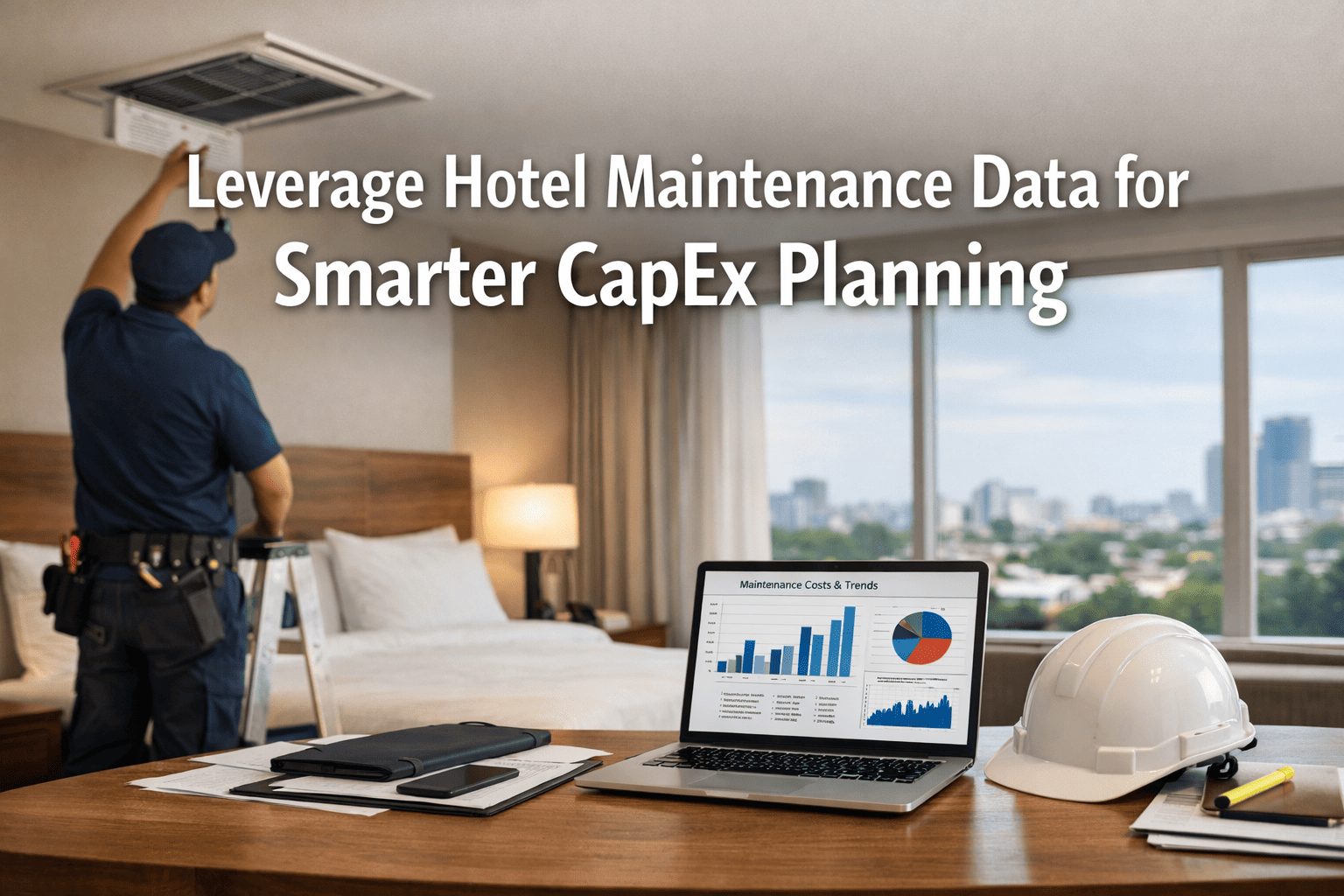
A 180-room upscale hotel in New York faced a critical decision: their $85,000 rooftop HVAC unit — installed 12 years ago with a 15-year design life — had begun requiring increasingly expensive repairs. In the past 18 months, maintenance costs totaled $12,400. The chief engineer estimated the next compressor rebuild would cost $6,500. Replacement with a new energy-efficient unit would cost $32,000, but the new unit would cut energy consumption by 22% and carry a 10-year warranty. Without a structured framework for lifecycle cost analysis, the property spent six hours debating the decision in management meetings, ultimately authorizing the $6,500 repair because it felt like the "cheaper option." Eighteen months later, the same compressor failed again — this time mid-summer, during peak occupancy. A weekend emergency replacement cost $48,000 in expedited procurement and installation, plus three days of guest complaints about degraded room temperature control that triggered a cascade of negative OTA reviews affecting occupancy for 90 days. The hotel learned an expensive lesson: equipment repair versus replacement decisions made without complete lifecycle cost data are not cost decisions — they are budget guesses that systematically defer true costs while creating catastrophic failure risk. This guide provides the complete framework for repair vs. replace decisions in hotel operations, the metrics OxMaint tracks to enable data-driven choices, and how to structure a capital planning process that moves hotels from reactive equipment failures to scheduled, predictable, budgeted asset replacement. Sign in to OxMaint to activate asset lifecycle tracking and repair vs. replace decision support for your property, or schedule a demo to see how OxMaint compares lifecycle cost components, flags replacement thresholds automatically, and generates capital budget requests based on asset condition and cost history.
Hotel Asset Lifecycle Management · Repair vs Replace Framework · Capital Planning · OxMaint CMMS
When to Repair and When to Replace: The Data-Driven Framework Hotels Use to Extend Asset Life and Optimize Capital Spending
OxMaint asset lifecycle tracking captures repair costs, energy consumption trends, downtime events, and condition scores for every piece of equipment — then applies the complete lifecycle cost analysis framework to determine the exact maintenance spend threshold where replacement becomes the economically superior choice. No more gut-feel decisions. No more deferred failures.
$6,500
average corrective repair cost that triggers repair vs replace review for major hotel equipment — when cumulative lifecycle costs exceed 40% of replacement value
3–5 yrs
the lifespan reduction when equipment operates on reactive maintenance vs. preventive schedules — a rooftop unit lasting 10 years instead of 15 represents $33,000+ in deferred replacement costs
22–35%
typical energy efficiency improvement when replacing 12+ year old equipment with current-generation units — on a 200-room hotel, this generates $18,000–$28,000 annual energy savings
200–400%
ROI in 18 months from preventive maintenance programmes using structured asset lifecycle data — through combined savings in emergency repair elimination, energy efficiency, and asset life extension
The repair vs. replace decision is not made at the moment of failure — it is made by the quality of data you have accumulated before failure occurs. Hotels that track cumulative maintenance costs, energy consumption trends, repair frequency, and downtime impact per asset can calculate the exact breakeven point where repair investment stops making financial sense. Hotels that don't have this data make the decision backward: they spend the repair cost first, then discover two years later that they should have replaced the equipment 12 months earlier. OxMaint lifecycle tracking puts the decision framework in place before the crisis, so capital planning committees approve replacements based on financials, not desperation.
Five Core Metrics That Determine Repair vs. Replace Decisions
01
Cumulative Maintenance Cost as % of Replacement Value
When annual maintenance cost exceeds 30–40% of current replacement cost, equipment is entering the replacement threshold zone. Example: a $28,000 rooftop unit incurring $9,000/year in repairs ($12,000 in compound lifecycle cost) signals replacement consideration — because at that burn rate, you will spend $45,000 maintaining equipment worth $28,000 before it reaches end-of-life. OxMaint flags this automatically for engineering review.
02
Age vs. Design Life Remaining
Equipment past 80% of design life enters risk escalation zone. A 12-year-old unit with a 15-year design life is at 80% consumed. At this age, failure risk begins rising nonlinearly — the last 20% of design life typically sees 50%+ of total failure events. Replacing at 80% of design life, rather than waiting for catastrophic failure, eliminates the guest impact and emergency cost premium that reactive replacement carries. OxMaint tracks age against design life and flags escalation points.
03
Repair Frequency Trend Over 24 Months
When repair frequency doubles over a 24-month period, the equipment is approaching end-of-useful-life even if it still functions. This trend line, combined with cost trajectory, is the strongest predictor of imminent failure. A chiller requiring two service calls per year, escalating to four calls in the following year, is signaling replacement demand even if each individual repair is successfully completed. Frequency trend is more predictive than age alone.
04
Energy Consumption Degradation
HVAC units and refrigeration equipment lose efficiency 0.5–1.5% per year after mid-life. Over 12 years, a chiller installed at 0.6 kW/ton efficiency (modern) degrades to 0.75+ kW/ton. A 300-ton chiller at that degradation level uses 45,000 additional kWh per year — roughly $5,400 in annual energy premium compared to a new unit. This energy cost often exceeds the annual maintenance premium for keeping the old unit running, making replacement financially attractive before failure risk even materializes.
05
Downtime Impact Cost During Critical Periods
A guest-facing system failure during peak occupancy (weekend, holiday, convention period) generates costs far beyond the repair bill: lost occupancy revenue, service recovery costs, OTA review recovery, staff overtime for troubleshooting. A Saturday night HVAC failure on a 200-room property during peak season costs $8,000–$12,000 in direct lost revenue alone, plus recovery overhead. Preventive replacement before this scenario occurs is economically justified even if the equipment could technically run longer.
The Repair vs. Replace Breakeven Framework
How OxMaint Calculates the Repair-vs-Replace Threshold
| Equipment Factor |
Repair Path (Keep Old) |
Replace Path (New Unit) |
| Initial Capital Cost |
$0 (already spent 12 yrs ago) |
$32,000 (new investment) |
| Annual Maintenance Cost (est. 5 yrs remaining) |
$9,000–$14,000 year 1, escalating |
$1,200–$1,800 (warranty-backed) |
| Annual Energy Cost (vs. baseline modern unit) |
+$5,400 energy premium from degradation |
Baseline (20–25% more efficient) |
| 5-Year Total Lifecycle Cost |
$45,000–$70,000 |
$38,000–$42,000 |
| Financial Advantage |
|
REPLACE: $7,000–$28,000 savings |
How Asset Lifecycle Data Flows Into the Capital Planning Process
Step 1: Continuous Cost & Condition Capture
Every maintenance action — PM service, corrective repair, parts replacement — is logged in OxMaint with cost, duration, parts used, and technician notes. Equipment condition is scored at each service touchpoint on a standardized 1–5 scale. This creates a continuous record of equipment trajectory rather than isolated snapshots. By year two, every asset has 24+ data points showing actual maintenance patterns and condition trends — far more reliable than manufacturer estimates or generic benchmarks.
Step 2: Automated Lifecycle Threshold Alerts
OxMaint continuously compares each asset's cumulative maintenance cost against its replacement value, age against design life, and repair frequency trend against historical baseline. When any asset crosses a threshold — e.g., annual maintenance exceeds 35% of replacement cost, or repair frequency doubles year-over-year — the system flags the asset for engineering review. This flag triggers a lifecycle analysis workflow, not an emergency panic.
Step 3: Structured Repair-vs-Replace Analysis
When an asset is flagged, OxMaint generates a standard lifecycle cost comparison showing: remaining useful life projection based on condition trend, 5-year cost estimate for repair path vs. replacement path, energy efficiency delta and projected savings, downtime risk during critical seasons, warranty and support coverage differences, and cumulative financial advantage of each path. This analysis is built from actual data captured in the system, not engineering guesswork.
Step 4: Capital Budget Request Generation
Assets recommended for replacement automatically generate a capital request document pre-populated with project scope, budget figure, vendor lead time, installation complexity, expected ROI, and supporting cost history. This document goes directly to the ownership or asset management committee with complete financial backing — no engineering presentation needed to justify the decision. The data speaks for itself.
Step 5: Replacement Execution and Lifecycle Continuity
When replacement is approved and executed, OxMaint archives the retired asset with its complete maintenance history, then registers the new asset in the same location with inherited PM templates. The PM schedule doesn't reset — it carries forward from the old equipment's patterns, ensuring the new asset starts with a structured maintenance plan rather than the ad hoc approach that typically follows equipment installation.
Asset Lifecycle Management · Repair vs. Replace Framework
Data-Driven Equipment Replacement Decisions. Predictable Capital Costs. Zero Catastrophic Failures.
OxMaint eliminates the guesswork from repair vs. replace decisions by tracking the complete lifecycle cost of every asset — maintenance history, energy trends, condition scores, and downtime impact — then applying a structured analysis framework that identifies the exact point where replacement delivers better economics than ongoing repair.
Asset Lifecycle Decision Framework: Equipment-Specific Thresholds
Rooftop HVAC Units
Replace Threshold: 12+ years old, annual maintenance >40% of replacement cost, or energy consumption >20% above new unit baseline
Design life 15 years. Most hotels delay replacement until failure, creating peak-season emergency costs. Proactive replacement at 12 years eliminates 90% of catastrophic failure risk while capturing 22–28% energy efficiency improvement ($18,000–$24,000 annual savings on 200-room property).
Chilled Water Systems / Chillers
Replace Threshold: 15+ years old, compressor work required, or kW/ton efficiency >15% above modern baseline
Design life 20 years if well-maintained; 12–15 years under reactive maintenance. Compressor replacement (major repair) is typically a sign that replacement economics have shifted. Energy cost alone on degraded chiller can exceed $40,000 annually, making newer units cost-positive within 3–4 years. OxMaint flags efficiency degradation automatically.
Elevator / Lift Systems
Replace Threshold: 20+ years old, modernization compliance required, or more than 2 unscheduled stops per month
Design life 25–30 years; safety regulatory updates often mandate control system upgrades at 18–20 years. Modernization (controller, safety systems, door mechanisms) can cost 40–60% of replacement, making full replacement more economical. Unscheduled stops above baseline indicate control or mechanical system degradation — repair vs. replace analysis should be triggered at 2+ stops/month for 3+ consecutive months.
Water Heaters / Boilers
Replace Threshold: 10+ years old, efficiency <80% of manufacturer spec, or annual maintenance >30% of replacement cost
Design life 12–15 years on commercial units. Efficiency losses and thermal efficiency degradation are measurable and continuous. A 500-gallon commercial water heater losing 1% annual efficiency across 12 years costs an extra $3,000–$4,000 annually in energy waste. Combined with increased repair frequency, this typically favors replacement at year 10–11 rather than waiting for failure.
Kitchen Equipment (Ranges, Fryers, Coolers)
Replace Threshold: 8+ years old, repair cost >25% of replacement, or guest-facing availability <95% monthly
Design life 8–12 years in high-use F&B environments. Kitchen equipment downtime directly impacts food service revenue. A broken line cooker during service creates immediate financial loss and service recovery cost. Preventive replacement at year 8 eliminates this risk and ensures equipment is under manufacturer support during peak ROI period. Guest-facing availability below 95% signals replacement readiness.
Guest Room Locks / Door Systems
Replace Threshold: 8+ years old, 3+ lock failures per month, or system requires proprietary card format no longer manufactured
Design life 7–10 years for electronic locks under continuous use (guest entries 5–15 times daily across entire property). Lock failures create security concerns and guest experience disruption. A 300-room property with modern electronic locks experiencing 2–3 failures monthly is already in replacement window. Upgrading to current-generation locks improves guest experience and eliminates legacy support costs.
Real-World Repair vs. Replace Scenarios: Decision Framework in Action
Scenario 1: The Compressor Failure Decision (Chiller)
300-room upscale property. 13-year-old Carrier chiller, design life 20 years. Compressor bearing failure. Repair quote: $8,500. Replacement: $52,000. Annual maintenance history: $2,100 Year 1, $3,200 Year 2, $4,800 Year 3 (escalating 40% annually).
OxMaint Lifecycle Analysis: Cumulative maintenance 12 years: $34,100 + $8,500 repair = $42,600 (82% of replacement cost). Energy efficiency degradation trending at -1.2%/year: current energy premium vs. new unit ~$6,500 annually. Age: 13/20 = 65% of design life consumed. Repair frequency: 3 service calls in Year 3 vs. 1 in Year 1 (tripled). Forecast: if repair authorized, expect another major failure within 24–36 months, likely under peak occupancy. 5-year cost projection for repair path: $8,500 + escalating annual maintenance + high failure risk = $32,000+ with 60% chance of catastrophic failure. Replacement path: $52,000 + low maintenance + 5% warranty coverage = $54,500 over 5 years with zero failure risk.
Decision: Replace. Compressor failure signals end-of-useful-life for the chiller, not just component failure. Replacement is $2,000 cheaper over 5 years and eliminates catastrophic risk.
Scenario 2: The HVAC Unit Age Decision (Rooftop Unit)
180-room regional property. 11-year-old Trane rooftop unit, design life 15 years. No current failures. Annual maintenance: $1,800. Recent preventive service: unit in good condition. Replacement cost: $28,000. Estimated remaining life: 4 years.
OxMaint Lifecycle Analysis: Current state: asset is healthy, maintenance costs are stable and reasonable at 6.4% of replacement value. Age: 11/15 = 73% of design life consumed. Energy consumption: 3.2% above modern baseline, costing ~$1,400 annually. Condition score: 4/5 (good). Remaining useful life: 4 years (conservative estimate based on design life, though could extend to 6 with aggressive PM). 4-year cost projection for repair path: ($1,800 × 4) + $1,400 energy premium × 4 = $12,800. Replacement now: $28,000 upfront but 5-year warranty, 22% energy improvement, zero failure risk. Breakeven: 7.3 years. Since unit only has 4 years likely remaining, replacement now would not be cost-optimal.
Decision: Repair/Maintain. At 11 years old with good condition and reasonable maintenance costs, replacement is not yet justified. However, schedule replacement for Year 14–15 (before end-of-design-life) to avoid emergency failure scenario. Flag annual energy benchmarking to track degradation trend.
Scenario 3: The Kitchen Equipment Downtime Decision (Combi-Oven)
250-room resort with significant F&B operation. 9-year-old Rational combi-oven. Repair history: 1 call Year 1–3, 2 calls Year 4–6, 4 calls Year 7–8, 6 calls Year 9. Latest repair: heating element failure, $3,200. Replacement: $18,000. Equipment down 8 hours during lunch service last month (revenue impact: $1,800).
OxMaint Lifecycle Analysis: Repair frequency escalation is severe: trending from 1 call/3 years to 2 calls/year. Cumulative maintenance: $1,200 + $1,800 + $2,400 + $3,200 = $8,600 over 9 years (48% of replacement cost). Critical metric: guest-facing downtime. One 8-hour service failure caused $1,800 direct revenue loss plus service recovery costs. With 6 service calls/year, probability of downtime event during peak service (lunch, dinner) is >70% monthly. Age: 9/12 = 75% of design life consumed. Remaining life estimate: 2–3 years realistically.
Decision: Replace. The kitchen equipment is critical to food service revenue. Downtime risk, combined with escalating repair frequency and age approaching end-of-life, makes replacement immediately justified. Avoid another peak-service failure that costs $2,000+ in lost revenue. Budget replacement within 6 months.
Your repair vs. replace decisions are only as good as the data behind them. Without lifecycle cost tracking, you spend the wrong money on the wrong equipment at the wrong time — extending old assets until they fail catastrophically, then replacing them in emergency mode at premium costs.
OxMaint tracks every maintenance action, captures condition scores at each service, monitors energy and efficiency trends, and flags replacement thresholds automatically — so your capital planning decisions are based on complete financial data, not engineering guesswork or budget pressure.
Frequently Asked Questions — Hotel Asset Lifecycle & Repair vs. Replace Decisions
How does OxMaint determine the "replacement threshold" for equipment at my property?
OxMaint compares cumulative maintenance cost against replacement value, tracks age vs. design life, monitors repair frequency escalation, and measures energy efficiency degradation — then flags assets when any metric crosses a threshold. The 30–40% maintenance-cost-to-replacement-value ratio is the primary trigger, but age, frequency trend, and energy cost also influence the decision. You can customize thresholds by equipment type or property type.
Can OxMaint predict how much longer equipment will last before replacement becomes necessary?
Yes. OxMaint builds remaining-useful-life projections based on your actual maintenance history, condition scores, and age vs. design life. These projections are not manufacturer estimates — they are equipment-specific forecasts built from your own data. Projections update monthly as new maintenance data is captured, becoming more accurate over time.
Does OxMaint help with capital budget planning if I have multiple properties or portfolios?
Absolutely. OxMaint aggregates lifecycle data across multiple properties and generates a consolidated capital forecast ranking all equipment by replacement urgency and budget requirement across the entire portfolio. This allows asset managers to optimize timing and coordinate replacement schedules across properties based on financial impact.
How do I handle the energy cost savings when calculating repair vs. replace ROI?
OxMaint automatically includes energy consumption trending in lifecycle cost analysis. For HVAC and refrigeration equipment, efficiency degradation is measured and monetized ($1–$10 per percentage point of efficiency loss, depending on equipment type and local energy rates). This energy cost component often tips the scale toward replacement even when maintenance costs alone appear reasonable.
What if I'm in the middle of the equipment lifecycle — not new, not at end-of-life. How do I decide?
This is where lifecycle cost analysis is most valuable. Equipment in mid-life (50–75% of design life consumed) often operates under reasonable maintenance costs, but energy efficiency degradation and repair frequency escalation begin to shift economics. OxMaint shows you the precise crossover point where ongoing repair becomes more expensive than proactive replacement — usually 2–3 years before catastrophic failure would occur.
Can repair vs. replace analysis account for franchise compliance requirements or brand standards?
Yes. Many franchise brands mandate equipment replacement or modernization at specific ages or condition thresholds (e.g., all guest-facing equipment must be <10 years old). OxMaint allows you to flag brand compliance requirements as a decision factor. If replacement is required by franchise agreement anyway, the financial analysis focuses on timing and budget optimization rather than whether to replace.
How does OxMaint handle replacement decisions for equipment with seasonal impact, like pool equipment or outdoor units?
Seasonal equipment downtime is weighted more heavily in the financial model because failure timing is more predictable and impactful. Pool equipment failure in summer season eliminates a major guest amenity during peak occupancy. OxMaint can model seasonal criticality, making replacement earlier in the off-season financially justified to avoid peak-season failure risk.
Before OxMaint, we were making repair vs. replace decisions in crisis mode — usually authorizing a $5,000 repair because we didn't have capital budget to replace the equipment, then discovering 18 months later that we should have replaced it immediately. After implementing lifecycle tracking with OxMaint, we can now show ownership exactly when equipment will need replacement and why. We built a three-year capital plan with confidence for the first time, and we eliminated the emergency repair cycle almost entirely. The system has paid for itself in the first six months through better decision timing alone.
— Director of Engineering, 320-Room Luxury Hotel · Chicago, Illinois · OxMaint User Since 2024
Equipment Repair vs. Replacement Doesn't Have to Be a Guess. OxMaint Lifecycle Tracking Puts the Complete Financial Framework in Your Hands — From First Cost Capture Through End-of-Life Replacement.
Cumulative maintenance cost tracking. Energy efficiency trending. Condition score progression. Repair frequency escalation alerts. Remaining useful life forecasts. OxMaint makes repair vs. replace decisions data-driven, defensible, and financially optimized — across every asset in your hotel.