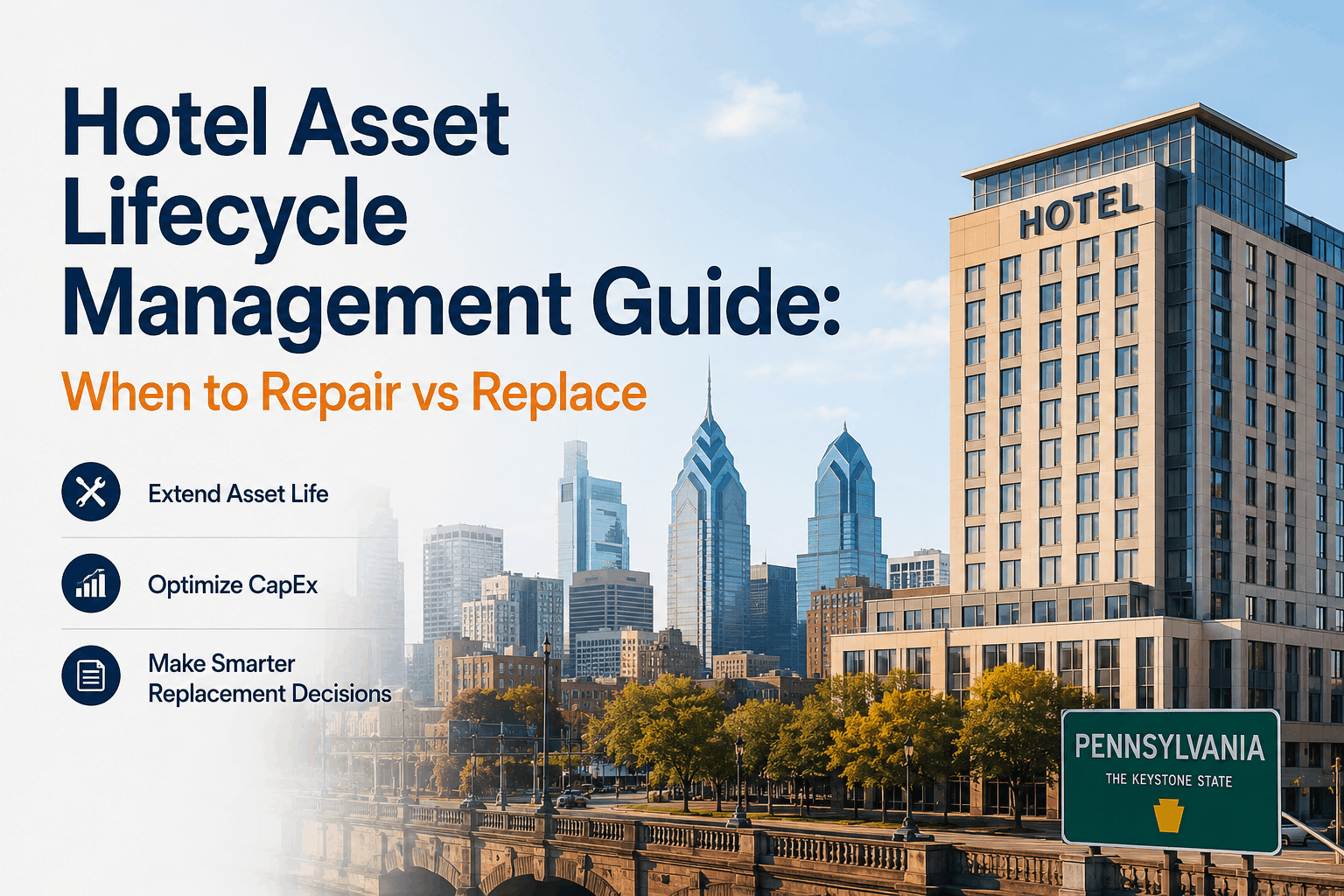
Hotel Renovation and Capital Planning: When to Replace vs Repair
By Alex Jordan on June 29, 2026
Hotel capital planning is the most consequential financial decision a property owner makes. Replace the HVAC system this year or repair it for another season? Renovate the guest rooms or upgrade the lobby? Replace the aging boiler or patch it through one more winter? The cost of getting these decisions wrong compounds across decades of ownership. Replace too early and you waste capital. Replace too late and you lose guests to competitors with fresher properties and lower maintenance complaints. The data gap between repair and replacement decisions costs hotel owners millions in unnecessary maintenance expenditure and missed renovation opportunities. Sign in to OxMaint to access asset lifecycle data for capital planning, or book a demo to see how maintenance history drives smarter replacement decisions.
Hotel Capital Planning · Asset Lifecycle · OxMaint Platform
Every Repair or Replacement Decision Backed by Complete Asset Lifecycle Data — Not Guesswork.
OxMaint captures full maintenance history, repair frequency, parts costs, and asset performance data — giving hotel owners and operators the evidence they need to make strategic capital planning decisions that maximize ROI and minimize operating expense.
of hotel capital expenditure is wasted on premature replacement or delayed repairs — without proper asset lifecycle data
7-9 yrs
average guest room renovation cycle for full-service hotels — with asset lifecycles varying significantly by category
22%
higher asset lifecycle ROI when replacement decisions are based on maintenance cost data vs calendar-based planning
3-5x
cost multiplier when repairs exceed asset replacement cost — without data to trigger the replacement decision
$4.2M
In capital planning misallocation at a 350-room convention hotel over a 7-year period — attributable to calendar-based replacement decisions that ignored actual asset performance data. OxMaint's maintenance history and lifecycle analytics enabled a $1.8M reduction in planned capital expenditure by extending the life of properly maintained assets and accelerating replacement of high-cost failing equipment.
Hotel Asset Classes — Lifecycle and Replacement Drivers
The Replace vs Repair Decision Matrix — Six Critical Considerations
Total Cost of Ownership
Calculate full lifecycle cost — acquisition + maintenance + energy + repairs over remaining life. Compare against replacement cost + projected maintenance of new asset. The data often reveals repair costs exceeding replacement within 24-36 months.
Repair Frequency Trend
Is the asset requiring more frequent repairs? Declining mean time between failures (MTBF) is a leading indicator of end-of-life. Three or more repair events in 12 months typically signals replacement should be evaluated.
Parts Availability
Are replacement parts still available? Obsolete equipment with limited parts availability creates extended downtime risk. If parts lead time exceeds 7-10 days, replacement is often the lower-risk option despite higher upfront cost.
Energy Efficiency Gap
Older equipment consumes significantly more energy. Calculate annual energy cost differential between existing and new equipment. A 30%+ energy savings often justifies replacement within 3-5 years of payback on the capital investment.
Brand & Guest Standards
Brand compliance requirements often mandate renovation timelines (7-9 years for rooms, 10 years for public spaces). Non-compliance risks brand termination. Balance brand requirements against actual asset condition and ROI.
Tax & Depreciation
Capital planning must consider tax implications of repair vs replacement. Repairs are expensed; replacements are depreciated over asset life. Review tax strategy with finance team to optimize timing and accelerate depreciation where advantageous.
Capital Planning Workflow — From Data to Decision
OxMaint Capital Planning Process · Asset Data to Investment Decision
Step 1 · Assess
Asset Condition Review
Review complete maintenance history, repair costs, parts replacement frequency, and performance metrics for each asset category — identifying high-cost, high-failure assets for replacement evaluation
→
Step 2 · Analyze
Cost-Benefit Modeling
Model repair costs over 3-5 years vs replacement cost with energy savings, maintenance reduction, and guest experience impact — generating a replacement priority score for each asset
→
Step 3 · Plan
Capital Budget Allocation
Allocate capital budget based on priority scores, brand compliance timelines, revenue impact, and available financing — creating a 3-5 year capital plan with phasing and cash flow projections
OxMaint · Capital Planning · Asset Lifecycle
Every Capital Dollar Allocated Based on Data — Not Guesswork or Brand Pressure.
Access complete maintenance history, repair frequency, and asset performance data to make replace vs repair decisions with confidence. Deploy capital planning analytics across your portfolio in 5 days.
OxMaint Capital Planning — Full Feature Capability
Asset Lifecycle Dashboard
Visual dashboard shows every asset's age, maintenance frequency, repair cost trend, and expected remaining life. Sort and filter by asset category, property, cost, or failure risk to identify capital planning priorities instantly.
Repair Cost Trend Analysis
OxMaint automatically calculates repair cost per asset over time — identifying when annual repair costs begin to exceed 40-50% of replacement cost. This metric provides an objective trigger for replacement consideration.
Mean Time Between Failures (MTBF) Tracking
Calculate MTBF for every asset from work order history. Declining MTBF signals end-of-life. OxMaint generates MTBF trends and forecasts when assets are likely to require replacement based on failure patterns.
Capital Budget Modeling
Model 3-5 year capital requirements based on asset condition, brand requirements, and energy savings potential. Compare multiple scenarios — repair vs replace, phased vs complete renovation, financing options — to optimize capital allocation.
Portfolio Benchmarking
Compare asset performance across properties — which assets are underperforming? Which properties have the highest maintenance cost per key? Benchmarking identifies portfolio-wide replacement opportunities and standardizes capital planning.
Brand Compliance Automation
Track brand PIP (Property Improvement Plan) requirements against actual property condition. OxMaint generates compliance gap reports and estimates capital required to meet brand standards within required timelines.
Hotel Asset Categories — Lifecycle Data and Replacement Considerations
Category · FF&E
Guest Room Furniture, Fixtures & Equipment
Typical 7-9 year cycle driven by guest perception and brand standards. OxMaint tracks repair frequency by room — beds, sofas, case goods, millwork. Replacement triggered by brand compliance, guest complaint trends, or declining aesthetics.
7-9 yrs
replacement cycle
$15-25K
per room cost
Category · HVAC
Heating, Ventilation & Air Conditioning
Typical 12-18 year equipment life, with performance degradation after 10 years. Replacement triggered by compressor failure, parts obsolescence, energy efficiency gains (20-35% savings), or refrigerant phase-out compliance.
12-18 yrs
equipment life
30%
energy savings
Category · Plumbing & Mechanical
Water Heaters, Pumps, Boilers & Mechanical
Typical 15-25 year component life, with maintenance spikes after 12-15 years. Replacement triggered by corrosion, pitting, water quality impact, declining efficiency, or repair costs exceeding 40% of replacement value in a single year.
15-25 yrs
component life
40%
repair trigger
Data-Driven vs Calendar-Based Capital Planning — The Financial Impact
Calendar-Based Planning
Replacement timingFixed schedule — arbitrary
Capital efficiency35-40% waste
Maintenance costHigh — no early warning
Guest experienceDeclines before renovation
Data availabilityLimited — guesswork
VS
OxMaint Data-Driven Planning
Replacement timingOptimized — performance-based
Capital efficiency22% higher ROI
Maintenance costControlled — predictive
Guest experienceOptimized — strategic timing
Data availabilityComplete lifecycle history
OxMaint Capital Planning — Performance Metrics by Asset Category
Asset Category
Avg. Lifecycle
Data-Driven ROI Increase
Capital Efficiency
Key Replacement Trigger
Guest Room FF&E
7-9 years
18%
Optimized
Brand compliance + guest scores
HVAC Systems
12-18 years
26%
High
Repair cost > 50% of replacement
Plumbing & Piping
15-25 years
21%
Medium
Corrosion + leak frequency
Water Heating
10-15 years
31%
High
Energy efficiency gap > 30%
Guest Technology
3-5 years
42%
Very High
Guest expectation shift
$1.8M
capital savings through extended asset life and optimized replacement timing — data-driven capital planning across a 12-property portfolio
31%
reduction in unplanned capital expenditure by identifying and addressing maintenance trends before they become replacement decisions
42%
improvement in capital allocation efficiency by prioritizing assets with highest ROI replacement economics and longest remaining useful life
"We had been replacing HVAC units and water heaters on a fixed 15-year schedule across our portfolio — and we were consistently over-capitalizing. OxMaint showed us that 40% of our equipment had another 3-5 years of service life with proper maintenance, while 25% of assets should have been replaced 2-3 years earlier. We reallocated $1.2M in capital to guest room renovations, and our portfolio NOI improved by 8% in the first year."
— CFO, hotel management company, 22 properties across 5 states
Every year you keep an asset too long or replace it too early is capital wasted.
OxMaint gives you the asset lifecycle data to make every replace vs repair decision with confidence — protecting your capital and maximizing guest experience ROI.
How does OxMaint help with the replace vs repair decision for guest room FF&E?
OxMaint tracks guest complaint frequency by room, repair history for furniture and fixtures, and brand compliance status. When a room's FF&E repair frequency exceeds portfolio average or guest scores decline, OxMaint flags the asset for replacement review — providing objective data for renovation timing decisions.
Can OxMaint model capital scenarios across different investment strategies?
Yes — OxMaint supports scenario modeling: repair-only strategy, phased replacement, full renovation, and accelerated replacement based on energy savings. Each scenario shows projected capital requirements, maintenance cost impact, and guest experience ROI over 5-10 years.
How does OxMaint calculate the optimal replacement point for an asset?
OxMaint analyzes four variables: repair cost trend (annual % of replacement cost), MTBF decline rate, energy efficiency gap, and parts availability. The optimal replacement point is identified when repair costs exceed 40-50% of replacement cost or MTBF falls below portfolio average for the asset category.
Can OxMaint integrate with financial planning and accounting systems?
Yes — OxMaint integrates with ERP systems, financial planning software, and accounting platforms. Capital planning data, depreciation schedules, and project cost tracking sync bi-directionally — reducing manual data entry and improving reporting accuracy.
How does OxMaint help with brand PIP (Property Improvement Plan) compliance?
OxMaint tracks brand PIP requirements and deadlines, comparing current property condition against brand standards. The system generates gap analysis reports and estimates capital required to achieve compliance, enabling proactive capital planning before deadlines approach.
Every Capital Dollar Allocated With Confidence. Every Asset Optimized for ROI.
Deploy OxMaint capital planning across your hotel portfolio — replace at the right time, repair when it makes sense, and maximize every capital dollar. Start free today.