A hotel chiller is the single most expensive mechanical asset on the property — a centrifugal chiller serving a 300-room full-service hotel represents a $250,000–$450,000 capital investment that cools every guest room, public space, kitchen, and meeting room simultaneously. When it fails in July, there is no quick fix: the repair timeline runs 5–14 days, parts are backordered, and the hotel faces either a full loss of cooling capacity or the cost of emergency portable chiller rental at $4,000–$12,000 per week. Properties that track chiller health through structured predictive maintenance catch developing compressor, tube, and oil system failures weeks before they escalate — eliminating the peak-season failure scenario entirely. OxMaint's chiller lifecycle management module tracks vibration trends, oil analysis results, tube condition, and efficiency metrics — converting predictive data into documented maintenance actions that extend asset life and maximize ROI.
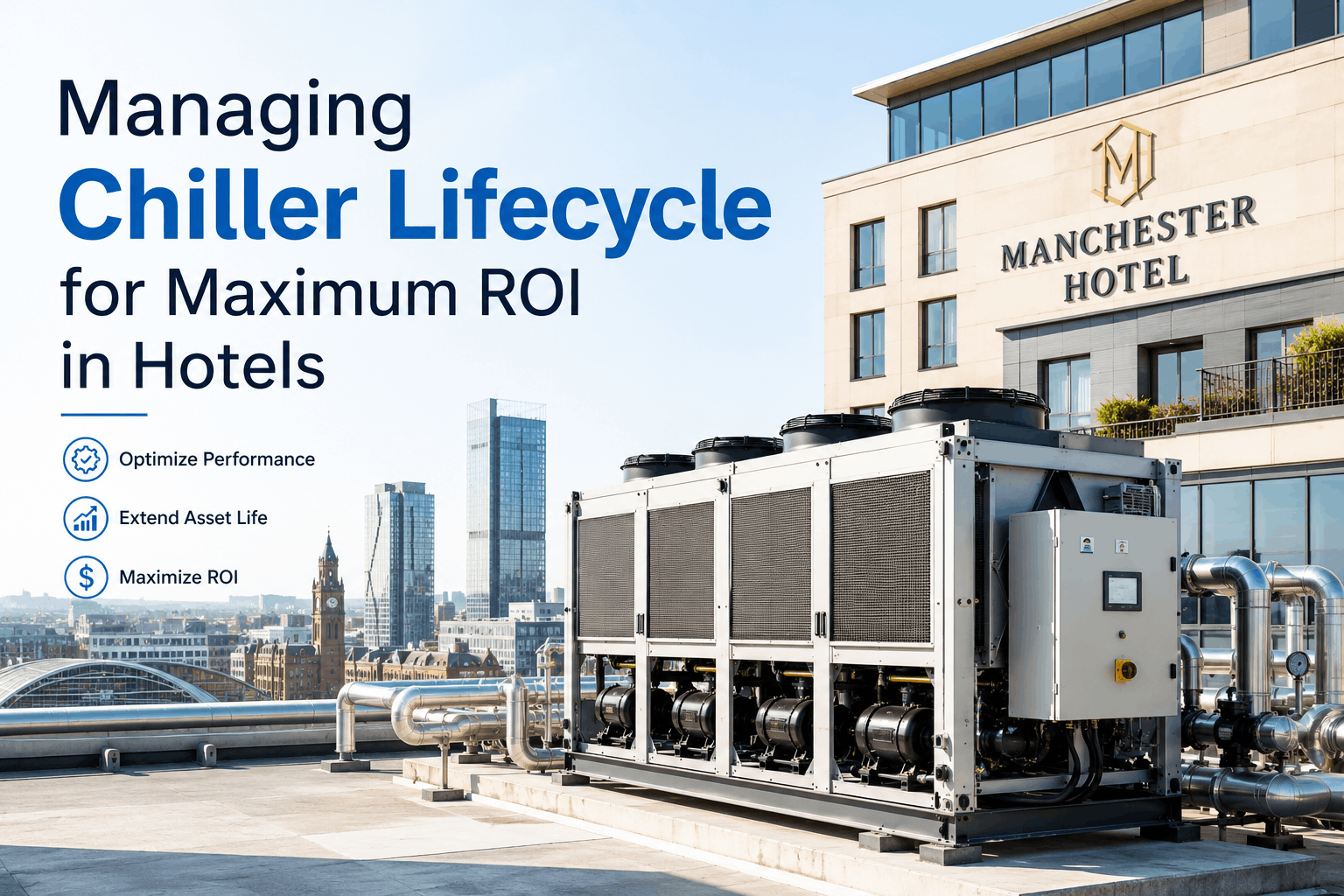
Managing Chiller Lifecycle for Maximum ROI in Hotels
Chillers are the most expensive HVAC asset in hotels. Strategies for oil analysis, tube cleaning, vibration monitoring, efficiency trending, and knowing when to retrofit vs replace — maximize ROI and prevent peak-season failures.
What Chiller Lifecycle Management Actually Delivers in 2026
The term "chiller maintenance" undersells what a structured lifecycle program actually provides. Vibration analysis detects bearing wear and impeller imbalance 30–90 days before failure — giving you time to schedule service in November rather than July. Oil sampling identifies refrigerant-in-oil contamination and particulate metals that reveal which components are generating wear debris before catastrophic failure occurs. Eddy current tube testing finds tube wall thinning before a rupture floods the refrigerant circuit with water. And efficiency trending quantifies kW/ton degradation from fouled tubes or low refrigerant charge — converting invisible efficiency loss into a financial justification for preventive action. Structured chiller lifecycle management converts the hotel's most expensive asset from a liability into a documented, predictable capital investment. OxMaint's chiller management platform automates every inspection, tracks every test result, and forecasts replacement timing — maximizing ROI across your chiller fleet.
The Five Chiller Subsystems: What Each Requires and Why
Chiller Plant Subsystems — Five Assets, Five Maintenance Disciplines
Compressor (CMP)Quarterly vibration analysis, oil sampling, and megohm testing. Bearing wear detection 30-90 days before failure.Action: Vibration increase >0.15 in/s above baseline requires service scheduling
Evaporator Bundle (EVP)Monthly approach temperature monitoring; annual eddy current tube testing. Approach >3°F above baseline indicates fouling.Action: Approach temperature increase >0.5°F per month = schedule tube cleaning
Condenser Bundle (CDN)Monthly approach monitoring; annual eddy current and physical cleaning. Approach >5°F above baseline requires cleaning.Action: Condensing pressure 15% above baseline = immediate tube inspection
Cooling Tower (CTW)Monthly basin inspection and Legionella prevention; quarterly fan bearing vibration; annual fill cleaning.Action: Legionella lab test positive = immediate tower shutdown and decontamination
Pumps & Controls (PWP)Quarterly VFD inspection; annual drive calibration; monthly flow and pressure verification.Action: Motor insulation resistance drop >50% = immediate motor evaluation
Predictive Disciplines: The Four Techniques That Catch Failures Before They Happen
Standard PM schedules prevent failures caused by deferred maintenance. Predictive techniques detect failures caused by material degradation and operating condition changes that no inspection schedule can anticipate. For a $350,000 chiller, these four disciplines pay for themselves in the first failure they prevent. Vibration analysis captures bearing wear 30-90 days before failure. Oil sampling identifies refrigerant-in-oil contamination above 2% — the threshold at which bearing film strength is destroyed. Eddy current testing finds tubes approaching failure wall thickness before they rupture. And efficiency trending detects the 10% kW/ton degradation that costs $18,000–$28,000 annually on a 500-ton chiller. OxMaint's predictive maintenance module logs every test result, trends values over time, and surfaces developing failures before they become emergencies.
Failure Modes, Warning Signs, and Prevention Costs
All failure modes below are detectable in advance with predictive disciplines — and all have a proven preventive intervention that costs a fraction of the repair. A $800 quarterly vibration and oil analysis program costs less than 1% of a $68,000 bearing failure. A $1,200 annual eddy current test costs 3% of a $40,000 tube rupture. The economic case for predictive maintenance is compelling: average avoided failure cost is $35,000–$75,000. Program cost is $4,000–$8,000 annually. The ROI is 4–9× annually.Book a demo to see how OxMaint schedules all predictive tasks and tracks results.
CMMS Integration: Chiller as a Digital Asset Tree
OxMaint Chiller Management — Digital Asset Tree & Predictive Workflows
Chiller Asset DataVibration readings (quarterly trends)Oil analysis results (lab reports)Approach temperature calculationsEddy current test findingskW/ton efficiency metrics
Sync after each test
OxMaint CMMS ActionsVibration trend alert at 0.15 in/sOil contamination >2% → service orderTube cleaning scheduled at thresholdEfficiency degradation → investigationCapital replacement recommendation
When cumulative repair spend approaches 40–50% of replacement cost, Oxmaint surfaces a capital replacement recommendation backed by actual repair history — ownership groups approve chiller replacement requests faster when supported by documented lifecycle cost data
30-90 daysEarly warning time from vibration analysis before bearing failureQuarterly vibration trending detects bearing wear before it becomes audible or affects performance.
$68KAverage bearing failure repair cost avoided by predictive maintenance$800 quarterly program vs. $68,000 emergency repair — 85× ROI per avoided failure.
10%Efficiency loss correction saves $18,000–$28,000 annually on 500-ton chillerkW/ton trending identifies fouling before utility bills show the increase.
4–9×Annual ROI from structured chiller predictive maintenance program$4,000–$8,000 program cost vs. $35,000–$75,000 single avoided failure.
Frequently Asked Questions — Chiller Lifecycle Management for Hotels
Maximize Chiller ROI — Predict Failures, Extend Life, Optimize Replacement Timing
Oxmaint's chiller lifecycle management module schedules quarterly vibration and oil analysis, tracks efficiency trends, logs eddy current test results, forecasts replacement timing, and generates capital planning reports — converting your most expensive HVAC asset from a liability into a documented, predictable investment. Free to start. Protect your peak-season cooling with structured predictive maintenance.