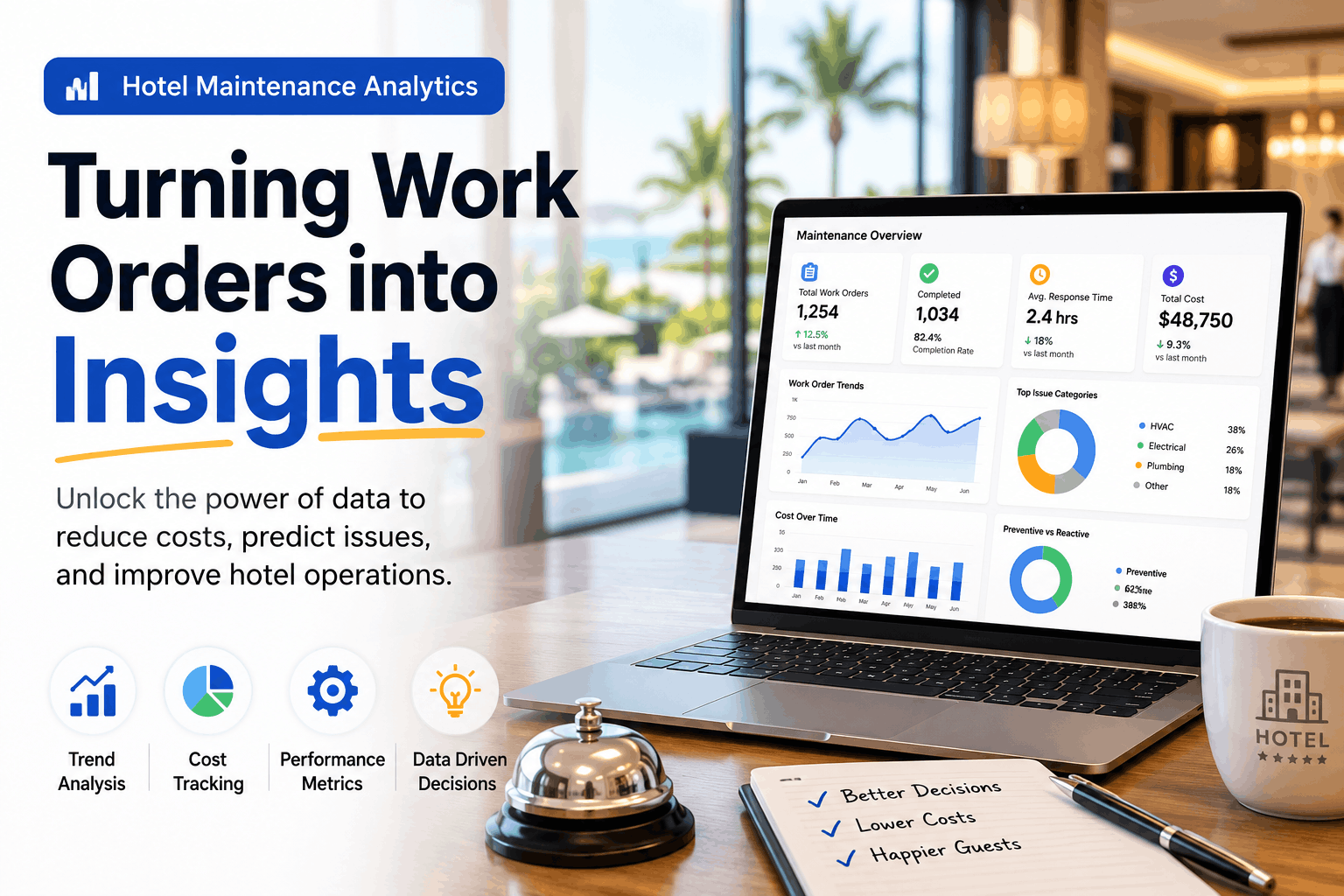
A 350-room full-service hotel in Orlando discovered its rooftop HVAC units were consuming 31% more energy than manufacturer baselines — not from a fault alarm, not from a guest complaint, but from an asset performance analytics report that flagged abnormal runtime-to-output ratios across 14 units simultaneously. The property had been paying that premium for an estimated 19 months before the analytics identified it. That single detection, acted on in one maintenance window, reduced the property's monthly utility bill by $6,400 and extended the projected service life of three units by an estimated four years. Sign up for OxMaint to connect your hotel's asset data to AI-driven performance analytics, or book a demo to see exactly what asset intelligence looks like for your property class and size.
Why Hotel Asset Management Cannot Stay Calendar-Driven
Hotel properties operate 24 hours a day, 365 days a year, across asset classes that include HVAC, elevators, pool and spa mechanical systems, commercial kitchen equipment, laundry infrastructure, backup generators, and building automation systems — each with different duty cycles, load profiles, and failure modes. A calendar-based PM schedule treats a guest room PTAC unit running at 18 hours per day the same as an identical unit running at 4 hours per day in a low-demand wing. It treats a rooftop chiller operating at peak summer load the same as one running in shoulder season. The result is a systematic mismatch between maintenance frequency and actual asset condition — some assets over-maintained at unnecessary cost, others under-maintained at unacceptable risk. Sign up for OxMaint to move your hotel's maintenance program from time-based to condition-based asset intelligence.
of hotel engineering teams operating without asset performance analytics report that their first indication of a major mechanical failure is a guest complaint or visible fault — meaning the performance degradation that preceded the failure went entirely undetected until the guest experience was already affected. OxMaint's asset analytics layer surfaces these degradation signals weeks before the threshold that produces visible failures.
5 Asset Analytics Capabilities OxMaint Delivers for Hotel Properties
Each of the five capability modules below addresses a specific hotel asset category where AI-driven performance analytics produces measurable improvements in cost, reliability, or guest experience outcomes — individually deployable, but compounding in value when operated as an integrated asset intelligence system. Book a demo to map these modules to your current property's asset register and maintenance maturity level.
HVAC represents the largest single energy cost category for most hotel properties — typically 38–42% of total utility spend — and the asset class with the widest gap between calendar-PM frequency and condition-based maintenance need. OxMaint's HVAC analytics module tracks runtime hours per unit against cooling or heating output delivered, compares actual energy consumption against manufacturer-rated efficiency baselines, and flags units where the runtime-to-output ratio has drifted beyond an acceptable variance threshold. This captures refrigerant charge loss, coil fouling, compressor degradation, and economiser faults at the performance data level — before any of these conditions produces a guest room temperature complaint. For properties with BMS or IoT sensor connections, OxMaint surfaces real-time efficiency curves per unit with trend lines that project when a unit will cross the maintenance threshold, allowing engineering to schedule corrective work during planned low-occupancy windows rather than emergency callouts during peak periods. Sign up for OxMaint to connect your HVAC asset data to AI performance benchmarking.
An elevator outage during peak check-in at a full hotel is one of the highest-visibility maintenance failures a property can experience — generating immediate guest complaints, social media documentation, and brand standard deviation reports. OxMaint's elevator analytics module tracks motor controller performance data, door cycle counts against door component rated service life, brake engagement response times, and load sensor calibration drift across all elevator units. Rather than waiting for the annual third-party inspection to surface degradation findings, OxMaint generates a continuous performance health score per elevator unit — updated with every operational cycle — that identifies units approaching maintenance thresholds in time for scheduled intervention. The analytics layer also detects usage pattern anomalies: an elevator logging twice its normal daily cycle count due to temporary service route changes will show an accelerated wear projection automatically, allowing the engineering team to adjust the PM interval before the original calendar-based schedule would have triggered an inspection. Book a demo to see elevator performance health scoring in OxMaint.
Energy cost is the second-largest operating expense for most hotels after labour — and it is the operating cost category where asset performance degradation has the most direct, measurable, and often invisible financial impact. OxMaint's energy asset benchmarking module compares each asset's current energy consumption profile against its own historical baseline, against the property's portfolio average for the same asset class, and against manufacturer-rated efficiency specifications. Assets that have drifted from all three benchmarks simultaneously are flagged as priority maintenance candidates — not because they have failed, but because the financial cost of their degraded performance has become quantifiable. The module also tracks energy consumption patterns by occupancy zone: a guest floor where energy consumption per occupied room has increased 15% over six months without a corresponding increase in occupancy or guest complaints is flagged for PTAC unit inspection across the entire floor, not just the units that have generated individual fault codes. This zone-level analytics approach identifies systemic degradation that unit-level monitoring misses. Sign up for OxMaint to activate energy asset benchmarking for your hotel property.
Hotel capital expenditure planning is routinely built on estimated asset age and manufacturer-rated service life — neither of which reflects actual asset condition. A commercial kitchen exhaust fan installed 8 years ago in a high-volume breakfast operation may have consumed its rated service life in 5 years. A backup generator that has never been called beyond monthly test cycles may still have 60% of its rated service life remaining at year 12. OxMaint's lifecycle forecasting module builds an actual-condition-based remaining useful life estimate for every major asset in the property's register — updating the estimate with every PM completion, every work order, every performance data point, and every usage log entry. The result is a capital expenditure forecast that reflects asset condition reality rather than installation date assumptions. For hotel asset managers presenting CapEx plans to ownership or brand management, OxMaint produces a rolling 5-year asset replacement and major maintenance schedule with confidence intervals derived from actual performance data — replacing the spreadsheet estimate with a data-driven projection that ownership can interrogate. Book a demo to see OxMaint's lifecycle forecasting module applied to a hotel asset register.
Hotel compliance obligations span fire suppression systems, emergency lighting, elevator certifications, pool and spa chemical systems, kitchen hood suppression, generator load testing, and backflow prevention — each governed by a different inspection authority, on a different cycle, with different documentation standards. OxMaint's compliance analytics module tracks the performance health of every compliance-critical asset, maps each asset to its governing inspection requirement and documentation standard, and generates a real-time compliance readiness score for the entire property. When a fire suppression system component shows a pressure variance outside its certified operating range, OxMaint generates both a maintenance alert and a compliance flag simultaneously — because the performance issue is also a compliance issue. For brand-flagged hotels undergoing Property Improvement Plan reviews or franchise brand standard audits, OxMaint produces a pre-audit compliance asset performance report that identifies any asset whose current condition would generate a deficiency finding before the auditor arrives. Sign up for OxMaint to build a real-time compliance asset performance dashboard for your property.
How OxMaint Asset Analytics Integrates with Your Hotel's Existing Systems
OxMaint's asset analytics layer is designed to deliver value at every stage of a hotel's technology maturity — from properties with no sensor infrastructure to those with a fully connected BMS and IoT network. The integration model is additive, not disruptive: OxMaint enriches the data your team already captures without requiring a technology overhaul as the prerequisite for analytics capability.
HVAC efficiency drift. Elevator cycle wear. Energy benchmark deviation. Compliance readiness gaps. OxMaint surfaces all of it — automatically, continuously, without additional data entry from your engineering team.
What Hotel Asset Analytics Changes for Engineering Teams
The operational change produced by asset performance analytics is not simply "more data." It is a fundamental shift in how the engineering team spends its time — from reactive triage and calendar-based task execution to condition-driven prioritisation and forward-looking capital planning. The table below maps the before-and-after operational reality across the five areas where asset analytics has the most direct impact on engineering team performance and guest experience outcomes.
| Engineering Activity | Without Asset Analytics | With OxMaint Analytics |
|---|---|---|
| HVAC PM scheduling | Fixed quarterly calendar regardless of unit runtime or condition | Condition-triggered based on runtime hours, efficiency drift, and seasonal load data |
| Failure detection | Guest complaint or visible fault — typically after 2–6 weeks of degraded performance | AI performance alert 14–42 days before guest-visible threshold is crossed |
| CapEx planning | Asset age estimate plus manufacturer rated life — often 30–40% inaccurate | Condition-adjusted RUL forecast with confidence intervals from actual work order and sensor data |
| Energy management | Monthly utility bill review — no asset-level attribution for consumption increases | Per-asset and per-zone energy benchmark tracking with automatic degradation flagging |
| Compliance preparation | Manual audit preparation 2–4 weeks before inspection — reactive documentation pull | Continuous compliance readiness score with pre-audit deficiency prediction report |
| Ownership reporting | Manually compiled maintenance summary — typically monthly or quarterly | Automated asset performance reports on scheduled delivery in ownership-ready format |
Swipe horizontally on mobile. Performance outcomes based on OxMaint hotel deployments 2023–2024.
The shift from calendar-based PM to OxMaint asset analytics changed how our entire engineering team operates. We went from reacting to failures to scheduling around condition forecasts. Our HVAC emergency call-out rate dropped 71% in the first year. More importantly, we submitted a CapEx forecast to ownership last quarter that was built entirely from OxMaint's lifecycle data — and it was the first CapEx presentation we've made where ownership didn't question the numbers.Director of Engineering · 480-room full-service hotel, Southeast US · OxMaint deployment, 2023
Frequently Asked Questions
Your Hotel's Assets Are Telling You What They Need. OxMaint Makes Sure You Hear It.
HVAC efficiency drift, elevator lifecycle risk, energy benchmark deviation, compliance readiness gaps, capital forecast accuracy — OxMaint's AI asset analytics surfaces all of it from the data your hotel already generates, without additional engineering overhead.