The general manager got the call at 2:18 AM during a summer thunderstorm. A lightning strike knocked out utility power to the 410-room convention hotel—and the backup generator didn't start. The automatic transfer switch engagedsent the start signal and nothing happened. The generator cranked for 12 seconds then locked out. The culprit: a dead starting battery that had been showing low voltage for four months. The block heater had also failed six weeks prior leaving the engine cold-soaked at ambient temperature. Total darkness: 47 minutes. Elevators trapped 11 guests. The fire alarm panel lost power and triggered a full evacuation in the rain. The kitchen walk-in cooler lost temperature—$14,000 in spoiled food. Emergency generator service call: $6,800. Starting battery replacement: $450. Block heater repair: $280. Guest compensation and refunds: $38,000. Insurance claim processing: 7 months. The total incident cost exceeded $72,000—all preventable with a $730 maintenance visit that should have happened 90 days earlier. The generator had run flawlessly during its last test—a no-load exercise that never would have revealed the battery weakness or heater failure that caused the catastrophic no-start when it actually mattered.
The Cost of Generator Maintenance Failures in Hotels
What hospitality properties risk when backup power systems aren't properly maintained and tested
75%
No-Start Failures
Caused by battery, fuel, or cooling issues detectable during proper PM
When generators fail to start—enough to trigger evacuations and liability
$730
PM Visit Cost
Quarterly maintenance that would have prevented the entire $72K incident
Understanding Generator Testing Protocols
Generator testing isn't one thing—it's a layered protocol where each test type reveals different failure modes. Hotels that only run no-load exercises are checking that the engine starts, but they're blind to the transfer failures, load-handling problems, and fuel system issues that cause real-world blackouts. When engineering teams implement structured generator maintenance tracking through a CMMS platform, every test type gets scheduled, documented, and analyzed—closing the gaps that manual tracking consistently misses.
Generator Testing & Maintenance Architecture
How layered testing protocols connect to comprehensive generator reliability
Testing Protocol Layer
Weekly No-Load Exercise
30-min run verifying start sequence, transfer switch, charging system, and alarm functions
Monthly Load Bank Test
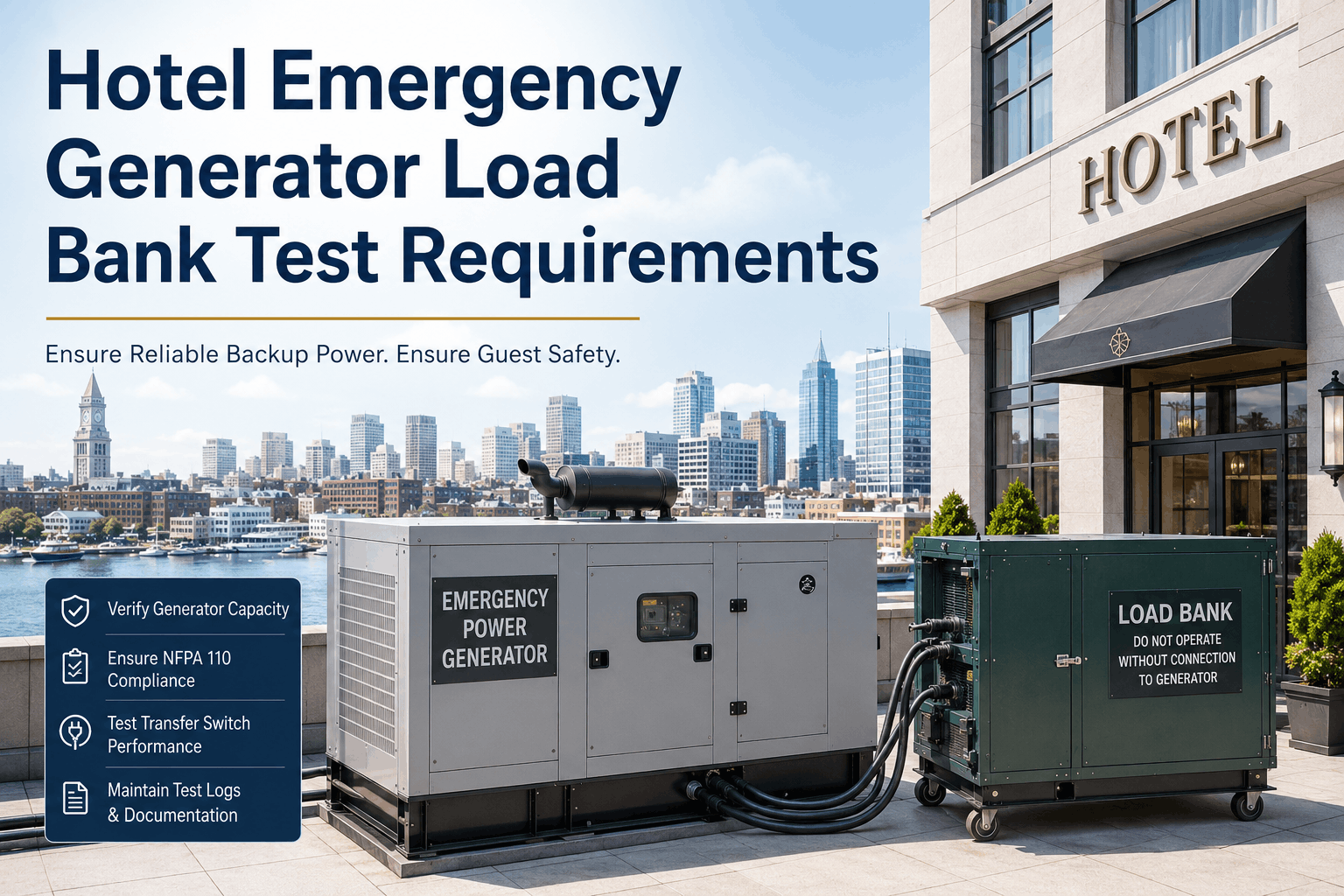
2-hr test at 30/50/75/100% rated load—reveals capacity issues invisible during no-load runs
Annual Full-Load Transfer
Complete building transfer simulating actual outage conditions with real connected loads
Recommended maintenance intervals matched to NFPA 110 and manufacturer requirements
Weekly
10
Check Points
Exercise, visual, fluids
Monthly
18
Check Points
Load test, battery, ATS
Quarterly
28
Check Points
Fluids, belts, full inspect
Annual
52
Check Points
Full-load, overhaul items
PM Workflow Automation Benefits
Never Miss a Test: Calendar-based triggers auto-generate weekly, monthly, and annual test work orders
Standardized Checklists: Pre-built test protocols ensure consistent execution regardless of technician
NFPA 110 Docs: Every test auto-updates compliance records for fire marshal and insurance audits
Critical Maintenance Tasks by System
Generator reliability depends on six interconnected systems—any one can cause a no-start or mid-run shutdown. The most dangerous failures come from systems that appear fine during casual inspection but degrade silently between tests. Hotels ready to close these gaps can schedule a walkthrough of CMMS-based generator PM tracking to see exactly how automated scheduling prevents the missed tasks that cause emergency failures.
Generator System Maintenance Requirements
Essential maintenance elements for hotel backup power reliability
Starting & Battery System
35-45% of no-start failures
Battery Load TestMonthly under cranking loadRequired
Charger Output VerificationFloat voltage & equalize cycleRequired
Terminal Cleaning & TorqueClean, coat, verify connectionsBest Practice
Contact InspectionPitting, arcing, resistanceBest Practice
Control Panel CalibrationVoltage/frequency setpointsRequired
Testing Types: What Each Test Actually Reveals
Generator Test Type Comparison
No-Load Exercise (Weekly)
Verifies engine starts, transfer switch activates, and basic systems function—but cannot detect load-handling issues
Start Sequence:✓ Verified
ATS Transfer:✓ Verified
Load Capacity:✗ Not Tested
Catches: 40% of potential failures
Load Bank Test (Monthly)
Applies controlled electrical load at 30-100% capacity—reveals cooling, fuel delivery, and voltage regulation problems
Full Capacity:✓ Verified
Wet Stacking:✓ Cleared
Cooling System:✓ Stress Tested
Catches: 75% of potential failures
Full Transfer Test (Annual)
Simulates actual power outage with building loads—the only test that validates complete emergency power performance
Real-World Load:✓ Verified
All Systems:✓ End-to-End
Life Safety:✓ Confirmed
Catches: 95%+ of potential failures
Compliance & Inspection Framework
Regulatory Requirements for Hotel Generators
What fire marshals and insurance auditors verify during inspections
Compliance Documentation Hub
NFPA 110 Test Logs • AHJ Inspection Records • Fuel Storage Permits • Emission Certifications • Insurance Audit Files • Load Test Certificates
NFPA 110
Emergency power systems
Mandatory
NFPA 70 (NEC)
Electrical installation
Mandatory
Local Fire Code
AHJ-specific requirements
Varies by Jurisdiction
EPA / Air Quality
Emission limits & testing
Required
Industry Insight
"I've investigated over 300 hotel generator failures in my career, and the pattern is painfully consistent: the generator ran fine during the last weekly exercise, so everyone assumed it was reliable. But a no-load exercise is like testing a fire truck by starting the engine in the parking lot—it tells you the engine runs, but nothing about whether it can pump water at a fire. Load bank testing is non-negotiable. Battery load testing is non-negotiable. Fuel quality testing is non-negotiable. The hotels that never lose power aren't lucky—they test comprehensively and maintain religiously."
— Chief Engineer, Luxury Resort Collection, 28 Years Emergency Power Experience
Battery Is #1 Killer
35-45% of no-start failures trace to battery issues. Monthly load testing under actual cranking conditions is the single most impactful PM task.
Fuel Degrades Silently
Diesel fuel begins degrading within 6 months. Water accumulation and microbial growth clog filters and injectors—causing mid-run shutdowns during actual emergencies.
ATS Is Overlooked
Transfer switches need their own PM program—contact pitting, timing drift, and control board failures account for 10-15% of emergency power failures.
Implementation Roadmap
Generator PM Program Implementation
01
Inventory & Baseline
Week 1
Generator inventory with nameplate data, ATS documentation, fuel tank capacity, current condition assessment
02
Schedule & Configure
Week 2
CMMS setup with weekly/monthly/quarterly/annual PM tasks, checklists, alert thresholds, parts inventory
03
Train & Launch
Week 3
Staff training on test protocols, mobile work order completion, documentation requirements, escalation procedures
04
Optimize & Sustain
Week 4+
First load bank test, compliance documentation review, trend analysis activation, continuous improvement
Key Performance Indicators
Metrics That Drive Generator Reliability
Reliability Metrics
Start Success:Target 99%+
Transfer Time:<10 seconds
Run Stability:Voltage ±2%
Critical
Maintenance Metrics
PM Completion:Target 100%
Test Compliance:All tests on time
Battery Health:Monthly verified
Operational
Cost Metrics
PM vs Emergency:Target 90/10
Cost/kW:Annual tracking
Fuel Efficiency:gal/hr at load
Financial
Compliance Metrics
NFPA 110:100% compliant
AHJ Ready:Docs current
Insurance:Audit-ready
Regulatory
Never Let a $730 Missed PM Become a $72,000 Blackout
OXmaint automates generator testing schedules, PM work orders, compliance documentation, battery tracking, fuel management alerts, and load test scheduling—creating the maintenance backbone that ensures your backup power starts every single time.
How often should hotel backup generators be tested?
NFPA 110 requires weekly no-load exercises (30 minutes minimum) and monthly load tests. Best practice for hotels adds quarterly comprehensive PM inspections and annual full-load transfer tests that simulate actual power outage conditions with real building loads. Weekly exercises verify start capability, monthly load tests confirm capacity, and annual tests validate complete emergency power performance. A CMMS platform like OXmaint automates all test scheduling and ensures no interval is missed—the single most common compliance failure during fire marshal inspections.
What is the most common cause of hotel generator failure?
Battery failure accounts for 35-45% of generator no-start events—making it the single largest cause. Batteries degrade gradually, showing reduced voltage under cranking load weeks before complete failure. Monthly battery load testing (not just voltage checks) catches this degradation early. The second most common cause is fuel system contamination (20-30%), where water accumulation and microbial growth in stored diesel clog filters and injectors. Semi-annual fuel quality testing and annual tank cleaning prevent these failures entirely.
What does a hotel generator PM program cost?
A comprehensive quarterly PM program for a typical hotel generator (200-500 kW) costs $2,500-$4,000 annually, including oil changes, filter replacements, coolant service, battery testing, and professional inspection. Monthly load bank testing adds $1,200-$2,400 annually. Total: $3,700-$6,400/year. Compare this to a single generator failure event averaging $40,000-$75,000+ in emergency repairs, guest compensation, spoiled inventory, and insurance impacts. CMMS software adds minimal cost while ensuring every task gets completed on schedule.
Why isn't a weekly no-load exercise sufficient for generator testing?
No-load exercises only verify the engine starts and the transfer switch activates—they cannot reveal fuel delivery problems under load, cooling system weaknesses, voltage regulation issues, or capacity limitations. Worse, extended no-load running causes "wet stacking"—unburned fuel accumulation in the exhaust system that degrades performance and can damage the engine over time. Monthly load bank testing at 75-100% rated capacity is essential to verify the generator can actually power your building during an outage, clear wet stacking, and stress-test cooling and fuel systems under real operating conditions.



.png)
