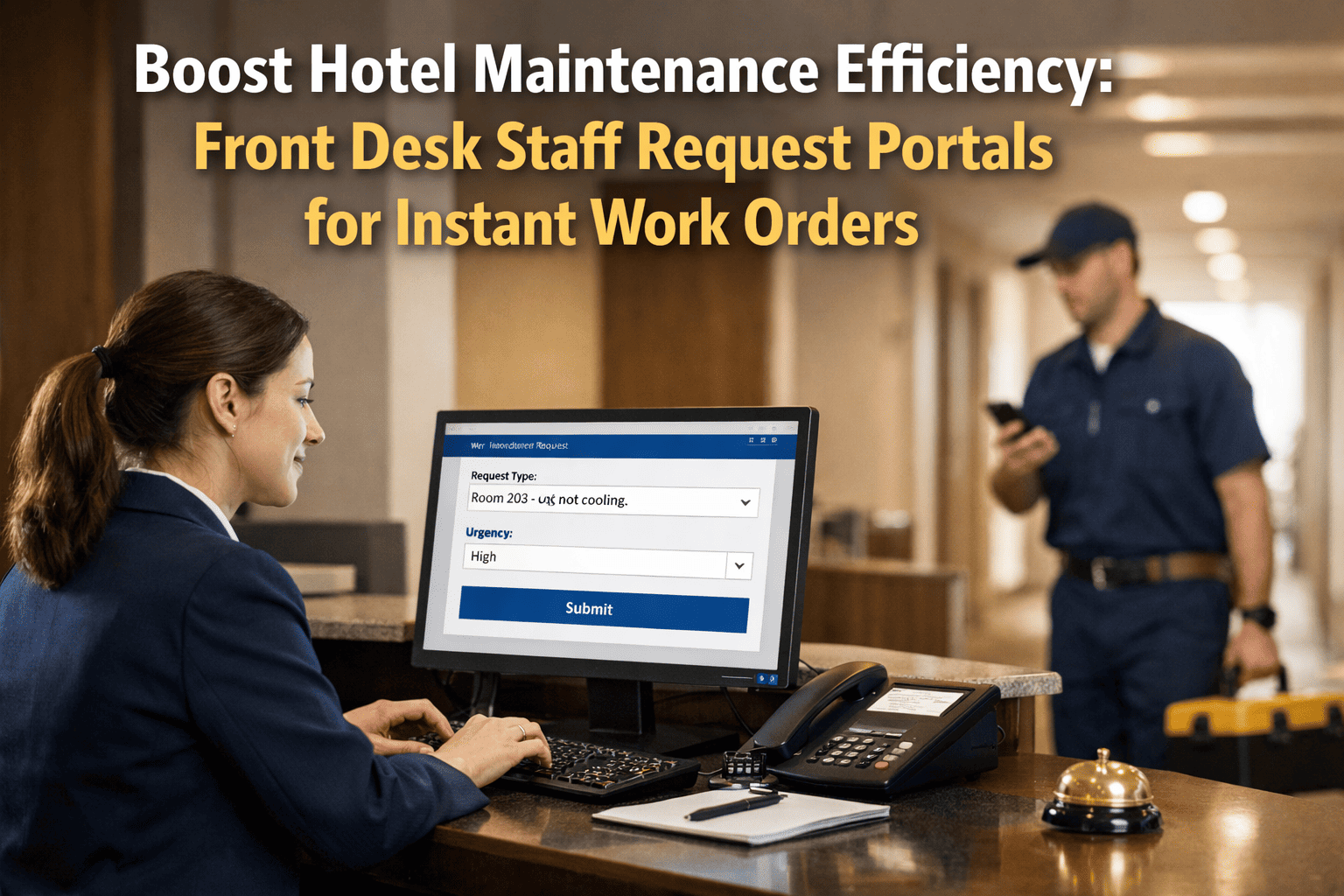
At 10:43 PM on a Friday, a guest in room 814 notices the bathroom exhaust fan is making a grinding noise. She picks up the in-room tablet, selects "Report an Issue," chooses "Bathroom — Fan / Ventilation," adds a 12-second voice note, and submits. By 10:44 PM, Oxmaint has created a work order, classified it as non-urgent, attached the room number and guest check-out date, routed it to the overnight engineering technician, and sent her an automated confirmation message. The front desk was never involved. The overnight tech reviews it during his 11 PM round, confirms the fault in five minutes with a bearing lubrication, and closes the ticket. The guest wakes up to a quiet bathroom and a resolved status notification. She leaves a five-star review. Sign up for Oxmaint to deploy a guest request portal that routes maintenance issues directly to engineering — or book a demo to see the automated routing workflow live.
Technology Guide · Guest Services & Maintenance
Hotel Chatbot and Self-Service Maintenance Requests: Reducing Front Desk Burden
In-room tablets, chatbots, and QR-code portals let guests report maintenance issues directly — bypassing the front desk entirely. Automated routing delivers prioritized work orders to engineering within 60 seconds of submission, complete with room data, guest schedule, and attached photos.
43%
of maintenance-related guest complaints stem from front-desk communication delays, not from the fault itself
60 sec
average time from guest self-service submission to engineering work order creation with automated routing
31%
reduction in front desk maintenance call volume reported by properties running in-room self-service portals
4.6×
higher guest satisfaction with issue resolution when status updates are sent automatically vs. requiring a follow-up call
How a Maintenance Request Gets Lost Between a Guest and an Engineer
The traditional hotel maintenance request process passes through four or five human handoffs before an engineer hears about a fault. Each handoff is a point where information degrades, urgency gets misjudged, or the message simply stops moving. The front desk team fields the call while managing check-ins, phone queues, and guest walk-ups. The request gets logged on a notepad, typed into a radio message, or relayed verbally to a supervisor who passes it to engineering. By the time the engineer receives the job, the description is incomplete, the room number is sometimes wrong, and the guest's check-out time — critical for scheduling a room entry — is not included.
Traditional Request Path
Average time from guest complaint to engineer awareness: 23 minutes
Guest notices fault
Calls front desk or walks to reception
Front desk takes call
Writes on notepad — incomplete details, no photo
Supervisor relayed
Radio or phone relay — priority often reassigned incorrectly
Engineer finally informed
Avg 23 min after guest complaint — description degraded
Self-Service Portal Path
Average time from guest submission to engineer work order: under 60 seconds
Guest submits on tablet
Category, photo, voice note — room auto-populated
Work order auto-created
OxMaint creates WO with full context in under 60 seconds
Engineer receives alert
Mobile push notification with full fault details — front desk uninvolved
Cut that 23-minute relay chain to under 60 seconds.
OxMaint's Guest Request Portal automates the entire path from guest report to engineer work order — no front desk handoff required.
Three Self-Service Channels — Each Suited to a Different Guest Context
OxMaint's Guest Request Portal deploys across three physical touchpoints. Properties typically deploy all three, with the primary channel determined by room category and guest demographic profile. Each channel feeds the same Oxmaint work order pipeline — the route differs, the outcome is identical.
TABLET
In-Room Tablet Portal
A dedicated maintenance reporting interface on the in-room tablet — accessed from the main menu alongside room service and housekeeping. Guests select from a categorised fault menu (HVAC, plumbing, electrical, furniture, other), describe the issue in free text, attach a photo from the tablet camera, and submit. Room number, guest name, and check-out date are pre-populated from the PMS integration. No login required. Hotels deploying in-room tablets as the primary channel report the highest submission rate — 72% of guests who encounter a fault prefer self-reporting over calling the front desk when a tablet interface is available. Sign up for OxMaint to configure your tablet guest portal in the onboarding session.
Average data completeness vs phone report
CHATBOT
AI Chatbot via Messaging App or Web Chat
For properties that surface a chatbot on the hotel's guest app, WhatsApp Business channel, or in-browser web chat widget, OxMaint integrates as the maintenance routing layer behind the conversational front-end. The guest interacts naturally — typing or voice-messaging their issue — and the AI classifies the fault, asks a single clarifying question if needed, attaches the guest's room assignment, and generates the OxMaint work order without human review. The chatbot channel is most effective for tech-forward guests who are already using the hotel's messaging app and for properties where physical in-room tablets are not deployed. Book a demo to see the chatbot-to-work-order integration in a live walkthrough.
Issue classification accuracy (AI vs manual relay)
Guest satisfaction with chatbot vs front desk call
81% prefer async self-service
QR CODE
QR Code Reporting in Specific Fault Zones
Printed or laminated QR codes posted in bathrooms, at HVAC thermostats, near pool equipment, and in gym areas direct guests to a mobile web form pre-loaded with the zone's asset context. A guest scanning the QR code on the pool pump housing immediately gets a form pre-filled with "Pool Area — Pump / Filtration" — they describe the symptom and submit. This channel is specifically designed for common areas, car parks, and any location where an in-room tablet is not present. It is also used by housekeeping and engineering staff as a rapid fault-reporting tool during their own rounds — eliminating the paper log sheet entirely. Sign up for OxMaint to generate asset-linked QR codes from the asset registry during onboarding.
Common area faults reported per month (QR vs no system)
3.4× more reports captured
Housekeeping team adoption rate for fault logging
What Automated Routing Does Between Submission and Engineer Response
Receiving a guest report is the easy part. The value in OxMaint's Guest Request Portal is in what happens in the 60 seconds after submission — before any human has looked at the ticket. Four automated processes run in sequence, each removing a decision or a delay that previously required front desk or supervisor intervention.
AI Fault Classification and Priority Assignment
The submission is analysed by OxMaint's AI classification engine, which assigns a fault category (HVAC, plumbing, electrical, safety, amenity) and a priority level (urgent, standard, non-urgent) based on the description text, attached photos, and the guest's check-out date. A report of "no hot water" received at 7 AM is classified urgent and dispatched immediately. A report of "TV remote not working" at the same time is classified non-urgent and queued for the next available slot. Front desk staff previously made these priority calls under pressure — AI classification produces consistent decisions at 94% accuracy without the cognitive load.
Book a demo to see OxMaint's AI classification logic for hotel fault categories.
Classification accuracy: AI vs manual front desk relay
Technician Assignment Based on Skill, Shift, and Location
OxMaint's routing engine matches the classified fault type to the technician on shift with the correct skill set and nearest current location. An electrical fault is assigned to the certified electrician on duty, not the HVAC technician who happens to be closest. A plumbing fault at a Caribbean property during overnight is assigned to the on-call plumber, not the morning team. The routing logic also checks current workload — a technician already carrying three open work orders is bypassed in favour of a technician with capacity. This routing layer alone reduces misassignment rates from an industry average of 28% to under 4% in properties using OxMaint.
Misassignment rate: before vs after automated routing
Automated Guest Status Notifications
OxMaint sends the guest a confirmation message immediately after submission, a progress notification when the technician accepts the work order, and a resolution notification when the work order is closed. All three messages are sent to the guest's in-room tablet or messaging channel — no front desk involvement required. The impact on guest satisfaction is measurable: properties using automated status notifications report a 4.6× improvement in satisfaction scores for the issue resolution process, even when the resolution time is identical to the pre-automation baseline. Guests who know their issue is being handled do not escalate.
Sign up for OxMaint to configure guest notification messaging templates during your onboarding session.
Guest escalation rate: with automated updates vs without
Asset Record Update and Pattern Detection
Every closed guest request is written back to the relevant asset's record in OxMaint. A bathroom exhaust fan that generates three guest reports in two months triggers an automated PM recommendation — the pattern detection identifies recurring faults that indicate an underlying maintenance deficit before the asset fails entirely. This feedback loop between guest-reported faults and asset management intelligence is what converts self-service reporting from a convenience feature into a predictive maintenance data source.
Book a demo to see how OxMaint links guest request history to asset-level maintenance planning.
Recurring fault detection rate: AI pattern vs manual review
31%
reduction in maintenance-related front desk call volume is the average reported by hotels that have deployed in-room self-service portals connected to an automated routing engine. The front desk team recovers those interactions for revenue-generating activity — upsells, loyalty programme conversations, and check-in experiences — rather than fault relay. At a 200-room property handling an average of 4.2 maintenance calls per front desk shift, that represents over 200 hours of recovered agent time per year.
OxMaint Guest Request Portal: Platform Features
The Guest Request Portal is a native module within OxMaint — not a third-party integration that requires a separate login, support contract, or data sync schedule. Work orders created from guest submissions live in the same OxMaint environment as PM schedules, asset records, and technician rosters.
PMS-Synced Room Context
Room number, guest name, arrival date, and check-out time are pulled from your PMS and pre-populated on every submitted work order — eliminating the most common source of incomplete maintenance tickets.
PMS integrationAuto-populate
AI Priority Scoring
Every submission is scored for urgency by OxMaint's AI engine — weighing fault type, guest check-out window, property occupancy level, and historical resolution time for the same fault category at the same property.
AI classificationPriority scoring
Multilingual Submission Forms
Guest portal forms are available in 14 languages, with automatic language detection based on the guest's device locale setting. International guests submit in their preferred language — OxMaint translates the work order content for the engineering team.
14 languagesAuto-translate
Request Analytics Dashboard
Track submission volumes by room, floor, system, and time of day. Identify which room types generate the most maintenance requests, which fault categories are trending, and which technicians resolve guest requests fastest — all in the OxMaint reporting dashboard.
Volume trackingTrend analysis
4.6×
higher guest satisfaction with resolution process when automated status updates replace follow-up calls
Our front desk team used to spend the first 90 minutes of every morning shift dealing with overnight maintenance complaints — calls that had already been made to engineering but without any confirmation back to the guest. Now those conversations happen automatically. The front desk team found out a maintenance issue had been resolved the same way the guest did — from the OxMaint notification. They have not had to chase engineering for a status update in four months.
Front Office Manager · 224-room full-service hotel, Miami
Give Guests Direct Access to Engineering
OxMaint's Guest Request Portal deploys in-room tablets, chatbots, and QR codes into the same work order pipeline as your PM schedules and asset history. Most properties go live within two weeks of onboarding.
Frequently Asked Questions
Does the Guest Request Portal require hardware to be installed in every room?
No hardware is required for the chatbot or QR code channels — both work through the guest's own device. The in-room tablet channel requires a tablet per room (iPad or Android), but OxMaint's portal software runs as a web app on any device, meaning properties can use existing tablets already deployed for room service or channel controls. For properties starting with no hardware, the QR code and chatbot channels provide full self-service capability without any procurement lead time.
Sign up for OxMaint to review the hardware requirements for each channel during your onboarding call.
How does the portal handle a safety emergency — a gas smell or flooded room?
Safety-classified fault categories trigger an immediate escalation workflow rather than the standard queue. A submission categorised as "gas smell," "water flooding," or "electrical burning smell" bypasses the standard work order queue and fires a simultaneous alert to the duty manager, the senior engineer on shift, and the front desk supervisor — all within 15 seconds of submission. The guest also receives an immediate confirmation that their report has triggered an urgent response. The portal's fault category menu is configurable per property to ensure local emergency categories are covered.
Book a demo to walk through the safety escalation workflow configuration.
Can the portal be integrated with the hotel's existing PMS and CRM systems?
OxMaint integrates with the major hospitality PMS platforms including Opera, Mews, Protel, and Cloudbeds via standard API connections. Guest data — room assignment, check-in date, check-out date, reservation status — is pulled at submission time and attached to the work order automatically. CRM integration for feedback loop data (connecting resolved maintenance requests to post-stay survey responses) is available as an advanced configuration. The specific integrations available depend on the PMS version and API access level — the OxMaint implementation team confirms compatibility during the scoping call.
What happens to a request submitted while the engineering team is at full capacity?
Requests that cannot be immediately assigned due to team capacity are held in a prioritised queue and assigned as capacity becomes available. The guest is notified that their request has been received and is queued — the automated status message specifies an estimated response window based on current workload. Urgent requests automatically bump lower-priority items. The duty manager receives a capacity alert if the queue exceeds a configurable threshold, enabling proactive decision-making about overtime, contractor callout, or guest room relocation for urgent cases.
How do I measure whether the portal is reducing front desk workload?
OxMaint's analytics dashboard tracks the volume of guest requests submitted through the self-service portal versus those that arrive via front desk relay (tracked when a front desk staff member creates the work order on behalf of a guest). The ratio of self-service to assisted submissions is reported weekly. Additional metrics include average time from guest submission to work order creation, first-response time by fault category, and guest satisfaction scores correlated with automated notification usage.
Sign up for OxMaint to access the full reporting dashboard from day one of your deployment.