Hotel comp night prevention starts with linking every complimentary room to the SLA failure that caused it — yet most hotels bury that linkage in spreadsheets and never close the loop. This CMMS hotel comp night guide shows how a modern, AI-powered maintenance platform turns reactive comp-night costs into a documented engineering improvement story. Properties that connect SLA failure tracking to work-order analytics typically cut comp-night volume 30–50% within the first year. You can explore the full workflow yourself when you Start Free Trial, or read on for the step-by-step prevention program.
CMMS Hotel Comp Night Guide 2026
Every comp night is an SLA failure you already paid for — but never tracked.
A single failed AC unit at 11 PM can cost a 250-room property $1,200+ in comped rooms, meals, and goodwill credits in one night. OxMaint links each comp night back to the SLA breach that caused it — then prevents the next one with predictive maintenance analytics.
The Hidden P&L Leak
Why hotel comp night prevention belongs in engineering — not guest services
Comp nights are typically written off as a front-desk cost of doing business. But when a guest is moved because a room hit 78°F at midnight, or a toilet won't stop running, or the elevator is down again — that's an engineering SLA failure dressed up as a hospitality credit. The average 250-room hotel issues 150–300 comp nights per year, and at an ADR of $180 that's $27K–$54K in quietly erased revenue. Comp night prevention via SLA failure CMMS workflows re-categorizes each credit as a maintenance event with a root cause, an owner, and a corrective action.
Hotels that implement a CMMS with SLA-failure linkage typically identify that 35–45% of all comp nights stem from just five recurring asset categories: HVAC, plumbing, electrical, elevators, and in-room technology. Once those categories are instrumented with preventive and predictive triggers, the comp-night count drops sharply — often within the first 90 days of deployment.
Root-Cause Analysis
SLA failure categories that drive the most comp nights
Not all SLA failures are equal. The table below shows the five categories responsible for the majority of hotel comp nights, their typical response-time SLA, and the comp-night risk each one carries when the SLA is breached.
| SLA Failure Category | Typical Response SLA | % of Comp Nights | Avg. Comp Cost / Event | Preventable via CMMS |
|---|---|---|---|---|
| HVAC / Climate Control | 30 min (in-room) | 34% | $240 | Yes — predictive sensors |
| Plumbing / Water Events | 45 min | 22% | $310 | Yes — PM checklists |
| Elevator / Vertical Transport | 60 min | 14% | $420 | Yes — vendor SLA tracking |
| Electrical / Power | 30 min | 12% | $285 | Yes — thermal inspection |
| In-Room Technology (TV, Wi-Fi, smart locks) | 20 min | 9% | $175 | Yes — asset lifecycle alerts |
When these five categories are monitored through OxMaint's asset-tracking and work-order modules, each failure is automatically tagged with an SLA timer, a severity level, and a comp-night risk score. Engineers see the highest-risk assets first — before a guest ever picks up the phone.
Prevention Workflow
A 4-step CMMS workflow to prevent comp nights before they happen
Comp night prevention isn't a single feature — it's a closed-loop workflow that connects guest complaints to engineering action. The timeline below maps the four phases a hotel engineering team follows using OxMaint to go from reactive firefighting to documented SLA compliance.
Detect & Tag the SLA Failure
When a guest complaint or IoT sensor triggers a work order, OxMaint auto-assigns an SLA clock based on asset type and priority. The front desk can flag a "comp risk" in real time, linking the complaint to the specific room and asset — no more lost paper tickets.
Root-Cause the Comp Event
Every comp night is logged with a failure code, root-cause category, and corrective action. OxMaint's analytics engine aggregates these across properties so the Director of Engineering can see that, for example, 60% of HVAC comp nights trace to dirty coils on floors 4–6.
Adjust the Preventive Maintenance Plan
The root-cause data feeds directly into OxMaint's PM scheduler. If coil cleaning was quarterly, it moves to monthly for the problem zone. PM tasks are auto-generated, assigned, and verified — closing the loop between comp-night cost and engineering action.
Track Comp-Night Reduction as a KPI
OxMaint dashboards display comp-night count, comp-night cost, and SLA compliance rate side by side. Month-over-month trends give the GM and Director of Engineering a defensible, auditable story for ownership reviews and brand audits.
Worked Example
A 250-room hotel recovering $38K in comp-night revenue — month by month
Consider a 250-room full-service property spending an estimated $46,000 annually on comp nights, the majority traced to HVAC and plumbing SLA breaches. After deploying OxMaint's CMMS with SLA-failure linkage and predictive maintenance triggers, the property tracked its recovery across six months. The timeline below shows the documented reduction.
By Month 6, the property had cut comp nights from 22 to 6 per month — a 73% reduction. Annualized, that's $33,600 in recovered room revenue plus an estimated $8,400 in ancillary credits avoided. Total first-year recovery: roughly $42,000, against a CMMS investment of under $12,000. Payback: under four months.
How OxMaint Helps
How OxMaint's CMMS prevents hotel comp nights and SLA failures
OxMaint is built for maintenance and reliability teams who need to move from reactive firefighting to documented, data-driven engineering. Four core capabilities map directly to comp-night prevention and SLA-failure reduction in hotel environments.
SLA-Linked Work Orders
Every work order carries an SLA timer, severity level, and comp-risk flag. Engineers see countdowns in real time and auto-escalation rules push at-risk tickets before a guest is ever affected. Hotels using OxMaint cut SLA breach rates by 30–50%.
Predictive Maintenance Analytics
OxMaint's AI engine analyzes asset history, sensor data, and failure patterns to predict the next breakdown — then auto-generates a work order before it happens. Predictive deployments typically eliminate 40% of unplanned HVAC and plumbing failures.
Asset & Equipment Tracking
Every room asset — from PTAC units to smart locks — has a lifecycle record, warranty status, and maintenance history. Engineers know which assets are failing most often and which ones are nearing end-of-life, so replacements happen before the comp night.
Comp-Night & SLA Dashboards
OxMaint's analytics dashboards display comp-night count, comp cost, SLA compliance rate, and top failing assets — all in one view. The GM, Director of Engineering, and ownership all see the same auditable numbers, updated in real time.
After six months on OxMaint, our comp nights dropped from 22 a month to six. For the first time, every comp night had a root cause, an owner, and a fix — not just a credit on the folio.
See how OxMaint links every comp night to the SLA failure that caused it.
Book a 30-minute demo and we'll show you the exact workflow — SLA-tagged work orders, predictive triggers, and comp-night dashboards — on assets like yours.
FAQ
Hotel comp night prevention & SLA failure CMMS — frequently asked questions
What is a hotel comp night and how does it relate to SLA failures?
A comp night is a complimentary room night issued to compensate a guest for a service failure — most commonly a maintenance issue like a broken AC, plumbing leak, or elevator outage. When the root cause is a maintenance event that breached a response-time SLA, the comp night is a direct, measurable cost of that SLA failure. Linking the two in a CMMS turns a vague P&L leak into a trackable engineering metric.
How does a CMMS prevent comp nights in hotels?
A CMMS like OxMaint prevents comp nights by catching asset failures before they affect a guest. It does this through SLA-timed work orders, preventive maintenance scheduling, predictive analytics on critical assets, and real-time dashboards that surface at-risk equipment. Properties typically reduce comp nights 30–50% in the first year of deployment. You can see it on your own assets when you Book a Demo.
How much does a hotel lose to comp nights each year?
A typical 250-room hotel issues 150–300 comp nights per year. At an average daily rate of $180–$200, plus ancillary credits for meals and incidentals (multiplier of roughly 1.3), the annual revenue at risk ranges from $35,000 to $78,000. Roughly 35–45% of these are preventable maintenance-related SLA failures.
What SLA response times should hotel engineering teams target?
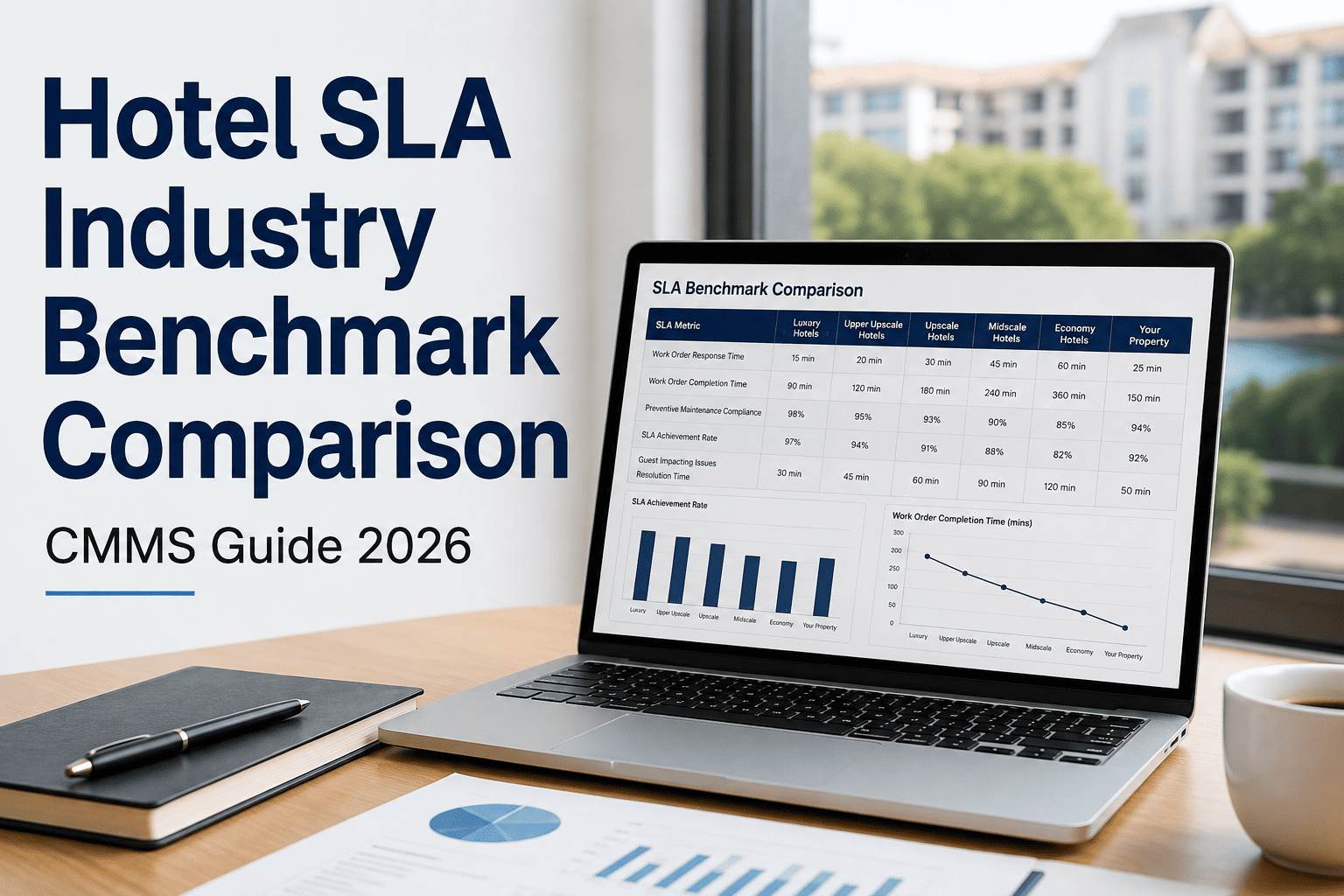
Industry benchmarks suggest 30 minutes for in-room HVAC and electrical issues, 20 minutes for in-room technology (Wi-Fi, TV, smart locks), 45 minutes for plumbing, and 60 minutes for elevator and vertical-transport failures. OxMaint lets you configure custom SLA timers per asset category and auto-escalate when a threshold is breached.
Can OxMaint track comp-night cost as a maintenance KPI?
Yes. OxMaint's analytics dashboards display comp-night count, comp-night cost, SLA compliance rate, and top failing assets side by side. Each comp night can be tagged with a failure code, root cause, and corrective action — giving the engineering team a documented improvement story for ownership and brand audits. Start tracking yours with a Start Free Trial.
Stop paying for SLA failures you can prevent.
Join the hotels using OxMaint to cut comp nights 30–50%, enforce engineering SLAs, and turn maintenance into a documented revenue-protection program.
Free 14-day trial · No credit card