Hotel Electrical System Inspection And Maintenance
By Martín Paredes on February 6, 2026
At 6:47 AM during peak checkoutthe main electrical panel serving floors 8-12 of a 340-room convention hotel trips without warning—killing power to 68 occupied rooms simultaneously. Guests trapped in dark bathrooms call the front desk in panic. Elevators stop between floors. The emergency generator covers life safety systems but not guest room circuits. The root cause: a loose bus bar connection that had been generating heat for months, visible only through infrared thermography that was never scheduled. The repair takes 4 hours. The reputation damage lasts years. Electrical failures represent the single highest-consequence maintenance failure category in hotels—responsible for 23% of all hotel fires, $127,000 in average property damage per incident, and immediate guest evacuation scenarios that generate devastating online reviews. Properties using systematic electrical inspection programs reduce unplanned outages by 68% and electrical-origin fire risk by 74%, transforming electrical maintenance from invisible background risk into documented operational confidence.
Electrical Maintenance Performance Data
Hotels using automated electrical inspection management systems
Full-Service Hotel Chain (22 properties)
74%Fewer Electrical Failures
ZeroElectrical Fires (3 Years)
Unplanned Outage Reduction: 68%
Convention Hotel (420 rooms)
$83KAnnual Cost Savings
100%Code Compliance
Insurance Premium Reduction: 16%
Boutique Resort Group (8 locations)
58%Time Savings
2.4xEquipment Life Extension
Guest Power Complaints: -81%
Critical Electrical Systems Requiring Regular Inspection
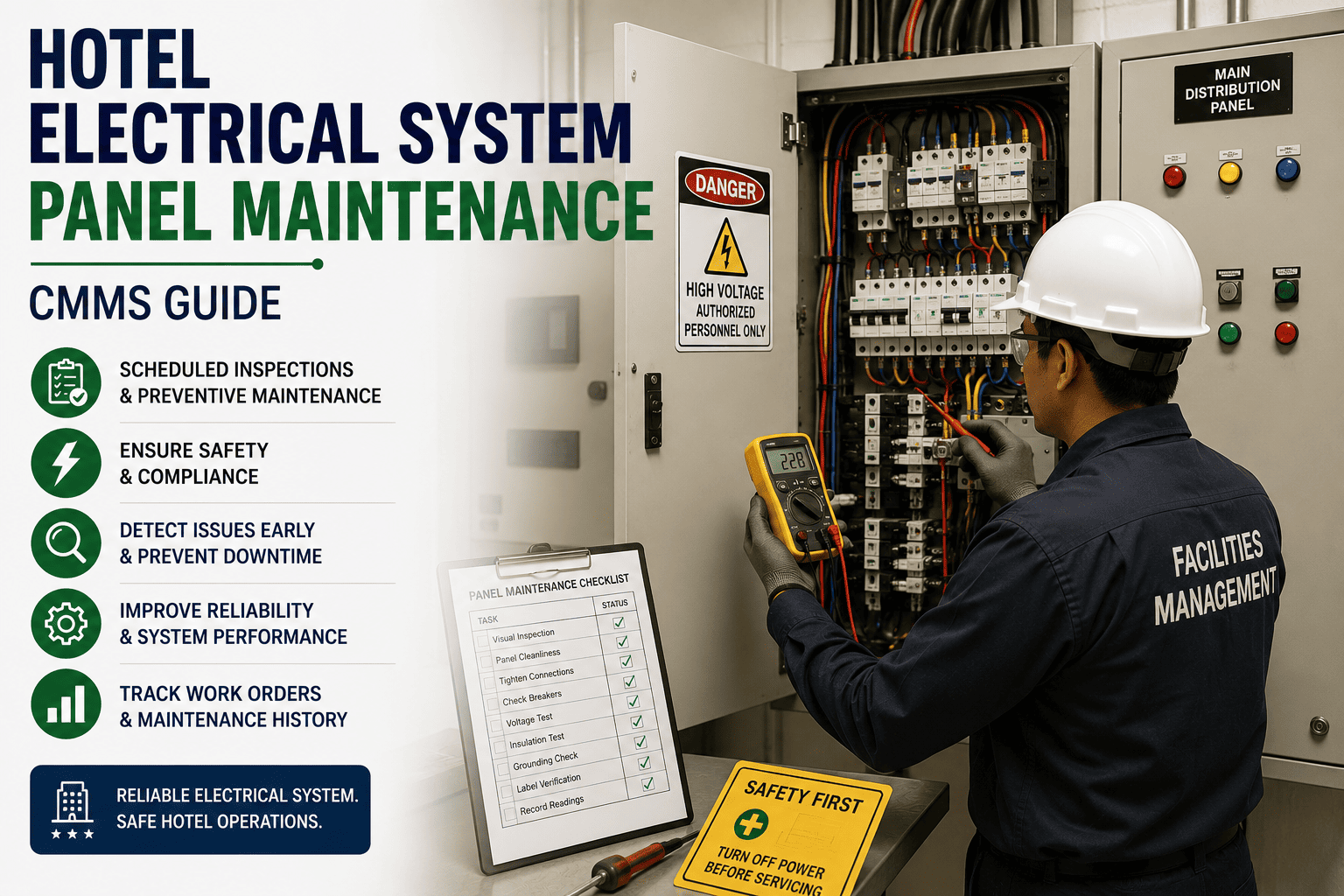
Hotel electrical infrastructure spans eight critical system categories, each with distinct inspection protocols and failure consequences. Main switchgear requires annual infrared thermography, torque verification on bus bar connections, and breaker exercise testing to prevent catastrophic panel failures. Distribution panels need quarterly thermal scans and annual load balancing analysis to detect overloaded circuits before tripping occurs. Emergency generators demand monthly load bank testing, weekly no-load runs, and annual fuel system inspections per NFPA 110 standards. Guest room circuits require biannual GFCI/AFCI testing in bathrooms and kitchenettes. Transformer systems need annual oil analysis and insulation resistance testing. UPS battery systems require quarterly capacity tests and annual full-discharge evaluations. Lighting systems need monthly emergency lighting tests and annual 90-minute battery discharge tests. Grounding and bonding systems require annual continuity verification to maintain shock protection and equipment safety.
Electrical Inspection Requirements by System
Switchgear & Panels (NFPA 70B)
Annual infrared thermography scan
Quarterly thermal imaging checks
Annual breaker exercise & torque
3-year arc flash study update
Generators (NFPA 110)
Weekly no-load test runs
Monthly load bank testing
Annual fuel system inspection
Transfer switch testing quarterly
Guest Room & Safety Circuits
Biannual GFCI/AFCI testing
Monthly emergency lighting test
Annual 90-min battery discharge
Annual grounding continuity check
Struggling to track electrical inspection deadlines across your property?
Effective electrical maintenance requires a systematic workflow that schedules tests based on code requirements, captures detailed inspection results, generates corrective work orders, and maintains audit-ready compliance records. Digital electrical inspection platforms replace fragmented spreadsheet tracking with automated workflows that ensure every breaker gets exercised, every panel gets scanned, and every deficiency gets corrected on schedule.
IR thermography scansTorque verificationLoad measurementsPhoto documentation
3
Remediate
Priority work ordersContractor dispatchParts procurementRe-test verification
4
Document
IR scan reportsTest result archivesCompliance certificatesComplete audit trail
74% Fewer Electrical FailuresComplete inspection history ready for insurance audits and code inspections
The Business Impact of Electrical Maintenance Excellence
Electrical failures carry consequences that cascade across every hotel department simultaneously—guest displacement, revenue loss, emergency contractor premiums, insurance claims, and regulatory scrutiny. Properties with documented electrical maintenance programs operate from a position of strength: lower insurance premiums, fewer emergency callouts, extended equipment life, and the confidence that comes from knowing critical systems are verified and documented. Digital electrical maintenance management transforms compliance from reactive scrambling into automated operational excellence.
Carriers reward documented electrical inspection programs with lower rates
2.4xEquipment life extension
Preventive maintenance extends switchgear and panel life from 15 to 35+ years
Operational & Safety Benefits
68% fewer unplanned power outages affecting guest rooms
74% reduction in electrical-origin fire risk through early detection
Complete audit trail for NEC, NFPA 70E, and OSHA compliance
81% fewer guest complaints related to power issues and outages
Automate Your Electrical Inspection Program
Stop managing electrical maintenance with spreadsheets and calendar reminders. See how hotels achieve 74% fewer electrical failures while cutting inspection coordination time by 58%.
Expert Perspective: Building Electrical Safety Excellence
Hotel Electrical Safety Professional
"The most dangerous electrical failures in hotels aren't the dramatic ones—they're the slow, invisible degradation happening inside panels and behind walls right now. A loose connection generating 180°F heat inside a panel looks perfectly normal from the outside until it causes an arc flash or fire. Infrared thermography catches these problems every time, but only if it's scheduled consistently. The properties with zero electrical incidents aren't lucky—they're systematic. They scan every panel quarterly, exercise every breaker annually, and document everything digitally so nothing falls through the cracks."
— Chief Engineer, International Convention Hotel Group
Infrared thermography is non-negotiable. Annual IR scans detect 89% of impending electrical failures—loose connections, overloaded circuits, and deteriorating components—before they cause outages or fires. The $2,000-$5,000 annual cost prevents $50,000+ single-incident losses.
Generator testing saves lives. Emergency generators fail 15-30% of the time during actual power outages when not regularly load-tested. Monthly load bank testing under NFPA 110 verifies generators actually deliver rated power when guests, elevators, and life safety systems depend on them.
Arc flash compliance protects workers and liability. NFPA 70E requires arc flash hazard analysis every 3-5 years and whenever electrical system modifications occur. Properties without current arc flash labels face OSHA citations averaging $15,000 per violation and catastrophic liability if worker injuries occur.
Your Path to Electrical Maintenance Excellence
Electrical system reliability doesn't require hiring additional engineers or investing in expensive monitoring hardware—it requires systematic inspection protocols that schedule thermographic scans, exercise breakers, test generators, and document results automatically. Properties achieving zero unplanned outages implement digital platforms that replace the spreadsheet chaos causing missed deadlines and incomplete records. The question isn't whether your hotel's electrical systems need maintenance—it's whether you'll detect the next failure before it blacks out 68 guest rooms at 6:47 AM or after.
Transform Electrical Maintenance from Risk to Confidence
Join hotels achieving 74% fewer electrical failures and 68% fewer unplanned outages through systematic inspection management. Automated scheduling, mobile inspections, IR scan tracking, and complete compliance documentation—all in one platform.
How often should hotel electrical panels be inspected with infrared thermography?
NFPA 70B recommends annual comprehensive infrared thermography scans for all main switchgear, distribution panels, and motor control centers, with quarterly visual thermal checks for critical systems serving guest areas. During IR scans, technicians capture thermal images of every bus bar connection, breaker terminal, and wire termination—identifying hot spots that indicate loose connections, overloaded circuits, or deteriorating components. A connection running 40°F above ambient temperature signals imminent failure requiring immediate corrective action. Properties should schedule IR scans during peak electrical loading (typically afternoon hours during high-occupancy periods) to capture worst-case conditions. The investment of $2,000-$5,000 annually for professional IR surveys prevents single-incident losses averaging $50,000+ in equipment damage, guest disruption, and emergency repair premiums.
What are the emergency generator testing requirements for hotels?
NFPA 110 requires weekly no-load test runs of at least 30 minutes to verify starting reliability, monthly load testing at minimum 30% of rated capacity for at least 30 minutes to prevent wet-stacking and carbon buildup, and annual comprehensive inspections covering fuel systems, cooling systems, exhaust, transfer switches, and control panels. Hotels must also perform transfer switch exercising quarterly to verify automatic switchover between utility and generator power. Load bank testing—connecting the generator to an artificial load to verify full rated output—should occur annually or whenever monthly testing consistently runs below 30% capacity. All test results must be documented with date, duration, load level, fuel consumption, and any deficiencies noted. Properties without documented generator testing face code violations and, critically, discover their generators can't deliver rated power during actual emergencies when guest safety depends on it.
What electrical safety codes apply specifically to hotel properties?
Hotels must comply with three primary electrical codes: the National Electrical Code (NEC/NFPA 70) governing installation and equipment standards, NFPA 70E covering electrical safety in the workplace including arc flash protection and safe work practices, and NFPA 110 addressing emergency and standby power systems. Additionally, NFPA 70B provides recommended practice for electrical equipment maintenance—while not legally mandated in all jurisdictions, insurance carriers increasingly require compliance for favorable premium rates. Guest room-specific requirements include GFCI protection within 6 feet of water sources (bathrooms, kitchenettes, wet bars), AFCI protection on bedroom circuits per current NEC editions, and tamper-resistant receptacles in all accessible locations. Hotels must also comply with local electrical codes, which may exceed national standards. Maintaining compliance across all applicable codes requires systematic inspection tracking—digital CMMS platforms automate this by scheduling code-specific inspections and maintaining the documentation trail required during inspections.
What does a hotel electrical maintenance program cost and what's the ROI?
A comprehensive electrical preventive maintenance program for a 300-room hotel typically costs $35,000-$55,000 annually including: annual IR thermography ($2,000-$5,000), quarterly thermal checks ($1,500-$3,000), annual breaker exercise and torque verification ($4,000-$8,000), monthly generator testing ($6,000-$12,000), GFCI/AFCI testing ($2,000-$4,000), and emergency lighting testing ($3,000-$6,000). Digital CMMS platforms add $200-$500/month for automated scheduling, mobile inspections, and compliance documentation. Against this investment, properties consistently report: $83,000+ in annual cost avoidance through eliminated emergency callouts, reduced equipment replacement, and avoided guest compensation; 16% insurance premium reductions representing $8,000-$15,000 annually; 2.4x equipment life extension deferring $200,000+ in capital replacement costs; and immeasurable protection against the $127,000 average electrical fire damage cost. Typical ROI reaches positive within 5-8 months with compounding benefits as equipment reliability improves year over year.
Can hotels manage electrical inspections without dedicated electrical staff?
Yes—most hotel electrical maintenance programs combine in-house general maintenance capability with specialized contractor services, coordinated through digital CMMS platforms. In-house staff handle routine tasks: monthly generator runs, monthly emergency lighting tests, quarterly visual thermal checks with handheld IR cameras ($300-$500 devices), and GFCI testing during room preventive maintenance cycles. Specialized contractors perform annual IR thermography surveys, breaker exercise and torque verification, arc flash studies, generator load bank testing, and transformer oil analysis. The CMMS platform schedules both internal and external tasks automatically, dispatches reminders to appropriate personnel, and captures all documentation in one compliance-ready system. This hybrid approach delivers comprehensive electrical maintenance at 40-60% lower cost than employing dedicated electricians, while ensuring licensed professionals perform work requiring specialized qualifications. Properties with as few as 2-3 general maintenance staff successfully manage complete electrical compliance programs using this model.




.png)

