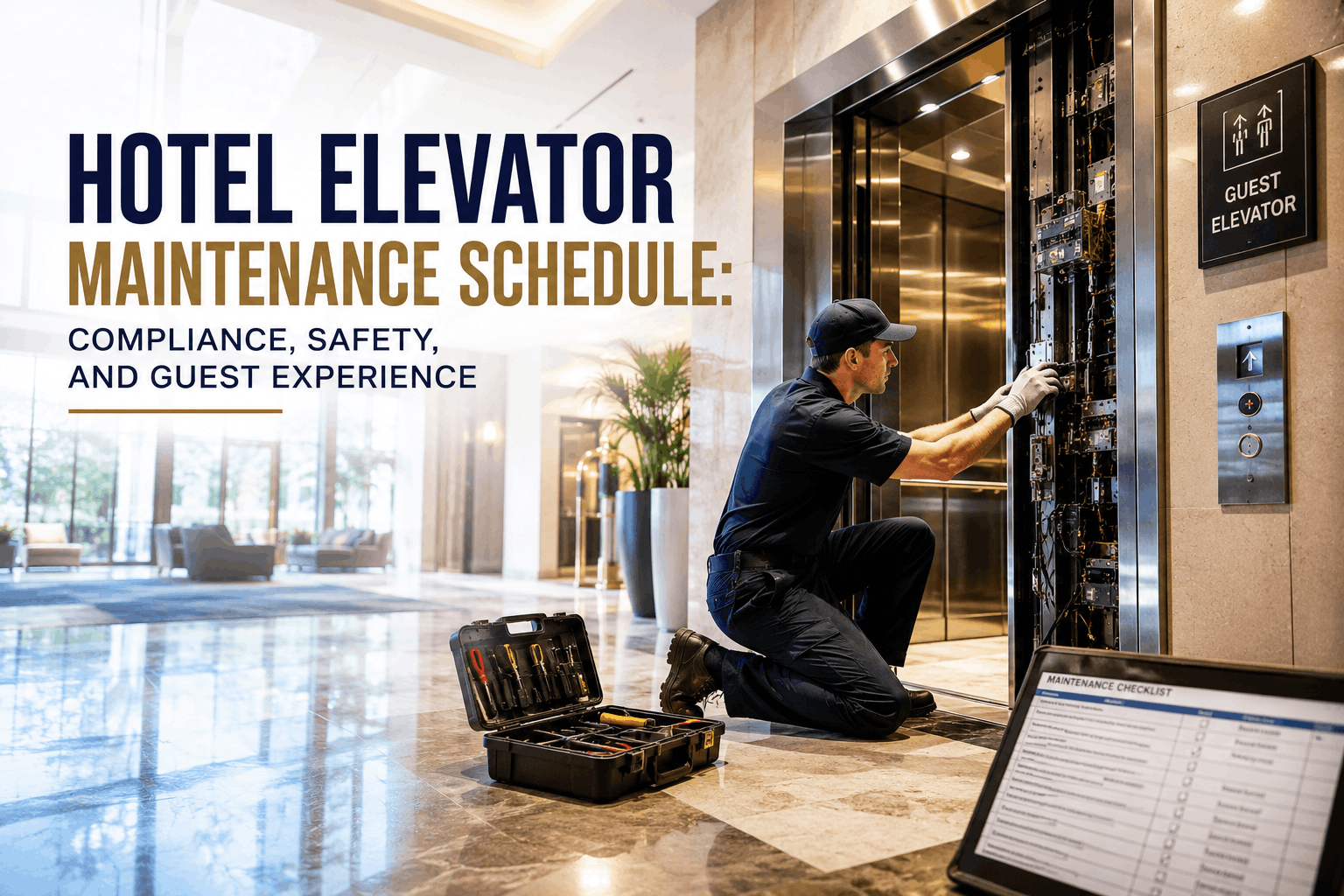
Vertical transportation systems — elevators, escalators, and moving walks — are among the highest-liability assets in any hotel. A single elevator entrapment generates guest experience damage, potential insurance claims, and regulatory exposure that far exceeds the cost of a full-service maintenance contract. Yet most hotel engineering teams manage elevator and escalator compliance through a combination of vendor-supplied service reports, paper inspection logs, and calendar reminders — a model that works until it doesn't, and fails at exactly the moment it matters most. Directors of Engineering overseeing properties with four or more vertical transportation units who want to bring compliance visibility in-house can sign up for Oxmaint's Elevator Asset Tracking module or book a demo to see the Compliance Calendar configured for their property's specific elevator count and jurisdiction.
Building Systems
Hotel Elevator & Escalator Maintenance: Safety Compliance, Inspection Checklist & Preventive Maintenance Program
10–12 min read
73%
of hotel elevator failures are attributable to missed or deferred preventive maintenance tasks
$18K–$45K
average cost of an elevator entrapment incident including guest compensation, downtime, and emergency repair
$2K–$25K
regulatory fine range per violation for non-compliant elevator operations in major jurisdictions
68%
reduction in unplanned elevator downtime within 12 months of structured PM programme deployment
Why Elevator & Escalator Maintenance Demands Structured Management
No piece of hotel equipment carries the simultaneous weight of life safety compliance, guest experience impact, and legal liability that elevators do. In most jurisdictions, hotel operators are the responsible party for compliance — not the maintenance contractor. A vendor performing a service visit does not relieve the property of its obligation to maintain inspection records, ensure mandatory testing is completed on schedule, or verify that the contractor's work meets the applicable code standard. Engineering teams that want to see how centralised asset tracking closes this accountability gap can book a demo to walk through Oxmaint's vendor management and compliance calendar, or sign up to begin building the elevator asset register for their property.
RISK INFOGRAPHIC
Guest Entrapment
$18K–$45K per incident
Emergency rescue, guest compensation, brand reputation damage, insurance claim processing
Compliance Violation
$2K–$25K per violation
Missed inspection deadlines, expired certificates, documentation gaps during regulatory audit
Emergency Repair Premium
3.2x planned cost
After-hours callout, expedited parts procurement, overtime technician rates on unplanned breakdowns
Revenue Displacement
$800–$4K per day
Operational disruption, staff deployment overhead, guest satisfaction score decline affecting future bookings
Regulatory Compliance Framework: What Hotels Must Maintain
Elevator and escalator compliance obligations vary by jurisdiction, but the structural requirement is consistent: hotels must maintain documented evidence that mandatory inspections occurred, findings were remediated, and the responsible party certified the equipment as safe for continued operation. In most US states, annual third-party inspections are mandatory and the certificate must be posted in the elevator cab. Failure during an unannounced inspection — or inability to produce records — triggers shutdown orders that cannot be reversed quickly. Engineering directors managing multi-property portfolios can sign up to centralise all compliance certificates and inspection records across every property, or book a demo to see how the Compliance Calendar generates advance alerts before deadline exposure occurs.
Annual Elevator Compliance Cycle
Q1
Annual Safety Inspection
Third-party inspector certification
Certificate of inspection renewal
Safety device full load test
Q2
5-Year Load Test
Full load hydraulic pressure test
Governor and safety gear test
Brake test under rated load
Q3
Mid-Year PM Inspection
Drive machine and sheave inspection
Door operator adjustment
Control wiring inspection
Q4
Year-End Compliance Review
Document archive and audit prep
Budget submission for next year CapEx
Vendor contract renewal review
CTA MID 1
Never Miss an Elevator Compliance Deadline Again
Oxmaint's Compliance Calendar tracks every inspection due date, certificate expiry, and regulatory milestone across all your vertical transportation assets — with automated alerts 30, 14, and 7 days before each deadline.
Hotel Elevator Preventive Maintenance Inspection Checklist
A structured PM inspection programme converts the unpredictable cost of reactive elevator maintenance into a predictable operational expense. The checklist below covers the four inspection tiers — daily, monthly, quarterly, and annual — that a comprehensive hotel elevator PM programme requires. Properties deploying this framework for the first time typically see unplanned downtime reduce by 60–70% within the first 12 months. Teams ready to digitise these checklists can sign up for Oxmaint to deploy all four tiers as mobile work order templates, or book a demo to see how the checklist library is pre-loaded for hotel vertical transportation assets.
Daily
Operator & Engineering Team
✓Door operation — open/close timing and obstruction detection
✓Levelling accuracy at each floor stop
✓Emergency communication system test
✓Interior cab condition — lighting, buttons, panels
✓Escalator handrail speed and step condition
✓Emergency stop button and safety edge function
10–15 min per unit
Monthly
Engineering Team / Contract Technician
✓Machine room temperature and ventilation
✓Lubrication of guide rails, sheaves, and rollers
✓Brake adjustment and response time test
✓Door clutch, cam, and gibs condition
✓Buffer oil level and condition check
✓Pit sump pump and water ingress inspection
45–60 min per unit
Quarterly
Specialist Contractor
✓Governor and safety gear function test
✓Drive machine bearing condition and vibration check
✓Control system diagnostics and fault log review
✓Landing door interlock testing — all floors
✓Escalator step-gap and comb plate inspection
✓Traction sheave groove depth measurement
2–3 hrs per unit
Annual
Certified Third-Party Inspector
✓Full safety device test under rated load
✓Overspeed governor test and sealing
✓Emergency lighting and battery backup test
✓Code compliance review — ASME A17.1 or local equivalent
✓Certificate of inspection renewal and cab posting
✓AHJ report submission and deficiency clearance
4–6 hrs per unit
Critical Component Failure Modes & Replacement Lifecycle
Understanding the failure mode and expected service life of critical elevator components is essential for capital planning, vendor contract scope negotiation, and maintenance investment prioritisation. The table below identifies the components responsible for the majority of hotel elevator failures, their typical service life under standard hotel operating conditions, and the cost consequence of reactive versus planned replacement. Engineering directors building or reviewing capital reserve plans can book a demo to see how Oxmaint's asset tracking logs component age against replacement schedule, or sign up to begin recording component installation dates and service life data against their elevator asset register today.
| Component |
Service Life |
Planned Replacement Cost |
Reactive Failure Cost |
| Hoist rope / cables |
5–8 years |
$3,500–$8,000 per unit. Scheduled during low-occupancy window with 2–4 hour outage. |
$12K–$28K including emergency inspection, AHJ shutdown order, and expedited replacement. |
| Door operator system |
8–12 years |
$4,000–$9,000. #1 cause of nuisance callbacks when maintained on schedule. |
$8K–$18K including entrapment response, parts premium, guest incident management. |
| Drive machine / motor |
15–25 years |
$18,000–$45,000. Planned within modernisation cycle; spread across FF&E reserve. |
$35K–$90K including motor rewind, emergency crane hire, extended outage premium. |
| Control system / MRL |
20–30 years |
$22,000–$55,000. Modernisation-cycle replacement, often triggered by obsolete parts availability. |
$40K–$120K including obsolete parts sourcing, extended lead times, temporary outage revenue loss. |
| Buffer springs / oil buffers |
10–15 years |
$1,200–$3,500. Replaced during scheduled pit inspection; minimal downtime. |
$6K–$14K — compliance shutdown mandatory if buffer fails annual test. |
| Escalator step chains |
8–14 years |
$6,000–$15,000. Planned during low-traffic period; 12–24 hour replacement window. |
$18K–$38K including emergency shutdown, injury liability assessment, expedited parts. |
CTA MID 2
Track Component Age & Automate Replacement Planning
Oxmaint's Elevator Asset Tracking links every component to its installation date, service life benchmark, and replacement cost — generating CapEx alerts before failure forces an emergency procurement decision.
Elevator Vendor Management: Contract Types, SLAs & Performance Tracking
The elevator maintenance contract is one of the most consequential vendor agreements in hotel operations — yet most hotels renew on auto-pilot without benchmarking coverage scope, response time commitments, or parts exclusions against market alternatives. The three contract structures below represent the principal options available to hotel operators, with material differences in cost, coverage, and risk transfer that engineering directors and asset managers must evaluate against their property's asset age profile and capital reserve position. Teams managing contracts across multiple properties can sign up to track all vendor SLAs and response times centrally within Oxmaint, or book a demo to see how the Vendor Management module flags SLA breaches automatically and links contractor performance to work order closure data.
Lubrication & Examination
$80–$180 / unit / month
Covers routine lubrication, adjustment, and examination only. All parts and labour for repairs are additional. Lowest upfront cost — highest total cost exposure on ageing equipment. Appropriate only for assets under 5 years with OEM warranty remaining.
✓ Routine lubrication
✓ Basic adjustment
✗ Parts included
✗ Major repair coverage
✗ Callback response SLA
Risk: HIGH on assets 5+ years
Comprehensive (Recommended)
$350–$700 / unit / month
Covers all labour, parts, and repairs excluding major modernisation components. Includes defined response time SLAs and callback coverage. Standard choice for full-service hotels with assets 5–20 years. Negotiate callback response within 2 hours and parts exclusion list explicitly in contract.
✓ All labour included
✓ Most parts included
✓ Callback SLA defined
✗ Major modernisation
✓ Annual inspection support
Risk: LOW — recommended standard
Full Maintenance
$700–$1,400 / unit / month
Covers all components including major drive machine, controller, and structural components short of full modernisation. Maximum cost predictability — appropriate for luxury properties, assets over 20 years, or portfolios where engineering teams lack specialist elevator expertise. Modernisation not covered.
✓ All labour and parts
✓ Drive machine included
✓ Controller included
✓ Priority response SLA
✗ Full modernisation
Risk: LOWEST — highest cost certainty
12-Month Outcomes: Structured vs Unmanaged Elevator Maintenance
Reduction in unplanned elevator outages within 12 months of PM programme deployment
Reduction in compliance-related shutdown orders at properties with digital inspection records
Cost reduction per elevator repair event — planned PM intervention vs reactive emergency callout
Of annual inspection certificates renewed on time with automated compliance calendar alerts
Reduction in vendor invoice disputes with work order–linked service verification records
Escalator-Specific Maintenance Considerations for Hotels
Escalators in hotel lobbies, convention centres, and multi-level retail environments carry a different risk profile from elevators: the failure modes are more visible, the injury consequence of a step or handrail fault is immediate, and the maintenance intervals are determined by passenger throughput as much as elapsed time. A lobby escalator in a 600-key convention hotel may require monthly step-chain tension checks that a comparable unit in a 150-key select service property would address quarterly. Engineering teams managing high-throughput escalator assets can sign up to configure throughput-adjusted PM intervals within Oxmaint's asset tracking module, or book a demo to see how Safety Alerts are configured to trigger work orders when step-gap or handrail speed deviations are logged by technicians in the field.
Key inspection points
Step-gap clearance ≤6mm
Comb plate tooth integrity
Step riser condition
Demarcation line visibility
Failure consequence
Foot/shoe entrapment — primary cause of escalator injury claims. ADA and EN115 compliance exposure. Mandatory shutdown on gap violation.
Monthly
inspection frequency for high-throughput hotel lobby escalators
Key inspection points
Handrail speed sync ±2%
Handrail inlet guards
Tension and tracking
Surface condition
Failure consequence
Speed mismatch causes passenger imbalance and fall risk. Handrail inlet entrapment is a reportable safety incident in most jurisdictions. Immediate shutdown required.
Weekly
handrail speed synchronisation check in high-use lobby environments
Key inspection points
Chain tension and elongation
Sprocket tooth wear
Lubrication adequacy
Drive chain alignment
Failure consequence
Chain elongation beyond tolerance causes step vibration, misalignment, and comb plate impact. Chain break results in emergency stop and full shutdown requiring specialist recovery.
Quarterly
full step-chain tension measurement and elongation check
Frequently Asked Questions: Hotel Elevator & Escalator Maintenance
QHow often must hotel elevators be inspected by a certified third party?
In most US jurisdictions, hotel elevators require annual inspection by an Authorities Having Jurisdiction (AHJ) certified inspector, with the certificate posted inside the cab. Many states also require a 5-year full load safety test in addition to annual examinations. Requirements vary significantly by state — New York, California, Florida, and Texas each have distinct inspection cycles, certificate formats, and fee structures. Hotels operating in multiple states need jurisdiction-specific compliance tracking, which Oxmaint's Compliance Calendar manages automatically by property location and asset type.
QWhat is the industry benchmark for elevator downtime in a full-service hotel?
Well-managed full-service hotel elevator assets target availability above 99% — equating to fewer than 88 hours of unplanned downtime per unit per year. Properties on reactive maintenance models typically run 300–600 hours of unplanned downtime per unit annually. The gap is almost entirely attributable to door operator failures, which account for over 60% of elevator callbacks and are highly preventable through monthly PM. Planned maintenance during low-occupancy windows (typically 1–5 AM) preserves guest-facing availability while allowing full inspection access.
QWhat should a hotel elevator maintenance contract SLA require as minimum performance standards?
A defensible hotel elevator maintenance contract SLA should specify: callback response within 2 hours for entrapment and 4 hours for non-safety outages; parts availability commitment (typically 24-hour turnaround on standard components); minimum monthly PM visit frequency; defined exclusions list for parts not covered under comprehensive agreements; technician qualification requirements; and documentation requirements including digital work order delivery within 24 hours of service. Hotels relying solely on vendor-supplied service reports without independent work order records have no audit trail if a compliance dispute arises — Oxmaint's Vendor Management module creates this independent record automatically.
QWhen does hotel elevator modernisation become more cost-effective than ongoing maintenance?
The modernisation decision point typically occurs when one or more of the following conditions applies: control system parts are no longer manufactured (typically 25–30 years for older relay systems); annual maintenance cost exceeds 15–20% of modernisation cost; unplanned outage frequency exceeds 2 events per unit per month; or a jurisdiction-mandated upgrade requirement is triggered by a comprehensive inspection failure. The financial case requires modelling current maintenance spend trajectory, displaced guest revenue from downtime, and the CapEx cost over a 20-year horizon for the modernised unit. Oxmaint's asset tracking provides the historical maintenance cost data required to build this business case with ownership group precision.
QHow should hotel engineering teams manage elevator safety incidents and documentation?
Any elevator or escalator safety incident — entrapment, injury, or safety device activation — requires immediate documentation of the exact time and circumstances, the asset identification, the response and rescue procedure followed, and the remediation action taken before the unit returned to service. In most jurisdictions this must be reported to the AHJ within 24–48 hours. Hotels that cannot produce this documentation in a structured format face compounded liability: both for the incident itself and for the documentation failure. Oxmaint generates incident work orders with timestamp, technician attribution, and photo evidence that satisfy most AHJ reporting requirements without additional administrative assembly.
Run Safer Elevators. Stay Ahead of Every Compliance Deadline.
Oxmaint's Elevator Asset Tracking, Compliance Calendar, and Vendor Management tools give hotel engineering teams complete visibility over every inspection, every certificate expiry, and every service visit — across a single property or a full portfolio.