Hotel Elevator Maintenance and Compliance: Safety Inspections and Emergency Protocols
By Peter Parker on February 26, 2026
A hotel elevator that fails during peak check-out drops guests between floors, triggers a city violation notice, and generates a liability exposure that no service contract fully covers. In most U.S. jurisdictions, the annual state elevator inspection is not optional — but the 12 months between inspections are entirely the property's responsibility. Missed monthly lubrications, deferred door sensor tests, and unchecked emergency phone systems create the conditions that cause failures precisely when elevators are carrying the most load. Properties using Oxmaint to track elevator PM schedules and compliance deadlines reduce elevator-related work orders by over 60% and have never missed a state inspection renewal.
Compliance Management · Asset Management
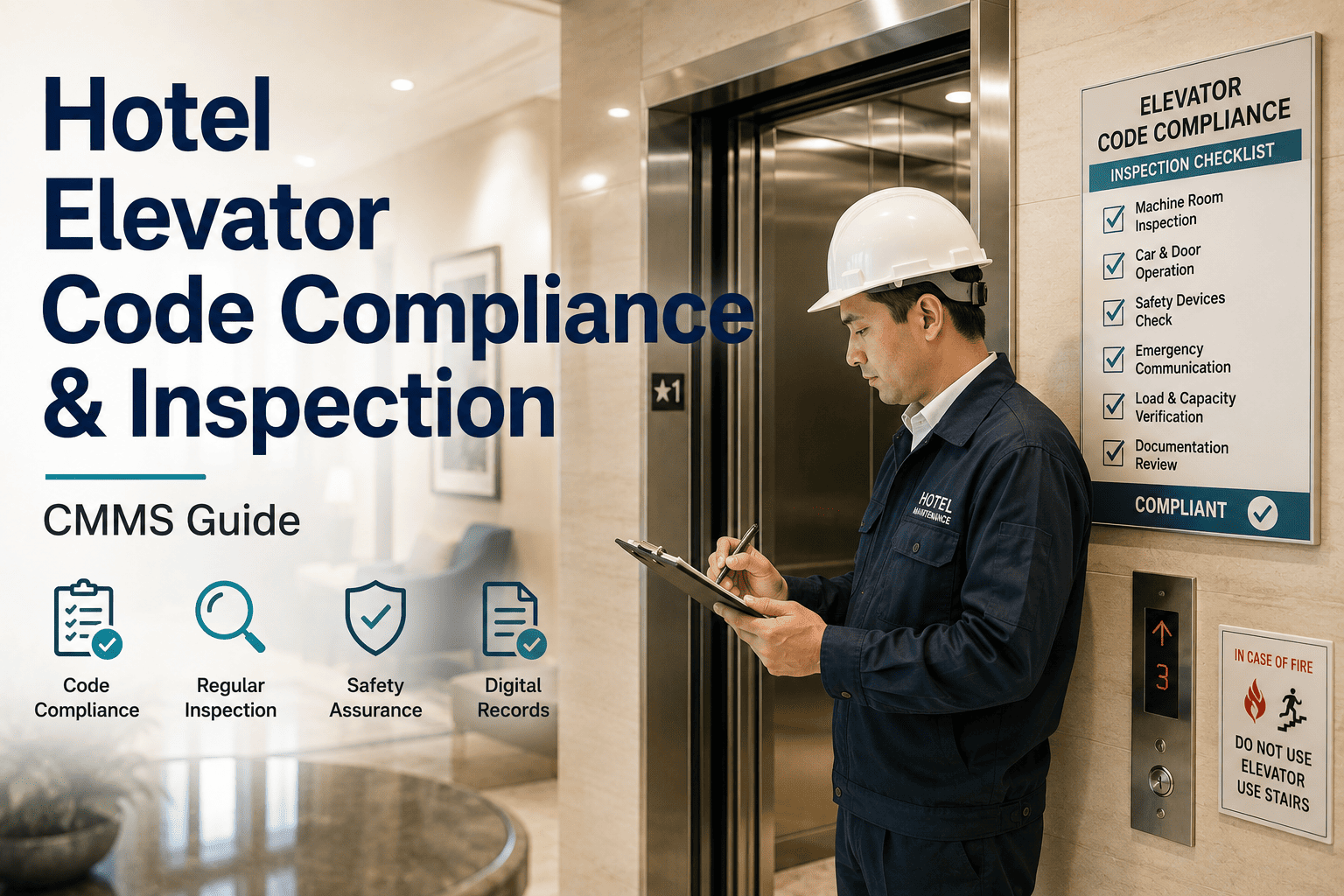
Hotel Elevator Maintenance and Compliance: Safety Inspections and Emergency Protocols
State-mandated annual inspections, monthly PM obligations, ADA verification, and emergency phone testing — all tracked automatically so no deadline is ever missed and no elevator is ever out of compliance.
100%of U.S. states require annual elevator inspection certificates
$15K+Average fine per violation for operating an uninspected elevator
68%of elevator failures preceded by at least one missed PM task in prior 30 days
48 hrsMaximum time allowed to restore service before city shutdown order in most jurisdictions
Compliance Calendar
The Three Maintenance Frequencies Every Hotel Elevator Requires
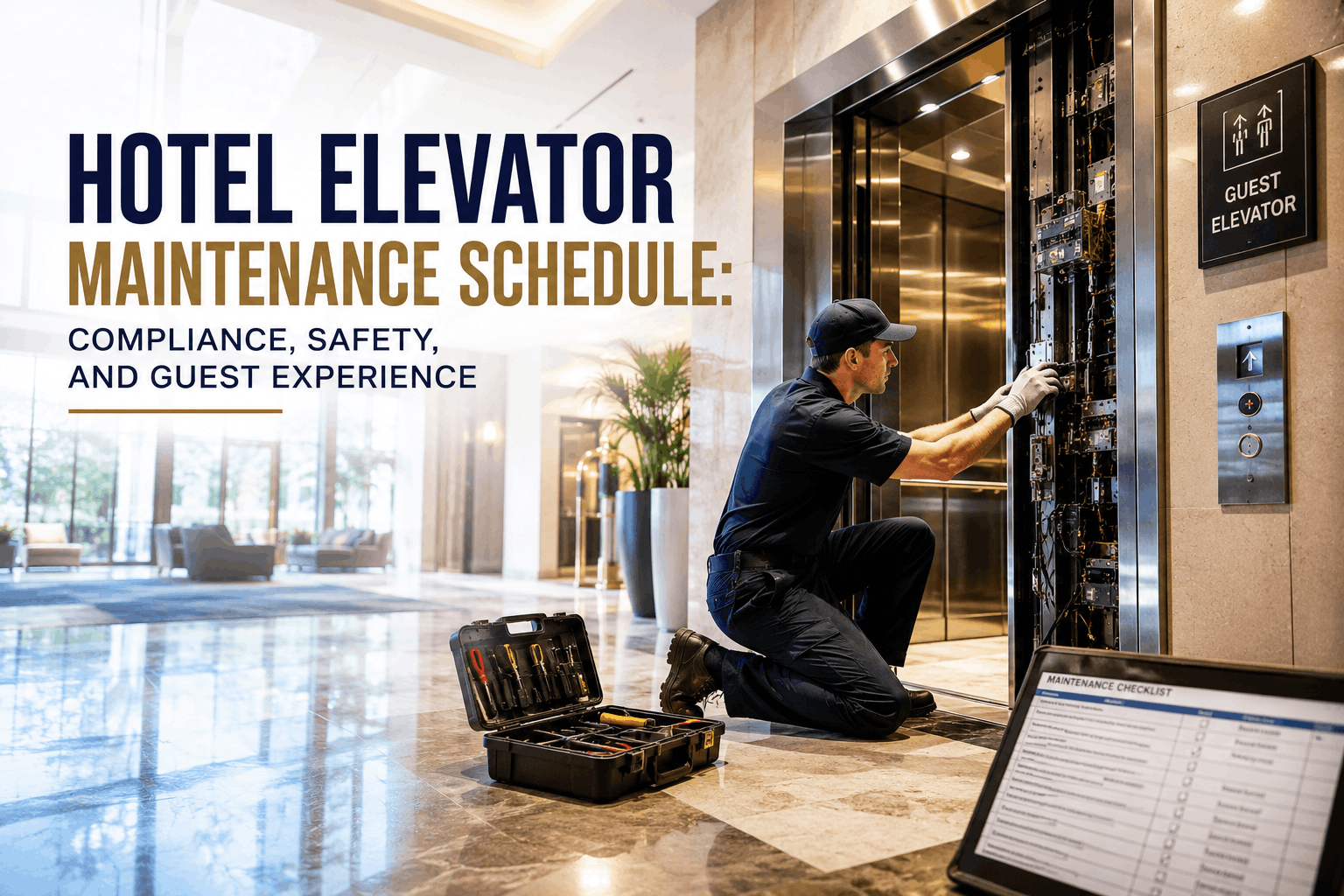
Every hotel elevator operates on three overlapping maintenance cycles — monthly, quarterly, and annual. Missing any single cycle does not just defer a task; it voids the manufacturer's warranty, creates a compliance gap for the state inspection record, and statistically doubles the probability of an unplanned failure in the following 60-day period. Oxmaint automates all three cycles from a single asset record.
Elevator PM Calendar
3 cycles · 12 months
Monthly — 30 days
Door open/close force and speed test
Safety edge and light curtain verification
Call button and floor indicator function check
Lubricate guide rails, door tracks, and hangers
Emergency lighting and phone system test
Interior cleanliness and cosmetic condition log
Detects: sensor drift, door alignment issues, phone system failures
Quarterly — 90 days
Full load capacity test with calibrated weights
Brake adjustment and holding capacity verification
Governor rope and overspeed device inspection
Motor controller and drive system diagnostics
Hydraulic fluid level and leak check (hydraulic only)
Machine room temperature, humidity, and ventilation
ADA compliance verification — dimensions, controls, signage
5-year and 10-year interval tests where due (pit, overhead, wire rope)
Certificate of inspection renewal and posting inside cab
Required by law — no certificate means elevator must be taken out of service
ASME A17.1
The national safety code that governs every hotel elevator in the United States.
The ASME A17.1 Safety Code for Elevators and Escalators defines minimum maintenance intervals, inspection procedures, load test requirements, and safety device specifications. All 50 states reference A17.1 in their elevator codes — even states with additional local requirements. Non-compliance with A17.1 is not a technicality; it is the basis on which inspectors issue violations, courts assign liability, and insurers deny claims. Oxmaint inspection checklists are built to A17.1 requirements — sign up free to access them.
Monthly Maintenance Protocol
What Every Hotel Engineer Must Check on a 30-Day Cycle
DRDoor System
The door system is responsible for over 40% of all elevator-related injuries and 60% of callback complaints. Monthly door tests prevent both safety incidents and the guest frustration of a door that closes too fast, too slow, or fails to reopen on contact.
Door open/close force testMeasure closing force using a calibrated door force meter. ASME A17.1 maximum: 30 lbs (new) — recurring measurement trends reveal spring or operator degradation before failure.
Safety edge and light curtain testPass a test object through the door plane at 6-inch, 24-inch, and 48-inch heights. All interruptions must reverse the door within 2 seconds. Failure here is an immediate write-up on state inspection.
Door timing checkRecord open and close cycle time. Creeping speed increase (doors slowing over months) indicates operator motor wear, roller wear, or track contamination. Log each reading to detect the trend.
Detects:
Sensor drift causing door reversals • Motor or operator wear • Track misalignment causing binding
SIGSignals and Communication
Emergency communication failures are cited in the majority of elevator entrapment incidents that result in guest injury claims. The law requires a two-way communication system that connects within 60 seconds to a location staffed 24 hours.
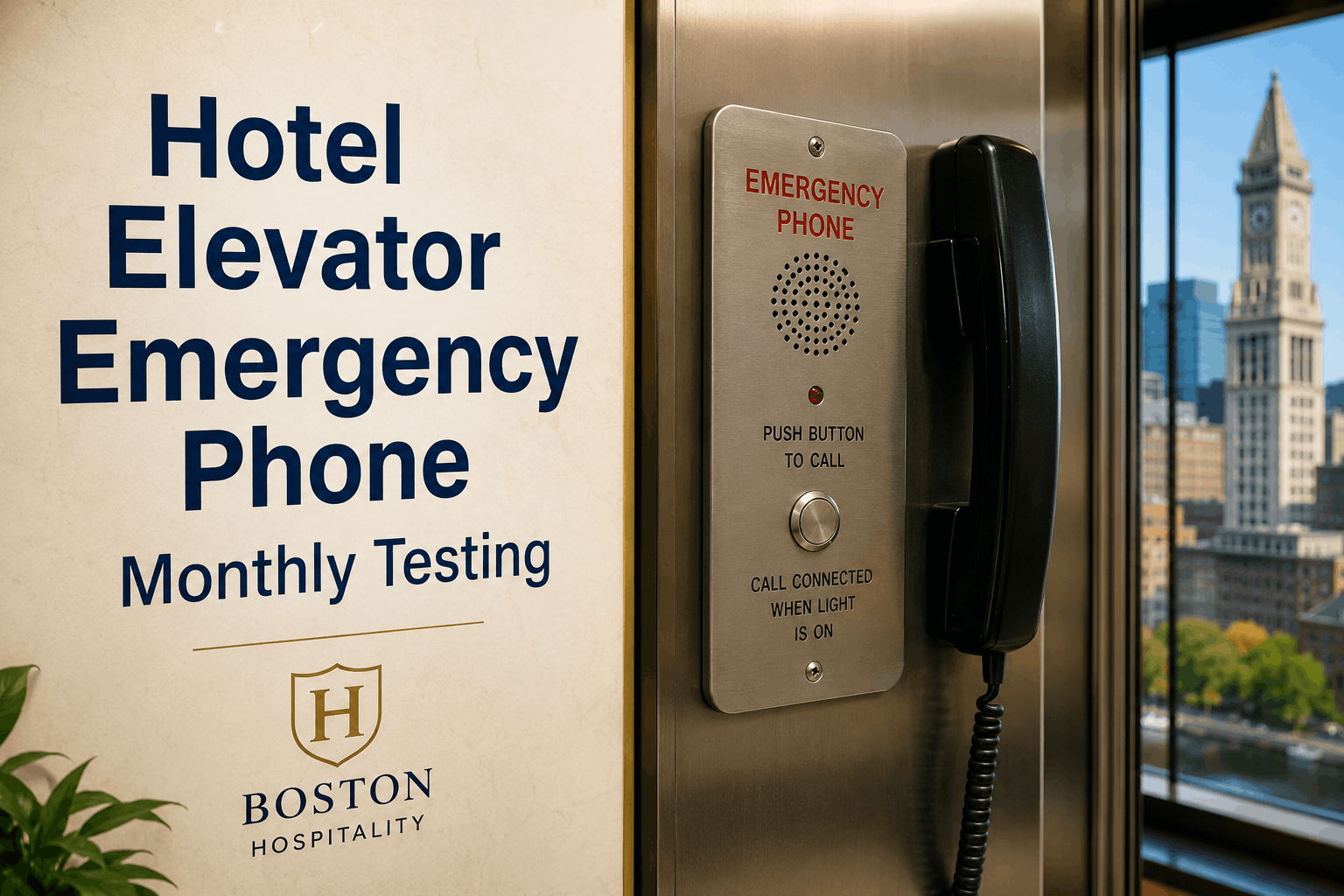
Emergency phone test — connection and voice qualityPress the emergency button from inside the cab. A staff member must answer within 60 seconds. Confirm both parties can hear clearly. Log the time of response. This test must be documented monthly — it is the first record requested after any entrapment incident.
Emergency lighting duration testSimulate power failure by cutting the elevator's main power. Emergency battery-backed lighting must illuminate for a minimum of 4 hours at 1 foot-candle. Any battery that holds less than 3 hours must be flagged for replacement before the next test cycle.
Floor indicator and call button functionVerify all floor buttons register correct floor calls. Confirm hall lanterns illuminate on car arrival. Stuck buttons or dead floor calls reported by guests should be logged against the asset record, not handled verbally — they indicate controller issues that escalate.
Detects:
Dead emergency phone lines • Battery backup failure • Controller signal faults
LUBLubrication and Mechanical
Guide rail lubrication is the single most effective mechanical PM task for elevator longevity. Dry rails increase wear on guide shoes, create noise that guests interpret as unsafe, and can cause erratic cab movement that triggers the governor.
Guide rail lubrication — full rail travelApply manufacturer-specified lubricant to both guide rails along the full cab travel path. Use the correct viscosity — over-lubricating attracts debris that abrades the rail over time. Record the lubricant type, quantity, and date in the asset log.
Door track and hanger lubricationApply door track lubricant to the hoistway door sill grooves and hanger rollers. Contaminated or dry tracks are the leading cause of the erratic door behavior guests describe as "jerky" or "grinding." Takes 4 minutes — avoids a callback worth 2 hours of technician time.
Quarterly tasks go deeper than monthly lubrication and function checks. They test the mechanical systems that, if they fail, result in an out-of-service elevator or a genuine safety emergency. These tasks require a licensed elevator mechanic in most jurisdictions — internal engineering staff can perform them only with specific state certifications. Track quarterly PM completions, contractor sign-offs, and findings in Oxmaint.
BRK
Brake System Inspection and Adjustment
Brake lining wear and spring tension change over time due to thermal cycling and mechanical fatigue. A brake that tests within spec at the annual inspection can drift out of spec within 6 months under heavy hotel use. Quarterly brake checks catch this drift before it results in elevator drift or a safety device trip.
Hydraulic elevators require quarterly fluid checks and leak inspections that traction elevators do not. A hydraulic system losing fluid over several months will begin settling between floors — a guest experience disaster and a code violation that causes immediate shutdown during inspection.
Hydraulic fluid level — tank sight glass check
Cylinder and jack seal inspection for seepage
Relief valve pressure setting verification
Pump motor current draw and temperature
CTL
Controller and Drive System Diagnostics
Modern elevator controllers store fault logs and error codes that surface operational anomalies weeks before they become visible failures. A quarterly controller review reads the fault history, clears resolved codes, and flags recurring patterns for the service contractor's attention.
Fault log review — identify recurring error codes
Drive system software version check and notes
Control panel connections — torque check and corrosion
Leveling accuracy — floor-to-sill tolerance test
MRM
Machine Room Conditions
The machine room must be maintained within specific temperature and humidity ranges to protect the controller, motor, and drive components. A machine room that overheats routinely will shorten the life of solid-state components in ways that do not appear until they fail completely — typically during the highest-load periods of hotel operation.
Room temperature — must not exceed 104°F (40°C)
Humidity — no condensation on equipment
Housekeeping — no storage of non-elevator materials
Access log — verify no unauthorized entry since last visit
Never miss a quarterly PM or annual inspection renewal date again.
Oxmaint sends automated alerts 30 days, 7 days, and 24 hours before every elevator compliance deadline — monthly, quarterly, and annual. Every completion is logged to the asset record automatically.
State Inspection, ASME A17.1, and ADA Compliance Requirements
Hotel elevators are subject to three overlapping regulatory frameworks. Failing any one of them — even while passing the others — results in a violation notice and an elevator taken out of service. Understanding the distinction between them is essential for the chief engineer managing the annual inspection cycle.
Requirement
Governing Authority
Frequency
Consequence of Non-Compliance
Documentation Required
Annual Safety Inspection
State elevator safety division (varies by state)
Every 12 months
Elevator shut down; fines from $1,000–$15,000+ per unit per day
Certificate posted inside cab; state database record
ASME A17.1 Maintenance
ASME (referenced by all state codes)
Monthly + quarterly intervals
Violation basis for liability; insurance coverage disputes
Signed maintenance logbook; CMMS records accepted
ADA Compliance
U.S. Department of Justice / ADA
Ongoing; verified at annual inspection
ADA complaint; mandatory remediation order; lawsuit exposure
Certificate renewal denied; elevator taken out of service
Licensed inspector test report; weight certificates
Emergency Phone (NEPA 72)
Local fire / building authority
Tested monthly; certified annually
Violation at annual inspection; liability in entrapment incidents
Monthly test log with timestamps; annual certification
All documentation must be retained for a minimum of 5 years. Oxmaint cloud storage provides permanent, retrievable compliance records for every elevator asset — access your records from anywhere.
Buttons: minimum 0.75 inch diameter, raised or flush
Braille floor designations on all buttons
Floor number tactile characters on both jambs
Communication
Two-way communication device accessible from wheelchair
Visual and audible floor signal at each landing
Verbal or visual floor announcement inside cab
Emergency instructions in accessible format
Emergency Protocols
Elevator Entrapment Response: What Every Hotel Must Have in Place
An elevator entrapment is not primarily a mechanical event — it is a guest experience crisis and a liability exposure that is resolved or compounded entirely by how quickly and professionally the hotel responds. A documented emergency response protocol, tested regularly, is the difference between a resolved incident and a lawsuit. See how Oxmaint structures emergency response workflows — book a demo.
T+0
Emergency Phone Activates
Guest presses the emergency button. The call routes to the front desk or 24-hour monitoring service. Staff must answer within 60 seconds. First response: confirm you hear them, confirm their floor and car number, tell them help is on the way, tell them to stay calm and not attempt to exit. Do not tell them to force open doors.
↓
T+2m
Engineering and Management Notified
Front desk immediately contacts on-call engineer and the duty manager. The engineer proceeds to the machine room — not to the floor — to assess the controller and attempt to run the car to the nearest landing using inspection controls. The manager contacts the elevator service contractor simultaneously.
↓
T+5m
Status Update to Passenger
Someone must stay on the phone with the entrapped guest at all times. A 5-minute update is mandatory — even if there is nothing new to report. Silence during an entrapment escalates guest fear. If the car can be safely run to a landing using inspection controls, the engineer does so — passengers then exit normally.
↓
T+30m
Licensed Mechanic Arrives
Elevator service contractor mechanic arrives and takes over. In most jurisdictions, only a licensed elevator mechanic may perform a manual rescue (lowering the car by hand to the landing). Hotel engineering staff may assist and observe but may not perform the rescue procedure. The car is taken out of service until the fault is corrected.
↓
T+1hr
Incident Documentation and State Notification
The duty manager completes an incident report capturing: the time of entrapment, duration, floor, number of passengers, cause identified by the mechanic, and repair action taken. Most states require the property to notify the state elevator safety office within 24 hours of any entrapment incident. Failure to notify is itself a separate violation. The Oxmaint work order record for this elevator becomes part of the incident file.
Service Contracts
What Your Elevator Service Contract Must Include — and What It Often Misses
Most hotel elevator service contracts are written in favor of the contractor. Understanding what is and is not included — and what you need to track internally regardless of the contract — determines whether your elevator stays in compliance between annual inspections.
What a Full-Coverage Contract Should Include
All parts and labor for breakdown repairs
Monthly and quarterly PM visits with written reports
Annual state inspection coordination and scheduling
24/7 emergency response — defined response time in writing
Hydraulic jack and cylinder coverage (hydraulic units)
Controller and drive system component replacement
Governor and safety device testing and certification
Modernization consultation when components near end of life
Create your elevator asset in Oxmaint once. Set monthly, quarterly, and annual PM schedules. The system sends alerts to your engineering team 30 days and 7 days before every due date — and escalates to the chief engineer if a task is not completed. No deadline gets missed because no one forgot to check a calendar.
Monthly PMQuarterly PMAnnual inspection alerts
02
Compliance Document Storage Per Asset
Every state inspection certificate, contractor service report, load test result, and monthly emergency phone log is stored against the elevator's asset record in Oxmaint. When an inspector arrives and asks to see maintenance records, you pull up the asset record on a tablet and show them every task completed for the past five years — in under 60 seconds.
Document storageInspection-ready records5-year history
03
QR Code Asset Tagging for Machine Room and Cab
Print a QR label for each elevator — one for the machine room panel, one for the cab interior inspection point. A technician scans the cab label to open the monthly checklist pre-populated with this elevator's asset details. A contractor scans the machine room label to log a service visit. Every scan is timestamped and stored. Sign up to generate elevator QR labels free.
QR asset tagsMobile check-inContractor log
04
Work Order History for Failure Pattern Analysis
When an elevator generates its third door-related work order in 60 days, Oxmaint's asset history surfaces that pattern automatically. The chief engineer sees it before the state inspector does — and can schedule the corrective action before it becomes a violation finding. Reactive maintenance on elevator doors should never surprise an informed engineering team.
We had three elevators and were managing all three inspection schedules in a spreadsheet. We missed the 5-year load test on Elevator B by 11 days — we didn't catch it until the state inspector arrived and shut the elevator down on a Saturday morning. The fine was $4,200 and we had 180 guests stranded on upper floors during checkout. Oxmaint would have sent me a reminder 30 days out. That's all it would have taken. We set up all three elevators in the system the following Monday.
Chief Engineer · 220-Room Full-Service Hotel, Mid-Atlantic Region
Frequently Asked Questions
Hotel Elevator Compliance FAQs
How often is a hotel elevator required to be inspected by the state?
In all 50 U.S. states, elevators in public-access buildings including hotels are required to undergo a formal safety inspection at least once every 12 months, conducted by a licensed elevator inspector (either a state employee or a licensed third-party inspector, depending on the jurisdiction). The certificate of inspection must be posted inside the elevator cab and be current — an expired certificate means the elevator is legally out of service. Some states with higher-traffic thresholds require semi-annual inspections. Oxmaint sends renewal alerts 30 days before your certificate expires so you always have time to schedule the inspection appointment.
Can hotel engineering staff perform elevator maintenance, or does it require a licensed elevator mechanic?
The answer varies by task and jurisdiction. General tasks — cleaning the cab, lubricating door tracks, testing call buttons, and conducting the emergency phone test — can be performed by hotel engineering staff in most states. Mechanical tasks involving the brake, governor, safety devices, hydraulic system, or controller must be performed by a licensed elevator mechanic in the majority of U.S. states, under ASME A17.1 Section 8.6. The annual state inspection must always be conducted by a licensed inspector. Hotels should confirm their state's specific requirements and document who completed each task — Oxmaint requires a technician sign-off on every work order, creating a defensible record of who performed each maintenance action.
What is the ASME A17.1 5-year test and when is it required?
ASME A17.1 requires a full-load pressure test and safety device test at 5-year intervals for hydraulic elevators, and a governor rope and safeties test at 5-year intervals for traction elevators. The 5-year test must be performed under the supervision of a licensed inspector and documented with a formal test report. Missing the 5-year test date is one of the most common causes of certificate renewal denial — because it is a 5-year window, many hotels using paper tracking systems simply lose track of when it is due. Book a demo to see how Oxmaint tracks 5-year and 10-year interval tests alongside monthly and annual schedules.
What happens if our hotel elevator fails the annual state inspection?
If a hotel elevator fails the annual inspection, the inspector issues a violation notice and the elevator is placed out of service immediately — a red tag or equivalent posted on the elevator doors. The hotel must correct the cited violations and schedule a re-inspection within the timeframe specified by the state (typically 30 to 60 days). During that period, the elevator cannot carry passengers. In hotels where elevator capacity is critical for guest access, this is a direct revenue and reputation event. Fines for operating a tagged elevator range from $1,000 to $15,000+ per day per unit depending on jurisdiction. All citations become part of the public inspection record in most states.
Does Oxmaint integrate with elevator service contractors for shared documentation?
Yes — contractors can be added to Oxmaint as external users with limited access, allowing them to log their own service visits and upload their maintenance reports directly to the elevator's asset record. Alternatively, the engineering team can upload contractor-provided service reports as attachments to the corresponding PM work order. Either way, the complete service history — internal engineering tasks and contractor visits — is consolidated in a single asset record, creating the unified maintenance log that inspectors and insurers require. Sign up free to set up your first elevator asset and try contractor access.