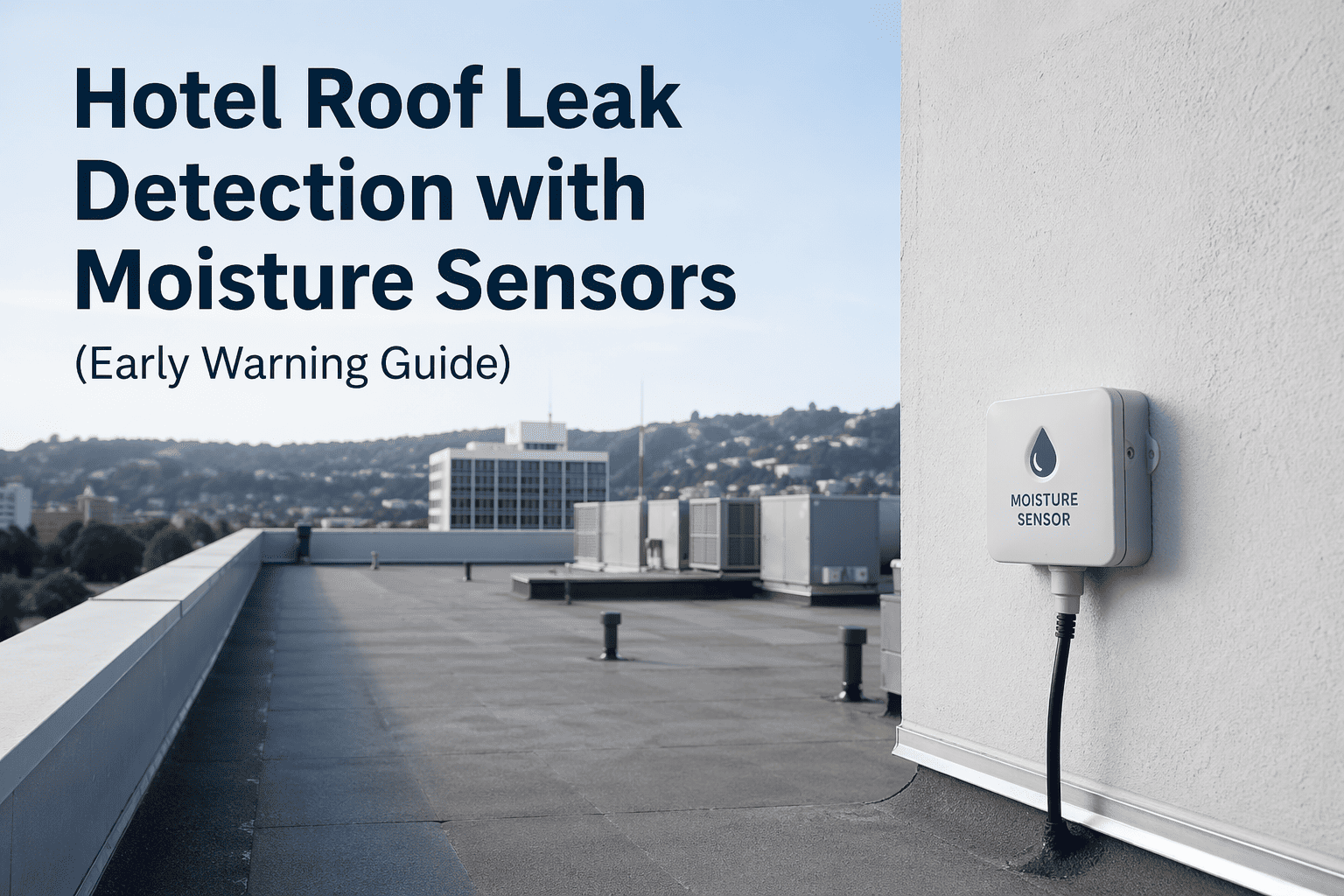
Hotel Roof Moisture Sensors: Detect Waterproofing Failure Before Damage Spreads
By Mark Strong on April 22, 2026
A pinhole breach in a flat hotel roof membrane lets through less than a teaspoon of water per hour during light rain. In two weeks, that water has saturated 4 square meters of insulation board. In six weeks, it has migrated along the deck and is softening the ceiling substrate in a fourth-floor suite. In four months, a guest notices a water stain. Hotels using IoT-integrated monitoring reduce water damage incidents by 85% and cut emergency repair costs by 71% — because sensors catch breaches in hours, not months. If your property is still relying on visual inspections and periodic vendor visits, book a demo with Oxmaint to see how real-time moisture monitoring works, or start a free trial and connect your first sensor zone today.
How Hotel Roof Membrane Failures Actually Begin
Most hotel roof leaks are not caused by catastrophic storm damage. They are caused by incremental failures that go undetected for months — seam separation from thermal cycling, flashing deterioration around HVAC penetrations, membrane blistering, and UV degradation of aged waterproofing systems. Each of these failure modes produces moisture intrusion that spreads horizontally through insulation layers before any visible sign appears inside the building.
Common Hotel Roof Waterproofing Failure Modes
01
Membrane Seam Separation
Thermal expansion and contraction cycles stress seam bonds over time. On EPDM, TPO, and PVC systems, seam failure is the single most common source of leaks — often occurring years before any interior signs appear.
Sensor catches: Elevated moisture readings in insulation layer adjacent to seam zones
02
Flashing Failure at Penetrations
HVAC units, pipe stacks, skylights, and drainage sumps all require flashing seals. Deteriorated or improperly installed flashing creates direct water entry points that are nearly invisible from the roof surface.
Sensor catches: Moisture spikes correlating with precipitation events near penetration zones
03
Membrane Puncture & Blistering
Rooftop foot traffic for HVAC servicing, debris impact, and UV-driven membrane brittleness create small punctures. Blisters trap moisture under the membrane, spreading wetted area rapidly during rain events.
Sensor catches: Localized moisture concentration following post-storm scan cycles
04
Blocked Drainage & Ponding
Clogged roof drains create standing water that applies hydrostatic pressure on the membrane. Ponding accelerates membrane degradation and forces water through any existing micro-breach over time.
Sensor catches: Sustained moisture readings hours after rain has stopped in affected zones
05
Parapet & Edge Failure
Roof edge flashings, parapet caps, and coping joints are exposed to wind-driven rain from multiple angles. Sealant failures here allow water to migrate behind the membrane into the wall assembly and insulation layer.
Sensor catches: Perimeter zone moisture readings inconsistent with central roof baseline levels
06
HVAC Condensate & Equipment Leaks
Rooftop HVAC units generate condensate and have supply line connections that can fail slowly. Condensate overflow from blocked drain pans is a frequent source of moisture accumulation in ceiling cavities below.
Sensor catches: Continuous baseline moisture elevation unrelated to weather events
Types of Roof Moisture Sensors: What Hotels Actually Deploy
Not all moisture detection is equal for a hotel roof. The sensor type determines detection depth, installation timing, coverage area, and integration capability with your CMMS. Each technology addresses a different part of the waterproofing failure spectrum.
Hotel Roof Moisture Sensor Technology Comparison
Sensor Type
Detection Method
Best For
Installation
CMMS Integration
Embedded Capacitive Sensors
Measures dielectric change in insulation moisture content continuously
New build or reroofing projects — installed under membrane
During roofing works
Wireless alert to CMMS work order on threshold breach
Surface Contact Sensors
Conductivity-based — triggers when water bridges sensor contacts
Ceiling cavities, drain sumps, HVAC condensate zones
Retrofit — no disruption
Instant alert via Wi-Fi / LoRaWAN — auto work order in under 8 seconds
Rope / Cable Sensors
Linear moisture detection along any length — pinpoints location of contact
Drain gutters, parapet edges, linear penetration runs
Retrofit — surface mounted
Location-specific alert identifying leak position along cable run
Humidity Differential Sensors
Compares internal roofing layer RH against outdoor reference sensor
Early-stage moisture accumulation before liquid water is present
During roofing works
Trend-based alerts — integrates with predictive maintenance schedules
Strategic Sensor Placement: Where to Monitor on a Hotel Roof
Sensors only detect what they can physically reach. Coverage gaps leave entire failure zones unmonitored. Effective hotel roof sensor programs place devices at every high-risk zone — not just the easiest-to-reach areas.
Hotel Roof Sensor Deployment Zone Guide
Priority: Critical
HVAC Equipment Perimeters
Each HVAC unit has multiple membrane penetrations, condensate pans, and vibration stress points. Sensors placed 300–500mm from unit bases catch flashing failures and condensate overflow before they migrate inward.
Sensor spacing: 1 per unit + 1 per condensate drain pan
Priority: Critical
Roof Drain Sumps & Scuppers
Blocked drains create ponding conditions that force water through any membrane weakness. Sensors at drain surrounds detect sustained moisture indicating blockage or overflow — triggering a maintenance work order before ponding causes membrane damage.
Sensor spacing: 1 per drain point, 1 per scupper location
Priority: High
Parapet & Edge Zones
Wind-driven rain at parapet walls and edge flashings accounts for a significant share of commercial roof leaks. Rope sensors along parapet bases and perimeter edges provide linear coverage across the entire building edge zone.
Sensor spacing: Rope sensor along full perimeter, spot sensors at corners
Priority: High
Seam Intersection Grids
On large flat hotel roofs, seam intersections represent concentrated stress points. Sensors placed every 6–10 meters along primary seam runs create a detection grid that localizes moisture to a specific repair zone, reducing investigation labor.
Sensor spacing: Grid pattern every 6–10m along seam lines
Priority: Standard
Ceiling Cavities Below Roof
Surface contact sensors in ceiling spaces below the roof catch moisture that has already penetrated the membrane — acting as a secondary detection layer for any event not caught by primary roof sensors. Battery-powered, no wiring required.
Sensor spacing: 1 per 25–30m² of ceiling cavity in top-floor rooms and corridors
Oxmaint Roof Monitoring
Connect Roof Moisture Sensors to Automatic Work Orders
The moment a sensor breaches threshold, Oxmaint auto-generates a work order with location, sensor ID, alert type, and recommended action — delivered to your technician before the leak reaches the next floor.
From Sensor Alert to Closed Work Order: The Detection Workflow
Hotel Roof Moisture: Detection to Resolution in 5 Steps
Step 01
Sensor Threshold Breach
Conductivity or capacitive sensor detects moisture contact or humidity differential beyond configured baseline. Sustained for 15–30 seconds to eliminate false positives from condensation or cleaning activity.
Time elapsed: 0–30 seconds
Step 02
Wireless Signal Transmission
Alert transmitted via LoRaWAN, Zigbee, Wi-Fi, or cellular to the gateway — carrying location ID, sensor ID, alert type, and timestamp. Battery-powered sensors last 3–5 years without wiring.
Time elapsed: Under 8 seconds
Step 03
CMMS Auto Work Order
Oxmaint generates a priority work order automatically — including roof zone map location, sensor history, weather event correlation, and recommended inspection checklist. Assigned to the responsible technician instantly.
Time elapsed: Under 60 seconds
Step 04
Technician Response & Inspection
Technician receives mobile push notification, navigates to precise sensor location, and conducts targeted inspection of the flagged zone — eliminating the full-roof search that manual leak investigation requires.
Response time: Minutes vs. hours or days
Step 05
Repair, Documentation & Audit Trail
Repair completed with photo documentation uploaded to the work order. Full event timeline — detection, assignment, inspection, repair — stored in CMMS for warranty records, insurance claims, and maintenance trend analysis.
Output: Audit-ready record for every moisture event
Early Detection Saves Thousands
From a $400 Patch to a $47,000 Remediation — The Difference Is Detection Speed
Oxmaint connects roof moisture sensors to instant work orders — catching breaches at the membrane before they reach your guest rooms, your ceilings, or your insurance claim forms.
71%
Reduction in emergency repair costs with IoT-integrated monitoring
85%
Fewer water damage incidents with connected sensor programs
$130K
Average hotel water damage claim — prevented by early detection
Integrating Roof Sensors with Your CMMS: What to Expect
CMMS Integration Capabilities for Hotel Roof Moisture Monitoring
Protocol Compatibility
Accepts sensor data via BACnet, Modbus, MQTT, REST API, and direct integrations with major platforms — no rip-and-replace of existing BMS infrastructure required.
Auto Work Order Generation
Every sensor alert becomes a structured work order — asset location, alert classification, sensor history, weather correlation, and recommended action pre-populated. No manual data entry required.
Trend & Pattern Analytics
Historical moisture data surfaces recurring problem zones, seasonal leak patterns correlated with rainfall, and membrane degradation trends — supporting CapEx planning and roof replacement forecasting 12–36 months in advance.
Insurance & Warranty Documentation
Timestamped event logs, repair records, and sensor data exports satisfy insurance claim documentation requirements and support roofing warranty compliance reporting — audit-ready at all times.
Configurable Alert Thresholds
False positive rates below 1% with properly configured thresholds. Sensors require sustained moisture contact for 15–30 seconds before triggering — eliminating condensation and cleaning-related false alarms entirely.
Mobile Technician Response
Push notification with one-tap work order acceptance and roof zone map navigation guides the technician directly to the sensor location — no building-wide search, no delay from unclear leak tracing.
Frequently Asked Questions
Can moisture sensors be added to an existing hotel roof without a full reroofing project?
Yes. Surface contact sensors, rope sensors, and ceiling cavity sensors are all retrofit-capable — they install without disrupting the existing membrane. Embedded capacitive sensors require placement during a roofing project, but the majority of roof monitoring deployments use surface-mounted wireless sensors that can be installed during normal maintenance windows without room closures or structural work.
How many sensors does a typical hotel roof require?
Sensor count depends on roof area, HVAC unit count, and drain point density. A practical starting approach deploys sensors at every HVAC penetration perimeter (typically 1 per unit), every drain sump, rope sensors along parapet edges, and contact sensors in ceiling cavities below top-floor guest rooms. A 10,000 square meter hotel roof typically requires 40–80 sensors for meaningful coverage — with battery-powered wireless units requiring no cabling infrastructure investment.
What happens during a storm — do sensors generate excessive false alarms?
Modern conductivity-based sensors have false alarm rates below 1% when properly installed and configured. Sustained contact thresholds (15–30 seconds) eliminate transient moisture from cleaning or condensation. Post-storm monitoring is actually the highest-value use case — sensors that show elevated moisture readings hours after rain has stopped indicate water retention in insulation, which is the earliest sign of membrane failure before any visible leak develops inside the building.
How does moisture sensor data help with roof replacement planning?
Historical sensor data creates a moisture map of the roof over time, identifying zones with recurring moisture events and tracking the progression of membrane degradation across different sections. This data supports evidence-based CapEx forecasting — replacing deteriorating roof sections proactively rather than reactively, and prioritizing which areas of a large hotel roof require attention before the next wet season. Facilities using trend-based sensor data typically plan replacements 12–36 months earlier than those relying on visual inspections alone.
Built for Hotel Facility Teams
Stop Finding Roof Leaks on Guest Review Sites
Oxmaint connects roof moisture sensors to automatic work orders, trend dashboards, and audit-ready documentation — so every breach is caught at the membrane, not the ceiling tile.