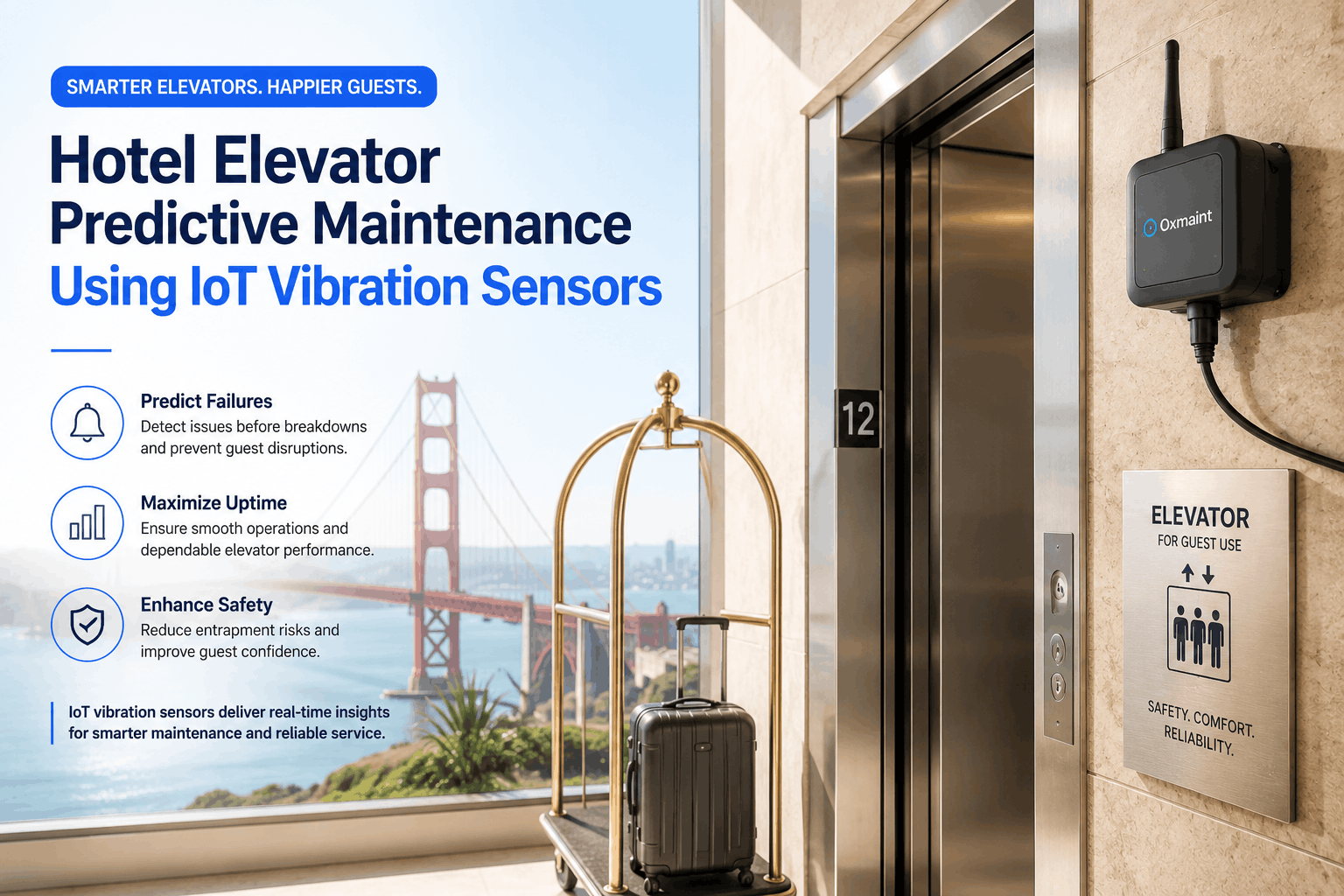
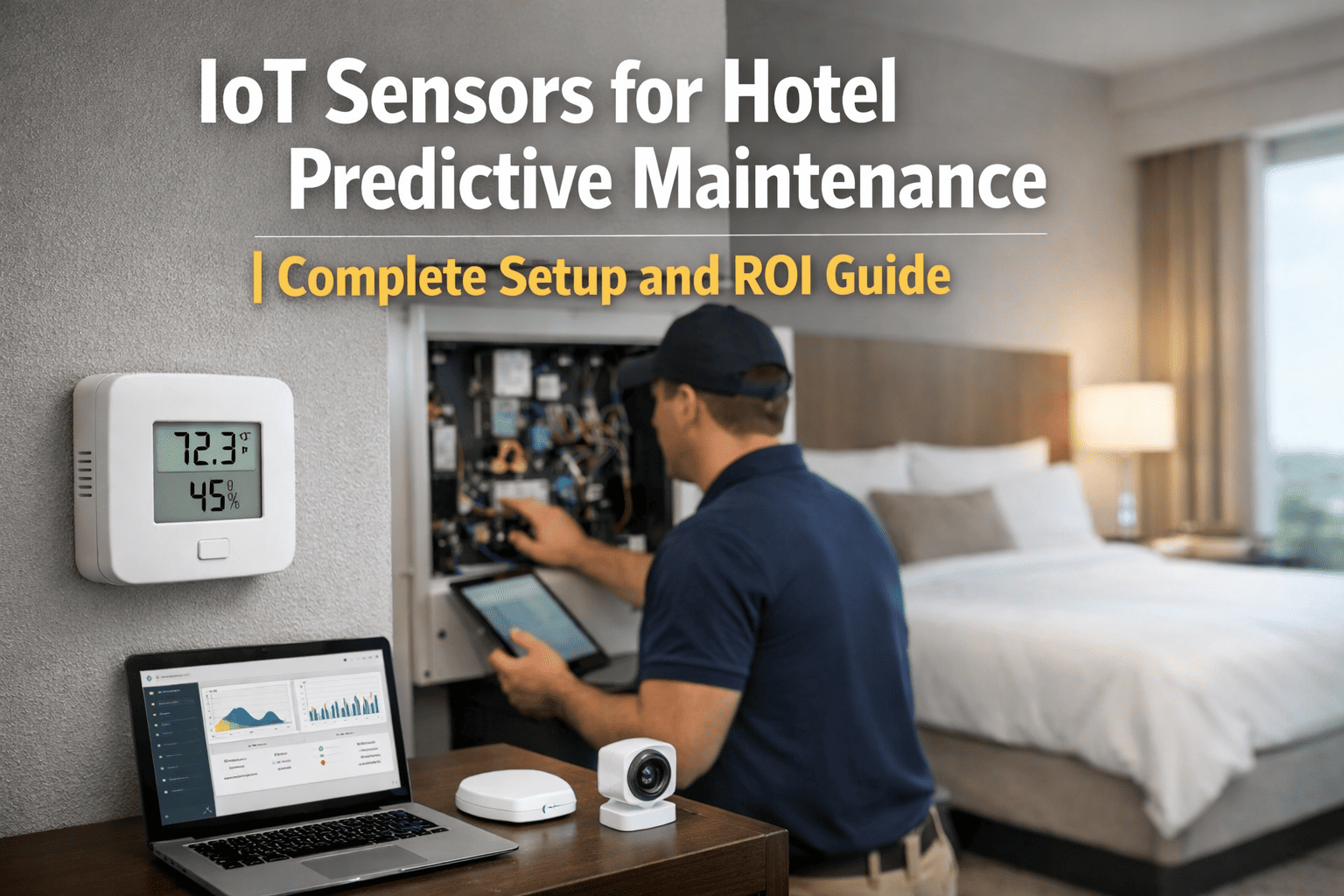
A hotel's chilled water pump runs silently for months. No alarms. No complaints. Then at 2 AM on a peak summer weekend — it fails. The bearing had been degrading for six weeks. Vibration levels had climbed 40% above baseline. The data existed, but no one was reading it. Emergency contractor, overnight parts, 11 hours of HVAC downtime across 60 rooms, $22,000 in repairs, and a front desk full of angry guests. A $380 wireless vibration sensor and a CMMS alert would have caught this three weeks earlier — during a planned maintenance window, at a fraction of the cost. This is exactly the gap that predictive vibration monitoring closes for hotel engineering teams. Start a free Oxmaint trial and connect your first sensor in under 30 minutes.
Predictive Maintenance for Hotels
Catch Pump & Motor Failures Weeks Before They Happen
Vibration sensors + AI analytics + CMMS automation — the modern engineering team's early warning system.
Why Hotels Are the Perfect — and Most Vulnerable — Case for Vibration Monitoring
Hotels run rotating equipment 24 hours a day, 365 days a year. Chilled water pumps, condenser pumps, domestic hot water circulation pumps, fan motors, cooling tower fans, boiler feed pumps — all spinning continuously, all subject to bearing wear, imbalance, misalignment, and cavitation. The problem isn't that failures happen. It's that failures happen at the worst possible moment: peak occupancy, summer heat, holiday weekends. Vibration monitoring doesn't eliminate wear — it gives you a 2-to-4-week window to schedule the repair on your terms, not the equipment's.
Bearing Wear
The #1 cause of pump and motor failure. Vibration signatures reveal wear 3-8 weeks before seizure.
Shaft Imbalance
Causes vibration at 1x running frequency. Detected early, corrected with balancing weights — not a new motor.
Misalignment
Pump-to-motor coupling misalignment shows as 2x frequency vibration — a correctable issue before seal and bearing damage occurs.
Cavitation
High-frequency broadband noise from vapor bubble collapse — destroys impellers silently. Sensors catch it before impeller pitting becomes visible damage.
How Vibration Sensors Actually Work: The Signal-to-Failure Chain
Every rotating machine produces a unique vibration signature — a fingerprint of its mechanical health. When components begin to degrade, that signature changes in predictable, measurable ways. MEMS accelerometers mounted on bearing housings capture these changes in three axes, and FFT (Fast Fourier Transform) analysis breaks the raw signal into frequency components that identify exactly what is failing and how quickly.
From Sensor to Work Order: The Complete Detection Flow
1
Sensor Capture
Wireless MEMS accelerometer mounted on bearing housing captures vibration in X, Y, Z axes at up to 3,200 Hz sampling rate. Temperature recorded simultaneously.
2
FFT Analysis
Raw time-domain signal converted to frequency spectrum. Bearing defect frequencies (BPFI, BPFO, BSF, FTF) compared against machine-specific fault frequencies.
3
AI Trending
Machine learning models compare current readings to historical baseline. Anomaly detection flags deviation patterns — not just threshold breaches — giving earlier warnings.
4
CMMS Work Order
Alert triggers automatic work order in Oxmaint with asset details, fault type, severity, and recommended action. Technician receives mobile notification with full context.
Hotel Equipment Priority Map: What to Monitor First
Not every motor needs a sensor on day one. Prioritize by criticality — what fails during a full house weekend and has no redundancy. The table below ranks hotel rotating equipment by failure impact, detection lead time, and monitoring priority.
Equipment
Failure Consequence
Detection Lead Time
Priority
Chilled Water Pump
HVAC failure across all guest floors — full property heat event
Elevator outage — guest mobility impact, ADA compliance exposure
2–4 weeks
Medium
Kitchen Exhaust Fan Motors
Hood system failure — fire code violation, kitchen shutdown
1–3 weeks
Medium
The Vibration Severity Scale Hotels Should Know
ISO 10816 and ISO 20816 define vibration severity zones for rotating machinery. Understanding these zones tells your team when to monitor more closely, when to schedule repair, and when to shut down immediately. Digital CMMS systems map sensor readings to these zones automatically — no manual interpretation required.
Vibration Severity Zones — Rotating Equipment (mm/s RMS)
Zone A — New / Baseline
< 2.3 mm/s
Normal operation. No action required.
Zone B — Acceptable
2.3–4.5 mm/s
Monitor trend. Schedule inspection within 30 days.
Oxmaint automatically maps live sensor readings to severity zones and generates CMMS alerts at Zone B — giving your team the maximum repair window before reaching Zone D.
Stop Reacting. Start Predicting.
Connect vibration sensors to Oxmaint and get automated work orders before your next bearing failure. Setup takes under one day.
The math on predictive maintenance for hotel pumps and motors is straightforward. The question isn't whether vibration monitoring pays for itself — it's how quickly. Most hotel properties see full ROI within the first prevented failure event.
Reactive Approach
Bearing fails at 2 AM, peak weekend
Emergency contractor (after-hours)$3,200
Overnight parts expediting$1,800
Room refunds / comp (14 rooms)$4,200
Portable HVAC rental (48 hrs)$2,400
Review damage + loyalty points$1,400
Total Event Cost$13,000+
VS
Predictive Approach
Sensor alert 3 weeks before failure
Wireless vibration sensor (amortized)$32/mo
Planned bearing replacement labor$420
Parts (standard lead time)$280
Guest impact$0
Downtime duration2 hrs
Total Event Cost$732
One prevented failure event = 17x return on annual sensor + CMMS investment
What Oxmaint Adds That Sensors Alone Cannot
Raw vibration data is just numbers. The value comes from connecting sensor readings to maintenance context — asset history, work order workflows, compliance documentation, and technician accountability. Oxmaint bridges the gap between sensor alert and resolved work order.
Baseline Auto-Calibration
Oxmaint learns each machine's normal vibration signature in the first 7 days. Alerts trigger on deviation from that specific baseline — not generic thresholds.
Automated Work Order Scheduling
Zone B alert creates a work order automatically — assigned to the right technician, with asset history, last service record, and required parts list attached.
Full Asset History Log
Every vibration reading, work order, part replacement, and technician note stored against the asset record. Proof of maintenance for insurance audits and brand inspections.
P-F Interval Tracking
Tracks the time between first detectable fault and functional failure. Gives your team visibility into the repair window — so you know whether you have 3 days or 3 weeks.
Multi-Property Dashboard
Engineering directors see vibration health across every property from a single screen. Critical alerts surface to the top — no dashboard-diving required.
Brand Audit Readiness
Sensor data + completed work orders = documented preventive maintenance record. Generates compliance reports for brand standards teams without manual data compilation.
For hotel engineering teams managing dozens of pumps and motors across floors, the manual approach — walking routes, vibration pen readings, paper logs — simply cannot match the continuous coverage that wireless IoT sensors provide. Book a demo to see how Oxmaint integrates sensor data with automated work order workflows for hotel properties.
Frequently Asked Questions
How hard is it to install vibration sensors on existing hotel equipment?
Wireless vibration sensors mount magnetically or with an adhesive pad directly to the bearing housing — no wiring, no modifications, no equipment shutdown. A typical hotel with 20 pumps and motors can be fully sensored in a single day. Once mounted, they pair with a gateway that connects to the Oxmaint cloud. Total installation time per sensor is under 15 minutes.
How many sensors do I need and what's the typical cost?
A mid-size hotel (150–300 rooms) typically has 15–30 critical rotating assets. Starting with the highest-priority equipment — chilled water pumps, condenser pumps, and cooling tower fans — covers the majority of catastrophic failure risk. Sensor hardware costs range from $300–$600 per point; CMMS subscription costs are typically $2–5 per asset per month. Most properties recover full investment cost with the first prevented emergency repair.
Do I need a vibration analyst to interpret the data?
Not with a modern AI-powered CMMS. Oxmaint's analytics layer performs automated FFT analysis and maps readings to fault categories — bearing wear, imbalance, misalignment, looseness — and translates them into plain-language alerts with recommended actions. Your hotel engineer doesn't need to understand spectral analysis; they receive a work order that says "Chilled water pump bearing — schedule replacement within 14 days."
What's the difference between vibration monitoring and standard preventive maintenance?
Standard PM runs on a fixed calendar schedule — quarterly bearing lubrication, annual alignment checks — regardless of actual equipment condition. Vibration monitoring is condition-based: maintenance triggers when sensor data indicates degradation is occurring, not when the calendar says to check. This eliminates both under-maintenance (missing real degradation between PM visits) and over-maintenance (replacing parts that still have 60% life remaining).
Can Oxmaint integrate with our existing hotel management system?
Oxmaint integrates with major PMS platforms and building automation systems, allowing work order scheduling to align with occupancy forecasts — so maintenance windows are planned during low-occupancy periods automatically. Sensor alerts, work orders, and completion records all flow through a single system without manual data transfer between platforms.
Your Next Pump Failure Is Already Starting. Are You Watching?
Oxmaint connects vibration sensors to automated maintenance workflows — so your team gets a 2-4 week warning window instead of a 2 AM emergency call. Free trial. No hardware required to start.