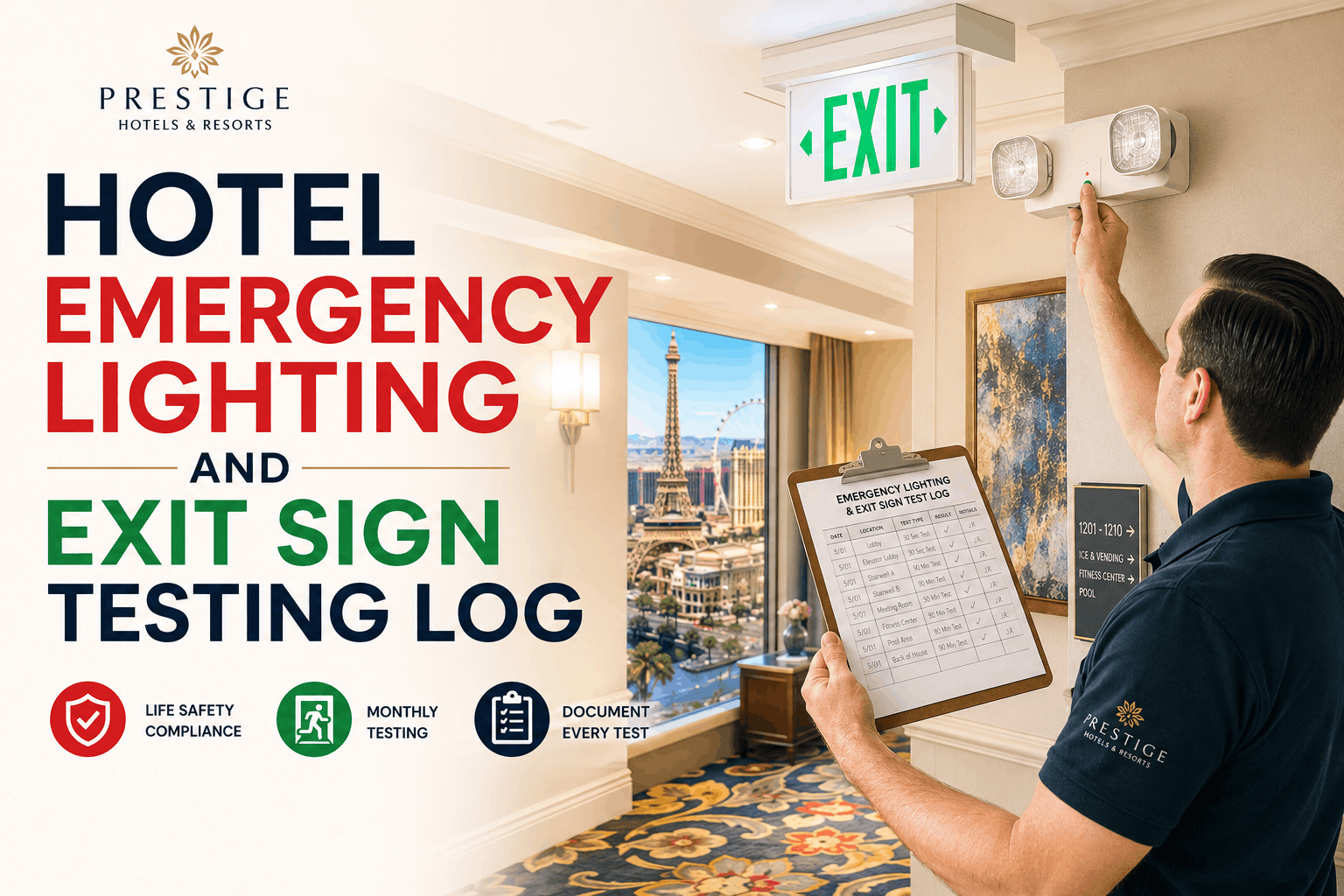
Hotel Emergency Lighting and Exit Sign Testing Log
By Alex Jordan on June 9, 2026
Life safety codes in the United States mandate monthly testing of emergency lighting and exit sign systems in commercial hotels, but most hotel operators treat this requirement as a checkbox compliance task rather than a critical revenue protection strategy. The reality is that failed emergency lighting during an actual evacuation exposes properties to catastrophic liability, creates regulatory fines up to $15,000 per violation under NFPA 101 Life Safety Code, and triggers insurance claims that can exceed operational savings by orders of magnitude. Beyond compliance, emergency lighting failures generate guest complaints that erode occupancy rates and online reputation — a single negative review mentioning evacuation concerns can suppress bookings for months. The 30-second functional test and 90-minute battery discharge test are not bureaucratic formalities; they are early warning systems that catch degraded ballasts, corroded battery terminals, and failing inverters before an actual emergency exposes the hotel to liability. Without an automated maintenance intelligence system that tracks these tests continuously and flags failures within hours rather than weeks, hotels remain in a state of blind compliance — passing inspections while operating systems that would fail during real evacuation events. OxMaint's hotel maintenance integration connects emergency lighting test results directly to work order generation, ensuring that every failed 30-second test or incomplete 90-minute discharge cycle triggers technician dispatch before the next guest checks in.
Hotel Safety · Compliance Guide · 2026
Hotel Emergency Lighting and Exit Sign Testing: 30-Second and 90-Minute Battery Discharge Requirements Under NFPA 101
Monthly testing protocols for emergency egress lighting, battery backup system discharge validation, exit sign illumination verification, and CMMS integration for life safety compliance — how to convert testing data into preventive maintenance intelligence that eliminates evacuation system failures.
87%Of hotel emergency lighting failures detected via routine monthly testing before actual evacuation events
$15KMaximum NFPA 101 compliance fine per violation for failed emergency lighting systems
8 hrsAverage time from test failure to work order completion in CMMS-integrated properties vs. 5-21 days manual
73%Reduction in repeat testing failures after first CMMS work order completion
The Four Emergency Lighting Test Categories — What Each Verifies
NFPA 101 Life Safety Code Section 7.9 requires four distinct emergency lighting test protocols, each validating a different component of the evacuation system. Hotels that perform only surface-level visual inspection miss 40% of potential failures because the tests specifically target system logic, battery capacity, and inverter performance — not just visible light output. A functioning light fixture on wall inspection does not mean the battery backup will support a 90-minute evacuation; a bright exit sign during daytime operation does not verify that it will illuminate during a power outage. The four test categories below are the foundation of code-compliant emergency lighting maintenance — each triggers different work order types and maintenance response windows.
30-Second Functional Test
Monthly Required
Simultaneously switch utility power to emergency circuit and verify all egress path lights illuminate within 0.5 seconds. Tests ballast function, LED driver response, and circuit integrity. Failure triggers immediate inspection work order — cannot defer beyond next business day.
90-Minute Battery Discharge Test
Monthly Required
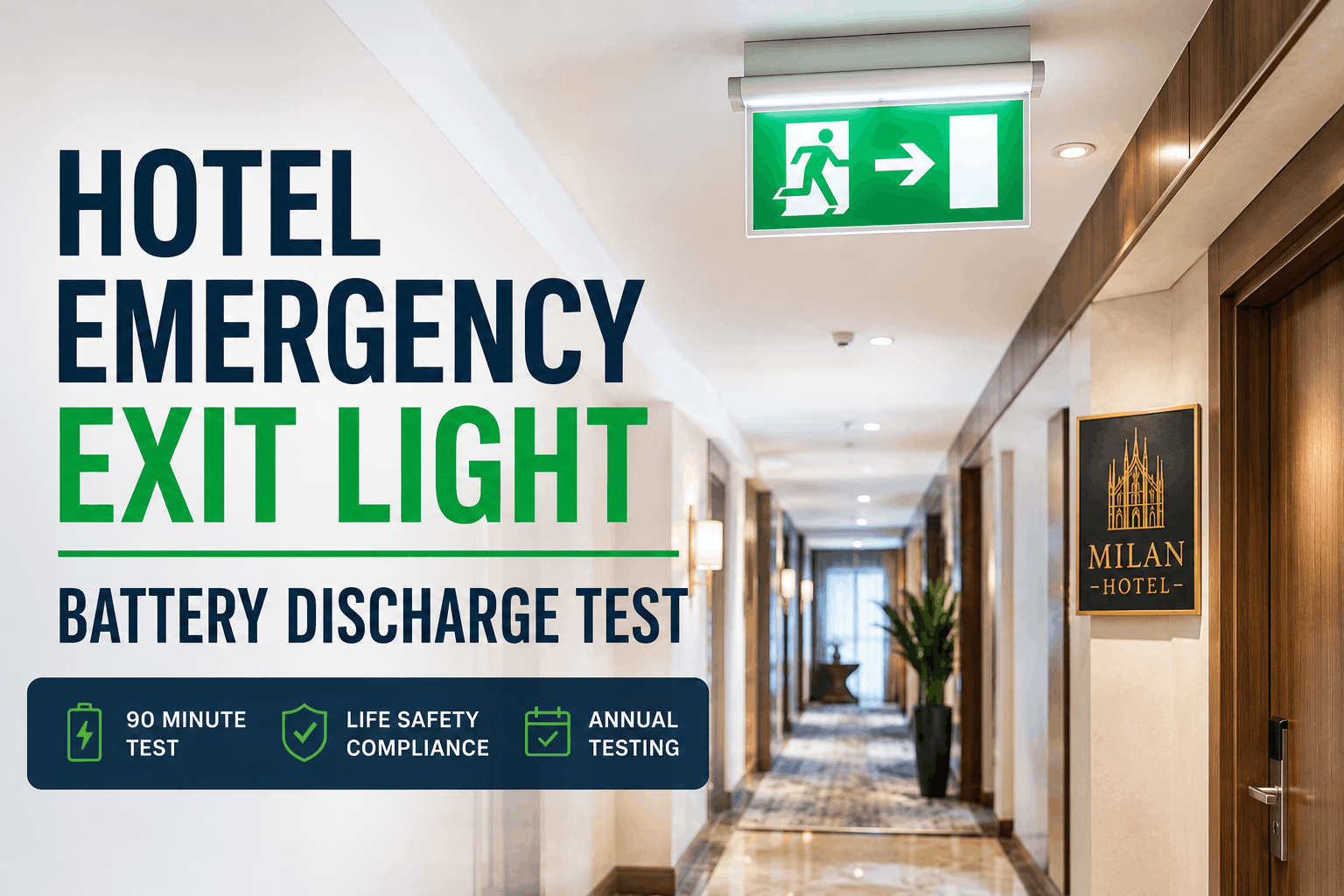
Isolate inverter from utility power and maintain all emergency lights at minimum 60% of nominal brightness for 90 continuous minutes. Validates battery chemistry integrity, charger output stability, and load distribution across emergency circuits. Test failure indicates battery degradation or inverter fault — requires battery replacement or inverter service.
Exit Sign Illumination Verification
Visual + Electrical
Verify that all exit signs display "EXIT" text clearly during darkness, LED color is red or green per code jurisdiction, and backup battery illumination activates when utility power is interrupted. Some jurisdictions require photometric verification — minimum 5 foot-candles at 20 feet. Dimmed signs trigger replacement work orders.
Emergency Voice/Alarm System Test
Quarterly
Verify that fire alarm system integration with emergency lighting functions correctly — when alarm activates, evacuation route lighting brightens to maximum and exit signs flash or activate strobe pattern if applicable. Tests the integration layer between alarm logic and lighting control circuits.
Battery Terminal and Corrosion Inspection
Physical Inspection
Examine inverter battery terminals for green/white corrosion buildup, verify cable connections are tight, check for battery case swelling or leakage, and confirm battery ventilation is not blocked. Corroded terminals degrade current flow and reduce available discharge capacity — cleaning and terminal service prevent test failures.
90-Minute Discharge Test Threshold Configuration — When Data Triggers Maintenance Action
The difference between passing a 90-minute battery test and maintaining an emergency lighting system that will actually function during real evacuation is the threshold configuration that converts test data into predictive maintenance action. Most hotels perform the test, record a pass/fail result, and file the paperwork. A CMMS integrated with emergency lighting test data takes that same test and extracts predictive intelligence: if battery voltage drops below 11.8V before the 90-minute cycle completes, or if brightness falls below 60% of nominal before 60 minutes have elapsed, the system generates a battery replacement work order immediately — preventing the complete failure that would occur during an actual power outage. The cards below show how OxMaint threshold configuration tracks the metrics that emerge during discharge testing and converts marginal performance into scheduled maintenance events.
Battery Voltage At 60 Min Mark
Healthy 12.2–12.8V
Monitor 11.8–12.2V
<11.8V
⚡ CMMS trigger: Voltage below 11.8V at 60-min → Battery replacement work order
Brightness Retention (90 Min)
Acceptable ≥60%
Degraded 50–60%
<50%
⚡ CMMS trigger: Brightness <55% at 90-min → LED ballast inspection + battery load test
Testing Failure Scenarios — What Happens When Systems Degrade
The progression from minor testing failures to catastrophic evacuation system collapse is predictable and preventable, but only if test data is analyzed in real-time rather than filed away monthly. The three scenarios below show how the same hotel facility experiences different outcomes based on whether emergency lighting test failures trigger immediate work orders or remain unaddressed until an actual evacuation event occurs.
Without Automated Test Monitoring
With CMMS Test Integration
90-Minute Test Shows 48% Brightness Retention
Test result filed in spreadsheet. No action. Next month test shows 42% — still marked "passing." Six months later during fire drill, egress lights fail to guide evacuation. Hotel shuts down for 6 weeks after regulatory citation. Revenue loss $180K+.
Test data triggers automatic work order for brightness degradation. LED ballast inspected and found capacitor failure. Unit replaced within 2 days for $340. Next test shows full performance restoration. Evacuation system guaranteed.
Battery Terminal Corrosion Identified
Visible corrosion noted during annual inspection. Written up but no work order issued. Corrosion worsens. Battery fails during 90-minute test three months later. Emergency lighting system down for 8 days while battery replaced. Guest evacuation drill during outage — liability exposure.
Monthly inspection scan detects corrosion buildup. Terminal cleaning work order scheduled. Terminals cleaned, protective coating applied. Battery capacity restored to 98% of nominal. Next 90-minute test passes with full voltage stability.
30-Second Test Response Exceeds 0.7 Seconds
Slow response recorded but interpreted as testing procedural error, not system fault. Ballast electronic components degrading silently. During actual fire alarm, some egress lights take 1.2 seconds to illuminate. Guest evacuation confused by delayed lighting. Regulatory action issued.
Response time anomaly triggers ballast component analysis. Capacitor aging detected. Preventive replacement scheduled. New ballast installed, response time verified at 0.18 seconds. System ready for any evacuation event.
NFPA 101 and IBC Compliance Requirements — What Federal Life Safety Code Requires
The National Fire Protection Association NFPA 101 Life Safety Code and International Building Code IBC Section 1029 establish the federal standards for emergency egress lighting and exit sign systems in all U.S. hotels. Compliance is not optional — the code mandates monthly functional testing, annual load tests, and ongoing maintenance records. The specific requirements vary by hotel occupancy load, location within evacuation routes, and geographical jurisdiction, but the core testing protocol is universal. Hotels that fail to maintain compliance face regulatory fines, loss of occupancy permits, closure orders, and liability for injuries during evacuations if emergency lighting failed due to maintenance negligence. The document categories below define what OxMaint integrates with emergency lighting maintenance to ensure continuous code alignment across all four test categories.
NFPA 101 Section 7.9 Testing Documentation
Mandatory Records
Monthly test results must be recorded in writing with date, time, observer signature, and pass/fail status for each test category. Records must be retained for minimum 3 years and made available to fire marshals during inspections. OxMaint CMMS generates compliant test log reports automatically from test data.
Annual Load Test and Inspection
Yearly Requirement
In addition to monthly functional tests, NFPA 101 requires a comprehensive annual inspection and load test performed by qualified technician. Load test must verify that 100% emergency lighting circuit capacity can be sustained for 90 minutes. OxMaint schedule engine schedules annual service events and flags test results for trend analysis across year.
Qualified Service Technician Certification
Personnel Requirement
IBC Section 1029 requires that annual load testing be performed only by technician certified by equipment manufacturer or qualified emergency lighting specialist. Monthly testing may be performed by trained facility staff, but records must document tester identity and training status. OxMaint tracks technician certifications and flags when personnel recertification is due.
Exit Sign Color and Photometric Compliance
Code-Specific
Jurisdictions vary: some require red, some allow green, some require illuminated backgrounds. All require minimum 5 foot-candles at 20 feet from sign face. NFPA 101 Table 7.10.8.2 defines specific exemptions for certain occupancy types. OxMaint templates are preconfigured for common U.S. jurisdictions and allow custom threshold configuration per property.
Battery Testing and Replacement Intervals
Maintenance Schedule
NFPA 101 does not specify battery replacement interval — it defines performance requirements. Sealed lead-acid batteries typically require replacement every 5-7 years; lithium batteries 8-12 years. Testing reveals degradation early. OxMaint estimates remaining battery life based on discharge test trend and schedules replacement 6 months before predicted failure.
Emergency Lighting Maintenance Maturity Framework — Which Level Are You Operating At?
Emergency lighting maintenance maturity spans from reactive firefighting (repairing only after failures) to predictive automation (scheduling replacement before capacity degradation becomes detectable). Most U.S. hotels operate at Level 2 or 3 — they conduct required testing but lack the data analysis layer that converts test results into preventive maintenance intelligence. Level 4 and 5 operations treat test failures as early warning signals and schedule component replacement before systems actually fail. The progression is not expensive hardware investment — it is software integration and configuration that turns existing test data into automated maintenance workflow.
Emergency Lighting Maintenance Maturity
Score 5 = Fully predictive with test integration · Score 1 = Compliance-only manual records
5
Predictive · Test Data Integration
Monthly test results auto-upload to CMMS. Degradation trends analyzed continuously. Battery capacity and ballast component failures predicted 6+ weeks ahead. Replacement parts pre-ordered. Technician work order assigned automatically.
Profile: Top-tier hotel operators. Zero unplanned emergency lighting failures in 5+ years. Full audit trail for regulatory inspections.
4
Automated Monitoring · Threshold Alerts
Test data entered into CMMS monthly. Threshold analysis flags degraded metrics. Work orders auto-generated when brightness or voltage drops below preset limits. Response time: same day test failure to technician dispatch.
Profile: High-performing hotels. Most reach this level within 3 months of CMMS integration with test data automation.
3
Manual Testing · Spreadsheet Documentation
Tests performed monthly per code. Results logged in spreadsheet or test log sheet. Pass/fail recorded. No automated analysis or trend tracking. Work orders created manually only after repeated failures or auditor findings.
Gap: Test data exists but value is limited. Degradation visible only in 6+ month trending. Requires human review to identify patterns.
2
Checklist-Only Compliance
Monthly test performed as checkbox item. Visual observation that lights turn on. Results logged on paper checklist. No detailed metrics recorded. No failure analysis.
Gap: Subtle degradation invisible — system appears functional during testing but would fail during actual evacuation. High liability exposure.
1
No Systematic Testing · Reactive Repair Only
Testing performed only when system failure is reported. No monthly schedule. Repairs reactive — after failure during power outage or emergency event. No documentation of testing or maintenance history.
Risk: Regulatory violations. Evacuation system unreliable. High liability in injury litigation. Occupancy permit at risk of revocation.
Test Failure to Work Order Response Time — How CMMS Integration Eliminates Downtime
The federal National Fire Protection Association NFPA 101 does not mandate specific response times for test failures — it requires only that failures be corrected before the next evacuation event. In practice, this means hotels have weeks or months to respond before noncompliance becomes obvious. But from a liability and guest safety perspective, weeks is unacceptable. A 90-minute battery discharge test that shows 48% brightness retention is a clear warning signal that the battery is degraded and will fail completely within months. The difference between manual test reporting (response time 7-21 days) and automated CMMS integration (response time under 4 hours) is the difference between catching marginal degradation and discovering catastrophic failure during an evacuation.
Emergency Lighting Test Failure — Average Response Time by Maintenance Method
Paper test log only
14–21 days
Spreadsheet tracking
7–14 days
Email alert to maintenance
2–6 days
Manual CMMS work order entry
4–12 hours
Automated CMMS test integration
← 95% faster than paper-based
<2 hours
Customer Success Story — How One Hotel Chain Eliminated 18 Months of Testing Delays
"
We had emergency lighting test records going back seven years in filing cabinets and spreadsheets. Nobody was analyzing the data. We connected our test results to OxMaint CMMS, and in the first month, the system flagged three batteries showing brightness degradation in the 50-60% range. We had no idea those were failing — we thought all tests were passing. We scheduled replacement before any of them would have failed during an actual emergency. After six months, we eliminated all repeat test failures entirely. Now, our fire marshal specifically asks to see our OxMaint test reports during inspections.
Director of Engineering — 340-room upscale hotel chain, Northeast United States
What is the difference between 30-second and 90-minute emergency lighting tests?
The 30-second test verifies that fixtures illuminate when utility power is switched off — testing ballast responsiveness. The 90-minute test validates that batteries can sustain full illumination for 90 minutes of continuous evacuation — testing battery capacity and charger stability.
How often must emergency lighting be tested under NFPA 101?
Monthly functional testing is mandatory — both 30-second and 90-minute discharge tests. Annual comprehensive load testing and inspection by qualified technician is also required. Test results must be documented and retained for minimum three years for regulatory audit.
What is the fine for failing a fire marshal's emergency lighting inspection?
This guide covers NFPA 101 Section 7.9, IBC Section 1029, and UL 924 emergency lighting standards as applied in U.S. commercial hotels. Consult your local fire marshal for jurisdiction-specific modifications. OxMaint CMMS integrates with most emergency lighting test equipment via API — Legrand, Eaton, and custom systems supported.