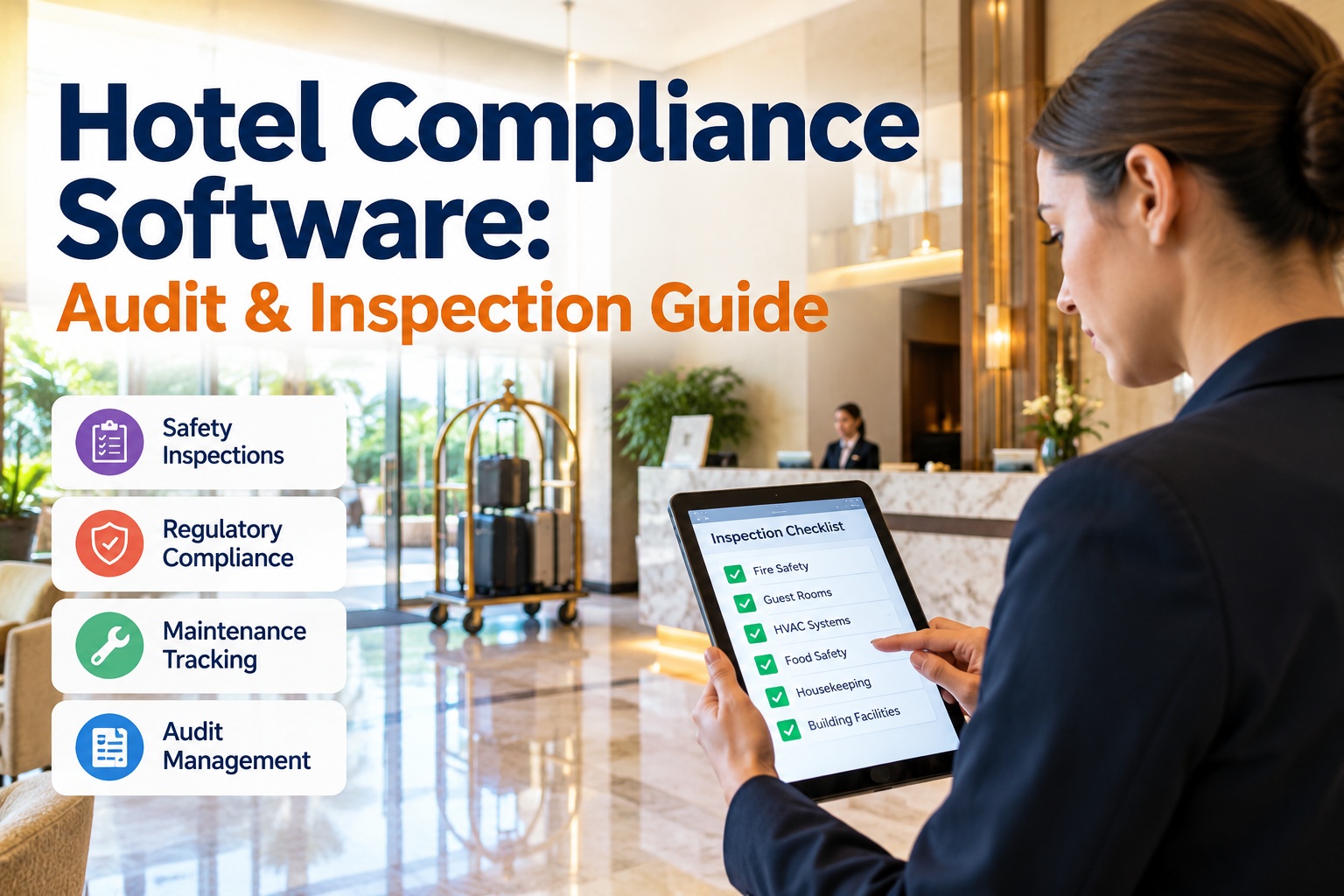
Hotel compliance is not a one-time checkbox — it is a living obligation that spans federal OSHA standards, ADA accessibility mandates, fire marshal inspections, and local health codes, all running on different schedules with different penalties for failure. Most hotels manage this across spreadsheets, paper binders, and memory. The result: missed audits, failed inspections, avoidable fines, and liability exposure that no operator can afford. This guide covers every major regulation your hotel must meet — and shows how automated compliance tracking eliminates the gaps. Start your free trial on Oxmaint or book a live demo to see how hotels are staying audit-ready year-round without the manual burden.
$15K
average OSHA fine per willful violation for hotels that skip mandatory inspections
63%
of hotel compliance failures traced to missed scheduled audits — not policy gaps
4
major regulatory frameworks every U.S. hotel must track simultaneously
91%
audit pass rate for hotels using automated compliance scheduling vs 54% manual
The 4 Regulatory Frameworks Every Hotel Must Stay Compliant With
Hotel compliance is not one regulation — it is four overlapping frameworks, each with its own inspection schedule, documentation standard, and penalty structure. Failing any one of them carries real consequences for your guests, your staff, and your license to operate.
OSHA
Occupational Safety and Health
Federal — All Hotel Staff
OSHA standards govern workplace safety for every person employed on your property. Housekeeping chemical exposure, slip-and-fall hazard prevention, lockout/tagout procedures, and bloodborne pathogen training are all OSHA-mandated requirements with defined inspection and documentation cycles.
Hazard communication
PPE requirements
Incident recordkeeping
ADA
Americans with Disabilities Act
Federal — Physical Access Standards
ADA compliance requires hotels to maintain accessible routes, room features, parking, pool lifts, and signage to mandated specifications — and to audit these regularly. Accessibility failures generate guest complaints, civil rights complaints, and lawsuit exposure that is fully preventable with scheduled inspections.
Accessible rooms audit
Pool lift inspection
Route compliance check
FIRE
Fire Safety Codes
State and Local — Life Safety Systems
Fire marshal requirements cover sprinkler systems, fire extinguisher certification, alarm panel testing, emergency lighting, exit signage, and evacuation plan posting. Inspection cycles vary by jurisdiction but failure to document them on schedule is one of the most common causes of hotel license suspension.
Sprinkler certification
Extinguisher inspection
Exit sign audit
HEALTH
Health and Local Regulations
Local Authority — Food, Water and Sanitation
Local health departments govern food service areas, pool water chemistry, Legionella water management plans, pest control logs, and sanitation standards. These inspections are unannounced in most jurisdictions — making proactive compliance tracking the only reliable safety net.
Water safety testing
Food service hygiene
Legionella management
Track all four compliance frameworks in one place
Oxmaint's multi-regulation compliance calendar keeps OSHA, ADA, fire, and health audit schedules synchronized — with automated task creation and digital documentation for every inspection.
OSHA Hotel Compliance: What Must Be Inspected and When
OSHA enforcement in hotels focuses on three high-risk departments: housekeeping, food and beverage, and maintenance. Each carries specific documentation requirements. Missing any of them creates liability — even if no incident has occurred.
| OSHA Requirement |
Department |
Inspection Frequency |
Documentation Required |
| Chemical Safety (SDS Access) |
Housekeeping, F&B |
Continuous — records always current |
Safety Data Sheets, chemical inventory log |
| Slip, Trip and Fall Hazards |
All departments |
Daily walkthrough log required |
Signed inspection record, corrective action |
| Lockout / Tagout Procedures |
Engineering, Maintenance |
Annual certification + per-job log |
LOTO procedure sheets, training records |
| Bloodborne Pathogen Training |
Housekeeping, Security |
Annual retraining required |
Training completion log per employee |
| Ergonomics — Lifting and Repetitive Motion |
Housekeeping, Laundry |
Semi-annual risk assessment |
Risk assessment report, corrective actions |
| Incident and Illness Recordkeeping (Form 300) |
HR / Management |
Ongoing — posted Feb 1 to Apr 30 annually |
OSHA 300, 300A, 301 logs |
ADA Hotel Compliance: High-Risk Areas and Audit Points
ADA violations in hotels are overwhelmingly physical — not policy-based. The most common failures are in areas that look compliant but have drifted out of specification over time due to wear, renovation, or equipment failure.
Accessible Rooms
Roll-in showers, grab bar positioning, door clearance, lowered peepholes, and visual alarm devices must meet exact specifications and be verified on a documented schedule.
Pool and Spa Access
Portable and fixed pool lifts must be operational, charged, and inspected regularly. Non-functional pool lifts are one of the most frequently cited ADA violations in hotel audits.
Parking and Routes
Van-accessible spaces, slope grades, cross-slope percentages, and signage must be maintained within tolerance. Resurfacing or repainting can introduce non-compliance if not checked post-work.
Public Space Signage
Braille signage, tactile characters, mounting height, and contrast ratios must meet ADA specifications across all public corridors, restrooms, elevators, and meeting spaces.
Elevators and Lifts
Call button height, interior dimensions, audible and visual indicators, and Braille floor designations are all inspectable elements that require documented maintenance and verification.
Food Service Access
Restaurant and bar counter heights, table knee clearance, accessible service routes, and self-service station reach ranges must meet ADA standards and be verified through regular inspection.
Never miss an ADA or fire inspection deadline again
Oxmaint's compliance calendar auto-schedules audits across OSHA, ADA, fire, and health frameworks — with mobile checklists, photo documentation, and digital sign-off for every inspection completed.
Book a Demo
Fire Safety Compliance: Inspection Cycles Hotels Cannot Miss
Fire code compliance in hotels is non-negotiable — and the inspection schedule is unforgiving. Most jurisdictions require documented inspections on monthly, quarterly, semi-annual, and annual cycles simultaneously. Missing any one of them is a violation, regardless of whether the equipment is actually functioning.
Monthly
Fire extinguisher visual check — pressure gauge and accessibility
Emergency exit door function test — latches, hardware, swing clearance
Exit sign illumination verification — all corridors and stairwells
Emergency lighting test — 30-second functional check per unit
Quarterly
Sprinkler head visual inspection — no obstructions within 18 inches
Fire alarm pull station test — rotation across zones
Smoke detector sensitivity test in select rooms and corridors
Kitchen hood suppression system visual check
Annual
Full fire alarm panel inspection and third-party certification
Fire extinguisher professional inspection and tagging
Sprinkler system flow test with licensed contractor sign-off
Fire pump test and emergency generator load test
Evacuation plan review, posting update, and staff drill documentation
Hotel Compliance Checklist: The 5-Area Audit Framework
A reliable hotel compliance audit does not happen randomly. It follows a structured five-area framework that covers every regulation zone on a documented schedule — with sign-off required before each area is marked clear.
OSHA Workplace Safety Audit Completed
Hazard communication records, PPE availability, lockout/tagout logs, bloodborne pathogen training completion, and OSHA Form 300 current — all verified and signed off by department heads.
ADA Accessibility Inspection Completed
Accessible rooms, pool lift operation, parking lot markings, public signage, elevator features, and food service reach ranges — all inspected against current ADA specifications with photo evidence on file.
Fire Safety Schedule Current for This Period
Monthly, quarterly, and annual fire inspection tasks completed on schedule, with contractor certifications attached and no overdue items flagged in the compliance calendar.
Health and Sanitation Audit Passed
Pool water test logs, Legionella water management plan current, food service hygiene records complete, and pest control documentation signed — ready for unannounced health department inspection.
Compliance Calendar Next 90 Days Populated
All upcoming inspection deadlines loaded into the compliance calendar with assigned owners, required documentation checklists, and automated reminders set — no deadlines approaching without coverage.
Full Audit Trail Available for Each Regulation
Every completed inspection linked to its regulatory requirement, with digital sign-off, photo evidence, corrective action records, and timestamps — available immediately in the event of a regulator visit.
Manual vs Automated Compliance: The Real Cost Difference
Manual Compliance Management
Audit schedules tracked in spreadsheets — deadlines missed under operational pressure
Paper inspection logs stored in binders — unavailable at point of regulator visit
No cross-regulation visibility — OSHA, ADA, fire, and health tracked in silos
Corrective actions assigned verbally — no follow-through tracking or escalation
Compliance status unknown until audit day — failures discovered publicly
Failed inspections generate fines, remediation costs, and potential license risk
Automated Compliance with Oxmaint
Compliance calendar auto-schedules all inspections across all four regulatory frameworks
Digital documentation stored against each audit — retrievable in seconds
Single dashboard shows compliance status across OSHA, ADA, fire, and health
Corrective actions assigned digitally with due dates, ownership, and escalation alerts
Live compliance status visible to management at all times — no surprises
91% audit pass rate — violations caught and corrected before the inspector arrives
How the Compliance Calendar Works Across All Regulations
A compliance calendar is not just a list of dates. For it to work at hotel scale, it must connect each deadline to the right inspection template, assign it to the right person, and escalate automatically when tasks are overdue or documentation is missing.
1
Regulation Mapping
Every applicable regulation — OSHA standards, ADA requirements, fire codes, and local health mandates — is mapped into the compliance calendar with its required frequency, documentation type, and responsible department.
▼
2
Automated Task Generation
Inspection tasks generate automatically on the correct schedule. Each task includes the applicable checklist, required photo documentation points, and the regulatory reference it covers — no manual scheduling required.
▼
3
Mobile Inspection and Documentation
Assigned staff complete inspections on mobile — checking items, capturing photos, logging findings, and digitally signing off. Non-conformances automatically convert to corrective action work orders.
▼
4
Multi-Regulation Dashboard View
Management sees live compliance status across all four regulatory frameworks in one dashboard. Upcoming deadlines, overdue tasks, open corrective actions, and recent audit results — all in one view without switching systems.
▼
✓
Audit-Ready Documentation at All Times
Every completed inspection is stored digitally with timestamps, photo evidence, and digital sign-offs linked to the specific regulation. When a regulator arrives unannounced, the full compliance record is retrievable in seconds — not hours.
Common Hotel Compliance Violations and How Automation Prevents Them
| Violation |
Regulatory Area |
Common Cause |
Automated Prevention |
| Overdue fire extinguisher tag |
Fire Safety |
Annual inspection date tracked manually — missed under operational pressure |
Compliance calendar auto-generates task 30 days before expiry with contractor assignment |
| Non-functional pool lift |
ADA |
Lift failure not reported promptly; no inspection schedule in place |
Monthly pool lift inspection task auto-assigned; failure triggers immediate work order |
| Missing OSHA Form 300 posting |
OSHA |
Annual Feb 1 posting deadline missed; no calendar reminder in place |
Compliance calendar generates Form 300 posting task automatically each January |
| Legionella management plan lapsed |
Health / Local |
Annual water management plan renewal missed; no cross-department tracking |
Water safety task auto-generated with engineering owner and documentation checklist |
| No documentation at health inspection |
Health / Local |
Paper logs stored physically — unavailable during unannounced inspection |
All inspection records stored digitally — retrieved on any device in seconds |
| ADA signage out of specification |
ADA |
Post-renovation signage not checked against ADA mounting and contrast standards |
Post-renovation ADA audit task auto-triggered by work order closure in affected area |
How Oxmaint Powers Hotel Compliance Across Every Regulation
Hotels managing OSHA, ADA, fire, and health compliance across disconnected systems — spreadsheets, paper binders, and calendar reminders — are one missed inspection away from a fine, a failed audit, or a public violation notice. Oxmaint connects multi-regulation tracking, automated audit scheduling, and digital documentation in one platform built for hotel compliance at scale. Start for free and build your compliance calendar today.
Multi-Regulation Compliance Calendar
OSHA, ADA, fire, and health inspection deadlines mapped in one calendar. Tasks auto-generate on the correct schedule for each regulatory requirement — no manual date-tracking required.
Automated Audit Scheduling
Inspections scheduled automatically based on regulatory frequency. Monthly fire checks, quarterly ADA audits, annual OSHA reviews — all generated without manual intervention and assigned to the right owner.
Mobile Inspection Checklists
Regulation-specific checklists completed on mobile with photo evidence capture and digital sign-off. Every inspection item linked to its regulatory standard — creating a defensible audit trail.
Corrective Action Tracking
Non-conformances found during inspection convert automatically to work orders with assigned owners, due dates, and escalation alerts. Corrective actions tracked to closure with documentation captured.
Cross-Regulation Dashboard
One view showing compliance status across all four regulatory frameworks — upcoming deadlines, overdue tasks, recently passed audits, and open corrective actions — without opening multiple systems.
Instant Audit Documentation Retrieval
All inspection records stored digitally with timestamps and photo evidence. When regulators arrive unannounced, the complete compliance history is retrievable in seconds — not searched for in filing cabinets.
Stay Audit-Ready Across Every Hotel Regulation — Without the Manual Burden
Oxmaint gives hotel operators the compliance calendar, multi-regulation tracking, and automated audit scheduling needed to stay compliant with OSHA, ADA, fire codes, and local health regulations year-round. Digital documentation, mobile inspections, and live compliance status — built for hospitality operations that cannot afford a failed audit.
Frequently Asked Questions
What OSHA regulations apply specifically to hotels?
Hotels are subject to OSHA's General Industry standards across several areas including hazard communication (chemical safety and SDS records for housekeeping staff), personal protective equipment, lockout/tagout procedures for engineering and maintenance, bloodborne pathogen exposure control for housekeeping and security, and recordkeeping requirements including the OSHA Form 300 injury and illness log. Each standard has its own inspection cycle and documentation requirement that must be maintained separately.
How often do hotels need to conduct ADA compliance audits?
There is no single federal mandated frequency for ADA self-audits, but best practice — and what most hospitality legal teams recommend — is a full ADA accessibility audit annually, with targeted inspections of high-risk elements like pool lifts and accessible rooms on a quarterly basis. After any renovation, an ADA compliance check of affected areas should be triggered immediately. The key principle is that ADA compliance is a condition that must be maintained, not a one-time approval.
What fire safety inspections are required every month in a hotel?
Monthly fire safety inspections required in most U.S. jurisdictions include a visual check of all fire extinguishers for pressure gauge status and unobstructed accessibility, a function test of all emergency exit doors, verification that all exit signs are illuminated, and a 30-second test of emergency lighting units. These inspections must be documented with the inspector's name, date, and findings — and records must be retained for review by the fire marshal at inspection time.
How does automated compliance scheduling prevent hotel violations?
Automated compliance scheduling eliminates the most common cause of hotel violations — missed inspection deadlines. Rather than relying on a team member to remember when fire extinguisher tags expire or when OSHA Form 300 must be posted, the compliance calendar generates the task automatically, assigns it to the appropriate person, sends reminders as the deadline approaches, and escalates if the task is not completed. Every inspection is documented digitally, making the complete compliance record available instantly if a regulator arrives unannounced.