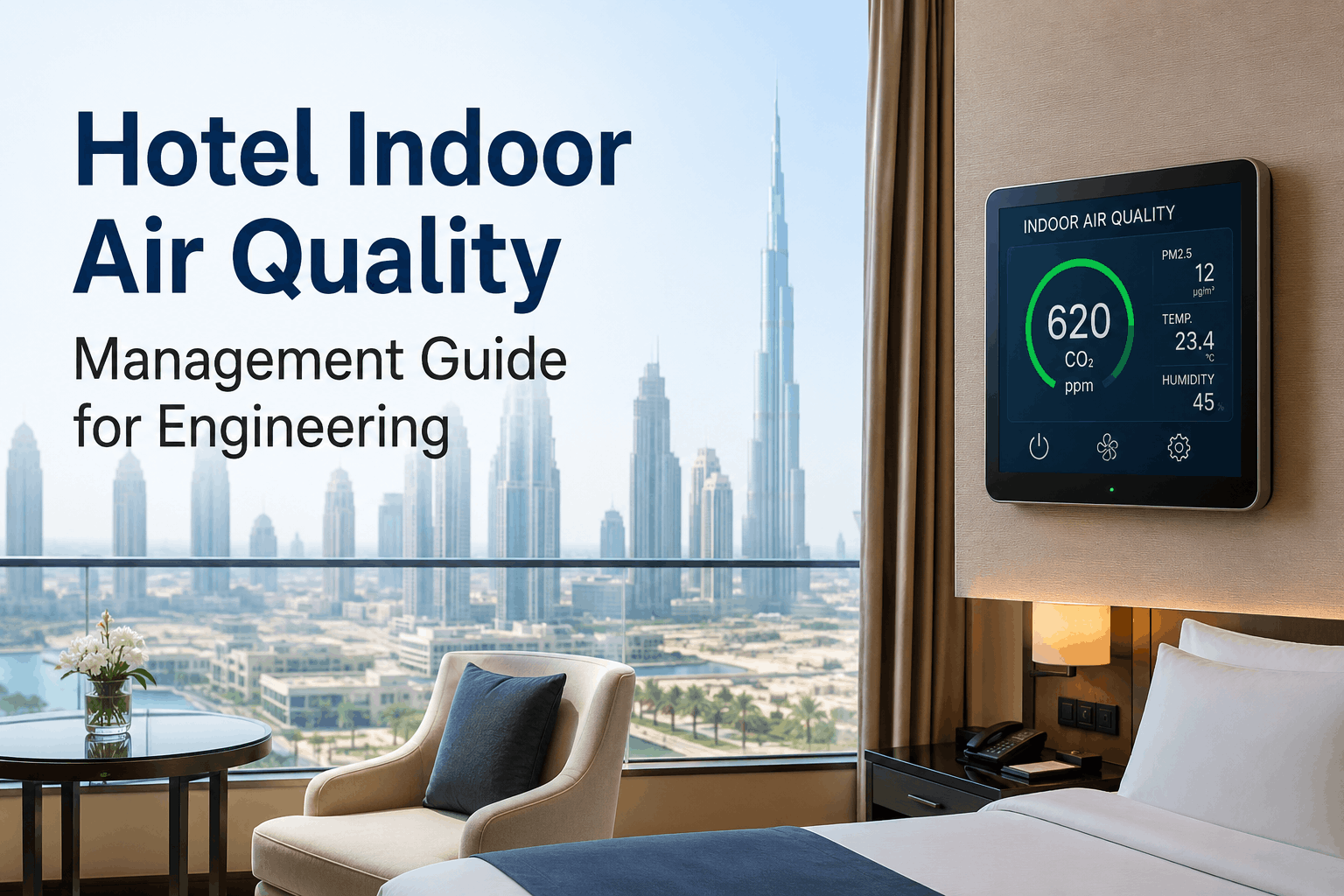
A luxury hotel in Miami received 14 guest complaints about "stuffy rooms" and "headaches" in a single weekend—all from the same floor. Engineering found nothing wrong during walkthroughs. Two weeks later, a corporate group cancelled a $180,000 booking after three attendees reported respiratory irritation during a conference. The culprit: CO₂ levels exceeding 2,500 ppm in meeting rooms during peak occupancy—more than double the ASHRAE recommended limit—while the HVAC system showed "normal" on the BMS dashboard. A post-incident air quality audit revealed VOC concentrations from new carpet adhesive had been off-gassing for months, PM2.5 levels spiking during housekeeping hours from chemical aerosols, and humidity consistently above 65% in corridors feeding mold growth behind wallpaper. None of this showed up because the property relied on scheduled HVAC filter changes and quarterly air quality spot-checks. An IoT indoor air quality monitoring system sampling every 60 seconds would have flagged the CO₂ spike within 3 minutes of the meeting room reaching capacity, triggered fresh air damper adjustment automatically, and generated a maintenance alert for the VOC anomaly the day the carpet was installed—not months later when guests started getting sick.
73%
Of Hotels Have Undetected Air Quality Issues
Studies show that 73% of commercial hospitality buildings have at least one zone consistently exceeding WHO indoor air quality guidelines. Poor IAQ is now the #2 driver of negative hotel reviews after cleanliness—and guests can't always articulate why a room "feels wrong." IoT continuous monitoring catches what human senses and scheduled checks miss.
IoT indoor air quality monitoring replaces periodic spot-checks and HVAC-only approaches with continuous, real-time sensor networks measuring CO₂, PM2.5, VOCs, temperature, humidity, and formaldehyde across every occupied zone—lobbies, guest rooms, meeting spaces, kitchens, spas, and parking structures. When any parameter breaches safe thresholds, alerts reach engineering staff instantly, not during the next quarterly audit. Hotels that implement structured HVAC and ventilation equipment maintenance tracking alongside IoT air quality monitoring create the complete indoor environment management system that protects guest health, prevents complaints, and documents compliance automatically.
The Real Cost of Poor Indoor Air Quality
What Hotels Risk Without Continuous IAQ Monitoring
$15K-75K+
Mold remediation costs per incident—plus room revenue loss during affected-zone shutdowns averaging 2-6 weeks
$4.1M
Average Legionnaires' disease lawsuit settlement—preventable with continuous humidity and water system monitoring
22%
Revenue drop in hotels with persistent IAQ complaints—negative reviews citing "musty smell" or "stuffy air" suppress bookings for months
2,160 hrs
Annual blind hours between quarterly IAQ audits—the window where mold grows, CO₂ spikes, and VOCs accumulate undetected
6 Core Components of IoT IAQ Monitoring
Modern IoT indoor air quality systems go far beyond basic CO₂ detection—they integrate multi-pollutant sensing, HVAC automation, occupancy correlation, and compliance documentation into a unified platform. Properties using OXmaint's asset management platform for HVAC equipment maintenance create the complete indoor environment ecosystem that passes every health inspection and keeps guests breathing easy.
IoT Indoor Air Quality Monitoring Architecture
1. Multi-Pollutant Sensor Arrays
Continuous measurement of CO₂, PM2.5, PM10, VOCs, formaldehyde, temperature, humidity, and CO every 60 seconds—covering every occupied zone from lobbies to guest floors.
2. Automated HVAC Response
AI-driven fresh air damper control and fan speed adjustment based on real-time sensor data, occupancy levels, and outdoor air quality—preventing CO₂ buildup before guests notice.
3. Instant Alert System
Push notifications to engineering when any IAQ parameter breaches thresholds—with escalation rules that notify management if corrective action isn't taken within set timeframes.
4. Humidity & Mold Prevention
Tracks relative humidity zone-by-zone 24/7 to detect moisture patterns that breed mold—triggering dehumidification before spores colonize walls, carpets, and HVAC ducts.
5. Compliance Documentation
Automatic timestamped logging of every reading creates ASHRAE/WHO/OSHA-ready records—replacing periodic spot-checks that only capture a snapshot of actual conditions.
6. HVAC Health Monitoring
Tracks AHU performance, filter pressure differentials, coil efficiency, and duct static pressure to predict maintenance needs before degraded equipment compromises air quality.
Setting Up IoT IAQ Monitoring
Implementation Sequence
Follow these steps to deploy continuous indoor air quality monitoring
01
HVAC & Zone Inventory
Document all AHUs, RTUs, fan coils, exhaust systems, and air handling zones with model numbers, CFM ratings, filter types, and maintenance history per building section.
02
Sensor Deployment
Install IAQ sensor nodes in guest rooms, lobbies, conference rooms, kitchens, spa areas, parking garages, and return air ducts. Add outdoor reference sensors for differential analysis.
03
Alert & Threshold Configuration
Set compliance ranges per ASHRAE 62.1 and WHO guidelines (CO₂ below 1,000 ppm, PM2.5 below 15 µg/m³, RH 30-60%). Configure alert routing by zone and severity level.
04
CMMS Integration
Connect IoT alerts to your maintenance platform to auto-generate work orders for filter replacements, coil cleaning, damper repairs, sensor calibration, and humidity remediation.
05
Staff Training & Validation
Train engineering staff on dashboard interpretation, alert response protocols, and sensor maintenance. Run parallel manual/IoT monitoring for 2 weeks to validate accuracy and baseline readings.
Preventive Maintenance Schedule
IoT-Enhanced HVAC & IAQ Equipment PM Matrix
Equipment
Daily (IoT)
Weekly
Monthly
Annually
IAQ Sensor Nodes
Auto-read every 60s
Calibration check
Sensor cleaning
Full sensor replacement
Air Handling Units
Supply/return temp delta
Belt tension check
Coil inspection
Full AHU service
HVAC Filters
Pressure differential
Visual inspection
MERV rating verify
Filter media upgrade review
Exhaust Fans
Amp draw & CFM rate
Vibration check
Belt & bearing inspect
Motor service & balance
Fresh Air Dampers
Position monitoring
Actuator response test
Linkage & seal inspect
Full damper overhaul
Dehumidification Systems
RH zone tracking
Drain line check
Coil & pan cleaning
Refrigerant & compressor service
OXmaint automatically generates work orders for each PM task, tracks completion rates, and flags overdue items before they compromise indoor air quality.
continuous IoT monitoring vs. quarterly spot-checks
Brand & Liability Standards
Timestamped digital IAQ records
HVAC performance logs
Mold prevention documentation
Guest complaint correlation data
Insurance & wellness audit readiness
100%
audit-ready documentation at all times
Protect Guest Health, Prevent Mold, Pass Every IAQ Audit
OXmaint tracks all HVAC equipment maintenance, filter replacement schedules, sensor calibration, humidity remediation tasks, and compliance documentation—creating the maintenance backbone that keeps your indoor air quality inspection-ready year-round.
Based on commercial HVAC management benchmarks and published data
75%
Fewer IAQ-related guest complaints with continuous monitoring
30%
HVAC energy savings through demand-controlled ventilation
20%
Reduction in mold remediation costs via early humidity detection
60%
Reduction in HVAC emergency repair calls through predictive alerts
"In hospitality, indoor air quality is invisible until it becomes a crisis. Guests won't tell you the air feels wrong—they'll just leave a bad review and never come back. IoT monitoring gives us the ability to see what human senses miss: the slow CO₂ creep in a packed ballroom, the humidity spike behind a bathroom wall, the VOC bloom from a renovation two floors away. The properties that invest in continuous IAQ monitoring aren't just preventing complaints—they're protecting their brand."
— Director of Engineering, International Hotel Management Group
HVAC tuning • Predictive alerts active • Compliance reporting automated
Don't Let Invisible Air Quality Issues Drive Guests Away
OXmaint brings structure to HVAC and IAQ equipment maintenance—automated PM scheduling, filter change tracking, sensor calibration reminders, humidity alerts, work order management, and inspection-ready documentation that protects your property from violations and liability.
What does an IoT indoor air quality monitoring system measure in hotels?
Modern IoT IAQ systems continuously monitor CO₂ (carbon dioxide), PM2.5 and PM10 (particulate matter), VOCs (volatile organic compounds), formaldehyde, carbon monoxide, temperature, relative humidity, and air pressure. Advanced systems also track ozone levels, radon in applicable regions, and TVOC breakdowns. Readings are taken every 60 seconds per zone and transmitted to a cloud dashboard accessible from any device, with instant alerts when any parameter drifts outside safe thresholds set by ASHRAE 62.1 or WHO guidelines.
How much does IoT IAQ monitoring cost for a hotel?
Individual IAQ sensor nodes typically cost $200-$800 per unit depending on parameters monitored. A 200-room hotel typically needs 30-60 sensors across guest floors, common areas, kitchens, and mechanical rooms—totaling $10,000-$35,000 for hardware. Gateway infrastructure adds $1,000-$3,000 per property. Cloud platform subscriptions range $500-$2,000 monthly. Most properties recover the investment within 6-12 months through HVAC energy savings, avoided mold remediation, reduced complaints, and prevented liability claims.
Does IoT monitoring integrate with existing hotel BMS and HVAC systems?
Yes. Modern IoT IAQ platforms integrate with major BMS systems via BACnet, Modbus, and API protocols. The IoT layer supplements BMS data with granular zone-level air quality readings that building automation systems don't capture. Integration enables automated responses—when CO₂ spikes in a conference room, the system can increase fresh air supply through the BMS without manual intervention. A CMMS platform like OXmaint then tracks all equipment maintenance triggered by IAQ alerts, creating a complete closed-loop system.
What maintenance do IoT IAQ sensors require?
CO₂ sensors use NDIR technology and typically require annual calibration with a 5-10 year lifespan. PM2.5 sensors need quarterly cleaning to prevent dust accumulation on optical components. VOC sensors may require annual replacement depending on type. Humidity sensors need biannual calibration checks. A CMMS platform like OXmaint automates all sensor maintenance scheduling, tracks calibration records, and ensures sensors are serviced before accuracy degrades—keeping your monitoring system reliable continuously.