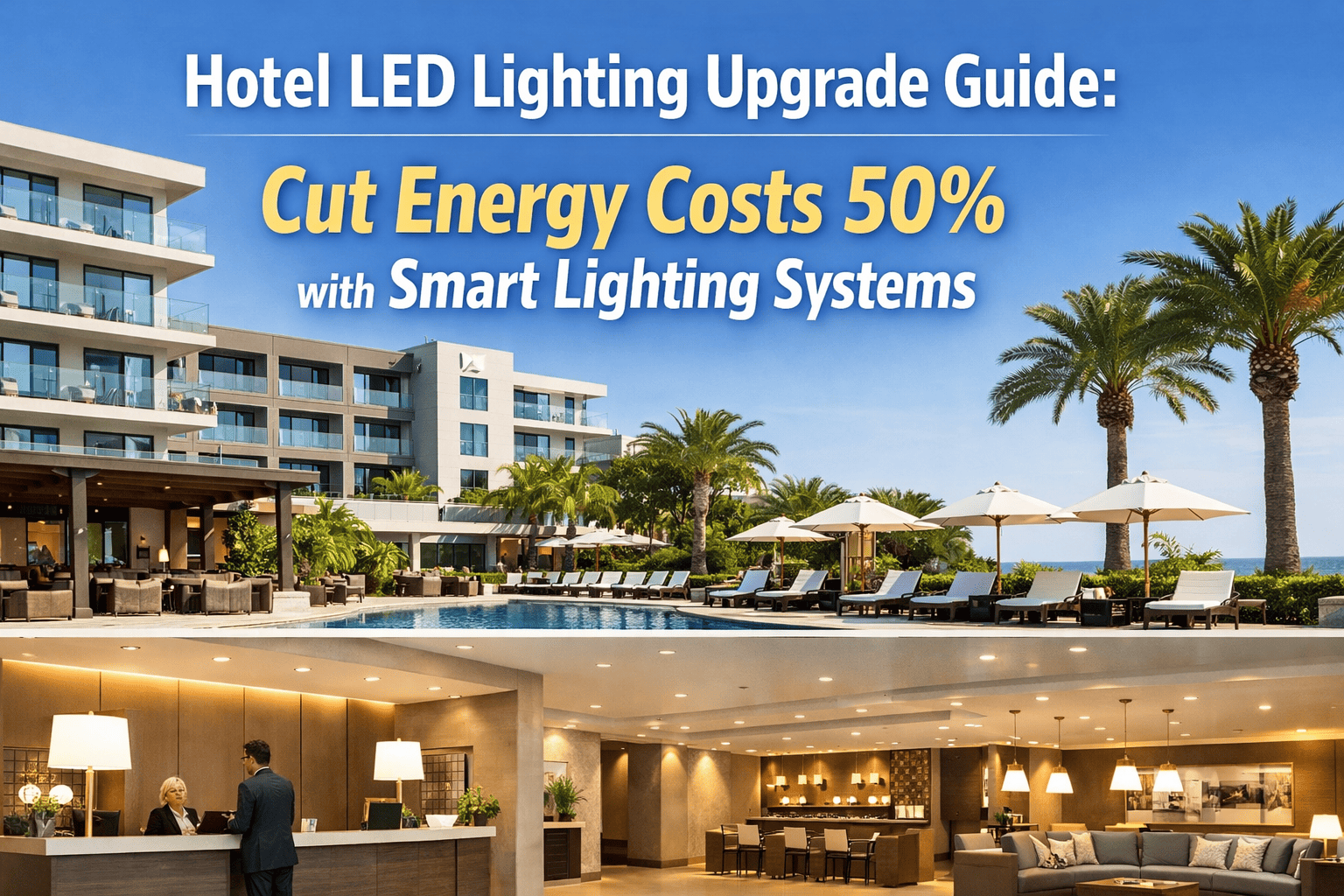
A 180-room hotel in Atlanta switched its guest room lighting from incandescent to LED in 2022 and watched its annual lighting energy bill drop from $68,000 to $31,000 — a 54% reduction — without touching a single light switch or dimmer. No renovation. No construction. Just bulb and fixture swaps paired with smart lighting controls that matched output to occupancy. Lighting is the most underestimated energy lever in hospitality — and the one with the fastest payback of any capital improvement a hotel can make. Start tracking your lighting assets on OxMaint or book a free demo to see how hotel engineering teams manage LED retrofits and replacement scheduling.
50%
average energy cost reduction from full hotel LED upgrade with smart controls
25x
longer lifespan of LED fixtures vs. incandescent — 25,000 hrs vs. 1,000 hrs
2 yr
average payback period for full hotel LED retrofit including smart controls
30%
additional savings added by occupancy-based lighting automation on top of LED baseline
Why Hotel Lighting Is the Fastest Energy Win Available
Hotels run lighting 18 to 24 hours per day across guest rooms, corridors, lobbies, restaurants, fitness centers, back-of-house, and parking — often with fixtures installed 15 to 20 years ago at efficiencies a fraction of what current LED technology delivers. Unlike HVAC upgrades, which require months of engineering and construction, LED retrofits can be phased room by room with no disruption to operations. The energy math is simple, the payback is measurable, and the guest experience improves at the same time.
A 200-room hotel replacing 10 incandescent fixtures per room saves the equivalent of powering 180 average homes for a year — just from the bulb swap alone, before smart controls are factored in.
The Four Areas Where Hotels Lose the Most Lighting Energy
01
Unoccupied Guest Rooms at Full Brightness
Standard hotel rooms run lighting continuously from housekeeping checkout to guest check-in — often 4 to 8 hours per day per room. Without occupancy sensors, this is pure waste on every vacant room night.
02
Corridor and Common Area Over-Lighting
Corridors, stairwells, and back-of-house areas are typically over-lit relative to code minimums and rarely adjusted for time of day. These spaces run at full output 24 hours, 365 days a year.
03
Aging Fixtures with No Replacement Tracking
Hotels without asset-level lighting tracking replace fixtures on complaint rather than schedule — meaning degraded output, increased energy draw, and emergency labor costs when groups of aging fixtures fail simultaneously.
04
No Dimming or Scheduling in Food and Beverage
Restaurant and lobby lighting runs at full output during setup, service, and breakdown — often for 16 hours when guests are present for 6. Preset dimming scenes and time-based scheduling address this without guest impact.
Track every lighting asset, schedule replacements automatically
OxMaint's lighting asset tracking gives hotel engineering teams a complete fixture inventory with age, type, and replacement schedule for every zone.
Start Free Trial
Hotel Lighting Upgrade Checklist: Zone by Zone
A successful hotel LED upgrade is not a single project — it is a phased programme by zone, each with different fixture types, dimming requirements, and guest experience considerations. Use this checklist to assess your current state and prioritise the highest-impact areas first.
All bulbs replaced with dimmable LED equivalents
Match colour temperature carefully — 2700K to 3000K for warm, residential feel that guests expect in sleeping areas. Avoid cool white LEDs above 4000K in guest rooms.
Occupancy sensors installed in each room
Passive infrared or microwave sensors detect vacancy and dim or cut lighting after a defined period. Pairs with keycard energy switches for maximum vacant-room savings.
Bedside control panels updated for LED dimming compatibility
Older dimmer switches often cause LED flicker. Replace trailing-edge dimmers with LED-compatible leading-edge or universal dimmer modules throughout all guest rooms.
Fixture age and type logged in asset management system
Each fixture entered with installation date, wattage, colour temperature, and expected replacement interval — enabling proactive group relamping before guest-facing failures occur.
LED tube and downlight replacements installed
Corridor fluorescent tubes and recessed downlights are among the highest-return replacements in the building — high run hours, easy group replacement during off-peak access.
Overnight dimming schedule programmed
Corridors can safely run at 40 to 60% output between midnight and 6 AM. Automated dimming during low-traffic hours adds 15 to 20% additional savings on top of LED baseline.
Emergency and exit lighting upgraded to LED
Emergency fixtures run 24/7 on battery backup — LED emergency units draw 2 to 3W vs 8W for fluorescent equivalents. Replacement is a code-compliance and cost improvement simultaneously.
Replacement intervals set by fixture type
Group relamping corridors on a defined schedule rather than responding to individual failures reduces emergency labor cost by 60 to 80% and prevents the visual patchwork of mismatched replacement bulbs.
Lighting scenes programmed for each day-part
Breakfast, lunch service, dinner, and event mode each have distinct output and colour temperature requirements. Preset scenes eliminate manual adjustments and ensure consistent guest experience.
Decorative and architectural fixtures assessed for LED retrofit
Chandeliers, wall sconces, and pendant fixtures often use halogen or incandescent sources for aesthetics. Many now have LED equivalents that match the original beam angle and colour rendering index.
Natural light integration assessed and calibrated
Daylight harvesting sensors in lobby and atrium spaces can dim artificial lighting automatically when natural light is sufficient — particularly impactful in south-facing spaces with high solar gain.
After-hours scheduling confirmed and documented
Lobby and restaurant spaces should operate on programmed off or minimum-output schedules after the last guest leaves. Confirm schedules are accurate, documented, and reviewed quarterly.
All storage, laundry, and kitchen lighting upgraded to LED
Back-of-house areas have no aesthetic constraints and the highest tolerance for efficient, high-output LED fixtures. These spaces are typically easiest and fastest to retrofit.
Motion sensors installed in low-traffic utility spaces
Linen rooms, mechanical spaces, storage areas, and stairwells are among the easiest wins — occupancy is intermittent, so motion-activated lighting often reduces run hours by 70% or more.
Parking structure lighting on photocell or scheduling control
Covered parking running full output 24 hours is a significant waste category. Photocell-based dimming at night and motion activation in low-traffic zones reduces parking lighting costs by 40 to 60%.
Outdoor and landscape lighting on timer or astronomical control
Landscape and facade lighting should run only between dusk and a defined overnight cutoff. Astronomical time clocks adjust automatically for seasonal variation — no manual schedule changes needed.
Schedule every fixture replacement before the bulb fails
OxMaint's replacement scheduling engine tracks fixture age, calculates expected end-of-life by zone, and generates maintenance work orders before failures happen on the guest floor.
Book a Demo
LED Upgrade ROI: What the Numbers Look Like by Hotel Type
| Hotel Type |
Typical Annual Lighting Cost |
Post-LED Saving |
Retrofit Cost |
Payback Period |
| 100-Room Limited Service |
$28,000 to $42,000 |
$14,000 to $21,000 |
$18,000 to $28,000 |
14 to 20 months |
| 200-Room Select Service |
$55,000 to $80,000 |
$27,000 to $40,000 |
$35,000 to $55,000 |
12 to 18 months |
| 300-Room Full Service |
$100,000 to $150,000 |
$50,000 to $75,000 |
$60,000 to $95,000 |
12 to 16 months |
| 500-Room Convention Hotel |
$180,000 to $280,000 |
$90,000 to $140,000 |
$100,000 to $160,000 |
10 to 15 months |
| Luxury Boutique (80 rooms) |
$40,000 to $65,000 |
$16,000 to $30,000 |
$30,000 to $55,000 |
18 to 28 months |
Smart Lighting Controls: The 30% Layer on Top of LED
LED retrofits alone deliver 50% energy reduction compared to incandescent. Smart lighting controls — occupancy sensing, daylight harvesting, preset scenes, and scheduled automation — add another 25 to 35% on top of the LED baseline. The combination is where hotels achieve 60 to 70% total lighting cost reduction. Book a demo to see how OxMaint tracks smart lighting system performance alongside fixture replacement scheduling.
Without Smart Controls
Guest rooms at full brightness whether occupied or vacant
Corridors running 100% output at 3 AM with no guests
Restaurant at full output during 2-hour pre-service setup
Lobby lighting unchanged from 6 AM to midnight regardless of activity
Parking at full output overnight with one car in the structure
Back-of-house lights left on between shifts with no occupancy detection
With Smart Controls Added
Guest rooms dim to 20% after 10 minutes of vacancy — save 60% per vacant hour
Corridors auto-dim to 40% from midnight to 6 AM — save 15% overnight
Restaurant pre-sets activate at scheduled time — no staff adjustment needed
Lobby transitions through 4 programmed scenes tied to time and occupancy
Parking dims to 30% with motion-triggered zones — save 50% overnight
Motion-activated utility spaces run only when occupied — save 70% per space
Key Metrics to Track After Your LED Upgrade
kW
kWh per Occupied Room Night
The primary lighting efficiency benchmark for hotels. Compare pre- and post-upgrade monthly to confirm savings are being captured and sustained over time.
$
Lighting Cost as % of Total Energy
Well-executed LED upgrades with smart controls reduce lighting from 35 to 40% of total energy spend to 15 to 20%. Track this ratio quarterly to confirm the upgrade is performing as modelled.
hr
Fixture Run Hours by Zone
Smart lighting systems log actual fixture run hours by zone. Compare against expected hours to identify scheduling gaps — areas running longer than occupancy patterns justify.
PM
Replacement Schedule Compliance
Track the percentage of planned group relamping tasks completed on schedule. On-schedule replacement prevents emergency failures and the guest experience damage they cause.
50%
lighting energy reduction from LED retrofit alone — before smart controls
70%
total lighting cost reduction achievable with LED plus full smart control integration
80%
reduction in emergency lamp replacement labor with proactive group relamping
How OxMaint Manages Hotel Lighting Upgrades and Ongoing Maintenance
The upgrade is not the finish line — it is the starting point. Hotels that sustain their LED energy savings over time are the ones with structured asset tracking, proactive replacement scheduling, and energy impact analytics that flag performance drift before it compounds. Start for free and have your lighting asset inventory live within days.
Lighting Asset Tracking
Every fixture catalogued by zone, type, wattage, colour temperature, installation date, and expected end-of-life. Full inventory visible from one dashboard — guest floors, common areas, back-of-house, and exterior.
Replacement Scheduling Engine
OxMaint calculates expected fixture lifespan by zone based on run hours and generates replacement work orders before failures occur. Group relamping tasks planned for off-peak access windows automatically.
Energy Impact Analytics
Track lighting energy consumption by zone before and after upgrade. Rolling dashboards show kWh per occupied room night, cost savings against pre-upgrade baseline, and fixture performance trends over time.
Smart Control System Integration
OxMaint connects with occupancy sensor data and lighting control system logs to track actual vs. expected run hours by zone — identifying scheduling gaps and sensor faults before they inflate energy bills.
Maintenance Work Order Tracking
Every lighting repair, replacement, and inspection task managed through OxMaint's work order system — technician-attributed, timestamped, and linked to the specific fixture asset record for full history.
Sustainability Reporting
Automated energy reduction reports for LEED documentation, ENERGY STAR certification, hotel brand sustainability scorecards, and management company ESG reporting — generated on demand without manual data compilation.
Every Month Without LED is a Month of Energy Savings You Cannot Recover
OxMaint gives hotel engineering teams the asset tracking, replacement scheduling, and energy analytics to execute an LED upgrade with confidence — and sustain the savings long after the last bulb is swapped. Most properties see measurable ROI within the first billing cycle after upgrade completion.
Frequently Asked Questions
How much can a hotel realistically save by switching to LED lighting?
Hotels replacing incandescent and CFL fixtures with LED equivalents consistently achieve 40 to 55% reduction in lighting energy costs from the bulb swap alone. Adding occupancy sensors and automated scheduling controls brings total lighting cost reduction to 60 to 70% in most properties. A 200-room full-service hotel spending $100,000 annually on lighting energy can realistically reduce that to $35,000 to $50,000 within 12 months of a full upgrade. Actual savings depend on fixture mix, run hours, and the extent of smart control integration.
Sign up free to build your property's savings estimate using OxMaint's energy impact analytics.
What is the best order to phase a hotel LED upgrade to minimise disruption?
The highest-return sequence for most hotels is: back-of-house and utility spaces first (no aesthetic constraints, easy daytime access), followed by corridors and stairwells (group relamping during low-occupancy periods), then guest rooms (phased by floor during renovation cycles or targeted during off-peak seasons), and finally lobby, restaurant, and event spaces (requiring most careful colour temperature and dimming compatibility testing). This sequence maximises early savings while protecting the guest-facing areas where lighting quality most directly affects experience ratings.
Do hotel LED lighting upgrades qualify for utility rebates or tax incentives?
Yes. Most U.S. utility providers offer prescriptive rebates for LED fixture replacements ranging from $10 to $150 per fixture depending on the utility and fixture type. The federal Section 179D energy efficient commercial building deduction provides up to $5.65 per square foot for lighting upgrades meeting ASHRAE 90.1 energy reduction thresholds. Many state-level energy efficiency programmes add additional incentives. Combined, rebates and tax incentives typically reduce the effective out-of-pocket cost of a hotel LED upgrade by 25 to 45%, bringing payback periods below 12 months in most markets.
Book a demo to discuss how OxMaint documents upgrade performance for rebate applications.
How does OxMaint's lighting asset tracking differ from a spreadsheet inventory?
A spreadsheet captures what was installed — OxMaint tracks what needs to happen next. OxMaint calculates expected fixture end-of-life from installation date and run-hour estimates, generates replacement work orders before failures occur, links every maintenance action to the specific fixture asset, and tracks energy consumption against the expected post-upgrade baseline. When a fixture fails, the full history is visible instantly — when it was installed, whether it was a repeat failure, and what the replacement should be. Spreadsheets go stale within weeks of a retrofit; OxMaint's asset records stay current with every work order completed.
Will LED lighting affect the ambiance and guest experience in hotel rooms and restaurants?
When specified correctly, LED lighting improves guest experience — not compromises it. The key is colour temperature and colour rendering index (CRI) selection. Guest rooms should use 2700K to 3000K LEDs with a CRI of 90 or higher for warm, flattering light. Restaurants and lobbies benefit from tunable white fixtures that can shift from warm (dinner service) to neutral (breakfast setup) under automated control. The risk to ambiance comes from poor specification — cool-white LEDs in guest rooms, low-CRI fixtures in food and beverage, or mismatched colour temperatures between adjacent zones. A well-executed LED retrofit is invisible to guests in the best possible sense: the room looks and feels right, the energy bill does not.
Sign up free to start logging your fixture specifications in OxMaint's asset registry.